
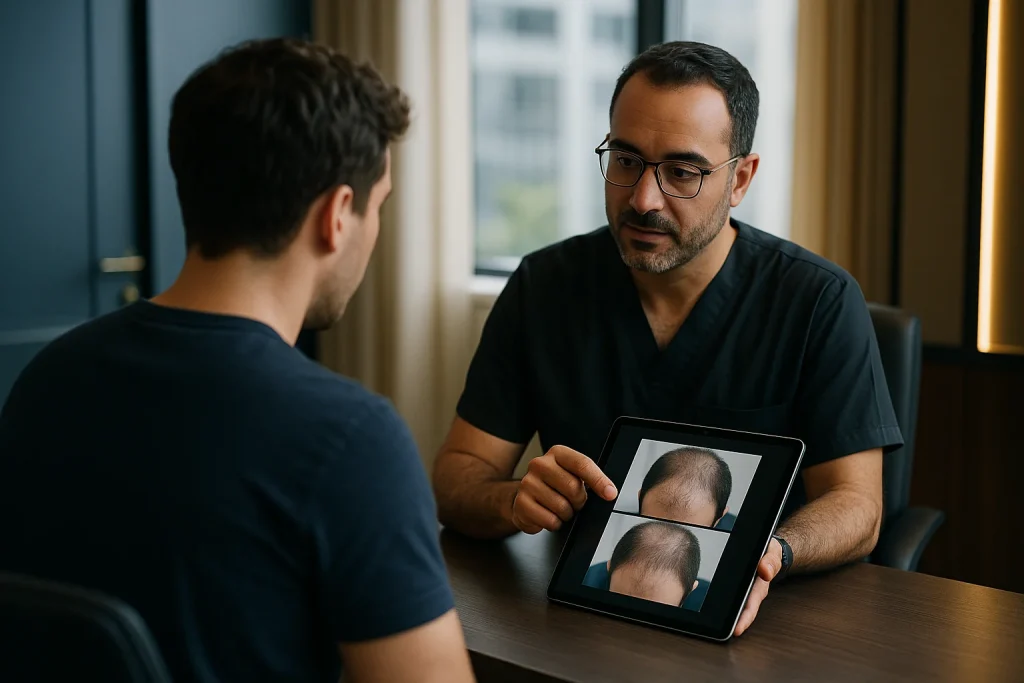
If my dad is balding does that mean i will? Not necessarily. A father’s pattern can be a useful family clue, but hair loss risk comes from genes inherited from both sides of the family, as well as age, hormones, health and lifestyle factors. For transplant planning, the key issue is not only whether hair loss may occur, but how stable your own pattern and donor area are.
- A bald or balding father may increase awareness of hair loss risk, but it does not predict your future with certainty.
- Male pattern hair loss usually has a genetic component from both maternal and paternal family lines.
- A transplant should be planned around your current hair loss pattern, likely future progression and donor hair capacity.
- Younger patients may need a cautious, long-term strategy rather than immediate dense frontal restoration.
- A medical hair assessment can help identify whether hair loss is pattern-related, temporary or linked to another cause.
01if my dad is balding does that mean i will
If my dad is balding does that mean i will? This is one of the most common questions asked by people who first notice a receding hairline, thinning crown or more hair left on the pillow. The simple answer is no: your father’s hair loss does not guarantee that you will become bald. However, it can be one part of the family history that helps explain your likelihood of developing androgenetic alopecia, also called male or female pattern hair loss. This condition is influenced by many genes, not by a single gene passed in a simple way from one parent to one child.
Your father’s hair pattern can still be useful information. If he developed hair loss early, progressed quickly, or had significant thinning at the front and crown, it may suggest that pattern hair loss exists in your family. Yet your mother’s family history is also highly relevant. Looking at close relatives on both sides can give a broader picture, although even this cannot predict exactly when hair loss might start, how quickly it may progress, or which areas of the scalp will be affected.
For transplant planning, family history is a starting point rather than a diagnosis. A doctor will consider your current scalp examination, hair shaft thickness, miniaturisation, donor density, age and the pattern of any change over time. These details matter because a successful-looking hair transplant should fit your likely long-term appearance, not only improve what is visible today. A careful plan may protect donor hair and leave options open if further native-hair thinning develops later.
02Family history is a clue, not a forecast
Pattern hair loss is often described as hereditary because it commonly runs in families. In clinical reality, inheritance is more complex. Multiple genes may influence how sensitive scalp follicles are to dihydrotestosterone, a hormone involved in androgenetic hair loss. Other biological factors can affect how strongly this sensitivity appears. For this reason, two brothers can have very different hairlines, different ages of onset and different degrees of crown thinning, even though they share the same parents.
It is also important to distinguish a family tendency from an inevitable outcome. Someone with several balding relatives may keep a relatively stable hairline for many years. Another person with little known family history may develop noticeable thinning in their twenties or thirties. Family memories can be incomplete as well. A relative may have worn a hairstyle that hid thinning, started treatment privately, or lost hair due to illness rather than genetic pattern loss.
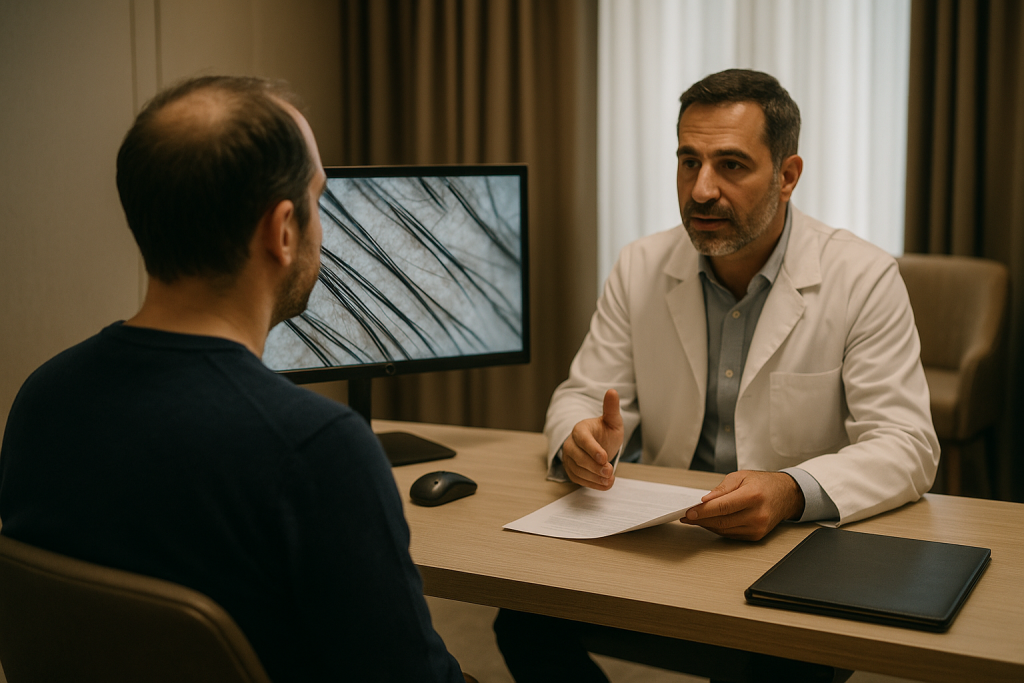
When discussing your risk, try to note the age at which relatives first began thinning, not only whether they were bald later in life. Early and extensive loss in several close relatives may be more relevant than a grandfather who gradually thinned in older age. Even then, it remains only one factor. A trichoscopic scalp assessment can show whether your own hairs are becoming finer in a pattern typical of miniaturisation, which provides more useful information than family history alone.
03The bald dad theory and the role of both parents
The so-called bald dad theory is the popular belief that a person’s future hair loss can be predicted mainly by their father’s hair. A related version says that hair loss comes only through the mother’s side of the family. Neither statement is fully accurate. Some genes associated with androgenetic alopecia are linked to the X chromosome, which a son receives from his mother, but many other relevant genes come from both parents.
In practical terms, it is reasonable to look at your father, mother, grandparents, siblings, uncles and aunts when thinking about family patterns. This wider view may reveal whether early recession, diffuse thinning or crown loss is common. It should not be used as a self-diagnosis tool. Hair loss can have different causes, and the same family can contain people with genetic pattern hair loss, autoimmune hair loss, nutritional concerns, hormonal changes or scalp conditions.
For patients considering transplantation, the most useful question is not “Which parent gave me baldness?” but “What is happening to my hair now, and what could happen next?” A clinician can compare the density and calibre of hairs across the frontal hairline, mid-scalp, crown and donor zone. This helps identify whether the current appearance is likely to be stable, actively progressing or potentially influenced by a reversible concern that should be addressed before surgical planning.
04Why younger adults may notice thinning earlier
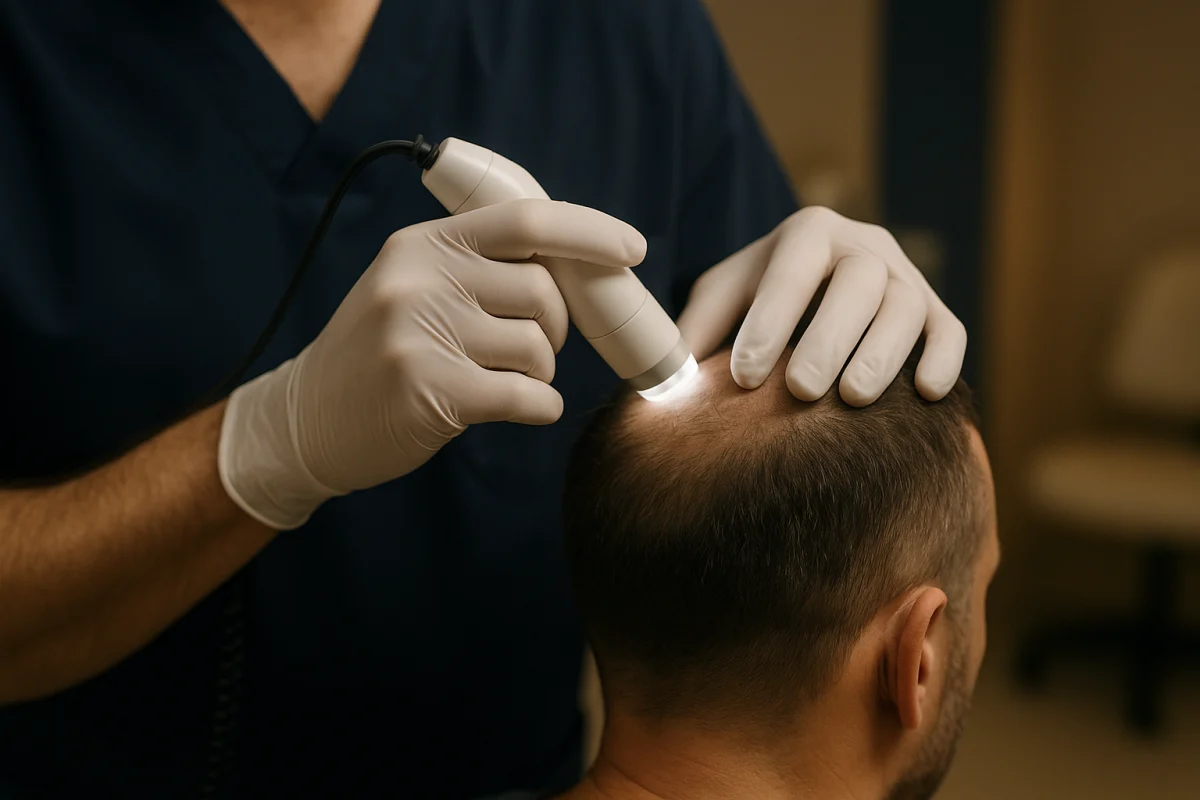
Many people feel that Gen Z is balding faster than earlier generations. There is no single explanation, and it is not possible to conclude that every younger generation is experiencing more biological hair loss. What has clearly changed is awareness. High-resolution phone cameras, video calls, social media images and close attention to hairlines can make early thinning easier to notice. People may also seek advice sooner than previous generations did.
Androgenetic alopecia can begin in late adolescence or early adulthood in genetically susceptible people. Stress, rapid weight change, illness, restrictive diets, iron deficiency, thyroid disorders, certain medicines and other health factors may also trigger increased shedding or reveal an existing tendency to thinning. Increased shedding is not always permanent balding. Telogen effluvium, for example, often causes diffuse shedding after a physical or emotional stressor and requires a different assessment from a receding genetic hairline.
A younger patient should be especially cautious about making decisions based on a few photographs or a temporary period of shedding. A transplant redistributes permanent donor follicles; it does not stop future loss of the surrounding native hair. If the pattern is still changing quickly, a doctor may recommend observation, medical evaluation or non-surgical management before surgery is considered. This approach is designed to support a natural result over time rather than create a hairline that may become isolated by future thinning.
05How genetics affect the right time for a transplant
If my dad is balding does that mean i will need a transplant early? Not automatically. A transplant is not a preventative procedure for someone who has no established hair loss. The right timing depends on whether there is a clear and sufficiently understood pattern, whether the hairline is stable enough to plan responsibly, and whether the donor area has adequate long-term capacity. Age alone does not make someone suitable or unsuitable, but younger age often calls for more conservative planning.
A mature-looking hairline should usually be designed with future change in mind. In a person who may continue to lose hair, placing a very low or densely packed frontal hairline can use a large number of grafts early. This may leave fewer grafts available for the mid-scalp or crown later. It can also look less natural if hair behind the transplant continues to thin. A thoughtful surgeon balances the patient’s goals with donor preservation and the likely evolution of the pattern.
Before planning surgery, a medical team may ask about how long thinning has been present, whether shedding has recently changed, which relatives experienced early loss, and whether there are health or scalp symptoms. Serial photographs can be helpful for showing progression. Your doctor will confirm whether transplantation is appropriate and may advise that stabilising or monitoring the situation first is the safer choice. A responsible consultation should explain both the potential benefits and the limitations of surgery.
06Donor area assessment matters more than family predictions
The donor area, usually the hair at the back and sides of the scalp, is central to transplant planning. These follicles are often more resistant to the hormonal process involved in pattern hair loss, but donor stability is not identical in every patient. Density, hair thickness, curl, scalp contrast and the distribution of hair all influence how many grafts can be safely harvested and what visual coverage may be realistic.
A strong donor area does not mean every follicle should be extracted. Overharvesting can make the donor region look thin and can limit options for future procedures. This is why estimated graft numbers should not be viewed as a simple sales figure. The appropriate number depends on the size of the area to be treated, the desired density, the characteristics of the hair and the need to reserve grafts for possible future loss. Crown work, for example, can require significant graft resources because of its wide surface area.
At Acibadem Hair Transplant Center, a dedicated hair restoration clinic in Istanbul licensed by the Turkish Ministry of Health, online hair analysis is reviewed by doctors before treatment planning. Photographs can help begin the discussion, but an in-person assessment remains important for confirming scalp condition and donor quality. The clinic offers Sapphire FUE and DHI techniques, selected according to the clinical plan rather than a one-size-fits-all approach. Technique choice cannot replace careful donor management.
07Building a long-term hair restoration plan
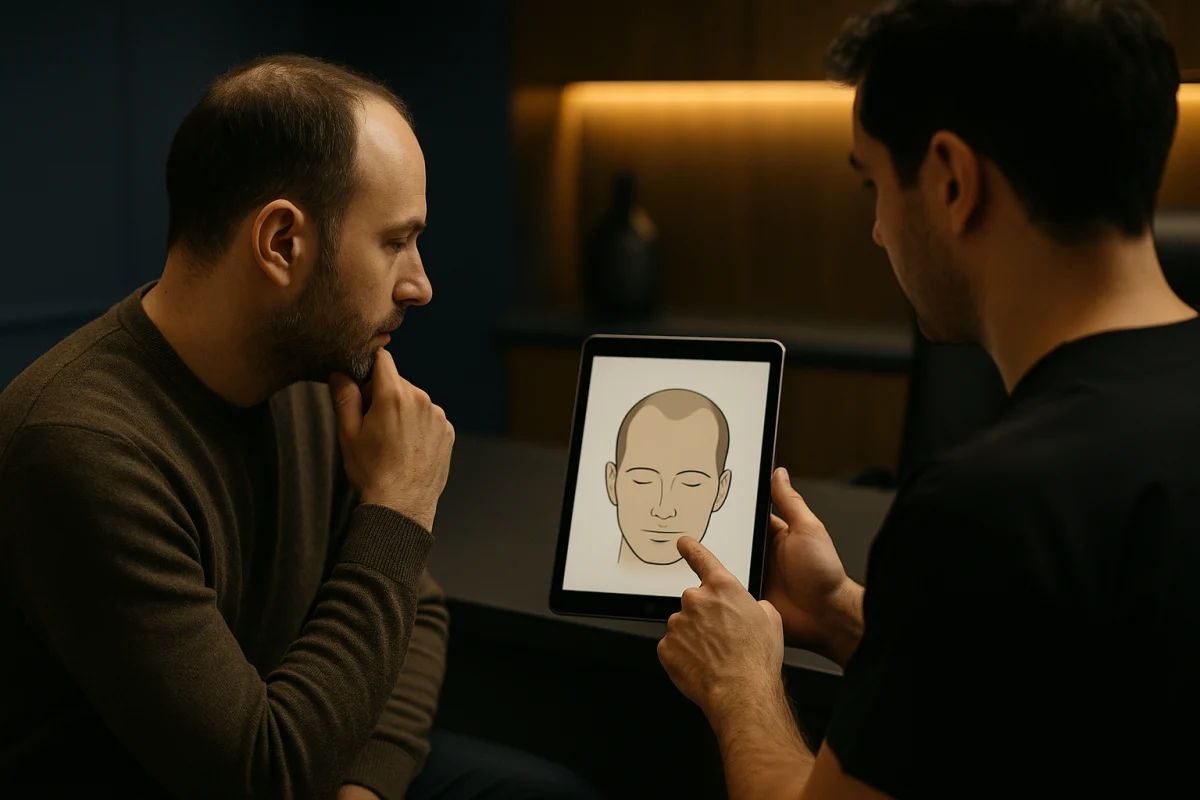
A long-term plan begins by identifying the priority area. For many patients, the frontal hairline and frontal third of the scalp have the greatest effect on facial framing, while the crown may be addressed later if donor supply permits. This does not mean that every patient should follow the same sequence. The right approach depends on the individual pattern, expectations, age, hair characteristics and likely progression. Your doctor should discuss what can be achieved now and what may need to remain a future option.
Hair transplantation can improve the appearance of thinning areas, but it cannot create unlimited density or stop the underlying process in untreated native hair. In most patients, realistic goals are more valuable than an aggressive short-term design. A natural transition from transplanted hair to existing hair, appropriate density distribution and a carefully placed hairline can help the result remain balanced if further thinning occurs. Some patients may require continuing medical follow-up or later treatment as their hair pattern changes.
Needle-free anaesthesia is available for suitable patients at Acibadem Hair Transplant Center. After the procedure, all-inclusive packages can include VIP transfer, a 4-star hotel, a care kit and 12 months of follow-up. The clinic measures results through trichoscopic graft survival at month 12 and documents a 98% rate under its written guarantee. Individual cosmetic results, density and future hair-loss progression can still vary, so follow-up remains an important part of responsible care.
08When to arrange a professional hair assessment
Consider a professional assessment if you notice gradual recession at the temples, reduced density at the crown, widening of a part, persistent diffuse thinning, or a clear change compared with older photographs. It is particularly sensible to seek advice before booking a transplant if you are young, have a strong family history, or are unsure whether your hair loss is stable. A timely assessment may clarify whether the concern looks consistent with androgenetic alopecia or whether further medical investigation is needed.
Seek medical attention promptly if hair loss is sudden, patchy, painful, itchy, associated with redness or scaling, or accompanied by other symptoms such as fatigue or unexpected weight change. These features are not typical of straightforward pattern hair loss and may need evaluation by an appropriate doctor. Avoid assuming that every change is genetic simply because your father is bald. Identifying the cause is an essential first step before deciding on any treatment.
Patients can request a free online hair analysis from Acibadem Hair Transplant Center, with cases reviewed by doctors and WhatsApp replies typically provided within around two hours. The clinic has welcomed patients from 38 countries over 12 years. An online review can help you understand the next steps, but it should be viewed as an initial assessment rather than a guarantee of suitability. Your doctor will confirm the diagnosis, donor assessment and treatment plan during the clinical process.
09Frequently Asked Questions
Will I go bald if my father is bald?
Not necessarily. Your father’s hair loss may indicate a family tendency, but androgenetic alopecia is influenced by genes from both sides of the family and by other factors. Your own scalp pattern, miniaturisation and rate of change provide a more useful guide than your father’s hair alone.
What does the bald dad theory mean?
The bald dad theory is the idea that a father’s baldness predicts whether his child will become bald. It is an oversimplification because hair loss genetics are polygenic, meaning many genes are involved, and they can come from both parents. Family history can be informative, but it cannot give a certain prediction.
Why do some Gen Z adults seem to be balding so quickly?
Earlier genetic pattern hair loss can occur in some people, especially where there is a family tendency. Greater awareness through cameras, social media and video calls may also make subtle changes more visible. Stress, illness, diet changes and medical conditions can cause shedding too, so an assessment is important before assuming permanent balding.
Is balding 100% genetic?
No. Genetic susceptibility is a major factor in androgenetic alopecia, but it is not the only influence on hair appearance and shedding. Hormonal factors, age, health conditions, nutrition, stress and some medicines can also affect the hair. A doctor can help determine whether hair loss appears to be genetic or may have another cause.
هذا المقال للمعلومات العامة فقط، وهو ليس بديلاً عن الاستشارة الطبية المتخصصة.
 06
06 12
12