
In diesem Artikel9
- Überblick
- How the full bald hair transplant cost is determined
- Coverage goals for the hairline, mid-scalp and crown
- Donor management and the possibility of staged treatment
- Technique choices: Sapphire FUE, DHI and anaesthesia
- What to look for in an all-inclusive treatment quote
- Graft survival, healing and value beyond procedure day
- How to prepare for a doctor-reviewed hair analysis
- Frequently Asked Questions
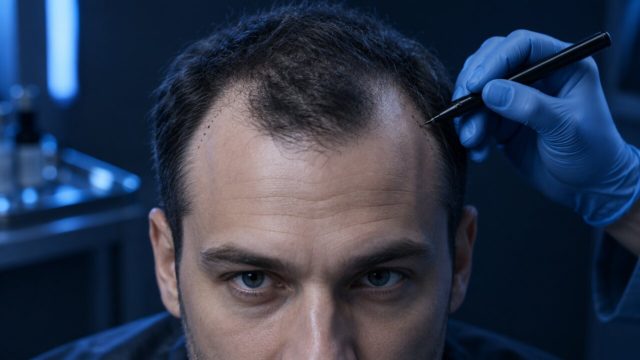
The full bald hair transplant cost for extensive baldness depends mainly on the number of safely available donor grafts, the area requiring coverage, the chosen technique and the level of care included. A doctor-led assessment is needed because advanced hair loss often requires careful planning rather than simply placing the highest possible number of grafts in one session.
- Extensive baldness usually requires a personalised graft plan based on donor capacity, not only the size of the bald area.
- A larger treatment area may involve one or more sessions, depending on scalp characteristics and long-term goals.
- Sapphire FUE and DHI can both be considered, but the most suitable method depends on the treatment plan.
- A transparent quote should clarify medical care, accommodation, transfers, aftercare and follow-up, not only the procedure itself.
- Long-term success depends on natural design, graft handling, healing and realistic use of limited donor hair.
01Hair Transplant Costs for Extensive Baldness: Key Factors
The full bald hair transplant cost is not a fixed figure because advanced hair loss is not one standard condition. A person with a large frontal recession may need a very different plan from someone with thinning across the hairline, mid-scalp and crown. During a proper consultation, the medical team reviews the pattern of loss, scalp condition, hair calibre, donor density and the person’s expectations. These points help determine whether treatment is clinically suitable and what level of coverage may be realistic.
For extensive baldness, cost discussions should begin with medical planning rather than with a graft number alone. A large bald surface can create the impression that every area should receive the same density, but donor hair is limited. In most patients, doctors prioritise the hairline and frontal zone because these areas frame the face and are most visible in daily life. The mid-scalp and crown may then be planned according to remaining graft availability and the expected progression of hair loss.
It is also important to separate a treatment quotation from a promised cosmetic outcome. Hair transplantation redistributes existing follicles; it does not create new donor hair. A responsible plan explains the likely coverage, the limitations of the donor area, the possibility of future treatment and the importance of protecting existing hair where appropriate. Your doctor will confirm the final plan after reviewing your hair and medical history.
02How the full bald hair transplant cost is determined
The main clinical driver of cost is usually the scope of the treatment plan. This includes the number of grafts that can be extracted safely, the number of recipient sites required and the complexity of distributing grafts across several scalp zones. A graft may contain one, two, three or more hairs, so graft count and hair count are not the same. For this reason, comparing quotations only by a single graft number can be misleading.
The condition of the donor area is equally important. Donor follicles are commonly taken from the back and sides of the scalp, where hair may be more resistant to the process that causes pattern hair loss. Doctors assess density, hair thickness, curl, colour contrast between hair and skin, and the size of the stable donor zone. Strong donor characteristics may allow improved visual coverage, while a limited donor area calls for a more conservative and carefully staged approach.
Cost may also reflect the clinical team, facility standards, technique, pre-procedure preparation and aftercare included in the plan. At Acibadem Hair Transplant Center, a dedicated hair restoration clinic in Istanbul licensed by the Turkish Ministry of Health, planning begins with a doctor-reviewed online hair analysis. This helps international patients understand the proposed approach before arranging travel, while the in-person assessment remains essential before treatment.
03Coverage goals for the hairline, mid-scalp and crown
Advanced baldness often affects more than one visible region, yet each region has a different cosmetic role. The frontal hairline needs a natural shape, irregularity and appropriate density so that it does not look artificial. The mid-scalp connects the frontal area to the crown and can make the overall result appear fuller. The crown is a larger circular zone that can consume many grafts, especially when a person hopes for dense coverage throughout.
Doctors commonly discuss prioritisation when donor supply is limited. A mature, age-appropriate hairline may use donor hair more efficiently than a very low or densely packed hairline. Building frontal framing first can offer meaningful visible improvement, even if the crown is addressed later or receives lighter coverage. This is not a compromise made without purpose; it is often a long-term strategy to preserve donor resources for future needs.
Hair characteristics also change the visual effect of transplantation. Coarse or wavy hair may create more apparent volume than fine, straight hair, while a strong contrast between scalp and hair can make thinning easier to see. Scalp laxity, previous procedures, scarring and the presence of existing miniaturising hair may also influence the design. A realistic coverage discussion should consider all of these factors rather than focusing on a single before-and-after style image.
04Donor management and the possibility of staged treatment
Safe donor management is central to planning extensive baldness. Removing too many follicles from the donor area can make the back or sides of the scalp look visibly thin. For this reason, the medical team generally evaluates how many grafts can be harvested while maintaining an acceptable donor appearance. A plan that looks ambitious on paper may not be appropriate if it places the donor area at risk of overharvesting.
Some patients may be candidates for a larger single session, while others may benefit from a staged approach. Staging can allow doctors to focus first on the hairline and mid-scalp, then reassess healing, existing hair changes and remaining donor reserve before considering a second session. The timing and suitability of any additional procedure vary from person to person. It should be decided only after medical review and not assumed from the start.
The full bald hair transplant cost can therefore be influenced by whether the plan is designed as one procedure or as a longer treatment journey. A lower initial quote does not always show the whole picture if substantial areas remain untreated or if important follow-up care is excluded. Asking how donor reserves are being protected can be as valuable as asking about the immediate procedure details.
05Technique choices: Sapphire FUE, DHI and anaesthesia
Technique is one part of the decision, but it should support the clinical plan rather than drive it. Sapphire FUE involves extracting follicular units and preparing recipient channels with sapphire instruments. It may be considered when treating larger areas because the team can organise implantation across broad regions. DHI uses an implantation tool to place grafts into the recipient area and may be selected for particular placement needs. Your doctor will recommend the approach that fits the scalp, graft plan and treatment objectives.
For extensive baldness, the quality of graft handling and the accuracy of placement are more important than a technique name alone. Grafts need careful protection throughout extraction, preparation and implantation. The angle, direction and distribution of implanted hairs should follow the natural growth pattern, particularly at the hairline and crown. Dense packing is not automatically better if it compromises natural appearance, circulation or the long-term use of grafts.
Comfort planning also matters. Needle-free anaesthesia is available at Acibadem Hair Transplant Center for eligible patients. This option may help reduce anxiety about injections for some people, but it is not suitable for everyone and does not replace a medical assessment. The clinical team will review medical history, allergies, medications and other relevant safety considerations before confirming the anaesthesia plan.
06What to look for in an all-inclusive treatment quote
When comparing the full bald hair transplant cost, ask exactly what the quote includes from arrival through recovery. International patients may need more than the procedure itself: airport transport, local transfers, accommodation, post-procedure supplies, washing instructions and a way to contact the team after returning home. A quote that appears lower may not include some of these practical elements, which can make comparisons inaccurate.
Acibadem Hair Transplant Center offers all-inclusive packages that include VIP transfer, a 4-star hotel, a care kit and 12 months of follow-up. These inclusions can simplify travel planning for patients visiting Istanbul from abroad. The clinic has welcomed patients from 38 countries over 12 years, and a free online hair analysis can be sent for doctor review before travel arrangements are made. Replies on WhatsApp are typically provided within around two hours.
A clear package should still be discussed in detail before booking. Ask whether medications, blood tests, additional nights, treatment for a future session or care for unexpected medical needs are included or separately charged. It is also sensible to understand cancellation terms and what follow-up support looks like once you are back home. Written information helps patients compare options on a like-for-like basis.
07Graft survival, healing and value beyond procedure day
A hair transplant should be assessed over months, not days. In the early period, transplanted hairs commonly shed before new growth becomes visible. Growth rates, hair texture changes and final coverage vary among patients. Most people need patience during the recovery phase, and the 12-month point is often used for a more meaningful review of growth and visual maturation.
At Acibadem Hair Transplant Center, results are measured by trichoscopic graft survival at month 12, with a documented 98% rate under written guarantee. This is a clinic-specific documented measure and should be understood alongside individual factors such as healing, scalp characteristics and adherence to aftercare instructions. It does not mean that every patient will have identical density, styling options or cosmetic results.
Value also includes the quality of pre-operative design and aftercare guidance. Patients should receive clear instructions on washing, sleeping position, activity restrictions, sun exposure and when to contact the clinic. Following these instructions can support uncomplicated healing, although no clinic can guarantee an identical recovery course for every person. A provider should be open about both the expected process and the limits of treatment.
08How to prepare for a doctor-reviewed hair analysis
A useful remote assessment starts with clear, recent photographs. Clinics commonly need views of the front, both temples, top, crown and donor area in good lighting, with dry hair and without filters. It is helpful to describe when hair loss began, whether it has progressed quickly, whether relatives have similar loss and whether you have had previous scalp procedures. This information gives the doctor a clearer starting point for an initial opinion.
You should also disclose relevant medical information, including regular medicines, allergies, smoking, chronic conditions and past reactions to anaesthesia. These details can affect suitability and preparation. An online review is a convenient first step, but it cannot replace a direct clinical examination. The doctor may need to adjust the plan after checking the scalp, donor area and health information in person.
Before committing, prepare practical questions. Ask which scalp areas are being prioritised, whether the suggested coverage is intended to be conservative or dense, how the donor area will be protected and what follow-up is provided. Patients should also ask what may happen if further hair loss continues around transplanted areas. Informed decisions are especially important for extensive baldness because the donor supply needs to serve both present and future appearance goals.
09Frequently Asked Questions
What is the Social Security retirement age in the United States?
For United States Social Security, the earliest age to claim retirement benefits is generally 62, but claiming early usually reduces the monthly amount. Full retirement age depends on year of birth and is 67 for people born in 1960 or later. Delaying beyond full retirement age can increase the monthly benefit until age 70.
Is there an average Social Security benefit payment chart by age?
There is no single average payment chart that can accurately predict an individual benefit, because earnings history, claiming age and work record all matter. As a general rule, for someone whose full retirement age is 67, claiming at 62 provides about 70% of the full retirement benefit, claiming at 67 provides 100%, and claiming at 70 provides about 124%. Official Social Security tools and statements are the most reliable source for personal estimates.
How can I estimate how much Social Security I will receive?
Your estimated benefit is based mainly on your highest 35 years of earnings that were subject to Social Security taxes, adjusted under the programme’s formula, and on the age when you claim. Creating or reviewing a personal Social Security statement through the official United States Social Security Administration website can provide an individual estimate. For decisions involving retirement income or taxes, consider speaking with a qualified financial professional.
When did the United States retirement age change from 65 to 67?
The Social Security Amendments of 1983 raised the full retirement age gradually from 65 to 67. The increase began for people born in 1938, and the full retirement age reached 67 for people born in 1960 or later. The change was phased in over many years rather than occurring on one date for everyone.
Dieser Artikel dient nur der allgemeinen Information und ersetzt keine professionelle medizinische Beratung.
Dieser Ratgeber dient der allgemeinen Information und ersetzt keine ärztliche Beratung. Behandlungsentscheidungen werden nach einer persönlichen oder Online-Untersuchung durch einen Arzt getroffen.