
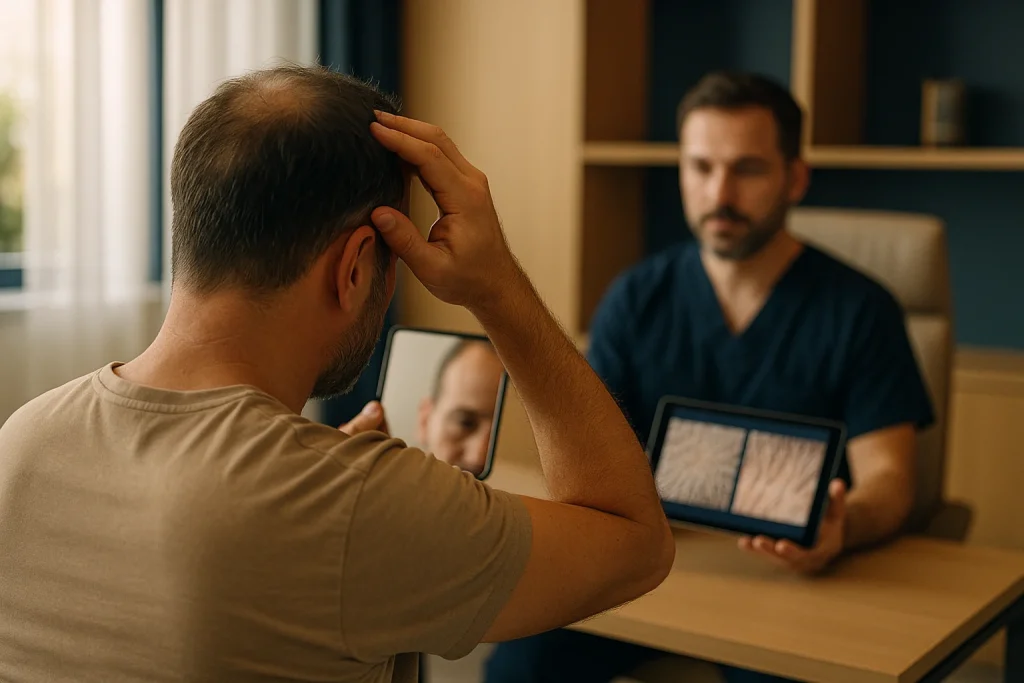
It is normal to lose some hairs every day because hair follicles naturally move through growth, resting, and shedding stages. The more important question is whether the shedding is persistent or comes with visible thinning, a widening part, receding areas, or reduced density; a transplant consultation can help identify the cause and assess your options.
- A daily hair count alone cannot reliably show whether hair loss is normal or progressive.
- Shedding can look heavier on wash days because loose hairs may collect between shampoos.
- Visible changes in density, part width, hairline shape, or scalp coverage are often more useful than a single daily number.
- Temporary shedding may follow illness, stress, hormonal changes, weight loss, or certain medications, while pattern loss usually develops gradually.
- A doctor-reviewed consultation can help distinguish active shedding from stable hair loss before considering a transplant.
01Normal shedding starts with the natural hair cycle
Many people ask how much hair fall is normal when they begin noticing hairs on a pillow, brush, clothing, or shower drain. Some daily shedding is a normal part of healthy hair biology. Each follicle follows its own cycle, so not all hairs grow, rest, and shed at the same time. This staggered process helps the scalp maintain an overall appearance of coverage even while individual hairs naturally fall out.
The active growth phase is followed by a transition phase and then a resting phase. At the end of the resting stage, an older hair is released and a new hair can begin to grow from the same follicle. Because follicles operate independently, a small amount of hair shedding happens every day in most people. Seeing shed hairs does not automatically mean that the follicle is permanently damaged or that a transplant is needed.
Hair length can strongly affect how dramatic shedding appears. Long hairs are easier to see on dark clothes, bedding, or bathroom surfaces, and a group of long strands can look alarming even when the actual number is not unusual. Curly, coily, or very thick hair may also retain loose strands until washing or detangling, making one occasion seem heavier than the shedding was over several days.
What matters clinically is the wider pattern over time. If replacement hairs continue growing normally and scalp coverage remains stable, shedding may simply reflect the regular cycle. If the hair appears finer, the scalp becomes more visible, or the hairline and crown are gradually changing, the concern may be less about normal shedding and more about a process affecting follicle growth. A doctor can assess these differences during a consultation.
02How Much Hair Fall Is Normal? Look Beyond the Count
There is no single daily number that can diagnose hair loss. General estimates of normal daily shedding vary because they are influenced by hair length, washing habits, grooming, season, scalp health, and the way hairs are counted. For this reason, how much hair fall is normal is best considered alongside visible changes in the hair rather than treated as one fixed limit for every person.
A person who washes their hair every day may notice a smaller number of hairs at each wash than someone who shampoos twice a week. In the second situation, loose hairs can remain caught among surrounding strands and release together later. Brushing, scalp massage, towel drying, and detangling can also bring out hairs that had already completed their shedding stage but had not yet fallen away.
It is also difficult to count accurately. Some hairs may be missed, while others may be counted more than once after moving from a brush to a sink or floor. A daily number can therefore create anxiety without giving a clear medical answer. A more useful approach is to observe whether the amount has clearly increased for several weeks and whether this change is accompanied by reduced volume or more visible scalp.
Photographs taken in the same lighting and from the same angles can provide a clearer record than a daily count. For example, images of the frontal hairline, temples, mid-scalp, part line, and crown taken monthly may show gradual changes that are difficult to notice in a mirror. Avoid changing your hairstyle, parting, or lighting too much when comparing photographs, as these details can make density look different.
03Visible thinning and pattern changes are important signals
Progressive hair loss often shows itself through changes in distribution rather than a sudden pile of hair. Some people first notice a receding temple area, less density through the frontal region, or a thinner crown. Others notice a widening central part, a more visible scalp under overhead light, or a ponytail that feels less full. These observations can be more meaningful than the number of individual hairs found during the day.
Hair shaft changes also deserve attention. In some forms of pattern hair loss, affected follicles gradually produce hairs that are finer, shorter, or lighter in appearance. The person may still have many hairs in the area, but they provide less coverage than before. This is why a scalp can look thinner even when shedding does not seem dramatic. A close clinical examination can help identify variation in hair calibre and distribution.
Family history can be relevant, but it is not a diagnosis by itself. Hair thinning may occur in people with or without known family patterns, and similar-looking changes can have different causes. Age, hormonal influences, inflammatory scalp conditions, nutritional factors, recent health events, and medications may all be considered by a doctor when appropriate. A consultation should focus on your own history and scalp findings rather than assumptions based only on relatives.
Sudden patchy areas, scalp pain, burning, marked itching, redness, scaling, or scarring changes should not be ignored. These symptoms may point to a condition that needs medical assessment before any cosmetic procedure is discussed. Hair transplantation is generally considered only after the cause of hair loss and the condition of the scalp have been properly evaluated. Treating an underlying issue may be the priority.
04Why shower-day shedding can look more severe
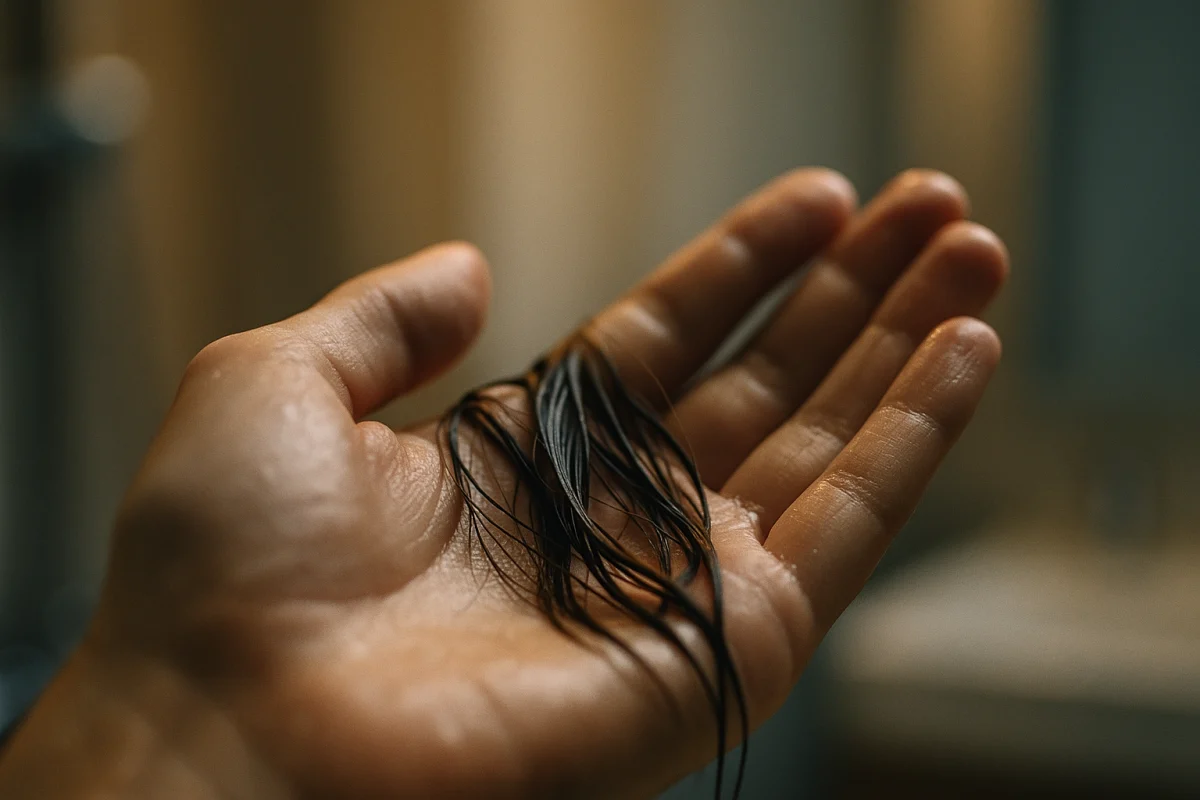
The shower is one of the most common places people notice hair fall. Water, conditioner, finger combing, and rinsing can release strands that were already loose within the hair. This is especially noticeable after several days without washing, after wearing the hair tied back, or when thick or textured strands have held shed hairs in place. A group of hairs in the drain does not necessarily mean they all shed at that moment.
Seeing around 20 hairs in the shower can be normal for many people, particularly when washing, conditioning, or detangling. The significance depends on the broader picture: how often this happens, whether the amount is clearly increasing, and whether you see thinning afterward. A single shower count is not enough to confirm excessive hair loss, because it does not account for hairs that were retained since the previous wash.
Gentle washing is usually preferable to avoiding shampoo out of fear of shedding. Not washing does not stop hairs that have reached the end of their cycle from shedding; it can simply delay when they are seen. Use a comfortable water temperature, avoid forceful scratching with nails, and detangle carefully from the ends upward. If washing causes pain, heavy scaling, bleeding, or unusual breakage, seek professional advice rather than changing your routine repeatedly.
It is useful to distinguish shedding from breakage. Shed hairs often have a small, pale bulb at one end, while broken hairs may appear shorter, uneven, and without a root bulb. Heat styling, bleaching, tight hairstyles, friction, and chemical processing can increase breakage. Breakage may make the hair look less dense, but it is different from hair being released from the follicle and may require a different approach.
05Temporary shedding can happen after body or lifestyle changes
Hair shedding may increase temporarily after a significant physical or emotional event. Illness with fever, surgery, rapid weight change, restrictive eating, major stress, childbirth, hormonal changes, and some medicines can affect the normal timing of the hair cycle. In these situations, shedding may become noticeable after the triggering event rather than immediately. A doctor can review the timing and relevant health history to help clarify possible contributors.
Temporary shedding does not always lead to permanent thinning. In many cases, follicles remain present and can return to their usual growth activity once the trigger has resolved, although the visible recovery process may take time. It is important not to assume that every period of shedding requires a transplant. Transplant surgery redistributes existing follicles; it does not treat every reason that hair may be shedding from across the scalp.
Dietary changes should be approached carefully. Hair growth depends on overall health, and inadequate intake of key nutrients can be relevant in some patients. However, taking supplements without identifying a need is not always helpful and may be unsuitable for certain individuals. A clinician may advise whether medical history, examination, or tests are appropriate. Avoid relying on unverified products or dramatic claims that promise to stop shedding quickly.
If diffuse shedding persists, comes with tiredness or other general symptoms, or follows a new medication, a medical review is sensible. Bring a clear timeline of when the shedding started, recent illnesses or changes, and any treatments you use. This information can make a consultation more productive. It also helps the doctor decide whether a hair restoration assessment, general medical assessment, or both may be appropriate.
06When 150 hairs a day deserves closer attention
Finding or estimating 150 shed hairs in one day can feel worrying, but it is not automatically proof of permanent hair loss. Counts can rise on wash days or after several days of retained shedding, and counting is often imprecise. However, if an amount around this level appears to be consistent over time, is clearly more than your usual shedding, or occurs with visible loss of density, it is reasonable to arrange a professional assessment.
Context is essential. Someone with long, dense hair may notice every shed strand, while someone with short hair may see fewer hairs even if the underlying change is similar. The number may also be influenced by brushing frequency, hair washing, styling, and whether hair has been kept in braids, curls, or a bun. Rather than focusing only on a count, note whether your scalp coverage, part line, or hairline has changed.
In a transplant-focused consultation, the doctor typically considers the donor area as well as the thinning area. The donor region is the hair at the sides and back of the scalp that may be suitable for redistribution in selected patients. Its density, hair characteristics, and long-term stability matter. A transplant may not be the right first step when shedding is active, diffuse, unexplained, or likely to affect the donor area.
Early assessment can still be valuable even if surgery is not advised. It can establish a baseline, identify signs that need medical attention, and help you understand whether the hair loss pattern appears stable. This avoids making decisions based on panic after one heavy shedding day. Your doctor will confirm whether further evaluation, observation over time, non-surgical management, or transplant planning is the most appropriate next step.
07What happens during a hair transplant consultation
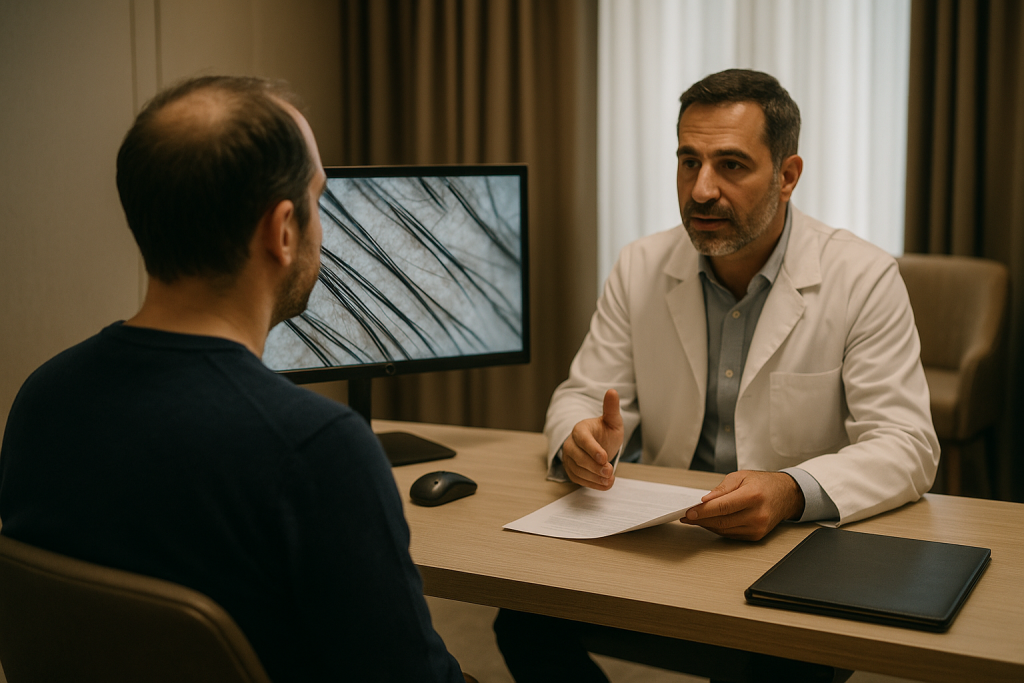
A good consultation begins with questions, not a promise of surgery. The clinician may ask when you first noticed changes, whether the loss is gradual or sudden, whether it affects specific areas, and whether there have been recent health or lifestyle changes. They may also ask about family history, medicines, prior procedures, scalp symptoms, and your expectations. Honest, detailed answers support a safer and more realistic assessment.
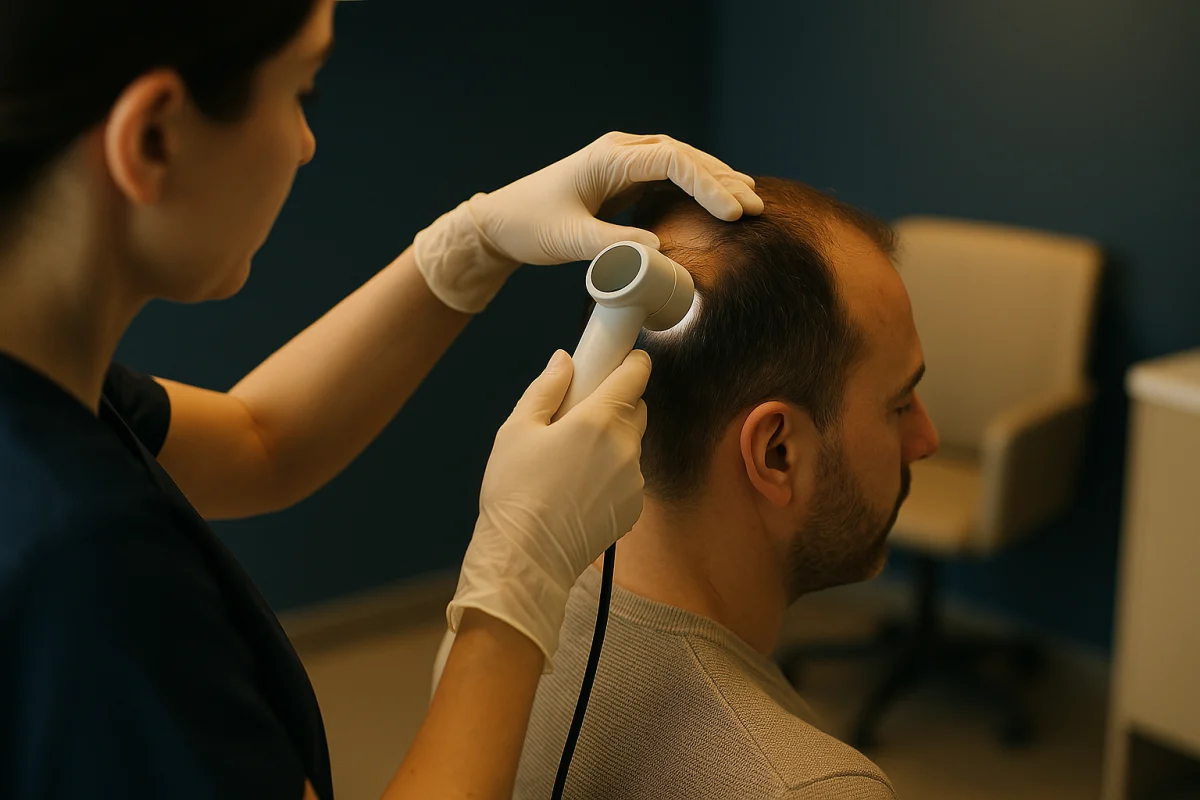
The scalp and hair are then examined for density, hair shaft thickness, distribution of thinning, and donor-area quality. Trichoscopic assessment may be used to look more closely at the scalp and follicles. This can help distinguish features of pattern hair loss from diffuse shedding or other conditions, although the final assessment depends on the complete clinical picture. If a medical issue is suspected, referral or further investigation may be recommended before proceeding.
For patients who may be candidates for transplantation, planning includes more than filling a current thin area. The doctor considers the likely future pattern of loss, available donor supply, facial proportions, existing hair direction, and the need to preserve a natural-looking result over time. A cautious plan is particularly important for younger patients or those with ongoing hair loss, as native hair may continue to change after surgery.
At Acibadem Hair Transplant Center in Istanbul, international patients can begin with a free online hair analysis reviewed by doctors. Photos should be clear and taken in good light so that the frontal area, temples, top, crown, and donor region can be assessed as far as possible remotely. Replies on WhatsApp are typically provided within around two hours, but an online review does not replace the clinical checks needed before any procedure is confirmed.
08How to prepare useful information before your consultation
Before a consultation, create a simple timeline rather than trying to count every hair. Record when you first noticed increased shedding or visible thinning, whether it began suddenly or gradually, and whether it is improving, stable, or progressing. Include major health events, changes in diet or weight, new medicines, hormonal changes, scalp symptoms, and hair treatments. This overview may reveal patterns that are easy to overlook in daily life.
Take consistent photographs about once a month if you want to monitor change. Use dry hair, similar lighting, and the same distance from the camera. Capture the front, both temples, top, part line if relevant, crown, and donor area. These images are not a substitute for examination, but they can show whether a concern is temporary shedding or a measurable change in coverage. They are also useful when discussing goals with a clinician.
Try not to make major changes immediately before assessment, such as starting several new supplements, changing hair colour repeatedly, or using aggressive scalp treatments. These steps can make it harder to understand what is affecting the hair or scalp. Continue normal gentle care unless a healthcare professional has advised otherwise. If you use prescription medicines or have a medical condition, mention this during the consultation process.
Set realistic questions for the appointment. You may ask what type of hair loss appears most likely, whether it seems active or stable, whether the donor area is adequate, and what results may be reasonable for your individual characteristics. It is also appropriate to ask about the limitations of a transplant. A responsible provider should explain that hair restoration outcomes vary and that long-term planning is important.
09Choosing the right time for a transplant discussion
A transplant consultation can be useful when thinning has become noticeable, when you are unsure whether shedding is temporary, or when you want a professional view of your donor area and future options. It does not mean you must choose surgery. In fact, the consultation may show that monitoring, treating a scalp concern, or waiting for a more stable pattern is a better course before surgical planning is considered.
Hair transplantation is usually designed to redistribute permanent donor follicles into areas with lower density. It cannot create unlimited new donor hair, and it does not necessarily prevent further loss in untreated native hair. This is why careful patient selection and a conservative design are important. A thoughtful plan should balance the appearance you would like now with the possibility of future changes in hair density.
Acibadem Hair Transplant Center is a dedicated hair restoration clinic in Istanbul, licensed by the Turkish Ministry of Health. The clinic offers Sapphire FUE and DHI techniques, with needle-free anaesthesia available for suitable patients. If surgery is confirmed as appropriate, all-inclusive packages can include VIP transfer, a 4-star hotel, a care kit, and 12 months of follow-up. Your doctor will explain which elements and techniques are suitable for your case.
Do not let one shower drain or one high daily estimate force a rushed decision. Observe the overall pattern, seek assessment if changes persist or concern you, and make choices based on clinical evaluation rather than fear. Healthy hair can shed, and visible thinning can have different causes. A well-timed consultation provides the information needed to decide whether a transplant discussion is appropriate now or whether another step should come first.
10Frequently Asked Questions
How can I tell if my hair loss is excessive?
Hair loss may deserve assessment when shedding is clearly more than your usual amount for several weeks or when you notice visible changes in density, part width, hairline shape, or crown coverage. Sudden patchy loss, scalp discomfort, redness, scaling, or scarring should also be reviewed by a medical professional. A daily count alone cannot diagnose the cause.
Is it normal to lose about 150 hairs in a day?
A one-day estimate of 150 hairs is not automatically abnormal, especially after washing or after several days without shampooing, when loose hairs may release together. If this level seems persistent, is increasing, or is accompanied by thinning, a doctor-reviewed assessment is advisable. The pattern of change is usually more informative than one count.
Is losing 20 hairs while showering normal?
For many people, seeing around 20 hairs during a shower can be normal. Washing and conditioning often release hairs that had already detached from the follicle but were held among other strands. Consider whether you also see ongoing visible thinning or a clear increase in shedding outside of wash days.
Does healthy hair naturally fall out often?
Yes, healthy hair naturally sheds as follicles move through their normal growth cycle. The key difference is that healthy shedding is usually balanced by ongoing growth and does not lead to progressive visible loss of coverage. If the hair looks increasingly finer or the scalp becomes more visible, a consultation can help clarify what is happening.
Este artículo tiene fines exclusivamente informativos y no sustituye el consejo médico profesional.
 06
06 12
12