En este artículo9
- Resumen
- Scalp micropigmentation vs hair transplant: a direct comparison
- When scalp micropigmentation may match your needs
- When a hair transplant may be the more suitable route
- Density, donor supply and realistic visual expectations
- Recovery, maintenance and long-term commitment
- Can SMP and hair transplantation be used together?
- How to make a confident, medically informed decision
- Frequently Asked Questions
Scalp micropigmentation can create the visual effect of fuller density or a close-shaved hairline, while a hair transplant moves living follicles to thinning areas. The better option depends on your hair-loss pattern, donor supply, preferred hairstyle, medical suitability and whether you want real growing hair or a cosmetic visual solution.
- Scalp micropigmentation is a cosmetic tattooing method that creates the appearance of hair follicles without growing new hair.
- A hair transplant uses your own donor follicles and may provide growing hair in suitable candidates.
- SMP can suit people who prefer a shaved style, want to camouflage scars, or are not currently suitable for surgery.
- Hair transplantation requires realistic donor-area planning because the donor hair supply is limited.
- Some patients combine SMP and a hair transplant to improve the appearance of density or reduce scar visibility.
01Scalp Micropigmentation or Hair Transplant: Which Fits Your Goals?
When considering scalp micropigmentation vs hair transplant, the first question is not simply which treatment is better. It is which option matches your goals, your current hair-loss stage and the type of result you would feel comfortable maintaining. Scalp micropigmentation, often called SMP, places tiny pigment impressions in the upper scalp to resemble closely shaved hair follicles. A hair transplant redistributes living follicles from a donor area, usually at the back and sides of the scalp, into areas affected by thinning or hair loss.
These treatments work in very different ways. SMP changes the visual contrast between the scalp and existing hair. It can make a receding hairline look sharper, diffuse thinning look less noticeable, or a shaved scalp appear more even. It does not stop hair loss, produce hair growth or add physical hair volume. Hair transplantation is a surgical procedure. In suitable candidates, transplanted follicles can grow hair after the normal healing and growth cycle, although the final result depends on many clinical factors.
For some people, the decision is clear. A person who enjoys a very short buzz-cut style and wants a non-surgical visual improvement may prefer SMP. Someone who wants to cut, style and grow their own hair in a thinning area may explore hair transplantation. Other people need a more careful discussion because they have progressive hair loss, a limited donor area, a scalp condition, a previous procedure or expectations that may not be achievable safely.
02Scalp micropigmentation vs hair transplant: a direct comparison
SMP is usually chosen for optical coverage rather than hair restoration. A trained practitioner uses specialised pigments and fine needles to build a pattern that resembles natural follicle dots. Treatments are normally completed over several sessions because colour, density and hairline design are adjusted gradually. The pigment sits in the skin and needs periodic review or refreshment over time, as fading can occur. The appearance is most convincing when it is designed to suit the person’s skin tone, age, facial proportions and remaining hair pattern.
A hair transplant can be performed with methods such as Sapphire FUE or DHI when a doctor considers the patient medically suitable. Follicular units are extracted from the donor area and placed into recipient sites using a plan that aims to respect natural direction, hairline design and existing hair. Transplanted hair does not appear immediately. In most patients, there is an initial healing period, followed by temporary shedding of transplanted hairs before new growth begins. The timeline and density vary, and your doctor will explain what may be realistic in your individual case.
In practical terms, SMP is less invasive and generally has a shorter visible recovery period, while a transplant involves surgical aftercare and a longer wait for visible growth. SMP gives the impression of density but does not feel like hair when touched. A transplant gives real hair growth but cannot create unlimited density because every patient has a finite donor supply. Neither option should be presented as a universal answer. A proper recommendation should account for clinical examination, future hair-loss risk and your long-term styling preference.
03When scalp micropigmentation may match your needs
SMP may be worth discussing if your main goal is to reduce the contrast of visible scalp. It is often considered by people with diffuse thinning who still have hair but see more scalp under bright light, by people with an advanced pattern of hair loss who prefer a clean-shaven appearance, and by people who want to soften the look of certain scars. It may also be considered when donor hair is limited or when surgery is not currently advisable. Suitability still depends on scalp health, skin characteristics and a careful assessment of expectations.
A close-shaved style is important to consider. If you have a largely bald scalp and choose SMP, the result typically looks most natural when the remaining hair is kept short enough to match the pigment impression. If you prefer medium or long hair, SMP cannot replace the movement, texture or coverage of actual hair. It can support the visual appearance of density in some situations, but it will not behave like a fuller head of hair in wind, water or styling products.
People with active scalp inflammation, certain skin disorders, a tendency towards problematic scarring or unstable hair loss may need further medical evaluation before proceeding. Pigment selection and placement also require care. A hairline that is too low, too straight or too dark may look less natural as a person ages. For this reason, conservative design and an experienced clinical approach are usually safer than trying to create an overly dense or youthful-looking result in one step.
04When a hair transplant may be the more suitable route
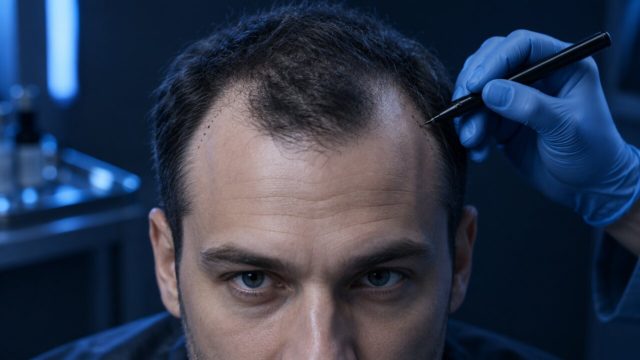
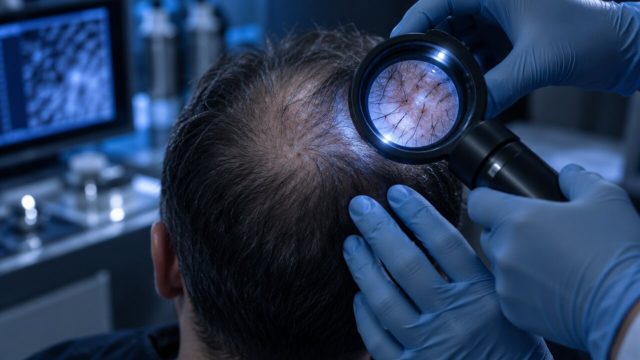
A hair transplant may fit patients who want growing hair and have enough stable donor follicles for a carefully planned procedure. It is commonly considered for patterned hair loss, including recession at the temples, thinning at the frontal area and selected crown concerns. The best candidates are not defined by age alone. Doctors typically assess the hair-loss pattern, the quality and density of donor hair, scalp condition, family history, current treatments and the likelihood of continued native-hair loss.
It is important to understand that a transplant does not create new follicles. It redistributes follicles from one part of the scalp to another. The donor area must therefore be managed carefully, especially in patients with extensive loss or fine hair. A conservative hairline and sensible graft allocation can help preserve options for the future. Your doctor may also discuss the possibility that non-transplanted hair can continue to thin over time, which may affect the overall appearance if hair loss is not stabilised or monitored.
At Acibadem Hair Transplant Center, a dedicated hair restoration clinic in Istanbul licensed by the Turkish Ministry of Health, doctors review each case before confirming candidacy. Sapphire FUE and DHI techniques are available, and needle-free anaesthesia may be offered where appropriate. The clinic provides a free online hair analysis reviewed by doctors, with WhatsApp replies usually within around two hours. This initial review cannot replace an in-person medical assessment, but it can help patients understand whether a transplant consultation is a sensible next step.
05Density, donor supply and realistic visual expectations
Density is one of the most misunderstood parts of scalp micropigmentation vs hair transplant. SMP can make an area look denser by darkening the scalp background, particularly when short existing hairs are present. However, it does not increase the number of hairs. A transplant adds follicles to a recipient area, but it may not reproduce the density of an untouched teenage hairline. The achievable appearance depends on hair calibre, curl, colour contrast, donor quality, the size of the thinning area and the number of grafts that can be harvested safely.
A graft is not the same as a single hair. One graft may contain one, two, three or sometimes more hairs. Therefore, graft numbers alone cannot predict a result. A larger area of baldness needs more donor resources, while a smaller frontal zone may allow a more focused change. Doctors also have to decide how to balance the front, mid-scalp and crown. Placing too many grafts in one area may leave insufficient donor supply if another area requires attention later.
Naturalness often matters more than chasing the highest possible graft number. An appropriate hairline should suit facial structure and likely future hair loss. The transplanted hairs should be placed at angles that work with the existing hair. With SMP, gradual layering of pigment and a soft, irregular front edge are usually more natural than a dark, sharply drawn line. Honest planning helps patients avoid choosing an approach based only on dramatic online images rather than on what may remain suitable over many years.
06Recovery, maintenance and long-term commitment
After SMP, the scalp normally needs protection while the pigment settles. Your practitioner will give instructions about washing, sweating, sun exposure and shaving during the early healing period. Mild redness or temporary sensitivity may occur. Longer term, sun exposure, skin turnover and individual skin characteristics can influence fading. Many patients need a touch-up at some point, although the timing varies. SMP is often described as semi-permanent because it can fade, but it should still be approached as a significant long-term cosmetic decision.
Hair transplant recovery requires more structured aftercare. Small crusts, redness, swelling or temporary numbness can occur in the early period, and patients are usually asked to avoid rubbing the grafts, intense exercise and certain activities for a period advised by their medical team. Transplanted hair often sheds before entering a new growth phase. Visible progress is gradual, and the final appearance is commonly assessed around month 12. Patience is necessary, as early results do not reliably show the final outcome.
At Acibadem Hair Transplant Center, all-inclusive packages include VIP transfer, a 4-star hotel, a care kit and 12 months of follow-up. The clinic measures results through trichoscopic graft survival at month 12 and documents a 98% rate under a written guarantee. This measurement relates to graft survival under the clinic’s defined guarantee process; it does not mean that every person will achieve the same cosmetic density or hairstyle. Your doctor will explain the factors that can influence your individual result and aftercare needs.
07Can SMP and hair transplantation be used together?
Yes, SMP and transplantation can sometimes complement each other. For example, a patient may have a transplant to restore a frontal hairline and use SMP later to reduce scalp contrast through the mid-scalp or crown. Another patient may choose SMP to make a donor-area scar less noticeable after a previous procedure, provided the scar and surrounding skin are assessed as suitable. Combining treatments is not automatically necessary, but it can be a useful option when the goal is improved visual coverage rather than surgical density alone.
The order of treatment matters. If you already have SMP and are considering a transplant, the pigment does not necessarily prevent surgery. However, doctors need to inspect the scalp, the quality of the pigment, the hair-loss pattern and the donor area. If you are considering SMP after a transplant, it is usually safer to wait until the scalp has healed and the transplant outcome can be assessed. Your medical team can advise on an appropriate timeline based on the procedure, healing and scalp condition.
A combined plan should remain conservative. Dark pigment can make it harder to judge true thinning, and an overly dense SMP effect may not blend well if the remaining hair continues to recede. Similarly, a transplant should not be planned as though the future pigment will solve every coverage limitation. The strongest plans usually begin with a clear priority: whether you value growing hair, the appearance of a shaved style, scar camouflage, or a balanced combination of these aims.
08How to make a confident, medically informed decision
Start by defining what you want to see in the mirror every day. Do you want a short, structured hairline that works with a shaved scalp? Do you want hair that can grow, be cut and be styled? Are you mainly concerned about a visible crown, diffuse thinning or a previous scar? Bringing clear goals to a consultation makes it easier for a doctor or qualified practitioner to explain what each treatment can and cannot do.
It is also wise to think beyond the next few months. Hair loss can progress, especially when native hair is still thinning. Ask how the plan accounts for future change, donor preservation and maintenance. For a transplant, ask how grafts are being allocated and what follow-up is provided. For SMP, ask how the practitioner will create a natural hairline, how pigment changes may be managed and whether the look will still suit you if your hair-loss pattern evolves.
If you are comparing scalp micropigmentation vs hair transplant from abroad, choose a clinic that provides clear medical information rather than pressure. Acibadem Hair Transplant Center has welcomed patients from 38 countries over 12 years and offers doctor-reviewed online hair analysis before travel planning. A responsible consultation should give you space to consider the proposed plan, ask questions and decide whether the benefits, limitations, recovery and long-term commitment fit your personal goals.
09Frequently Asked Questions
Can I have a hair transplant after scalp micropigmentation?
In many cases, a previous SMP treatment does not prevent a hair transplant. Your doctor will need to examine the scalp, pigment placement, skin condition, hair-loss pattern and donor area before confirming suitability. If a transplant is performed, the pigment may remain visible between hairs, so the treatment plan should consider how both results will blend.
What does 3,000 hair grafts usually cost in the USA?
The cost of 3,000 grafts in the USA varies widely by city, clinic, surgical method, team structure and what is included in aftercare. It is best to request a written, itemised quote and confirm whether consultations, medication, follow-up and any future touch-up work are included. A graft number alone should not be the only factor when choosing a medical provider.
Does using 5,000 grafts always mean the donor area has been overharvested?
No. Whether 5,000 grafts is appropriate depends on donor density, scalp laxity where relevant, hair characteristics, extraction pattern, previous procedures and the size of the area being treated. In some patients, that number may be unsafe or unnecessary; in others, it may be planned over more than one session. Only an individual donor-area assessment can determine whether harvesting is being performed conservatively.
Is a hair transplant a better choice than a hair patch?
A hair transplant and a hair patch meet different needs. A transplant may suit medically appropriate candidates who want growing hair and accept surgery, healing time and gradual results. A hair patch can provide immediate coverage without surgery but usually needs regular fitting, maintenance and replacement; the better choice depends on your preferences, scalp condition, lifestyle and expectations.
Este artículo tiene fines exclusivamente informativos y no sustituye el consejo médico profesional.
Esta guía es de carácter informativo y no sustituye una consulta médica. Las decisiones de tratamiento se toman tras una valoración médica presencial u online.