

Preparing for a hair transplant istanbul consultation means gathering your medical information, clear photographs, and a realistic description of your hair goals. A good consultation should help a doctor assess your donor area, discuss suitable techniques, explain limits and risks, and provide a personalised treatment plan.
- Bring a complete medical history, medication list, and clear recent scalp photographs to support a more accurate assessment.
- Ask how your donor area, hair-loss pattern, graft estimate, and long-term hair changes will be evaluated.
- Choose a licensed clinic that provides clear information about who performs each stage of the procedure and how follow-up works.
- Do not base your decision on graft numbers or promotional claims alone; suitability and safe planning matter more.
- Arrange travel only after you understand the proposed plan, recovery schedule, written terms, and contact options for aftercare.
01Hair Transplant Istanbul: Preparing for a Consultation
Preparing for a hair transplant istanbul consultation is an important first step, whether you are considering treatment soon or simply comparing your options. The purpose is not only to receive a graft estimate. It is to understand the likely cause and pattern of your hair loss, check whether your donor area appears suitable, discuss your expectations, and learn what the procedure and recovery may involve. A responsible consultation should leave you better informed, not pressured to make a fast decision.
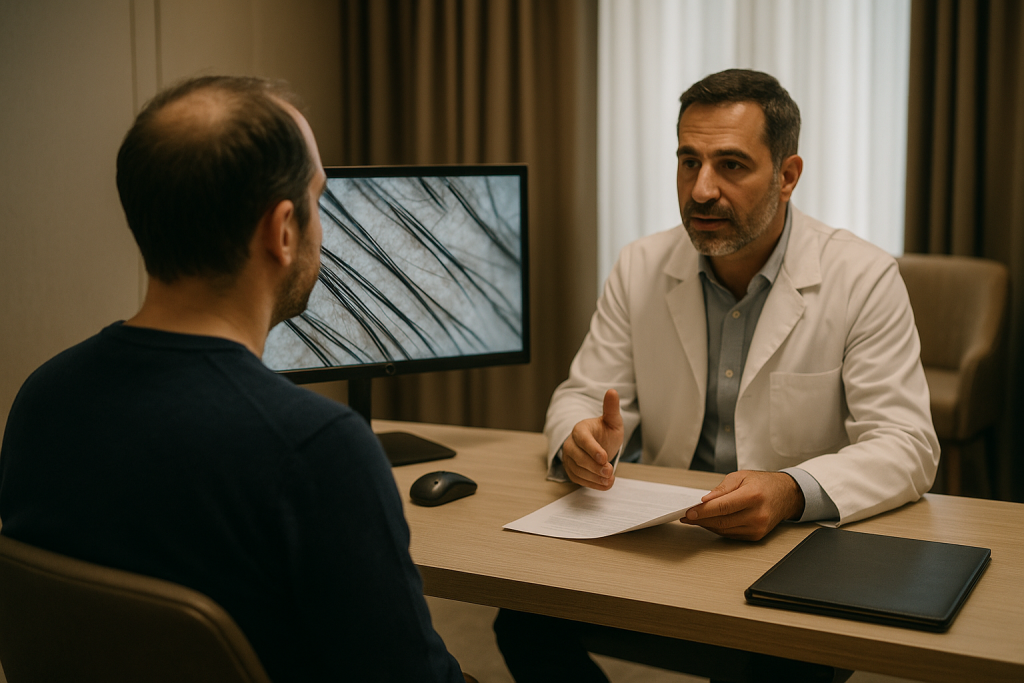
For international patients, a consultation often begins online. You may be asked to send photographs of the front, top, sides, back, and donor area of your scalp in bright natural light. These images help the medical team make an initial assessment, although they cannot replace an in-person examination. Your doctor will confirm the final plan after assessing your scalp, hair characteristics, medical history, and current hair-loss stage.
It is helpful to approach the meeting with practical goals rather than a single fixed number of grafts or a copied hairline. You may want to improve a receding hairline, add coverage to the crown, conceal a scar, or restore a more balanced overall appearance. Explain what concerns you most, how long the change has been present, and what result you consider realistic. This gives the consultation a clearer clinical focus.
02Prepare Your Hair-Loss History and Recent Photos
Before your consultation, write down when you first noticed hair thinning and whether the change was gradual or sudden. Mention if hair loss followed illness, surgery, major stress, rapid weight change, or a new medicine. Also note whether thinning affects the temples, frontal hairline, mid-scalp, crown, beard, or eyebrows. A clear timeline can help the doctor distinguish a stable long-term pattern from hair loss that may still be changing.
Family history can also be useful. If close relatives have had progressive hair thinning, share which areas were affected and at what age it became noticeable. This does not predict your result with certainty, but it can help with long-term planning. In many patients, designing a conservative, age-appropriate hairline helps preserve donor hair in case additional restoration is considered later.
Take current photographs shortly before sending them, rather than using filtered social media images or older pictures. Keep your hair dry, avoid heavy styling products, and use even lighting. Include close and wider views from several angles, especially the back and sides where donor hair is usually assessed. If you have older photographs showing how your hairline has changed, they may be useful as background information, but current images remain most important.
03Share Medical Information Clearly Before You Travel
A safe consultation depends on honest medical information. Prepare a list of diagnosed health conditions, past operations, allergies, regular medicines, vitamins, herbal supplements, and any previous scalp treatment. Tell the team about conditions that affect healing, bleeding, immune function, or skin health. This information allows the doctor to decide whether further checks are needed and whether a hair transplant is appropriate at this time.
For patients arranging a hair transplant istanbul visit from abroad, it is especially important not to stop prescribed medication without advice from the clinician who manages it. Some medicines and supplements may need to be reviewed before surgery because they can affect bleeding, anaesthesia, or recovery. The appropriate steps vary from person to person, so your doctor will give instructions based on your individual medical situation.
Mention any history of fainting, sensitivity to local anaesthesia, difficult healing, raised scars, scalp infections, or allergic reactions. If you have had a previous hair transplant, share the approximate date, method if known, and any concerns you had during recovery. Previous procedures can affect donor availability and the way a new plan is designed. Open communication helps avoid surprises on the treatment day.
04Understand Donor Area Assessment and Graft Planning
The donor area is usually the permanent-looking hair at the back and sides of the scalp. During a consultation, the doctor considers its density, hair shaft thickness, colour contrast between hair and skin, curl pattern, and the area that can be harvested conservatively. A large graft number is not automatically a better plan. Removing too many grafts from a limited donor area may create visible thinning and reduce options for the future.
You may hear estimates expressed in grafts rather than hairs. One graft can contain one or more hair follicles, so graft numbers alone do not fully describe expected coverage. The position of the hairline, scalp size, existing hair, and the priority area all influence how grafts may be distributed. Your doctor should explain whether the main aim is density at the front, coverage through the middle, improvement of the crown, or a staged approach.
At Acibadem Hair Transplant Center, both Sapphire FUE and DHI techniques are available. These methods may be considered according to the treatment plan, scalp characteristics, and area being restored; no single technique is best for every patient. The consultation is the time to ask why a particular approach is being suggested and what its practical implications may be. The final technique should be selected on clinical suitability rather than marketing language.

05Set Realistic Expectations for Hairline and Density
Bring examples of styles you like, but use them as a conversation starter rather than a fixed template. A hairline should usually suit your facial proportions, age, pattern of hair loss, and likely future needs. A very low or very dense hairline can use a substantial number of grafts. In some patients, a more conservative design may provide a natural appearance while protecting donor resources for areas that may need attention later.
Hair transplantation redistributes existing follicles; it does not create an unlimited supply of new hair. The native hair around transplanted areas may continue to thin over time, particularly when hair loss is still active. Your doctor may therefore discuss whether medical evaluation, monitoring, or a staged restoration strategy should be considered. These discussions are intended to support a balanced plan, not to discourage you from asking for improvement.
Ask to see how the proposed hairline and coverage plan would be mapped on your scalp. You should understand which areas are being prioritised and which areas may remain less dense. It is also reasonable to ask about expected visibility during early recovery, normal shedding of transplanted hairs, and the broad timeline for growth. Individual growth patterns vary, and a clinic should avoid presenting a single outcome as certain for every patient.
06Ask Specific Questions About the Procedure Day
A useful consultation includes a clear outline of the procedure day. Ask who will carry out the medical assessment, donor extraction, channel opening or implantation stages, and postoperative checks. You should also ask how long the procedure may take, how breaks are managed, and what kind of local anaesthesia is planned. Written answers or a documented treatment plan can make it easier to compare information later.
If anxiety around injections is a concern, ask whether needle-free anaesthesia is available and whether it is appropriate for your situation. At Acibadem Hair Transplant Center, needle-free anaesthesia is available as an option. However, the doctor will confirm whether it can be used and explain the anaesthesia process before treatment. Do not assume that an option advertised online is automatically suitable for every medical history.
Ask what you need to do in the days before the procedure, including guidance about alcohol, smoking, scalp products, exercise, and medication review. Follow only the instructions provided by the clinic and your own treating clinician where relevant. You should also understand what to wear on the day, usually choosing clothing that does not need to be pulled tightly over the scalp after the procedure. Clear preparation can make the day more comfortable and organised.
07Check Safety Standards for Hair Transplant Istanbul Care
When choosing hair transplant istanbul care, safety should be assessed before convenience, social media images, or a low advertised package price. Check that the clinic is licensed, that doctors are involved in the medical evaluation and planning, and that the team can explain its infection-control and emergency procedures. A transparent provider should welcome appropriate questions and give you time to review the information before committing.
Acibadem Hair Transplant Center is a dedicated hair restoration clinic in Istanbul licensed by the Turkish Ministry of Health. The center has welcomed patients from 38 countries over 12 years. These facts can be reassuring, but they do not replace your own consultation or the need to discuss personal medical suitability. Every procedure has potential risks, including swelling, bleeding, infection, numbness, scarring, shock loss, or an unsatisfactory cosmetic result.
Ask how results are assessed and how aftercare concerns are managed. At Acibadem Hair Transplant Center, results are measured by trichoscopic graft survival at month 12, with a documented 98% rate under a written guarantee. Ask for the written terms and make sure you understand what is measured, what follow-up is included, and any conditions that apply. A clear explanation of documentation is more meaningful than a vague promise of success.

08Plan Travel, Recovery, and Your First Days in Istanbul
International patients should avoid booking a very tight travel schedule around surgery. You may need time to rest, attend checks, receive washing instructions, and travel home comfortably. Ask when you can fly, whether you should avoid carrying heavy luggage, and how long you should remain in Istanbul. The answer can depend on the procedure plan and your general health, so confirm the timetable with the clinic before finalising flights.
All-inclusive packages at Acibadem Hair Transplant Center include VIP transfer, a 4-star hotel, a care kit, and 12 months of follow-up. Even when travel services are arranged, review exactly what is included and ask what you need to bring yourself. Keep your passport, medicines, contact numbers, booking documents, and comfortable front-opening clothing easy to reach during your journey.
Plan for a quiet recovery period after you return home. You may need to protect the recipient area, sleep in a recommended position, follow washing guidance, and temporarily limit strenuous activities. Scabbing, redness, swelling, and temporary shedding can occur as part of recovery, but your clinic should explain which changes are expected and which symptoms require prompt contact. Save all aftercare instructions in a format you can access while travelling.
09Use the Consultation to Decide Without Pressure
A consultation should help you decide whether to proceed, postpone treatment, or explore another approach. Take notes during the discussion and ask for a written summary of the recommended technique, estimated graft range, preparation steps, recovery guidance, and costs. If a recommendation is unclear, ask for it to be explained in simple terms. You should feel able to consider the information without being rushed by limited-time messages or unrealistic claims.
For an initial review, Acibadem Hair Transplant Center offers a free online hair analysis reviewed by doctors, with WhatsApp replies typically within around two hours. This can be a convenient way to send photographs and ask early questions before travelling. The online review is an initial assessment only, and the doctor will confirm the treatment plan after the necessary clinical evaluation.
Before making a final decision, check that the proposed plan fits your medical circumstances, available recovery time, financial understanding, and long-term expectations. Compare the quality of the consultation, not only the headline graft number. A clinic that explains uncertainty, protects the donor area, and provides structured follow-up is helping you make a more informed choice. Careful preparation is one of the strongest foundations for a positive treatment experience.
10Frequently Asked Questions
What should I expect to pay for 5,000 hair grafts in Turkey?
The cost of 5,000 grafts in Turkey can vary widely according to the clinic’s licensing, medical team, technique, donor assessment, included services, and follow-up plan. A high graft number is not suitable for every patient, so a responsible clinic should assess your donor area before confirming a plan or quote. Ask for a written breakdown of what is included and any conditions connected to the treatment package.
Are hair transplants in Turkey generally of good quality?
Turkey has many clinics serving international hair restoration patients, but quality is not the same at every provider. A good experience depends on medical assessment, appropriate technique selection, donor-area protection, hygiene standards, transparent communication, and structured aftercare. Check licensing and ask clear questions about who performs each part of the procedure.
Is Istanbul a suitable city for a hair transplant?
Istanbul can be a practical location for international patients because it has established medical tourism services and travel connections. However, the city itself does not determine the quality or safety of a procedure. Focus on the specific clinic’s licensing, medical process, communication, and follow-up arrangements before making a decision.
Is it safe to have a hair transplant in Turkey?
Hair transplantation can involve risks wherever it is performed, including infection, bleeding, swelling, scarring, temporary shock loss, and an unsatisfactory aesthetic outcome. Safety depends on your individual health, appropriate medical screening, a licensed clinical setting, trained professionals, and careful aftercare. Your doctor should confirm whether treatment is suitable for you and explain the relevant risks before you proceed.
Cet article est fourni à titre d’information générale uniquement et ne remplace pas un avis médical professionnel.
 06
06 12
12