Dans cet article9
- Vue d’ensemble
- Why frontal hairlines need a different design approach
- How a natural hairline transplant uses angles and direction
- Density transitions: soft at the edge, stronger behind it
- Age, ongoing hair loss and protecting the donor area
- Choosing graft placement techniques for the frontal zone
- From online assessment to the first year of growth
- Long-term styling, follow-up and realistic expectations
- Frequently Asked Questions
A natural hairline transplant depends on more than placing grafts at the front of the scalp. It typically requires careful planning of the hairline shape, single-hair graft placement, changing angles and density transitions, while protecting donor hair for possible future needs. Your doctor should assess your pattern of hair loss, donor capacity and long-term goals before recommending a plan.
- Natural-looking hairlines usually use irregular softness, fine single hairs and gradual density changes rather than a hard straight line.
- Graft angle and direction must change across the frontal hairline, temple points and corners to reflect normal hair growth.
- A stable long-term plan considers continuing hair loss and protects donor grafts for future treatment where appropriate.
- Age alone does not decide transplant suitability; the pattern, cause and progression of hair loss require medical assessment.
- Sapphire FUE and DHI are graft placement approaches that may be selected according to the individual treatment plan.
01Natural Hairline Transplants: Angles, Density, and Long-Term Planning
A natural hairline transplant is designed to restore the frontal frame of the face while avoiding an overly straight, dense or artificial-looking result. The goal is not simply to lower a hairline or fill an empty area. It is to create a hair-growth pattern that can look balanced from close range, in bright light and as the surrounding native hair changes over time. This requires clinical planning before any graft is removed or implanted.
The frontal hairline is one of the most visible areas in hair restoration. Even a small change in its position, shape, direction or density can affect how the result is perceived. For this reason, surgeons generally consider facial proportions, the original hairline where it can be identified, age, family pattern of hair loss, scalp characteristics and the quality of available donor hair. A hairline that appears suitable today may not be the safest choice if future thinning is likely.
Modern planning also recognises that a natural hairline is not a single uniform line. It includes a soft leading edge, subtle asymmetry, irregular groupings of hairs and a gradual build-up in fullness behind it. These details are often more important than trying to achieve the lowest possible hairline. During a medical consultation, the proposed design should be discussed as part of an overall restoration strategy, not as an isolated cosmetic feature.
02Why frontal hairlines need a different design approach
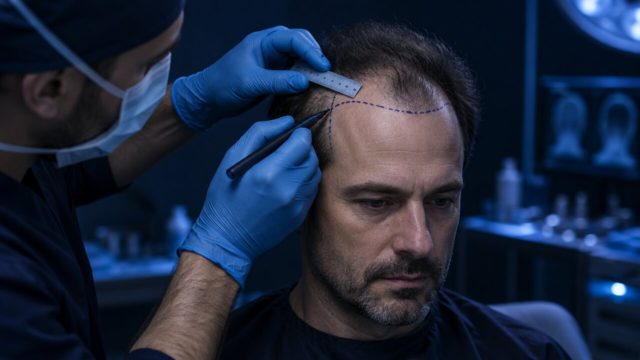
Natural frontal hair does not grow in a ruler-straight border. In most people, the first few millimetres contain scattered finer hairs, with small variations in height and spacing. This softer transition is sometimes called the micro-irregularity of the hairline. A carefully designed transplant may reproduce this effect by placing selected fine single-hair follicular units at the leading edge, rather than using the same type of graft throughout the entire frontal zone.
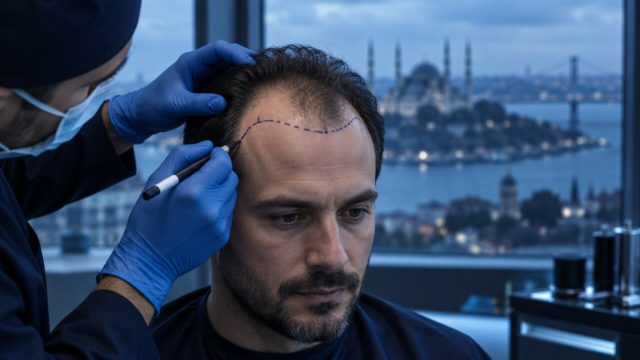
The hairline also needs to fit the individual face. A design that is too low can create pressure on the donor supply and may look less age-appropriate later in life. A design that is too high may not address the person’s main concern. Doctors typically assess forehead size, facial width, the position of the temples, existing recession and the expected pattern of future hair loss before drawing a proposed line. Symmetry is considered, but complete mirror-image symmetry is not usually the aim because natural hairlines are rarely identical on both sides.
Temple corners and temporal points deserve particular care. These areas help connect the front of the scalp to the side profile, but they often contain very fine hairs growing at a distinct angle. Rebuilding them without considering hair calibre, direction and future loss can make the result appear disconnected. In suitable patients, the doctor may include these areas in the plan, reduce their priority or preserve grafts for more important frontal coverage.
03How a natural hairline transplant uses angles and direction
Hair grafts at the front of the scalp should usually be placed at a very acute angle, meaning they lie close to the skin rather than pointing upward. This helps transplanted hair follow the flatter, forward-growing appearance of a typical frontal hairline. If grafts are placed too upright, the hair may be more difficult to style and can look visibly different from the surrounding native growth. The precise angle depends on the location, scalp contour and existing hair direction.
Direction is just as important as angle. In the central frontal area, hairs commonly move forward with a slight variation to either side. Moving toward the corners, their direction often changes gradually, sometimes sweeping outward or backward in line with the person’s natural pattern. A clinician studies the remaining hairs, photographs and scalp anatomy to map these changes. Where little original hair remains, planning is based on recognised anatomical patterns and the individual’s facial structure.
Creating a natural hairline transplant also involves avoiding a repeated, planted appearance. Grafts are not typically arranged in obvious rows at the leading edge. Instead, placement can be staggered with controlled irregularity, while preserving a coherent overall shape. This is a technical process that requires careful handling of grafts and precise site creation. The final visual effect develops gradually as transplanted hairs grow and mature, rather than immediately after the procedure.
04Density transitions: soft at the edge, stronger behind it
Density is not the same across a natural scalp. The first line of hairs is usually lighter and more transparent than the area behind it. A well-planned frontal restoration often follows this pattern by creating a feathered transition zone. Fine single-hair grafts can be reserved for the very front, while grafts containing more than one hair may be placed behind that zone when appropriate. This approach can provide visual fullness without making the edge look abrupt.
Hair calibre also matters. Donor areas may contain hairs of different thicknesses, and finer hairs can be especially useful for a soft hairline when they are available and clinically suitable. However, graft selection is only one part of the plan. The recipient area, skin contrast, natural hair density and curl or wave pattern can all influence how much coverage is needed for an even appearance. A doctor will explain what level of density is realistically achievable from the available donor supply.
A natural hairline transplant should be planned with the mid-scalp in mind. A dense front placed ahead of a thinning mid-scalp may not look balanced in the future. In many patients, the strongest visual result comes from a measured distribution of grafts across priority areas, rather than concentrating every available graft at the very front. This is why graft numbers should be discussed after a proper assessment instead of being treated as a fixed solution for every hairline.
05Age, ongoing hair loss and protecting the donor area
Hair loss can continue after a transplant, particularly when androgenetic hair loss is active. This is a key issue for younger adults and for anyone whose pattern has changed recently. Transplanted follicles are generally selected from areas that are more resistant to pattern hair loss, but the native hairs around them may still thin over time. A responsible plan therefore considers how the scalp may look if recession or crown thinning progresses.
Being in the early twenties does not automatically rule out treatment, but it does require particular caution. At this age, the final pattern of hair loss may not yet be clear, and a low aggressive hairline may use grafts that could be valuable later. Your doctor may assess the pace of loss, family history, miniaturisation seen on scalp examination, donor density and medical background. In some cases, monitoring the pattern or discussing non-surgical medical options with an appropriate doctor may be part of the wider conversation.
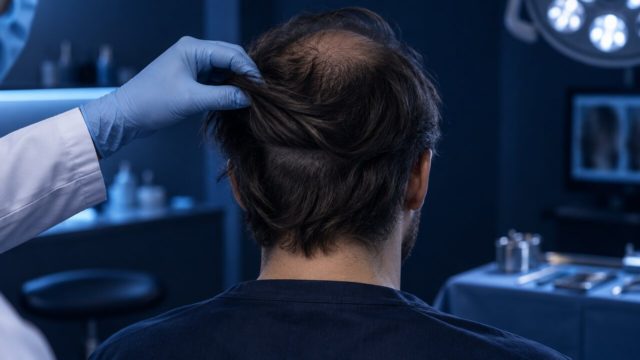
Donor management is central to long-term planning. The donor area has a limited number of grafts that can be harvested safely while maintaining an acceptable appearance. Taking too many grafts or allocating them without considering future needs can reduce flexibility later. A treatment plan should set realistic priorities, whether the main concern is the frontal hairline, frontal density, mid-scalp coverage, crown coverage or a combination of these areas.
06Choosing graft placement techniques for the frontal zone
Sapphire FUE and DHI are two techniques that may be considered for hair restoration, including frontal work. With Sapphire FUE, follicular units are extracted individually and recipient sites are created before graft placement. With DHI, grafts are commonly implanted using a specialised implanter approach. Neither name alone guarantees a natural result; the quality of design, graft handling, angle control and clinical decision-making remains essential.
The best approach depends on factors such as the planned area, hair characteristics, scalp condition, number of grafts needed and the doctor’s assessment. Some treatment plans may be particularly focused on detailed recipient-site direction, while others may involve broader coverage requirements. During consultation, patients can ask how the proposed technique supports the intended hairline design, density transition and protection of existing native hair.
At Acibadem Hair Transplant Center in Istanbul, Sapphire FUE and DHI techniques are available as part of doctor-reviewed treatment planning. The clinic is licensed by the Turkish Ministry of Health and offers needle-free anaesthesia where appropriate. Technique selection should be based on clinical suitability rather than a trend or a promise of a particular result. Your medical team will confirm which approach is suitable after reviewing your case.
07From online assessment to the first year of growth
A clear consultation process can help prevent misunderstandings about hairline position, graft allocation and expected development. A free online hair analysis can be reviewed by doctors before travel planning, using suitable photographs and relevant medical information. At Acibadem Hair Transplant Center, replies on WhatsApp are typically provided within around two hours. An online review is useful for initial guidance, but the final clinical assessment and hairline confirmation take place through the appropriate medical process.
On the procedure day, the planned hairline is reviewed before treatment begins. The team may reassess the design in relation to facial movement, existing hair and the donor area. Following implantation, tiny scabs and temporary redness are common parts of early healing. The clinic’s care instructions should be followed carefully, especially regarding washing, sleeping position, physical activity, sun exposure and avoiding friction in the recipient area. Individual recovery times can vary.
New transplanted hairs do not usually provide their final appearance immediately. Early shedding of implanted shafts can occur, followed by a period when visible growth is limited. New growth commonly develops progressively over subsequent months, with maturation continuing through the first year. At Acibadem Hair Transplant Center, results are measured by trichoscopic graft survival at month 12, with a documented 98% rate under a written guarantee. This measurement relates to documented graft survival, while cosmetic density and appearance can still vary between individuals.
08Long-term styling, follow-up and realistic expectations
Once new growth has matured, styling can help show the direction and texture of the restored hairline. Many patients prefer a hairstyle that works with their natural growth pattern rather than against it. A softer hairline often allows flexibility, but the final styling options depend on hair shaft thickness, curl, density, existing hair and the extent of restoration. Your team can provide aftercare guidance, but individual concerns should be discussed directly with the treating medical professionals.
Follow-up matters because hair restoration is a long-term process rather than a single visual event. Photographs, scalp checks and discussion of any change in native hair can help the patient and medical team evaluate progress. Acibadem Hair Transplant Center includes 12 months of follow-up in its all-inclusive packages, alongside VIP transfer, a 4-star hotel and a care kit. These practical arrangements do not replace the importance of medical follow-up and clear communication about healing.
The most sustainable outcome is usually based on realistic expectations. A transplant can redistribute available donor hair; it does not create an unlimited supply of new follicles or permanently stop all forms of future hair loss. For this reason, careful hairline design, conservative use of donor grafts and ongoing review are often more valuable than pursuing an extremely low or unusually dense frontal line. A qualified doctor can help explain the benefits and limitations for your own pattern of loss.
09Frequently Asked Questions
Is age 23 too early for a hair transplant?
Age 23 is not automatically too early, but many younger patients need especially careful assessment. Hair loss may still be progressing, and the long-term pattern may not yet be clear. A doctor should evaluate donor capacity, family history, scalp findings and the stability of hair loss before discussing whether transplantation is appropriate.
What is the cost of 3,000 hair grafts?
The cost of 3,000 grafts can vary according to the clinical plan, technique, donor requirements, travel arrangements and aftercare included. A graft number alone does not show whether that number is medically appropriate or how it should be distributed. Acibadem Hair Transplant Center offers all-inclusive packages, and a tailored quotation can be provided after doctor review of the case.
How can I regrow my frontal hairline?
The right approach depends on why the frontal hairline has changed, whether hair follicles are still active and whether hair loss is ongoing. A doctor may discuss diagnosis, evidence-based medical management where clinically appropriate, or hair transplantation for suitable candidates. A transplant redistributes donor follicles and should be planned around future hair loss, not only the current frontal appearance.
What did Elon Musk use to regrow his hair?
There is no confirmed medical information that should be used to state which treatment any public figure has received. Changes in a person’s appearance can have many explanations, and photographs alone cannot confirm a procedure or medication. It is safer to focus on a doctor-led assessment of your own hair loss pattern and suitable options.
Cet article est fourni à titre d’information générale uniquement et ne remplace pas un avis médical professionnel.
Ce guide est fourni à titre d’information générale et ne remplace pas une consultation médicale. Les décisions de traitement sont prises après une évaluation par un médecin, en personne ou en ligne.