Dans cet article9
- Vue d’ensemble
- How FUE Donor Marks Form and Why They May Be Visible
- Who May Be Suitable for Donor Scar Camouflage
- Planning Fue Hair Transplant Scar Repair Safely
- How Grafts Are Placed Into Scarred Donor Skin
- Alternatives and Combined Approaches for Visible Donor Areas
- Recovery, Growth Timeline, and Result Assessment
- Protecting the Donor Area for the Long Term
- Frequently Asked Questions
Fue hair transplant scar repair may reduce the visibility of selected donor scars by placing carefully chosen grafts into or around the affected area. It cannot usually erase a scar completely, but it may improve coverage, colour contrast, and the overall appearance when donor supply and scalp health allow.
- FUE commonly leaves many tiny dot-like scars, although they are often difficult to notice when hair is kept at a moderate length.
- Scar repair may involve transplanting grafts into a wider or lighter donor area to improve visual camouflage.
- A doctor should assess donor density, scar type, scalp condition, and the remaining graft reserve before recommending treatment.
- Results develop gradually because transplanted hairs need time to grow, mature, and blend with surrounding hair.
- Long-term hair planning matters because future thinning and further procedures can affect the donor area over time.
01Repairing Fue Donor Scars With Hair Transplant Techniques
Fue hair transplant scar repair is a specialised camouflage approach that uses carefully selected hair grafts to make visible donor marks less noticeable. It is most often considered when a person has had follicular unit extraction, or FUE, and remains concerned about pale dots, uneven density, or a patchy look after wearing the hair very short. The aim is not to promise scar removal. Instead, the clinical goal is usually to soften the contrast between the scarred skin and nearby hair so the donor area looks more even in normal daily settings.
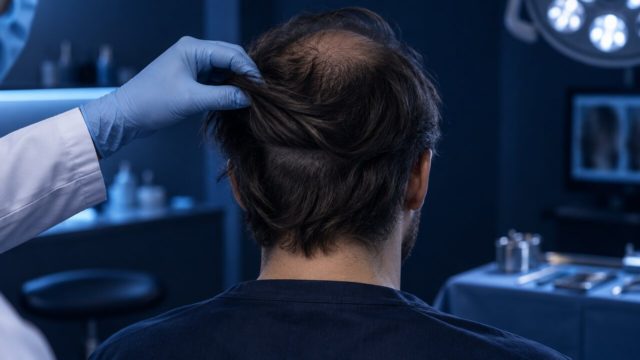
FUE removes individual follicular units through very small circular openings, usually from the back and sides of the scalp. Each extraction site heals with a small mark. In many patients these marks are discreet, particularly once surrounding hair grows through. However, visibility can be greater when the donor hair is cut very close, when the skin is fair or easily pigmented, when extractions were widely spaced, or when healing was less predictable. A detailed examination is needed because not every visible donor concern is a true scar.
Hair transplantation can be one part of a broader scar-management plan, but the best option depends on the cause and appearance of the concern. Some people mainly need time for recent healing. Others may benefit from letting the donor hair grow slightly longer, adjusting grooming habits, or discussing medical or dermatological scar care with an appropriate clinician. When grafting is suitable, planning must protect the remaining donor area while creating natural-looking coverage rather than simply placing as many grafts as possible.
02How FUE Donor Marks Form and Why They May Be Visible
After an FUE procedure, the tiny extraction sites normally close and heal as small circular marks. Although the instruments used are fine, the skin cannot return to exactly the same condition as before every follicle was removed. This is why FUE is often described as a minimally invasive technique rather than a scar-free technique. The final appearance is influenced by skin healing, extraction pattern, the number of grafts taken, hair calibre, curl, natural density, and how short the patient prefers to wear the donor hair.
Some donor areas appear more visible because of contrast. A lighter scar can stand out against darker hair or darker skin, while a darker healed mark may be more noticeable on lighter skin. Reduced density is another issue. If too many grafts were removed from one zone, the area can look thin even when the individual dots are difficult to identify. In these cases, a repair plan may focus on restoring a more balanced density rather than treating every single extraction point.
Healing concerns should be assessed carefully before any repair is discussed. Persistent redness, discomfort, raised areas, scaling, discharge, or active inflammation may need medical evaluation first. A surgeon may also examine whether there are signs of a scalp condition that affects healing or hair growth. Transplanting into unhealthy or unstable skin can reduce the chance of satisfactory growth, so a conservative, step-by-step approach is typically safer than rushing into another procedure.
03Who May Be Suitable for Donor Scar Camouflage
Suitable candidates commonly have a stable, fully healed donor area and enough remaining donor hair to support a conservative repair procedure. The doctor will assess the width or distribution of the visible area, the quality of the hairs around it, and whether extraction can be performed without making the surrounding density look weaker. Hair with a thicker shaft, wave, or curl may give stronger visual coverage than very fine straight hair, but every scalp should be assessed individually.
Timing matters. Fresh scars can change in colour, texture, and visibility as they mature, so doctors often prefer to review a donor concern after an appropriate healing period rather than making an early decision. A person who is also continuing to lose hair on the top of the scalp may need a wider long-term plan. Using too much of the limited donor reserve on a small cosmetic concern could leave fewer options for future restoration where it is more needed.
Not everyone is an ideal candidate for additional graft extraction. Very low donor density, widespread overharvesting, extensive scarring, active scalp disease, or a history of unusual scarring may change the recommendation. Expectations are equally important. A repair procedure may make a scar less obvious, especially at a chosen hair length, but it may still be visible under close inspection, bright lighting, wet hair, or a shaved hairstyle. Your doctor will confirm what is realistically achievable after examining the area.
04Planning Fue Hair Transplant Scar Repair Safely
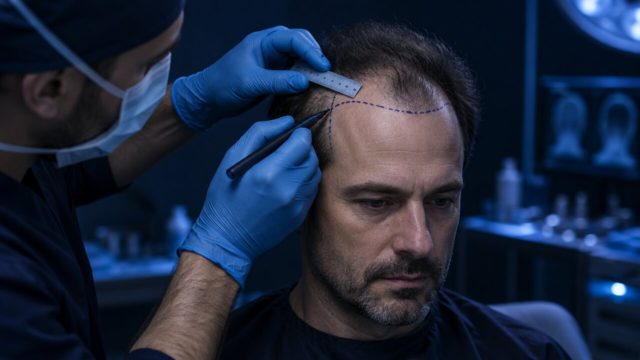
Planning fue hair transplant scar repair starts with mapping both the visible donor concern and the remaining safe donor reserve. The team considers where the scars are located, whether the issue is dot scarring or diffuse thinning, and how the hair naturally grows in that area. Photos in different lighting and hair lengths can be useful because a donor area that appears acceptable indoors may look different under direct sunlight. The treatment plan should be designed around the patient’s current appearance and likely future needs.
Grafts for repair are usually selected conservatively. Fine single-hair grafts can be useful for delicate scar edges, while slightly fuller follicular units may help create blending where density is reduced. The placement angle is important because donor hairs lie close to the scalp and follow changing directions around the occipital and temporal regions. If transplanted hairs grow at an unnatural angle, the repair may be less convincing even if the grafts survive well.
A qualified clinic should explain that donor management is a limited resource decision. More grafts do not automatically mean a better cosmetic result. Placing too many grafts into scar tissue may create competition for blood supply, while taking too many new grafts from nearby hair can widen the appearance of thinning. At Acibadem Hair Transplant Center in Istanbul, doctor-reviewed planning is available through a free online hair analysis, helping international patients understand whether an in-person assessment may be appropriate.
05How Grafts Are Placed Into Scarred Donor Skin
Scarred skin may behave differently from unscarred scalp. Its thickness, firmness, and blood supply can vary, especially if the area is raised, depressed, or has changed colour after healing. For this reason, the surgeon typically creates recipient sites with particular care and may use a lower density than would be considered in healthy scalp skin. The intention is to support graft healing while still creating enough hair coverage to improve the visual blend.
The procedure can use FUE-based graft harvesting, and in selected situations the method is chosen according to the available donor area rather than the scar alone. Sapphire FUE and DHI are hair restoration techniques offered at Acibadem Hair Transplant Center, but the most suitable method depends on the clinical findings and surgical plan. Needle-free anaesthesia is also available for appropriate patients. Your medical team will explain the practical steps, limits, and aftercare requirements before treatment.
Hair shafts create camouflage in several ways. They break up the smooth appearance of a scar, reduce contrast with the surrounding scalp, and add texture over a low-density zone. Growth direction and spacing are therefore as important as graft number. A natural donor-area result should look balanced rather than sharply packed. Even with meticulous placement, scar tissue can have less predictable graft growth than healthy skin, which is why results are normally discussed in cautious terms.
06Alternatives and Combined Approaches for Visible Donor Areas
Hair grafting is not the only possible way to address a visible donor area. Some people prefer to maintain a slightly longer haircut that covers small FUE marks effectively. Others may ask a dermatologist about scar-focused treatments when texture, pigment, or irritation is the main concern. These approaches are not interchangeable, and their suitability depends on the scar type. A clinical evaluation can help distinguish between a density issue, a colour issue, and a texture issue before choosing a path.
Scalp micropigmentation may be considered as a camouflage option for selected patients, particularly when the concern is colour contrast between small pale dots and surrounding scalp. It uses pigment to reduce the visual difference, rather than growing real hair through the area. It may be used alone or alongside transplantation in carefully selected cases. Patients should understand that pigment appearance can change over time and that it does not restore donor hair reserve or correct all scar textures.
A combined plan can sometimes offer a more balanced result than one method alone. For example, conservative graft placement may provide texture while another professionally guided approach addresses colour contrast. However, every additional procedure should be timed correctly, especially if the scalp is still healing. The safest plan is usually one that begins with a clear diagnosis, protects the remaining donor supply, and avoids treatments that could interfere with future surgical options.
07Recovery, Growth Timeline, and Result Assessment
Following scar camouflage transplantation, the recipient area generally needs gentle care while the grafts settle. Temporary crusting, mild redness, and short-term sensitivity can occur, and the care team will provide specific washing and activity guidance. Patients should not pick crusts or expose the area to avoidable friction during early healing. Individual recovery differs, particularly in previously scarred skin, so it is important to follow the instructions provided by the treating clinic rather than comparing progress with someone else.
Transplanted hairs often shed during the early phase before new growth begins. This can be worrying, but it is a commonly expected part of the hair growth cycle after transplantation. New growth generally develops gradually over several months, and the hairs may initially appear fine before gaining more calibre. A more meaningful cosmetic assessment is usually made later, once growth has matured and blended with the donor area. Scar repair should be judged under realistic conditions, including the hair length the patient plans to maintain.
At Acibadem Hair Transplant Center, results are measured by trichoscopic graft survival at month 12, with a documented 98% rate under written guarantee. This measurement relates to documented graft survival and should not be understood as a guarantee that every scar will become invisible or that every individual will have the same cosmetic outcome. The clinic’s all-inclusive packages include a care kit and 12 months of follow-up, which can support communication during the recovery process.
08Protecting the Donor Area for the Long Term
Long-term donor-area appearance depends on more than the repair procedure itself. Continued hair thinning, very short hairstyles, sun exposure, scalp inflammation, and future harvesting can all influence how visible old extraction marks become. Patients considering further transplantation should ask how the next procedure may affect donor density and whether the reserve should be kept for the frontal scalp, crown, or other areas that could thin later. A responsible plan considers the whole scalp, not only the current scar.
Ten years after a transplant, transplanted follicles that have grown successfully can often continue producing hair because they retain many of their donor-area characteristics. However, native non-transplanted hair may continue to thin over time, which can alter the balance between transplanted and existing hair. Some people may eventually consider medical management, styling changes, or an additional procedure if their donor reserve permits. Regular review is helpful when hair loss patterns or scalp health change.
Acibadem Hair Transplant Center is a dedicated hair restoration clinic in Istanbul licensed by the Turkish Ministry of Health. The clinic has welcomed patients from 38 countries over 12 years. International patients can begin with a free online hair analysis reviewed by doctors, with WhatsApp replies typically available within around two hours. An online review cannot replace an in-person examination, but it can help clarify the next appropriate questions about donor scars, graft availability, and realistic treatment options.
09Frequently Asked Questions
Can FUE scars be removed completely?
FUE scars cannot usually be removed completely because each extraction site heals with a small permanent change in the skin. However, their visibility may often be reduced through suitable hair length, graft-based camouflage, or other professionally assessed options. The best approach depends on scar type, skin characteristics, and remaining donor hair.
Did Elon Musk have an FUE hair transplant?
There is no confirmed public medical information that can establish which hair restoration procedure Elon Musk may or may not have had. It is not appropriate to diagnose or identify a treatment from photographs alone. Hairline changes can have several explanations, and only the individual and their treating medical team could confirm a procedure.
Does FUE leave permanent scars?
Yes, FUE leaves tiny permanent extraction scars because follicles are removed from the donor area. In many patients, these dot-like scars are difficult to notice once the hair has grown, especially when the hair is not shaved very short. Their visibility varies with healing, skin tone, hair density, extraction technique, and hairstyle.
What can happen 10 years after a hair transplant?
Successfully transplanted hair may continue to grow for many years, but the surrounding native hair can still thin as hair loss progresses. This may change the overall density or hairline balance and, in some cases, lead a patient to discuss further treatment. Long-term planning and careful use of the donor area are important from the first procedure.
Cet article est fourni à titre d’information générale uniquement et ne remplace pas un avis médical professionnel.
Ce guide est fourni à titre d’information générale et ne remplace pas une consultation médicale. Les décisions de traitement sont prises après une évaluation par un médecin, en personne ou en ligne.