In questo articolo9
- How a big head hair transplant plan is created
- Why scalp surface area matters for graft coverage
- Donor area: the main limit on graft numbers
- Big forehead, hairline shape and facial balance
- How doctors calculate a realistic graft range
- Technique choice and safe graft placement
- Planning for future hair loss, not just today’s appearance
- What to expect from an online assessment and consultation
- Frequently Asked Questions
Head size can affect how widely grafts need to be distributed, but it does not alone determine whether a hair transplant is suitable. In a big head hair transplant plan, doctors assess the scalp area, donor supply, hair thickness, curl, colour contrast and future hair-loss pattern before recommending a graft range.
- A larger scalp area may require more grafts to create comparable visual coverage, especially in the frontal and crown areas.
- Donor capacity, hair calibre and the degree of hair loss are usually more important than head circumference alone.
- A conservative, age-appropriate hairline can help use available grafts efficiently and support a natural appearance over time.
- Graft planning should consider possible future hair loss rather than focusing only on the current bald area.
- A doctor-led assessment with scalp examination and hair analysis is needed before a reliable graft estimate can be given.
01How a big head hair transplant plan is created
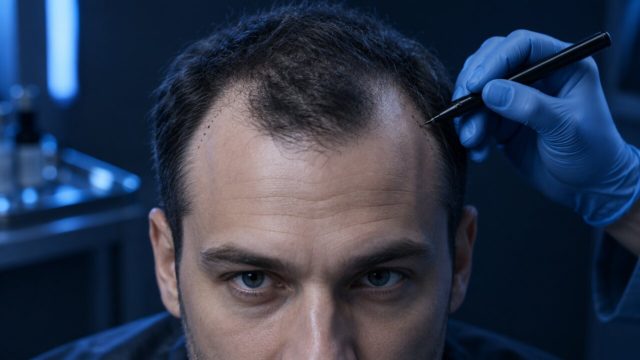
A big head hair transplant does not follow one fixed graft number. A wider scalp can mean that the same number of follicles covers a larger surface area, so the visual density may look different from that of a person with a smaller scalp. However, head size is only one planning detail. The clinical team first looks at where thinning is present, how much native hair remains, and whether hair loss is likely to progress.
Grafts are not simply spread evenly across every visible area. In most patients, the hairline and frontal third of the scalp receive particular attention because they frame the face and are usually seen first. The mid-scalp and crown are then planned according to the available donor supply, the patient’s priorities and the expected pattern of future loss. This approach aims to use grafts where they can provide the most natural visual benefit.
Doctors also distinguish between the size of the skull and the usable recipient area. Someone may have a broad head but only limited recession, while another person with a smaller head may have extensive thinning from the hairline to the crown. For this reason, a measurement of head circumference cannot provide a useful transplant quote or graft recommendation on its own. A proper plan needs photographs, a scalp examination and a review of the donor area.
02Why scalp surface area matters for graft coverage
Hair transplantation moves follicular units from the donor area, usually the sides and back of the scalp, to areas affected by thinning. Each graft may contain one, two, three or occasionally more hairs. The number of grafts needed is therefore related to the size of the recipient zone, but also to the number of hairs within the grafts and the density that can be placed safely.
When the bald or thinning area is wider, available grafts must cover more skin. This can make it necessary to prioritise certain zones rather than trying to create very high density everywhere in a single session. A natural-looking result is generally based on thoughtful distribution, gradual changes in density and a hairline design that does not look too low or too dense for the person’s facial proportions and age.
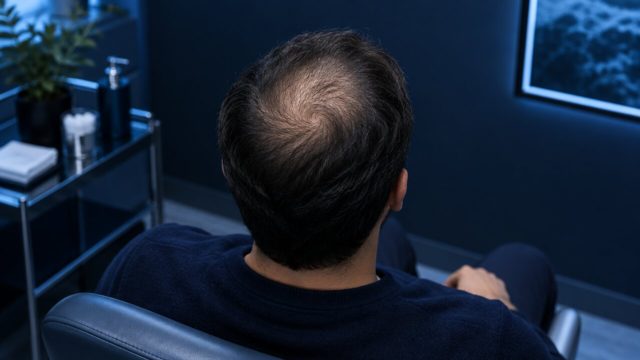
The crown deserves special consideration because its circular growth pattern can make scalp show more noticeable, particularly under direct overhead light. A large crown area may use a significant number of grafts, yet it is often less visible than the frontal area in everyday interactions. Your doctor may discuss whether it is more appropriate to treat the front first, divide treatment into stages, or reserve grafts for future needs.
03Donor area: the main limit on graft numbers
The donor area is the most important practical limit in graft planning. It must provide enough stable follicles while continuing to look natural after extraction. A larger head does not automatically mean a larger or stronger donor area. Donor density, scalp laxity, hair shaft thickness, colour contrast between hair and skin, and the stability of the donor hair all need clinical assessment.
During an evaluation, doctors examine whether donor follicles are likely to remain resistant to the hair-loss process. They may use trichoscopic assessment to look closely at hair density and hair calibre. If extraction is too aggressive, the donor zone can appear thin. For this reason, responsible planning protects the donor area instead of aiming for the highest possible graft number.
Hair characteristics can sometimes improve the appearance of coverage without increasing the graft count. Coarser hair often provides more visual volume than very fine hair. Wavy or curly hair may also cover more scalp surface than straight hair. Lower contrast between the hair and scalp can reduce the appearance of thinning. These factors help explain why two patients receiving a similar graft range can have different visible results.
04Big forehead, hairline shape and facial balance
A naturally high forehead is not, by itself, a reason to avoid hair transplantation. Many people seek treatment because they have a high hairline, temple recession or a forehead that appears larger after hair loss. The key question is whether the donor area can support a hairline restoration that is proportionate, sustainable and appropriate for the individual’s present and future hair pattern.
Lowering a hairline substantially can require a large number of grafts because the new area needs careful, fine placement. It may also create future planning challenges if existing hair continues to thin behind the transplanted hairline. Doctors usually consider facial dimensions, age, family history of hair loss and the quality of existing frontal hair before recommending a design.
In big head hair transplant planning, a broad forehead may need a different visual strategy from a narrow forehead. Rather than creating a straight, low line, the team may recommend a softly irregular and age-appropriate hairline with natural temple transitions. Single-hair grafts are often selected for the leading edge, while grafts containing more hairs can be placed behind it to build a gradual impression of density.
05How doctors calculate a realistic graft range
A graft estimate usually starts with mapping the recipient zones. The doctor considers the frontal hairline, temple points, frontal third, mid-scalp and crown separately. The size of each zone, the amount of existing hair and the desired density all influence the calculation. Existing miniaturised hair may offer some coverage, but it may not remain stable over time, so it should not always be treated as permanent density.
Next, the donor area is assessed to identify a safe extraction range. This is a medical judgement rather than a simple calculation. The plan should leave enough donor hair for a natural appearance and should account for the possibility that further hair restoration could be requested later. In patients with more advanced loss, one procedure may not be designed to restore every area at maximum density.
A big head hair transplant consultation should also include a discussion about goals. Some patients value a stronger frontal view, while others place more importance on the crown. Clear goals help doctors explain the trade-offs involved. At Acibadem Hair Transplant Center, the free online hair analysis is reviewed by doctors and can provide an initial direction, but an individual treatment plan must be confirmed after appropriate clinical assessment.
06Technique choice and safe graft placement
Sapphire FUE and DHI are established techniques that may be considered depending on the patient’s hair and scalp characteristics. In Sapphire FUE, follicles are extracted individually and recipient channels are created before graft placement. DHI uses an implanter approach for placement. Neither technique automatically creates more donor hair or removes the need for careful planning; the right option depends on the clinical findings and the desired distribution.
For a larger recipient area, the team may use a combination of precise hairline work and broader coverage behind it. Graft angle, direction and spacing are important because they influence how naturally the transplanted hair blends with existing hair. The crown requires particular attention to its natural swirl pattern, while the frontal hairline needs fine, irregular placement to avoid an artificial edge.
Comfort during the procedure is also part of patient care. Needle-free anaesthesia is available at Acibadem Hair Transplant Center for suitable patients. Your medical team will explain the anaesthesia approach, procedure steps and aftercare instructions before treatment. Suitability for any technique or anaesthesia method is always confirmed by the doctor after reviewing medical history and clinical needs.
07Planning for future hair loss, not just today’s appearance
Hair loss can continue after a transplant because transplanted follicles and non-transplanted native hairs do not behave in the same way. A successful long-term plan therefore aims to preserve flexibility. If a very low hairline is created early without enough donor reserve, later thinning behind it can make the overall pattern look less balanced.
For patients with early or changing hair loss, a doctor may recommend monitoring the pattern, discussing medical management where appropriate, or choosing a conservative transplant design. This is especially relevant for younger patients and for those with a strong family history of extensive hair loss. It is not a refusal to help; it is part of protecting the appearance of the donor and recipient areas over time.
Photos taken in consistent lighting can be useful for tracking changes before and after treatment. Following the clinic’s aftercare guidance and attending follow-up reviews can support monitoring. Acibadem Hair Transplant Center includes 12 months of follow-up in its all-inclusive packages, alongside VIP transfer, a 4-star hotel stay and a care kit. The clinical plan, however, remains individual and should never be based on package details alone.
08What to expect from an online assessment and consultation
A good first assessment asks for clear photographs of the hairline, top, crown, sides and donor area. It should also cover age, previous procedures, general medical history, medications and the history of hair loss in the family. Images help the doctor estimate the visible pattern, but they cannot replace an in-person scalp assessment where this is required.
At Acibadem Hair Transplant Center in Istanbul, patients can request a free online hair analysis reviewed by doctors, with WhatsApp replies typically available within around two hours. The clinic is licensed by the Turkish Ministry of Health and has treated patients from 38 countries over 12 years. These details can help international patients understand the service pathway, while medical suitability is still decided case by case.
Ask direct questions about the proposed graft range, which areas will be prioritised, how the donor area will be protected and what may happen if hair loss progresses. It is also reasonable to ask how results are evaluated. At the clinic, graft survival is measured trichoscopically at month 12, with a documented 98% rate under its written guarantee. Individual results can vary, and your doctor will explain what is realistic for your hair characteristics and treatment plan.
09Frequently Asked Questions
What does a 3,000-graft hair transplant cost?
The cost of a 3,000-graft procedure cannot be stated reliably without a medical assessment, because the final plan depends on donor quality, technique, the recipient areas and the services included. Prices and package details can change, so it is best to request a written quote after your photographs and medical information have been reviewed. A graft count alone should not be the only factor used to compare treatment plans.
Can a person with a large forehead have a hair transplant?
In many cases, yes. A large forehead or high hairline does not automatically prevent treatment, but the doctor must assess donor capacity, current hair loss and the likelihood of future thinning. A conservative, well-proportioned hairline is often important for a result that can remain natural as the years pass.
What did Elon Musk use to regrow his hair?
There is no verified medical information that allows us to confirm which treatment, if any, Elon Musk used. Changes seen in public photographs cannot diagnose a condition or identify a procedure. Anyone considering hair restoration should make decisions based on a personal medical assessment rather than a celebrity comparison.
What can disqualify someone from a hair transplant?
Unsuitable donor density, unstable or rapidly progressing hair loss, certain scalp diseases, active infections, uncontrolled medical conditions and unrealistic expectations may mean treatment should be delayed or may not be advised. Some medications and previous procedures can also affect suitability. Your doctor will review your medical history and scalp condition before confirming whether a transplant is appropriate.
Questo articolo ha scopo puramente informativo e non sostituisce il parere medico professionale.
Questa guida ha scopo informativo generale e non sostituisce una visita medica. Le decisioni sul trattamento vengono prese dopo una valutazione del medico, di persona o online.