
In questo articolo9
- What laser hair restoration therapy is and how it works
- Does laser hair restoration therapy work for thinning hair?
- Who may be a suitable candidate for low-level laser therapy
- When laser therapy has important limits
- What treatment sessions and results usually involve
- Safety, side effects, and practical precautions
- Laser therapy compared with medicines, PRP, and hair transplantation
- How to make an informed decision about laser hair restoration
- Frequently Asked Questions
Does laser hair restoration therapy work? Low-level laser therapy may help some people with pattern hair loss improve hair density or reduce shedding over time, particularly when it is used consistently and as part of a doctor-led plan. It does not work equally for every cause of hair loss, cannot restore follicles that are no longer active, and results are usually gradual rather than dramatic.
- Low-level laser therapy may support hair growth in some people with early to moderate pattern hair loss.
- Laser devices require regular, long-term use, and visible change commonly takes several months.
- Laser therapy is not a reliable solution for scarring alopecia, advanced baldness, or untreated medical causes of shedding.
- A medical assessment is important because the best treatment depends on the type and stage of hair loss.
- Hair transplantation may be considered when donor hair is suitable and medical or non-surgical options cannot meet the patient’s goals.
01What laser hair restoration therapy is and how it works
Does laser hair restoration therapy work? The short answer is that it may help selected patients, especially those with androgenetic alopecia, also called male-pattern or female-pattern hair loss. This treatment uses low-level light energy, often delivered through a cap, helmet, comb, or band, with the aim of supporting follicle activity. It is also known as low-level laser therapy, low-level light therapy, or photobiomodulation.
The light used in these devices is not designed to burn, cut, or remove hair. Instead, it reaches the scalp at a low intensity. Researchers believe it may influence cellular activity around the hair follicle, including energy production and signalling processes involved in the hair cycle. Better local blood flow and reduced inflammatory signalling have also been proposed, although the full biological mechanism is still being studied.
Hair follicles move through growing, resting, and shedding stages. In pattern hair loss, genetically sensitive follicles gradually become smaller and produce finer, shorter hairs. Laser therapy is intended to encourage weakened but still living follicles to remain in the growth phase for longer. It cannot create new follicles, and it is unlikely to bring back hair in an area where follicles have been inactive for many years.
02Does laser hair restoration therapy work for thinning hair?
Clinical research suggests that low-level laser therapy can produce a modest improvement in hair count, hair thickness, or patient-reported hair appearance in some people with pattern hair loss. The quality of studies, devices, treatment schedules, and patient groups varies. For this reason, the evidence supports laser therapy as a possible supportive option, rather than a universal or guaranteed answer to thinning hair.
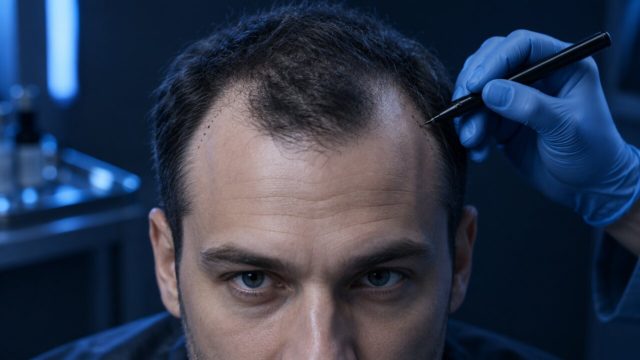
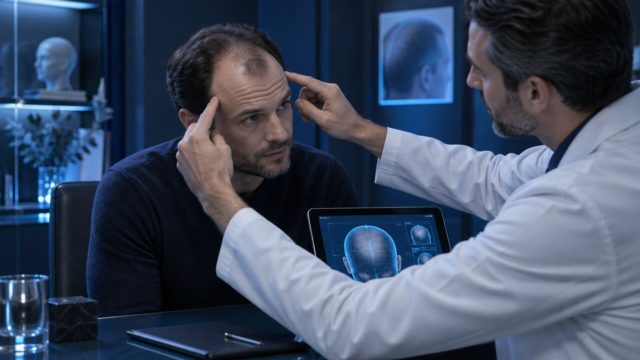
People with early thinning commonly have a better chance of noticing benefit than people with extensive bald areas. A follicle needs to be present and capable of responding. If the scalp is smooth and shiny with long-standing hair loss, a laser device is less likely to make a meaningful cosmetic difference. Your doctor can examine the scalp and use trichoscopy to help assess whether miniaturised hairs are still present.
When patients ask does laser hair restoration therapy work, it is also important to define what “work” means. For one person, reduced shedding or less visible scalp may be a useful result. Another person may hope to restore a receding hairline or a large bald crown, which laser treatment alone is less likely to achieve. Clear expectations help patients decide whether the time and cost of ongoing treatment are reasonable for them.
03Who may be a suitable candidate for low-level laser therapy
Low-level laser therapy is most often considered for adults with mild to moderate androgenetic alopecia. This can include diffuse thinning across the top of the scalp, early crown thinning, or a gradual widening of the part line. It may be used by men and women, but suitability depends on the individual diagnosis, scalp health, medication history, and treatment goals.
It can also be discussed as an adjunct to a broader hair-loss plan. Depending on the diagnosis and medical suitability, a doctor may recommend combining non-surgical treatments rather than relying on one method. Combination care may be more practical because pattern hair loss usually progresses over time. Any treatment plan should be reviewed regularly so that changes in shedding, density, or scalp symptoms are not overlooked.
Before starting laser therapy, it is sensible to identify potentially reversible triggers. Recent illness, major stress, rapid weight change, nutritional deficiency, thyroid disorders, hormonal changes, and some medicines can contribute to shedding. A device cannot correct an underlying medical issue. For sudden shedding, patchy loss, scalp pain, redness, scaling, or eyebrow loss, prompt medical assessment is particularly important.
04When laser therapy has important limits
Laser therapy has clear limits. It is not a cure for inherited hair loss, and it does not permanently stop the biological process that causes follicles to miniaturise. If treatment is stopped, any benefit may gradually reduce because the underlying tendency to hair loss remains. Continued use is therefore usually needed to maintain a response.
It is not generally the main treatment for every form of alopecia. Scarring alopecias can permanently damage follicles and need specialist medical evaluation. Alopecia areata is an autoimmune condition with a different disease process, while telogen effluvium often improves after its trigger is addressed. Using a laser device without identifying the condition may delay the care that is more appropriate.
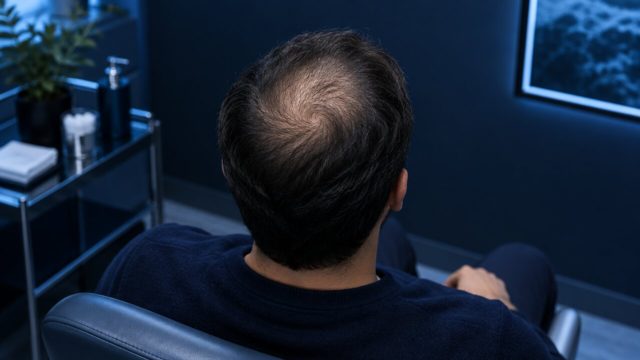
Advanced hair loss is another limitation. A laser cap may improve the quality of existing miniaturised hairs in a responsive patient, but it cannot reliably recreate a dense frontal hairline or fill a broad bald area. In such cases, a hair transplant may be discussed if the patient has a stable pattern of loss, adequate donor supply, and realistic expectations. Your doctor will confirm whether this is clinically suitable.
05What treatment sessions and results usually involve
Home laser devices are commonly used several times per week, but the schedule depends on the specific device and its instructions. Clinic-based protocols may be different. More frequent use is not necessarily better, so patients should follow the recommended routine rather than extending session length on their own. Consistency matters because hair growth changes slowly.
In most patients who respond, early changes are not immediate. Some people first notice reduced shedding or easier styling, while visible density changes may take several months. Hair photographs taken in the same lighting and angle can provide a more useful comparison than checking the mirror every day. A clinician may also use trichoscopy to monitor hair shaft diameter and follicle activity.
Does laser hair restoration therapy work well enough to replace all other care? Usually, no single treatment can be assumed to do that. A doctor may suggest laser therapy as one part of a structured approach, or may advise a different option if the expected benefit is limited. Decisions should be based on diagnosis, the degree of hair loss, safety considerations, daily routine, and the patient’s own priorities.
06Safety, side effects, and practical precautions
Low-level laser therapy is generally considered non-invasive, and many users tolerate it well when it is used as instructed. Reported effects can include temporary scalp warmth, mild itching, irritation, headache, or a short period of increased shedding. Increased shedding can have several causes and should not automatically be viewed as proof that a treatment is working or failing.
A person with a scalp condition, known light sensitivity, a history of skin cancer on the scalp, or treatment that increases photosensitivity should ask a qualified clinician before using a light-based device. Pregnancy, breastfeeding, and complex medical histories also deserve individual medical guidance. A hair-loss consultation is not a substitute for wider medical care when there are health symptoms beyond the scalp.
Device quality and correct use are important. Patients should avoid making decisions based only on dramatic before-and-after images, which can be influenced by lighting, hair length, styling, fibres, and camera angle. Look for clear instructions, an identifiable manufacturer, and advice from a medical professional who can explain what the device can realistically do for your type of hair loss.
07Laser therapy compared with medicines, PRP, and hair transplantation
Laser therapy, medical treatment, platelet-rich plasma procedures, and hair transplantation work in different ways. Medical treatments may help slow miniaturisation or support growth in suitable patients, but they require medical review because benefits, risks, and contraindications differ. PRP involves using a concentrated component of the patient’s own blood and has variable protocols and evidence. Laser therapy is non-invasive, but its results tend to be modest and depend strongly on continued use.
Hair transplantation redistributes permanent donor follicles from the back or sides of the scalp to thinning areas. It does not stop further loss in non-transplanted hair, so many patients still benefit from a long-term hair-preservation strategy. At Acibadem Hair Transplant Center, a dedicated hair restoration clinic in Istanbul licensed by the Turkish Ministry of Health, doctors assess whether Sapphire FUE or DHI may be suitable after reviewing the donor area, scalp condition, and goals.
For transplant patients, laser therapy may sometimes be discussed as supportive care, but timing and suitability should be confirmed by the treating doctor. It should never be treated as a replacement for post-procedure instructions. A well-planned treatment pathway focuses on protecting existing hair, using donor resources carefully, and choosing techniques that match the individual pattern of loss rather than following a one-size-fits-all trend.
08How to make an informed decision about laser hair restoration
Start with an accurate diagnosis. A free online hair analysis can be a useful first step for people exploring options, but a doctor should review the information and confirm the appropriate pathway. Clear photographs, a history of when shedding began, family history, medical conditions, and current medicines can all help create a more informed discussion.
Ask practical questions before committing to a laser device: What type of hair loss do I have? Is there enough existing miniaturised hair for this treatment to help? How often will I need to use it? When should results be reviewed? What should I do if shedding becomes worse or my scalp becomes irritated? A responsible provider will explain both expected benefits and limitations.
For international patients considering surgical options, Acibadem Hair Transplant Center provides doctor-reviewed online hair analysis, with WhatsApp replies typically within about two hours. The clinic has treated patients from 38 countries over 12 years and offers all-inclusive packages with VIP transfer, a 4-star hotel, a care kit, and 12 months of follow-up. For eligible hair transplant patients, results are measured by trichoscopic graft survival at month 12, with a documented 98% rate under written guarantee. This information does not mean that laser therapy or transplantation is suitable for every person; your doctor will confirm the appropriate option after assessment.
09Frequently Asked Questions
Can laser therapy really regrow hair?
Laser therapy may encourage thicker-looking growth or improved density in some people who still have active, miniaturised follicles, especially in early pattern hair loss. It is less likely to regrow hair in long-standing smooth bald areas, and the change is usually gradual. A doctor can help determine whether your hair follicles are likely to respond.
What did Elon Musk use to regrow his hair?
There is no confirmed public medical record explaining which treatment or treatments Elon Musk may have used. Photos alone cannot reliably identify a procedure, medicine, or device. It is best not to base a treatment decision on speculation about a public figure’s appearance.
What treatment did Jennifer Lopez use for hair loss?
There is no verified public medical information that confirms a specific hair-loss treatment used by Jennifer Lopez. Hair appearance in photographs can change due to styling, extensions, lighting, colouring, and many other factors. A personal hair-loss plan should be based on a medical assessment rather than celebrity claims.
What is the number one treatment for hair loss?
There is no single number one treatment for every type of hair loss. The most effective option depends on the diagnosis, stage of loss, health history, donor hair availability, and personal goals. Medical treatment may be appropriate for some patients, while others may benefit from non-surgical support or, in suitable cases, hair transplantation.
Questo articolo ha scopo puramente informativo e non sostituisce il parere medico professionale.
Questa guida ha scopo informativo generale e non sostituisce una visita medica. Le decisioni sul trattamento vengono prese dopo una valutazione del medico, di persona o online.