В этой статье9
- How the fue process unfolds from consultation to placement
- Medical assessment and personalised hairline planning
- Donor-area preparation and comfort on treatment day
- Individual graft extraction during the fue process
- Recipient-site creation: direction, angle and density
- Graft placement and protecting follicular units
- The first two weeks: washing, scabbing and return to routine
- Month-by-month growth, follow-up and long-term expectations
- Frequently Asked Questions
The fue process usually begins with a medical assessment and hairline planning, followed by donor-area preparation, individual graft extraction and precise placement in thinning areas. It is normally completed in one treatment day or over planned sessions, while visible growth develops gradually during the following months.
- FUE removes follicular units individually from a selected donor area rather than taking a linear strip of scalp.
- A doctor-led consultation helps confirm whether the donor supply, hair loss pattern and health history are suitable for treatment.
- Grafts need careful handling between extraction and placement to support their survival and natural-looking direction.
- Early shedding after FUE can be expected, while new visible growth commonly develops gradually over several months.
- Follow-up and aftercare instructions are important parts of protecting both the donor area and implanted grafts.
01How the fue process unfolds from consultation to placement
The fue process is a step-by-step hair restoration method in which naturally occurring follicular units are collected individually from a donor area and placed into areas affected by thinning or hair loss. A follicular unit may contain one, two, three or sometimes more hairs. The treatment is planned to preserve the donor area while distributing grafts where they can contribute to a balanced, age-appropriate appearance. Although the treatment day is important, good preparation before it and careful healing afterwards are equally relevant to the overall result.
FUE stands for Follicular Unit Extraction. Unlike older strip-based methods, it does not involve removing a long strip of scalp from the back of the head. Instead, a specialist uses a small instrument to extract individual units, usually from the back and sides of the scalp where hair is often more resistant to common pattern hair loss. The extracted units are then sorted and placed in prepared recipient sites according to a personalised surgical plan.
The exact timeline differs between patients. The number of grafts needed, the quality and density of the donor hair, the size of the recipient area, hair characteristics, medical history and the technique chosen can all influence the plan. Some patients are suitable for treatment in one day, while more extensive cases may require a longer schedule or staged treatment. Your doctor will confirm what is clinically appropriate after reviewing your scalp and expectations.
02Medical assessment and personalised hairline planning
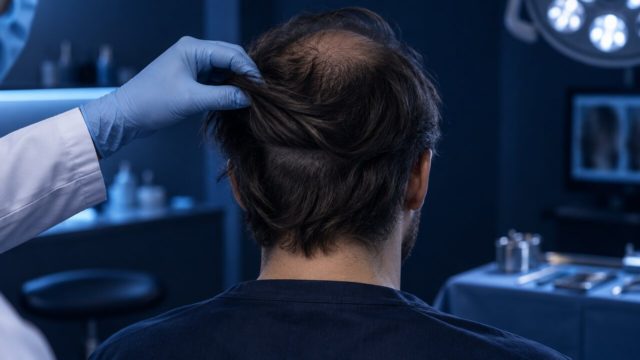
A responsible FUE timeline starts before surgery. During an assessment, the clinical team reviews the pattern and progression of hair loss, the condition of the scalp, donor-area density and hair calibre. They should also ask about your general health, regular medicines, allergies, previous scalp procedures and relevant family history. This helps identify factors that may affect suitability, healing or the likely need to protect existing hair alongside transplanted hair.
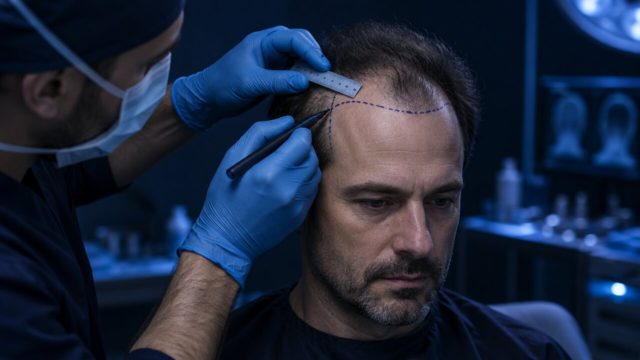
Hairline design is not simply a cosmetic drawing. It is a clinical and aesthetic planning stage that considers facial proportions, age, sex, the direction of natural hair growth and the possible future progression of hair loss. A very low or overly dense hairline may not be suitable for every patient because donor hair is limited. In most patients, a conservative design that uses grafts thoughtfully is more likely to remain balanced over time.
At Acibadem Hair Transplant Center, patients can begin with a free online hair analysis reviewed by doctors. Clear photographs can help the team make an initial assessment, although an online review does not replace a full medical evaluation. Replies on WhatsApp are typically provided within around two hours. For international patients, this early stage can also help explain the expected visit schedule and the questions to discuss before travelling to Istanbul.
03Donor-area preparation and comfort on treatment day
On the day of treatment, the donor area is prepared so that follicular units can be seen and accessed safely. This often involves trimming or shaving part of the donor hair, depending on the clinical plan and the method used. The scalp is cleansed, and the planned donor zone is checked again before extraction begins. The team aims to spread extractions across an appropriate area rather than concentrate them in one small location, which helps protect the appearance of the remaining hair.
Local anaesthesia is commonly used for FUE. Patients are generally awake during the procedure but should not feel sharp pain once the area is fully numb. Some people notice pressure, movement or brief discomfort during anaesthesia administration. Needle-free anaesthesia is available at Acibadem Hair Transplant Center for patients who may prefer this option, subject to clinical assessment. The team monitors comfort throughout the day and can explain what sensations are normal at each stage.
Good donor preparation also includes practical measures. Patients are usually advised to wear comfortable clothing that does not need to be pulled over the head after treatment. The clinical team will provide individual guidance about food, drinks, medicines, smoking, alcohol and scalp products before the appointment. It is important to follow these instructions rather than rely on general advice found online, because health needs and medication use can vary significantly between patients.
04Individual graft extraction during the fue process
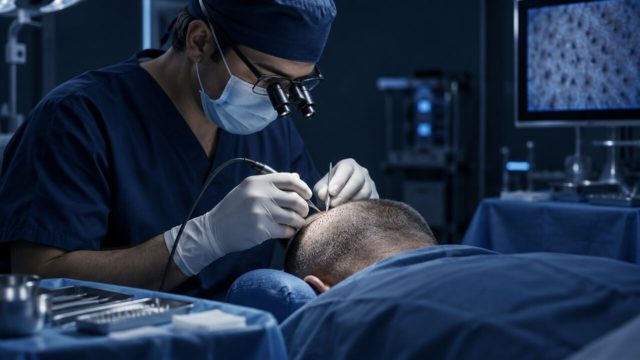
During extraction, the surgeon or trained clinical team identifies follicular units and uses a fine punch instrument to separate each unit from the surrounding tissue. The graft is then gently removed and placed into a controlled holding solution or storage environment. The aim is to minimise unnecessary handling and prevent dehydration or trauma. This stage requires attention to the natural angle of the follicle beneath the skin, as incorrect extraction technique can damage a graft or affect the donor area.
Not every follicular unit is identical. Some grafts contain a single hair, while others contain several hairs. Singles are often valuable for creating a soft, natural-looking transition at the front hairline. Multi-hair units may be used farther behind the hairline where more visual density is desired. The distribution is decided during planning, but the team may make careful adjustments during surgery based on the actual graft characteristics found on the day.
The donor area has limits. A safe extraction plan considers how many grafts can be removed without creating noticeable thinning or placing the donor region under unnecessary stress. This is one reason a high graft number should not be viewed as a goal by itself. The best number is the number that supports the agreed treatment objective while respecting donor capacity, existing hair and the possibility that future hair loss may continue.
05Recipient-site creation: direction, angle and density
After or alongside graft extraction, the recipient area is prepared for placement. Tiny channels or sites are made in the scalp where grafts will sit. Their position, angle, direction and spacing are central to the final appearance. Hair does not grow straight up from the scalp in a uniform pattern; it changes direction across the hairline, temples, mid-scalp and crown. The recipient-site plan should reflect these natural variations as closely as possible.
Density planning needs a careful balance. Placing grafts too close together may affect blood supply or healing, while placing them too far apart may not provide the visual coverage a patient expects. Hair thickness, colour contrast between hair and scalp, curl pattern and the number of hairs per graft all influence how full an area may look. A patient with coarse or wavy hair may achieve a different visual effect from the same graft count as someone with very fine, straight hair.
Sapphire FUE is one technique available at Acibadem Hair Transplant Center. It uses sapphire blades during the recipient-site creation stage, where clinically appropriate. DHI is another available technique that may be considered for selected cases. The choice should be based on scalp characteristics, target area, hair goals and medical assessment rather than on a claim that one approach is always best for every individual.
06Graft placement and protecting follicular units
The placement stage is when the extracted follicular units are inserted into the prepared recipient sites. Grafts are handled with care and positioned according to their planned role. Single-hair grafts may be placed at the leading edge of the hairline, while units containing more hairs can be positioned behind them to build coverage. This gradual arrangement can help avoid a harsh, plug-like look and support a more natural transition between transplanted and existing hair.
Timing and graft care matter throughout the procedure. Once removed from the scalp, follicular units are more vulnerable to drying, crushing and unnecessary manipulation. The clinical team works in an organised sequence to maintain appropriate storage and place grafts efficiently. Patients may spend several hours at the clinic, with comfort breaks planned as needed. The length of the day depends on the individual treatment plan and should not be rushed for the sake of speed alone.
Following placement, the recipient area commonly has small scabs and mild redness. These are expected features of early healing rather than an immediate sign of a problem. The team will explain how to sleep, wash the scalp and avoid friction or pressure during the first days. Patients should contact their clinic promptly if they have concerns such as significant pain, increasing swelling, unusual discharge, fever or symptoms that feel different from the aftercare guidance provided.
07The first two weeks: washing, scabbing and return to routine
The initial recovery period begins as soon as the procedure ends. In the first days, patients are generally asked to protect both the donor and recipient areas from rubbing, impact and direct pressure. Swelling can occur, especially around the forehead, but its degree and duration vary. A care kit and detailed washing instructions are commonly provided so that cleansing can begin at the time recommended by the clinical team without disturbing the newly placed grafts.
Small crusts usually form around implanted hairs. They should not be picked, scratched or removed forcefully, because this may irritate the skin and could dislodge vulnerable grafts early in recovery. With gentle washing according to the clinic’s instructions, scabs commonly loosen over the following days. The donor area also heals gradually, and tiny extraction marks generally become less visible as the skin recovers and surrounding hair grows.
Many people return to light daily activities within a relatively short period, but timing depends on comfort, the nature of work and the doctor’s advice. Exercise, swimming, sun exposure, headwear and travel require particular attention in the early stage. The fue process does not end when grafts are placed: following aftercare directions is an active part of supporting healing. Your clinic can give the most appropriate timeline for your own activity level and treatment details.
08Month-by-month growth, follow-up and long-term expectations
During the first weeks to months, transplanted hairs often shed. This phase can be worrying, but it is commonly part of the normal hair cycle after transplantation. The follicles remain beneath the skin and may later begin a new growth phase. Existing hair can also continue to change if the underlying cause of hair loss is progressive, which is why a long-term plan and realistic expectations should be discussed before surgery.
New growth is usually gradual rather than sudden. Early hairs may appear fine and uneven before becoming stronger over time. Changes are often assessed across several months, with the crown area sometimes appearing later than the frontal region due to its growth pattern and the complexity of covering a wider area. Final maturation may take up to 12 months or longer in some patients. Individual biology, hair characteristics, aftercare and the extent of the procedure can influence the timeline.
Acibadem Hair Transplant Center offers all-inclusive packages that include VIP transfer, a 4-star hotel, a care kit and 12 months of follow-up. The centre is a dedicated hair restoration clinic in Istanbul and is licensed by the Turkish Ministry of Health. Results are measured by trichoscopic graft survival at month 12, with a documented 98% rate under written guarantee. This measurement describes the clinic’s documented protocol and guarantee terms; your doctor will explain what it means for your treatment plan and follow-up assessment.
09Frequently Asked Questions
Does an FUE procedure hurt?
FUE is typically performed under local anaesthesia, so patients should not feel sharp pain during extraction or graft placement once the scalp is numb. Some discomfort, pressure or brief stinging can be felt during the anaesthesia stage, and mild tenderness may occur during early recovery. Needle-free anaesthesia is available at Acibadem Hair Transplant Center, subject to clinical suitability.
What are the possible disadvantages of an FUE hair transplant?
FUE has potential limitations as well as benefits. It requires a sufficient donor supply, can take many hours, and over-harvesting may affect the look of the donor area if planning is poor. It also does not stop future hair loss in non-transplanted hair, and results depend on factors such as donor quality, healing, technique and adherence to aftercare.
Is FUE better than DHT?
DHT is a hormone linked to common pattern hair loss; it is not a hair transplant technique, so FUE and DHT cannot be compared as alternatives. If you meant DHI, both FUE and DHI can be appropriate in selected patients. Your doctor can recommend a technique after assessing the donor area, recipient area, hair type and treatment goals.
What is the average cost of an FUE hair transplant?
There is no single reliable average cost because treatment fees vary by country, clinic standards, graft requirements, technique, travel arrangements and follow-up care. A lower advertised price may not include medical supervision, aftercare or accommodation. Ask for a written plan that clearly explains what is included and whether the treatment recommendation is based on a doctor’s assessment.
Эта статья носит исключительно информационный характер и не заменяет профессиональную медицинскую консультацию.
Это руководство носит общий информационный характер и не заменяет консультацию врача. Решения о лечении принимаются после очной или онлайн-оценки врачом.