
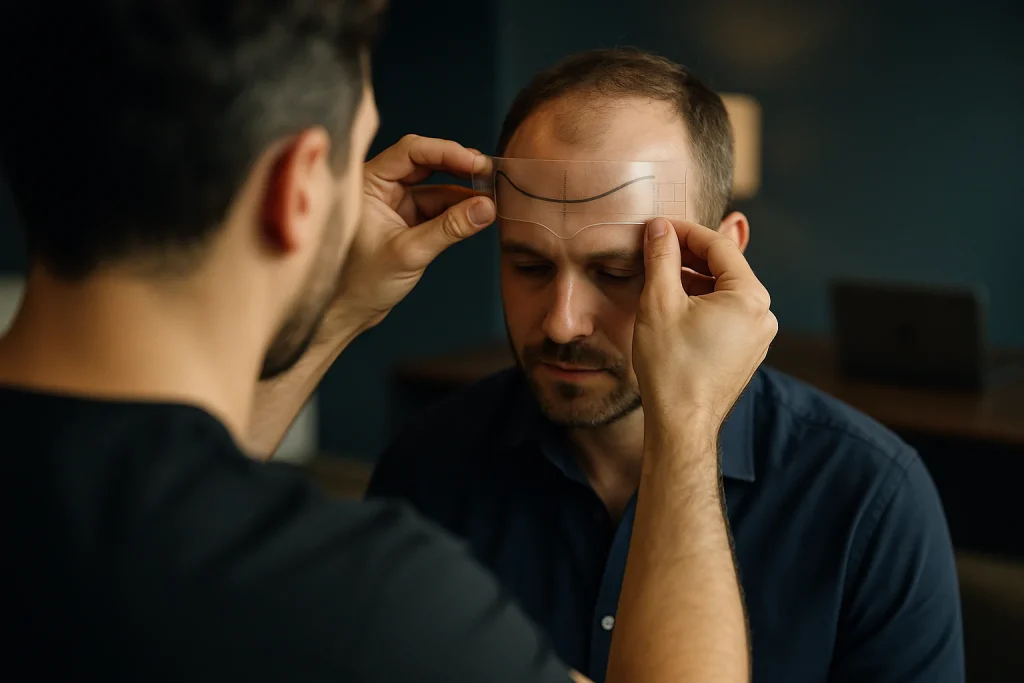
Hairline types describe the natural shapes, heights, curves and temple patterns seen at the front of the scalp. A natural transplant design usually matches these features to your facial proportions, age, existing hair and likely future hair loss rather than creating an unnaturally low or straight line.
- A successful hairline transplant design is usually conservative, irregular in detail and appropriate for the patient’s age.
- Facial proportions, temple shape, donor supply and future hair loss all influence the safest hairline position.
- Natural-looking hairlines use carefully selected single-hair grafts at the leading edge.
- A transplanted hairline should blend gradually into existing hair instead of appearing as a sharp border.
- A doctor-led assessment helps confirm whether a proposed design is suitable for your hair loss pattern and donor area.
01Hairline Types and Choosing a Natural Transplant Design
Hairline types vary naturally from person to person. Some people have a rounded hairline, while others have a flatter shape, a soft M-shaped pattern, stronger temporal recession or a higher mature hairline. When planning a hair transplant, the goal is usually not to copy a fixed template. Instead, the design should reflect the patient’s natural features and create a front hairline that can remain believable as the person ages. This is why a natural hairline assessment looks beyond the forehead alone. It also considers the temples, facial balance, existing hair density, donor availability and the possibility of continued hair loss.
In most patients, the most natural result comes from a hairline that is placed with restraint. A very low line may look attractive in a drawing, but it can use a large number of grafts and may not suit future changes in the surrounding hair. Your doctor will typically assess the distance between facial features, the quality of the donor area and the pattern of thinning before recommending a design. The best plan is individual: it should restore confidence while respecting the long-term limits of the scalp and available donor hair.
02Why the Front Hairline Needs Individual Planning
The front hairline is one of the first features people notice because it frames the face. Even when a transplant has good density, an unsuitable hairline position, angle or shape can make the result appear artificial. For this reason, the planning stage is as important as the implantation stage. A doctor normally studies the hairline from the front, above and side views. This helps identify the natural direction of growth and the degree of recession that already exists around the temples.
A person’s facial proportions can guide the overall height and width of the planned line, but there is no single measurement that suits everyone. Forehead height, brow position, head shape and facial length all matter. Men and women may also have different natural patterns, although individual variation is wide. In many cases, a design that keeps some mature recession and soft temple definition can look more convincing than an overly youthful, straight line. The aim is harmony, not simply the lowest possible placement.
03Recognising Common Hairline Shapes
Common hairline shapes include rounded, oval, gently curved, flatter and M-shaped patterns. A rounded hairline often has a soft central curve and smooth transitions towards the temples. A flatter pattern may still be natural when it includes small irregularities and a gradual change in density at the front. An M-shaped hairline has mild recession at the temples with a central forelock or peak. This can be a normal mature pattern and does not always need to be removed during transplant planning.
When discussing hairline types, it is useful to separate a natural mature hairline from active hair loss. Many adults develop some recession at the front corners over time, especially after adolescence. This can create a more adult facial frame without indicating severe baldness. However, progressive recession, diffuse thinning or reduced density behind the hairline may require a wider assessment. A doctor can examine the scalp and donor area to help distinguish stable features from a pattern that may continue to change.
04How Hairline Types Guide Graft Placement
Different hairline types affect where grafts are placed, how densely they are distributed and which hairs are selected for the leading edge. The first centimetres of a natural hairline usually need finer, single-hair grafts. These grafts can create a soft transition from skin to hair. Larger graft groupings are generally more suitable behind this zone, where they can add visual fullness without making the front border look plug-like or abrupt.
Natural growth is not arranged in a ruler-straight row. Individual hairs emerge at slightly different points, directions and angles. During a transplant, the surgeon typically recreates this controlled irregularity through small variations in placement. The frontal hairs are also positioned at a low angle so they lie close to the scalp in a natural way. A carefully planned transition zone can make the hairline look less detectable in daylight, close conversation and photographs, although every surgical result can vary between patients.
05Choosing a Hairline Height That Can Age Well
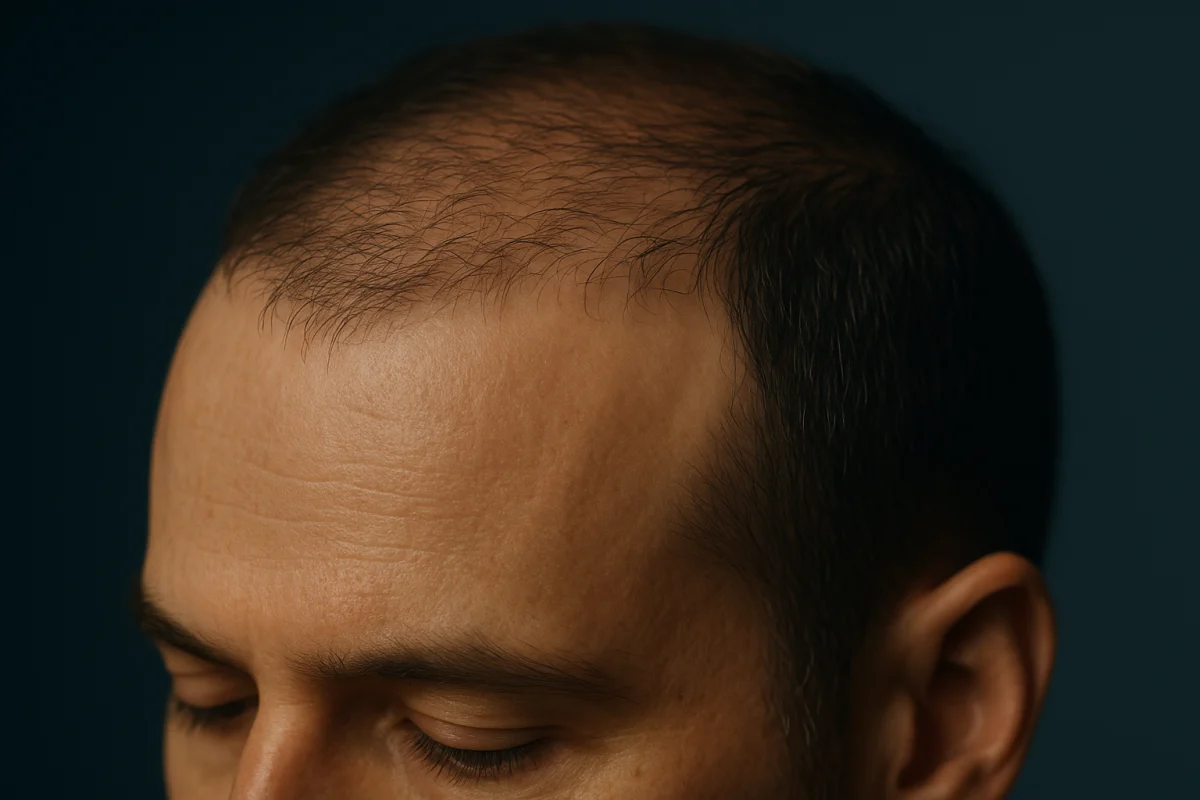
Hairline height is one of the most important long-term decisions in transplantation. A low hairline can require more grafts at the front and may leave fewer grafts available if thinning develops further back. For this reason, doctors often recommend a conservative position for patients with ongoing hair loss, a younger age or a family history of more extensive baldness. This approach is not about denying restoration. It is about building a design that has a better chance of remaining proportionate over time.
Future planning also includes the area behind the transplanted line. A dense new hairline can look disconnected if native hair continues to thin in the mid-scalp or crown. Depending on the clinical assessment, a doctor may discuss treatment options, a staged transplant plan or simply a design that protects graft supply for later needs. No one can predict future loss with complete certainty. Still, a careful review of pattern, family history and hair miniaturisation can support a more responsible plan.
06Temple Points, Side Profiles and Natural Transitions
The temple points are the small areas where the front hairline meets the side hair. They have a strong effect on the apparent width and shape of the face. Restoring them too strongly can make the hairline appear closed or overly youthful, while leaving them too open may reduce the visual improvement from a frontal transplant. In suitable patients, a subtle temple design can support a balanced profile and connect the frontal hairline to the existing side hair.
Temple hair is naturally fine and grows at a different direction from the central hairline. It also often lies very flat against the skin. These details make temple work technically demanding. Your doctor will consider whether the donor hair has appropriate characteristics and whether temple restoration fits the wider design. In some patients, preserving a natural degree of recession is the safer choice. A good transplant plan does not need to fill every open area to create a noticeable and natural-looking change.
07Technique Choices and the Importance of Graft Handling
The technique used for extraction and implantation is important, but it does not replace good design. Sapphire FUE and DHI are both techniques that may be considered for suitable candidates. The choice can depend on the scalp, hair characteristics, number of grafts planned and the clinical approach recommended by the medical team. In all cases, careful graft handling, correct recipient-site angles and thoughtful distribution are central to creating a soft and natural front hairline.
At Acibadem Hair Transplant Center in Istanbul, hair restoration planning is based on a doctor-reviewed assessment. The clinic is licensed by the Turkish Ministry of Health and offers Sapphire FUE and DHI procedures. Needle-free anaesthesia may be available for eligible patients. During the planning discussion, patients can ask how the proposed line relates to their donor supply, their existing hair and the possibility of future thinning. Clear communication before surgery helps ensure that the design is understood and realistic.
08What Happens During a Hairline Design Consultation
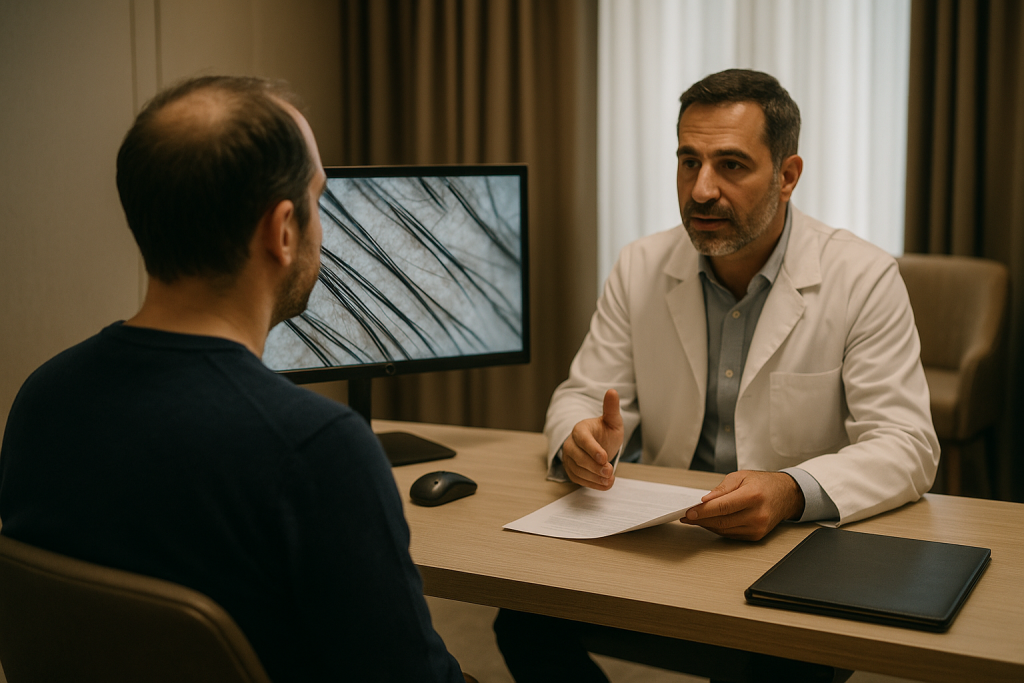
A hairline consultation usually begins with photographs and an assessment of the current scalp pattern. The doctor may review the frontal hairline, temples, mid-scalp, crown and donor area. Hair calibre, curl, colour contrast and density can all influence how much coverage a given number of grafts may provide. Fine hair or high contrast between hair and scalp, for example, can require especially careful planning at the front. The doctor may also use scalp examination tools to assess the condition of existing hairs.
For international patients, Acibadem Hair Transplant Center provides a free online hair analysis reviewed by doctors, with WhatsApp replies typically within around two hours. An online review can offer useful initial guidance, but the final suitability and design are confirmed through medical assessment. The clinic also provides all-inclusive packages that can include VIP transfer, a 4-star hotel, a care kit and 12 months of follow-up. Patients should share clear, recent photographs and ask direct questions about hairline height, temple work, graft planning and aftercare before making a decision.
09Preparing for a Hairline Transplant: Questions and Practical Checks
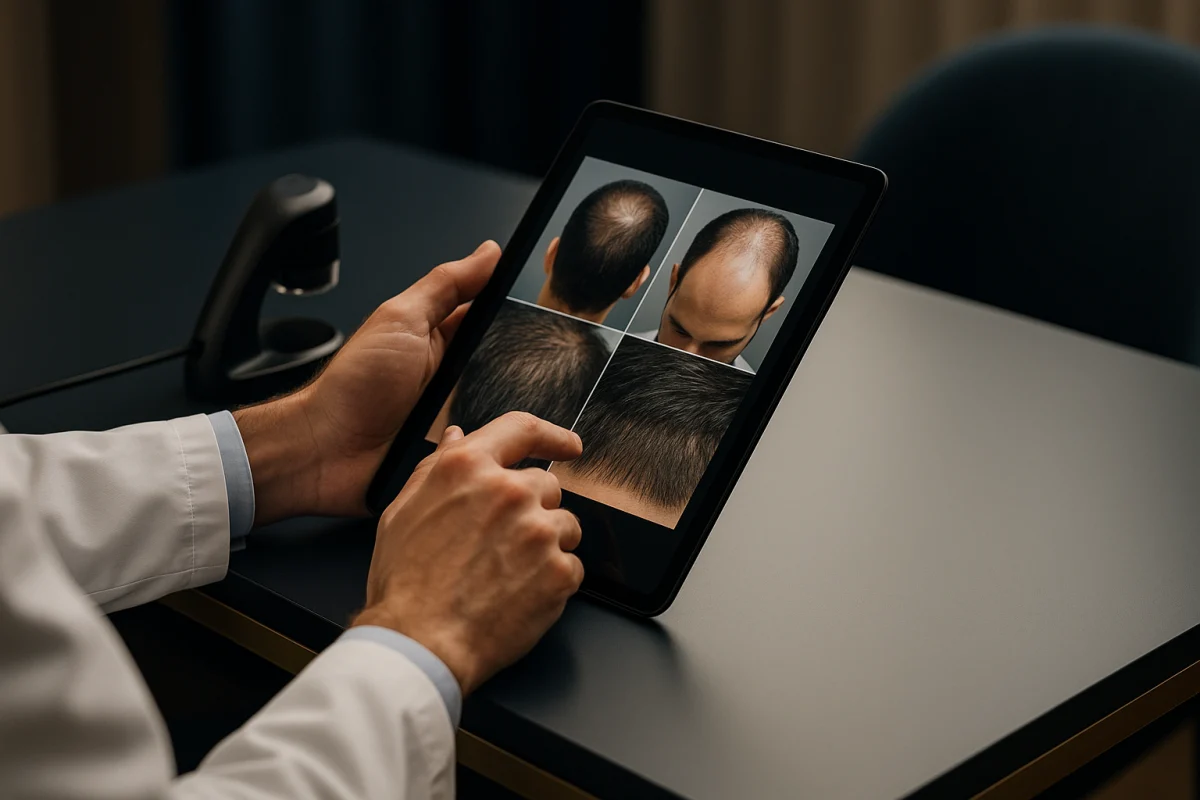
Before committing to a hairline transplant, it is helpful to collect the information that affects planning rather than focusing only on the number of grafts. Patients should provide recent photographs taken in clear light from the front, both sides, above and the donor area at the back of the scalp. They should also tell the medical team about previous hair procedures, scalp conditions, medicines, allergies and any significant health history. This information helps the doctor decide whether an in-person examination is needed before confirming the final plan.
A useful consultation should make the proposed design easy to understand. Ask where the central point of the hairline would sit, how the corners and temple points would be treated, and whether grafts may need to be reserved for future areas of thinning. It is also reasonable to ask what the design may look like with short hair, styled hair and natural daylight. A drawn hairline is a planning guide, not a guarantee of an exact final appearance. Your doctor will confirm whether the requested shape is clinically appropriate for your scalp, donor supply and longer-term hair loss risk.
10Hairline Transplant Aftercare: Protecting the Newly Placed Grafts
The first days after a hairline procedure are important because the recipient area needs time to settle. Patients are usually given individual instructions about washing, sleeping position, headwear, activity and travel. It is important to follow these instructions exactly, avoid touching or scratching the implanted area, and avoid any pressure or friction against the new grafts. Small crusts, temporary redness and mild swelling can occur during early recovery. Patients should not attempt to remove crusting early unless the medical team has explained how and when to wash the area safely.
Physical activity, sun exposure, swimming, smoking and alcohol may need to be limited for a period advised by the doctor, as these factors can affect healing or irritate the scalp. Hair styling products, colouring and haircut methods should also be discussed before they are resumed. Contact the clinic promptly if you have concerns such as increasing pain, marked swelling, unexpected discharge, fever or any symptom that feels unusual. At Acibadem Hair Transplant Center, patients receive a care kit and 12 months of follow-up within eligible all-inclusive packages. Follow-up allows the team to review recovery and answer practical questions as healing progresses.
11Hairline Growth Timeline: What Usually Changes During the First 12 Months
A transplanted hairline does not usually look complete immediately after surgery. In the first days, the implanted hairs and tiny crusts can make the outline appear more visible than it will later. After the initial healing period, many patients experience shedding of the transplanted hair shafts. This is commonly part of the normal growth cycle and does not necessarily mean that the grafts have been lost. The scalp can then appear similar to its pre-procedure state for a temporary period, which can be emotionally difficult if it is not expected in advance.
New growth typically begins gradually over the following months, but the speed, texture and density vary between patients. Early hairs may initially look finer, curlier or less even than the final result. As more hairs grow and mature, the front edge generally becomes softer and better integrated with the surrounding hair. A hairline is often assessed over many months rather than after a few weeks. At Acibadem Hair Transplant Center, results are measured through trichoscopic graft survival at month 12, with a documented 98% rate under written guarantee. This measurement relates to graft survival; the visual result still depends on factors such as hair characteristics, healing and the planned design.
12Frequently Asked Questions
What are the most common hairline types?
Common patterns include rounded, gently curved, flat, oval and M-shaped hairlines. Many adults also have natural temple recession, which can be part of a mature hairline rather than a problem that requires full restoration.
Can a hair transplant make my hairline lower?
In suitable patients, a transplant may lower or reshape the frontal hairline. However, doctors usually consider age, donor supply, current hair loss and possible future thinning before recommending how low the line should be.
Why should a transplanted hairline not be perfectly straight?
Natural hairlines have small variations in position, density and direction. A soft, irregular leading edge using fine single-hair grafts generally looks more natural than a sharply straight border.
Do temple points need to be transplanted with the hairline?
Not always. Temple restoration may support facial balance in selected patients, but it requires careful planning because temple hairs are fine and grow at specific angles. Your doctor will confirm whether it is appropriate.
How long does it take to judge the final hairline result?
Early growth commonly develops gradually after the procedure, and the appearance continues to mature over many months. The timing and density of growth vary, so your medical team will explain the expected follow-up schedule and recovery process.
Эта статья носит исключительно информационный характер и не заменяет профессиональную медицинскую консультацию.
 06
06 12
12