V tomto článku9
- Prehľad
- When full hair restoration is a realistic goal
- The donor assessment that shapes every treatment plan
- Choosing priorities across the hairline, mid-scalp and crown
- Why graft numbers are estimates, not a treatment promise
- Sapphire FUE, DHI and comfort during a large procedure
- Staged treatment, healing and the 12-month timeline
- How to prepare for a safe international hair restoration journey
- Frequently Asked Questions
Full hair restoration for extensive hair loss is usually planned as a personalised, often staged process rather than a single standard procedure. A doctor needs to assess your donor hair, pattern of loss, scalp condition and long-term goals before confirming whether transplantation, medical support or a combined approach may be appropriate.
- Extensive hair loss requires careful donor-area assessment before any graft number can be planned.
- A natural result depends on prioritising the hairline, frontal area and visual density rather than simply covering every area equally.
- Some patients may need staged procedures because the donor supply is limited and future hair loss can continue.
- Sapphire FUE and DHI are graft-placement techniques, but the right choice depends on your clinical assessment.
- Long-term follow-up and realistic planning are important parts of a safe full-scalp restoration journey.
01Planning Full-Scalp Hair Restoration for Extensive Hair Loss
Planning full hair restoration for extensive hair loss starts with an honest assessment of what can be achieved safely over time. When thinning affects the hairline, frontal scalp, mid-scalp and crown, it is understandable to want complete coverage as soon as possible. However, transplanted hair is limited by the number and quality of follicles available in the donor area, usually at the back and sides of the scalp. A responsible plan considers both today’s appearance and how your hair may change in the future.
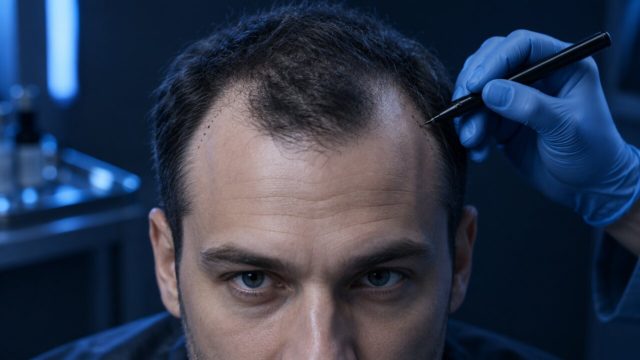
In most patients, extensive loss is not treated as a simple calculation of bald area divided by grafts. The scalp has different visual zones, and each zone has a different role in how full the hair appears. The frontal hairline frames the face, the mid-scalp connects the front to the crown, and the crown often requires a large number of grafts because of its circular growth pattern. Your doctor will normally discuss which areas should receive priority and whether all areas can be addressed in one session.
A good plan also respects the natural characteristics of your existing hair. Hair calibre, curl, colour contrast between hair and skin, donor density and scalp flexibility can all influence the visual result. For example, stronger or wavy hair may create the appearance of greater coverage than very fine, straight hair at the same graft density. This is why online photographs can be useful for a first review, but an individual treatment plan should only be confirmed after medical assessment.
02When full hair restoration is a realistic goal
Full hair restoration can be a realistic visual goal for some people with extensive hair loss, but it should not be understood as a promise of returning to the exact density or hair pattern of adolescence. In hair transplantation, the aim is typically to create an age-appropriate, natural-looking frame for the face and improve coverage in the most important areas. The achievable level of density depends mainly on the donor supply and the size of the recipient area.
Patients with a stable pattern of hair loss, healthy donor hair and modest scalp-to-hair contrast may be suitable for broad coverage planning. Others may have a limited donor reserve, ongoing thinning in non-transplanted hair or scalp conditions that need attention first. In these situations, a doctor may advise focusing on the front and mid-scalp, preserving grafts for a later stage, or combining a transplant plan with medically appropriate hair-loss management.
It is important to distinguish coverage from density. A transplant can distribute follicles across a large area, but spreading grafts too widely may produce a sparse appearance. Concentrating them only at the front may leave the crown thinner, while prioritising the crown can reduce the impact around the face. A balanced plan uses grafts where they give the greatest visual benefit, while maintaining a natural transition between transplanted and existing hair.
03The donor assessment that shapes every treatment plan
The donor area is the foundation of a full-scalp plan. During assessment, the medical team evaluates the density of donor follicles, the thickness of the hair shafts, the proportion of multi-hair grafts, the condition of the scalp and the likely safe extraction range. Not every visible hair in the donor zone can be removed. Overharvesting can make the back or sides of the head look thin, so donor preservation is a core safety principle.
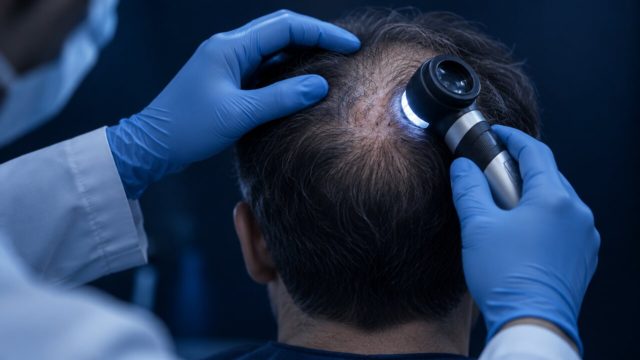
Trichoscopic examination can help the doctor look closely at hair and scalp features that may not be clear in standard photographs. It may reveal variation in hair thickness, signs of miniaturisation, inflammation or other factors that affect planning. The doctor may also ask about family history, previous procedures, medications, illnesses and how rapidly the hair loss has progressed. These details help establish whether the pattern appears stable enough for transplantation planning.
For international patients, a free online hair analysis can provide an early indication of suitability and likely priorities. At Acibadem Hair Transplant Center, online submissions are reviewed by doctors, and WhatsApp replies are typically provided within around two hours. This initial review does not replace an in-person medical assessment, but it can help clarify what photographs are needed, whether a staged approach may be discussed and what questions to prepare before travelling.
04Choosing priorities across the hairline, mid-scalp and crown
For many people with advanced loss, the hairline and frontal third are the first priorities because they are seen directly in conversation, photographs and mirrors. A carefully designed hairline should suit the person’s facial proportions, age and likely future hair-loss pattern. Lowering a hairline too aggressively can use a large number of grafts and may look less natural if the surrounding native hair continues to thin. Conservative design usually supports better long-term planning.
The mid-scalp is often the key bridge between the frontal area and crown. Restoring this zone can create a fuller overall impression, especially under normal indoor lighting. Doctors may use a distribution pattern that gives visual continuity without trying to reproduce uniform density across every centimetre of scalp. Existing hairs in the mid-scalp may also be vulnerable to future miniaturisation, which is another reason to plan for change rather than only the current appearance.
The crown needs particular discussion because it may require more grafts than patients expect. Its whorl pattern spreads hair in several directions, and the area is often large in advanced hair loss. Some patients choose to treat the crown in a second stage after the front and mid-scalp have healed and grown. Others prefer a more modest crown improvement during the first procedure. Your doctor will explain the trade-offs based on the available donor reserve and your priorities.
05Why graft numbers are estimates, not a treatment promise
Graft estimates are useful for planning, but they should never be treated as a guaranteed number before proper examination. A graft is a naturally occurring follicular unit that may contain one, two, three or sometimes more hairs. Therefore, 3,000 grafts do not equal 3,000 hairs. The cosmetic value of a graft depends on how many hairs it contains, where it is placed and how it grows after healing.
For extensive loss, the total number of grafts discussed may be substantial, yet a safe single-session limit is not the same for every patient. It may be influenced by donor density, extraction method, scalp health, the expected duration of the procedure and the need to avoid excessive trauma to grafts or donor skin. A clinic should explain whether the proposed number is designed for one procedure or whether it forms part of a staged treatment strategy.
It is also sensible to ask how graft counting and documentation are handled. Clear records help patients understand what has been planned and what has been implanted. At Acibadem Hair Transplant Center, results are measured through trichoscopic graft survival at month 12, with a documented 98% rate under a written guarantee. Individual appearance and density can still vary because healing, hair characteristics and ongoing native hair loss differ from person to person.
06Sapphire FUE, DHI and comfort during a large procedure
Sapphire FUE and DHI are commonly discussed techniques for hair transplantation, but neither name alone determines whether a result will look natural. In Sapphire FUE, follicles are generally extracted individually and placed into prepared channels. In DHI, grafts are implanted with a specialised implantation tool. The most appropriate method depends on the recipient area, hair direction, graft type, scalp features and the clinical plan established by the medical team.
For broad recipient areas, technique selection may vary between zones. The frontal hairline requires detailed control of angle and direction, while the mid-scalp and crown need planning that follows existing growth patterns. The experience of the team, careful graft handling and safe donor management are as important as the implantation approach. Patients should be cautious of claims that one technique is automatically best for every pattern of extensive hair loss.
A longer treatment day may raise understandable concerns about comfort. Needle-free anaesthesia is available at Acibadem Hair Transplant Center for suitable patients, subject to medical assessment. Before a procedure, the team should review your medical history, allergies and medications, explain what to expect during the day and provide instructions about preparation. You should tell the medical team about any health concern rather than stopping or changing prescribed medication without advice from your own doctor.
07Staged treatment, healing and the 12-month timeline
A staged plan can protect the donor area and allow a more measured approach to full hair restoration. The first stage may focus on the hairline, frontal scalp and mid-scalp, creating a meaningful improvement in facial framing and visible coverage. After growth develops, the remaining donor capacity and crown needs can be reassessed. This approach can be especially helpful when hair loss is extensive or when the likely future pattern is still evolving.
After transplantation, short-term shedding of transplanted hairs is commonly expected before new growth begins. Visible regrowth often develops gradually rather than all at once. Early changes may be seen after several months, while maturation typically continues through month 12 and sometimes beyond, particularly in the crown. Your follow-up team can explain normal healing signs and when it is important to contact them. Results should be judged patiently, not in the first weeks after treatment.
Follow-up matters because the transplant is only one part of long-term hair management. Acibadem Hair Transplant Center provides 12 months of follow-up as part of its all-inclusive packages, together with a care kit, VIP transfer and a 4-star hotel stay. These practical arrangements can support international patients, but medical suitability and aftercare instructions remain the most important considerations. Your care team will provide individual post-procedure guidance based on your treatment.
08How to prepare for a safe international hair restoration journey
Before booking travel, request a clear written plan that explains the proposed treatment areas, estimated graft range, technique options, recovery expectations and what is included in the package. Ask who will perform each stage of the procedure and how medical supervision is organised. It is also reasonable to ask what happens if the doctor finds a reason to change the plan after an in-person examination. Clear communication supports informed consent.
Choose a clinic that is appropriately licensed and transparent about its processes. Acibadem Hair Transplant Center is a dedicated hair restoration clinic in Istanbul licensed by the Turkish Ministry of Health. The centre has welcomed patients from 38 countries over 12 years. These points can help international patients understand the clinic’s experience, but your decision should still be based on your own medical assessment, communication with the team and a plan that feels realistic for your needs.
Finally, plan enough time for recovery and avoid making important social or work commitments immediately after treatment if possible. Follow instructions concerning washing, sun exposure, physical activity and travel, as these may differ according to your procedure and medical history. Bringing a list of medications and questions can make the consultation more productive. A careful, long-term mindset gives you the best basis for discussing extensive hair loss treatment safely and confidently.
09Frequently Asked Questions
What is the cost of restoring hair?
The cost of hair restoration varies widely because treatment plans differ in graft needs, technique, donor complexity, medical support and travel arrangements. A clinic should provide an individual quotation only after reviewing your hair-loss pattern and donor area. It is more useful to compare what is medically included, who provides the care and what follow-up is available than to choose solely by a headline price.
How did Matthew McConaughey regrow his hair?
Matthew McConaughey has spoken publicly about changes in his hair, but it is not possible to clinically verify the exact cause or method behind any individual celebrity’s result. Public stories and photographs are not a reliable basis for treatment decisions. A doctor should assess your own pattern of hair loss, scalp and donor area before discussing appropriate options.
What does 3,000 hair grafts cost?
The cost of 3,000 grafts is not fixed and should not be assumed from graft count alone. The quotation may depend on whether 3,000 grafts are clinically appropriate, the technique used, the complexity of the case, medical services and aftercare. Your doctor and clinic should confirm both the safe graft estimate and the complete treatment details before you decide.
What does 10,000 hair grafts cost?
A figure of 10,000 grafts usually represents a major restoration plan and may involve more than one procedure, depending on donor capacity and medical suitability. It is not appropriate to assume that every patient can safely provide this number of grafts. A doctor must assess the donor area and explain whether staged treatment, different coverage priorities or another approach is more suitable.
Tento článok slúži len na všeobecné informačné účely a nenahrádza odbornú lekársku radu.
Tento sprievodca slúži na všeobecné informovanie a nenahrádza lekársku konzultáciu. O liečbe sa rozhoduje po osobnom alebo online posúdení lekárom.