Bu yazıda9
- Genel bakış
- A hair transplant to make forehead smaller: how it works
- Who may be a suitable candidate for hairline lowering
- Designing a natural hairline instead of a straight line
- Hair transplant or surgical forehead reduction: key differences
- What happens during treatment and recovery
- Limits, risks, and realistic expectations
- Planning your hairline treatment in Istanbul
- Frequently Asked Questions
Yes, a hair transplant to make forehead smaller can make the forehead appear shorter by placing grafts in front of the existing hairline. This approach does not physically move the forehead skin, but it may create a lower, softer, and more balanced-looking hairline when the donor area and hair-loss pattern are suitable.
- Hairline transplantation can create the visual impression of a smaller forehead without removing forehead skin.
- A natural result depends on donor-hair quality, stable hair loss, facial proportions, and careful hairline design.
- Surgical forehead reduction and hair transplantation work differently and suit different anatomical needs.
- Transplanted hair usually grows gradually, so the cosmetic change should be assessed over several months.
- A medical consultation is important because future hair loss, scarring, and individual healing can affect the plan.
01Can a Hair Transplant Make the Forehead Appear Smaller?
A hair transplant to make forehead smaller is a hairline-lowering treatment that may reduce the visible height of the forehead. During the procedure, healthy follicles are moved from a donor area, usually at the back or sides of the scalp, to the front of the hairline. Once those hairs grow, they can frame the upper face at a lower point. The forehead itself is not surgically shortened, but the change in the hairline can create a meaningful visual difference for suitable patients.
A high forehead is not automatically a medical concern. It can be a natural family feature, the result of a naturally mature hairline, or a consequence of hair thinning and recession. Some people feel that it makes their face look longer or that certain hairstyles are difficult to wear. Hairline transplantation is generally considered for people who want to adjust this balance while keeping the result as natural-looking as possible.
The best outcome is usually not the lowest possible hairline. A natural hairline should fit the person’s age, facial shape, ethnic background, existing hair density, and likely future pattern of hair loss. Your doctor will examine these factors and discuss whether lowering the hairline is appropriate, how much movement may be realistic, and whether a staged plan could be safer in the long term.
02A hair transplant to make forehead smaller: how it works
Hairline lowering with grafts begins with collecting individual follicular units from the donor area. These units may contain one, two, three, or more hairs. The surgeon then places them into very small recipient sites at the planned front hairline. Single-hair grafts are commonly selected for the leading edge because they can help create the fine, irregular transition seen in a natural hairline.
The placement angle is especially important at the forehead. Hair does not grow straight out from the scalp at the front; it typically lies close to the skin and changes direction across the temples. Grafts must be positioned to follow these patterns. If angles, direction, or density are poorly planned, the hairline may look too straight, too dense at the edge, or disconnected from the surrounding hair.
Sapphire FUE and DHI are techniques that may be used depending on the treatment plan. Sapphire FUE involves preparing fine channels for graft placement, while DHI uses a specialised implantation approach. Neither technique is automatically better for every patient. The most appropriate choice depends on scalp characteristics, the number of grafts needed, the desired design, and the doctor’s assessment.
03Who may be a suitable candidate for hairline lowering
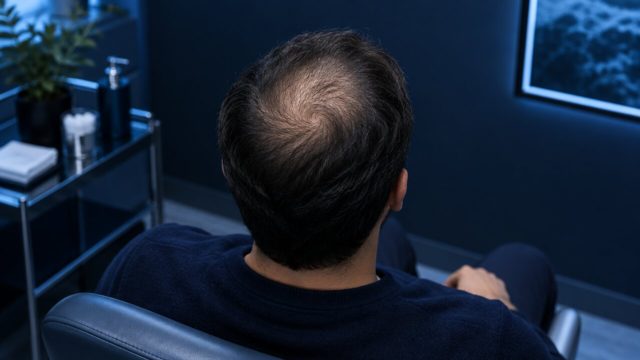
People with a naturally high but stable hairline may be potential candidates if they have sufficient donor density and healthy scalp tissue. Women with a broad forehead and no active pattern of diffuse thinning may also ask about this treatment. Men can be candidates too, although male-pattern hair loss requires particularly careful planning because recession may continue behind the newly transplanted area.
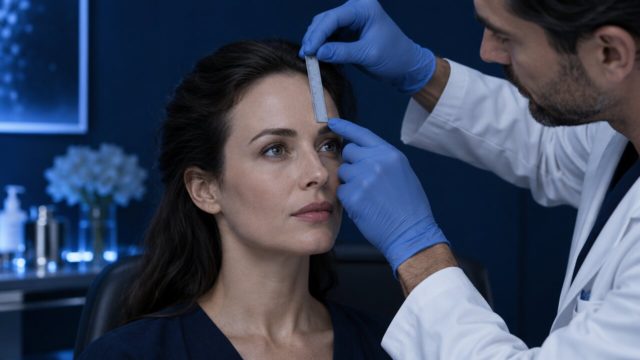
An assessment should look beyond the forehead measurement alone. Doctors commonly review the density and quality of donor hair, the contrast between hair and skin, hair texture, scalp flexibility, family history of hair loss, medication use, and general health. Fine hair may require a different density strategy from coarse hair, while curly or wavy hair can create visual coverage differently from straight hair.
Patients with active hair shedding, poorly controlled scalp conditions, significant scarring, or an uncertain hair-loss pattern may need further evaluation before treatment. In younger patients, an aggressively low hairline can become less suitable if the natural hair recedes later. A conservative, age-appropriate design often helps protect the appearance of the result as the person gets older.
04Designing a natural hairline instead of a straight line
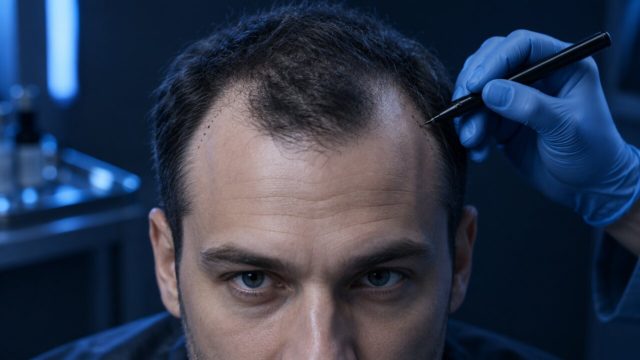
A natural frontal hairline is rarely perfectly symmetrical or ruler-straight. It normally has small, soft irregularities and a gradual change from finer hairs at the front to greater density behind it. For this reason, the planning stage is as important as the grafting stage. The doctor may draw and adjust the proposed hairline with the patient seated, considering the full face rather than focusing only on one measurement.
The temples deserve close attention because they connect the frontal hairline to the sides of the face. Restoring or preserving a gentle temporal transition can make a lower hairline look more integrated. However, temple work may use additional grafts and is not necessary for everyone. The plan should balance the desired cosmetic improvement with the available donor supply.
Density is also built in layers. Placing every graft at maximum density is not always the safest or most natural option, particularly if a patient may need grafts for future thinning. A thoughtful plan may prioritise a soft hairline and appropriate coverage rather than promising a dense, youthful pattern. Your doctor can explain the expected visual effect based on your own hair characteristics.
05Hair transplant or surgical forehead reduction: key differences
When considering a hair transplant to make forehead smaller, it is useful to understand how it differs from surgical forehead reduction. Hair transplantation adds hair to the front of the scalp and can visually lower the hairline. Surgical forehead reduction, also called hairline advancement surgery, removes a strip of forehead skin and advances the scalp forward. It can produce a more immediate physical shortening of the forehead, but it is a different operation with different eligibility criteria and risks.
Forehead reduction surgery may be discussed for people with good scalp laxity who want a larger reduction in forehead height. It leaves a scar along or near the hairline, although the scar may become less noticeable over time in some patients. Patients who are prone to progressive hair loss need careful assessment, because hair recession after surgery could potentially expose the scar more clearly.
A transplant may be preferred when a patient wants to avoid removing skin, needs to soften a hairline scar, has limited scalp laxity, or wants gradual and adjustable hairline refinement. It may also be used after forehead reduction surgery to improve scar camouflage or add density at the hairline. Neither option is universally better; the most suitable approach depends on anatomy, goals, hair-loss stability, and the doctor’s clinical evaluation.
06What happens during treatment and recovery
On the day of a hairline transplant, the team usually reviews the agreed design before the procedure begins. The donor area is prepared and grafts are extracted, then the recipient sites are created or grafts are implanted according to the chosen technique. Local anaesthesia is commonly used, and needle-free anaesthesia may be available for patients who are concerned about injections. Your medical team will explain what is available and appropriate for your case.
After treatment, small crusts and temporary redness in the recipient area are common. Mild swelling can also occur, especially around the forehead, and usually settles during the early recovery period. Patients are normally given instructions on washing, sleeping position, physical activity, sun protection, and when they can return to routine work. Following these instructions carefully supports uncomplicated healing.
Transplanted hairs commonly shed in the first weeks after the procedure. This can be expected and does not necessarily mean the follicles have failed. New growth typically starts gradually after several months, with further maturation in texture and density over time. The final appearance is often assessed around 12 months, although individual growth patterns can vary and some patients may notice continued refinement after that point.
07Limits, risks, and realistic expectations
Hair transplantation is a surgical procedure, so it has potential risks. These can include swelling, bleeding, infection, temporary numbness, folliculitis, visible scarring, poor graft growth, or an unnatural-looking result if the design is unsuitable. While serious complications are uncommon when treatment is properly planned and performed in an appropriate clinical setting, no procedure is risk-free and individual healing cannot be guaranteed.
The most important long-term limitation is that transplanted hair does not stop ongoing hair loss in surrounding native hair. If recession or thinning continues behind a lowered hairline, the contrast may become noticeable. This is why doctors often advise a conservative plan for patients with a strong family history of progressive hair loss or an unstable current pattern. Medical treatment for hair loss may be discussed separately where clinically appropriate.
A transplant also depends on finite donor supply. Moving grafts to lower the hairline means those follicles cannot be used elsewhere later. Patients who may need crown or mid-scalp coverage in the future should consider this carefully. An honest consultation should cover what can reasonably be achieved, what may remain visible, and whether one session, a future session, or no surgery is the most sensible choice.
08Planning your hairline treatment in Istanbul
If you are exploring a hair transplant to make forehead smaller, start with clear photographs and a professional review rather than choosing a hairline from an edited image. At Acibadem Hair Transplant Center, a free online hair analysis is reviewed by doctors, and replies on WhatsApp are typically provided within about two hours. This early review can help identify whether the concern appears to be a naturally high hairline, hair loss, or a situation needing an in-person examination.
Acibadem Hair Transplant Center is a dedicated hair restoration clinic in Istanbul licensed by the Turkish Ministry of Health. Patients can discuss Sapphire FUE and DHI options, donor-area assessment, hairline design, and the expected recovery process with the clinical team. For international patients, all-inclusive packages can include VIP transfer, a 4-star hotel, a care kit, and 12 months of follow-up, depending on the agreed package.
Results should be judged with appropriate follow-up rather than immediately after surgery. At the clinic, graft survival is measured trichoscopically at month 12, with a documented 98% rate under a written guarantee. This clinic outcome does not replace individual assessment, as each patient’s donor quality, healing, and hair-loss pattern differ. A consultation remains the right place to confirm suitability and make a plan that protects both present appearance and future options.
09Frequently Asked Questions
What are the risks of surgical forehead reduction?
Surgical forehead reduction is a significant procedure and may involve risks such as bleeding, infection, temporary or persistent numbness, scarring, uneven hairline position, and wound-healing concerns. It may also be less suitable for people with limited scalp laxity or a risk of future hairline recession. A qualified surgeon should assess these issues before recommending surgery.
How much does forehead reduction cost?
The cost of forehead reduction varies according to the country, surgical facility, anaesthesia, surgeon’s experience, aftercare, and whether additional hair transplantation is planned. A reliable price can only be given after a clinical assessment and a written treatment plan. It is important to compare what medical care, follow-up, and possible revision support are included, not only the initial quote.
Is a hair transplant a good option for a large forehead?
A hair transplant can be a good option for some people with a large or high forehead because it can create a lower-looking hairline without removing skin. Suitability depends on donor-hair availability, scalp health, the stability of hair loss, and realistic expectations about density. Your doctor will confirm whether grafting can achieve a natural-looking improvement in your situation.
Is forehead reduction better than a hair transplant?
Neither treatment is always better. Forehead reduction physically advances the scalp and may create a larger immediate reduction, while hair transplantation can gradually lower and soften the hairline with grafts. The appropriate choice depends on scalp laxity, scar considerations, donor supply, future hair-loss risk, and the result you hope to achieve.
Bu yazı yalnızca genel bilgilendirme amaçlıdır; profesyonel tıbbi tavsiyenin yerini tutmaz.
Bu rehber genel bilgilendirme amaçlıdır ve tıbbi muayenenin yerini tutmaz. Tedavi kararları, bir doktorun yüz yüze ya da online değerlendirmesinden sonra verilir.