Bu yazıda9
- Genel bakış
- Why ongoing hair loss matters more than your exact age
- Understanding your likely future pattern of hair loss
- Donor area planning: protecting a limited resource
- Choosing a hairline that can still look natural later
- Medical management and monitoring before surgery
- Technique, graft numbers and realistic density expectations
- Building a decision plan you can feel confident about
- Frequently Asked Questions
A hair transplant at 23 is not automatically too early, but it requires particularly careful assessment because hair loss may still be active. A doctor should confirm the likely cause, pattern and speed of hair loss, assess donor hair, and build a plan that protects future options rather than focusing only on today’s hairline.
- At age 23, the main concern is not age alone but whether androgenetic hair loss is still progressing.
- A stable-looking hairline does not always mean future hair loss has stopped, so long-term planning is essential.
- Donor hair is limited and should be used conservatively, especially when future graft needs are uncertain.
- A natural, age-appropriate hairline can preserve more options if additional restoration is needed later.
- A doctor-led assessment of scalp health, family history, hair loss pattern and donor area should come before surgery.
01Hair Transplant at 23: Assessing Future Hair Loss Risks
At 23, it is understandable to want a fast and lasting answer to thinning hair, a receding hairline or visible scalp. However, a hair transplant at 23 should be approached as a long-term medical and aesthetic decision, not only as a solution for the appearance of hair today. The central question is whether the current pattern is likely to remain similar or continue to expand over the coming years. If native hair continues to miniaturise behind newly transplanted grafts, the result can eventually look uneven without a wider treatment and restoration plan.
Hair transplantation moves follicles from a donor area, usually at the back and sides of the scalp, to areas with thinning or baldness. These transplanted follicles are generally selected because they are more resistant to the hormonal process involved in common pattern hair loss. Yet the procedure does not stop loss in the surrounding, non-transplanted hair. For a younger patient, this distinction matters because there may be many decades during which existing hair can continue to change.
The right timing is therefore individual. Some people in their early twenties have a clearly established pattern, a strong donor area and a carefully defined long-term plan. Others have recent, rapid or diffuse thinning that makes the eventual extent of loss difficult to predict. Your doctor will consider the full picture before advising whether surgery, observation, medical management where clinically appropriate, or a combination of approaches is the most suitable next step.
02Why ongoing hair loss matters more than your exact age
Age can offer useful context, but it is not a diagnosis. Androgenetic alopecia, often called male or female pattern hair loss, may begin in the late teens or early twenties and can progress at different speeds. In some patients, the hairline changes gradually over many years. In others, thinning advances quickly through the frontal scalp, temples, mid-scalp or crown. A person aged 23 with stable findings over time may need a different discussion from someone aged 30 with rapidly changing density.
The concern with operating during active loss is not that transplanted hair necessarily disappears. Rather, the native hairs around it may become finer and less dense. For example, grafts placed into the front may remain while the area immediately behind them thins later. This can create a separation between transplanted and native hair, sometimes called an island-like appearance. Repairing this may require more grafts, but the donor supply is finite and must be planned carefully.
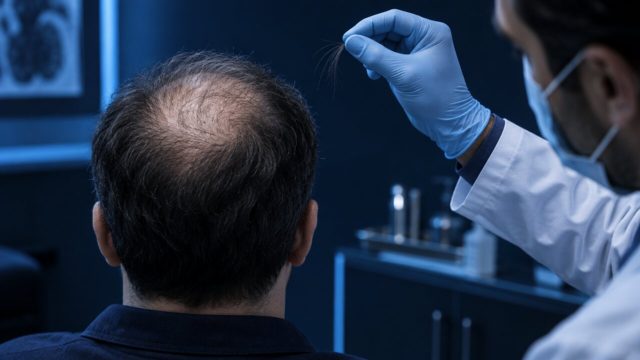
Photos taken at different times can be very helpful during assessment. They may show whether the temples are receding, whether the crown is opening, or whether diffuse thinning is becoming more visible. Trichoscopic examination can also help doctors evaluate hair shaft variation and scalp features. A responsible consultation should look beyond a single photograph and avoid assuming that a current hairline represents the final pattern of loss.
03Understanding your likely future pattern of hair loss
Family history can provide clues, although it cannot predict your future with certainty. Looking at relatives with hair loss may help identify whether there is a tendency toward frontal recession, crown thinning, diffuse loss or more extensive baldness. However, inherited patterns can differ between family members, and the rate of progression can vary significantly. A consultation should use family history as one part of the assessment, rather than as a fixed forecast.
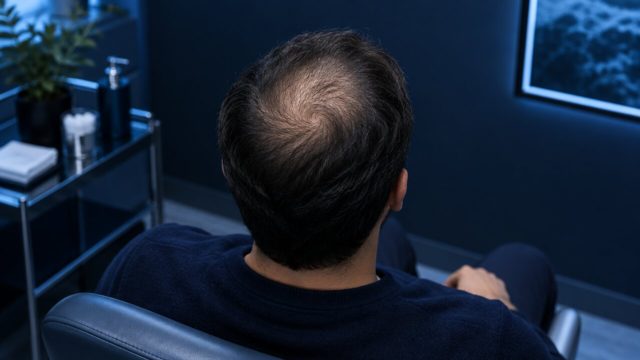
Doctors also assess the distribution of thinning on your own scalp. A receding hairline with stable density behind it may suggest a different long-term strategy from widespread thinning across the top of the scalp. The crown requires particular attention because it can use a substantial number of grafts if hair loss progresses there later. At a younger age, reserving enough donor capacity for possible future needs is often more important than achieving the densest possible coverage in one session.
A diagnosis should also exclude other explanations for shedding or reduced density. Stress-related shedding, nutritional issues, scalp inflammation, traction, autoimmune conditions and some medical factors can affect the hair. These conditions are not managed in the same way as androgenetic hair loss. If shedding is sudden, patchy, associated with itching or scaling, or follows a major health change, a medical evaluation is important before considering a surgical procedure.
04Donor area planning: protecting a limited resource
The donor area is the foundation of every hair transplant plan. It contains follicles that may be moved, but it is not an unlimited bank of grafts. Removing too many units, or taking them from an area that may not remain stable, can reduce density at the back and sides of the scalp. For this reason, donor assessment should examine hair density, hair calibre, scalp characteristics and the likely safe extraction zone.
At Acibadem Hair Transplant Center, doctors can review initial photographs through a free online hair analysis before recommending the next steps. This preliminary review is useful for discussing the visible pattern and likely expectations, but an in-person clinical assessment remains important for final planning. The goal is not simply to estimate the maximum number of grafts that could be extracted. It is to identify a number that supports a balanced result while protecting the appearance of the donor area.
For someone considering a hair transplant at 23, conservative use of donor follicles can be especially valuable. Future loss may create a need for added coverage, and donor hair used aggressively in the first procedure cannot be replaced. A plan may therefore prioritise the most visible areas, such as the frontal frame of the face, while keeping realistic density goals and preserving grafts for possible later needs.
05Choosing a hairline that can still look natural later
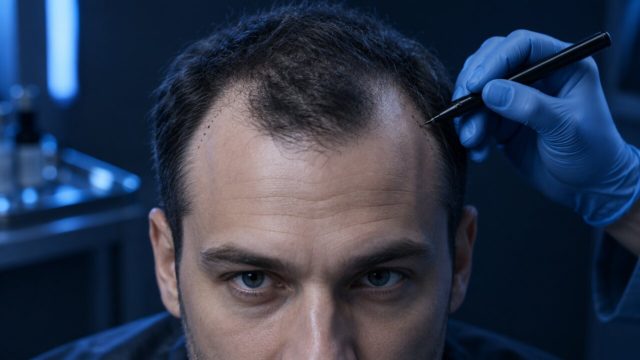
A low, dense, sharply defined hairline may look attractive in an edited image, but it may not be the wisest choice for every young patient. As people age, a mature hairline often sits higher and has a softer, irregular transition. Designing an extremely low line at 23 can create future challenges if hair loss continues behind it. It may also require a large number of grafts that could otherwise support the mid-scalp or crown later.
A good hairline design considers facial proportions, current hair quality, likely future recession and the available donor supply. It should not copy another person’s hairline or recreate an adolescent hairline without considering how it may look over decades. Single-hair grafts are commonly used at the leading edge to create a gradual, natural-looking transition, while graft placement behind the hairline supports the appearance of density. Your doctor will confirm what can be achieved safely in your individual case.
The same principle applies to temple restoration and crown work. Temples can strongly affect the overall frame of the face, but they may also be difficult to maintain if surrounding hair continues to recede. Crown restoration can offer meaningful cosmetic improvement, yet the crown may demand many grafts because of its circular growth pattern and surface area. At 23, a staged plan may sometimes be more sensible than trying to address every zone at once.
06Medical management and monitoring before surgery
Surgery is not the only part of managing pattern hair loss. Depending on the diagnosis, medical history and suitability, a doctor may discuss evidence-based medical options intended to slow further loss or support existing hair. These treatments are not appropriate for everyone, and they can have limitations or possible side effects. They should only be considered after a qualified clinician has reviewed your health information and explained the potential benefits and risks.
A period of monitoring can also be valuable. Comparing standardised photographs over several months may reveal whether the hairline, mid-scalp or crown is changing. This does not mean that every 23-year-old must wait for years before having a procedure. It means that when the future pattern is unclear, time can provide important information and may reduce the risk of designing a transplant around a temporary picture of the scalp.
If surgery is appropriate, ongoing care still matters after the procedure because native hair can continue to change. Hair transplant at 23 is most successful when it is part of a wider long-term plan, including follow-up and realistic expectations. Acibadem Hair Transplant Center provides 12 months of follow-up within its all-inclusive packages, alongside a care kit, VIP transfer and 4-star hotel accommodation for eligible international patient arrangements.
07Technique, graft numbers and realistic density expectations
Sapphire FUE and DHI are hair restoration techniques that may be considered according to the patient’s scalp, hair characteristics, recipient area and treatment plan. Sapphire FUE involves extracting follicular units and placing them into carefully created recipient sites. DHI uses an implantation approach designed for controlled placement of extracted grafts. Neither technique removes the need for a sound diagnosis, donor protection or a realistic long-term design.
The number of grafts needed cannot be decided by age or by a single request such as a certain number of grafts. It depends on the size of the area, the desired coverage, existing hair, hair thickness, curl, colour contrast and donor capacity. A younger patient should be cautious about treating graft count as a measure of quality. More grafts are not automatically better if extracting or implanting them would compromise the donor area or use resources needed later.
Comfort measures may also be discussed during planning. Needle-free anaesthesia is available at Acibadem Hair Transplant Center for suitable patients, subject to clinical assessment. Aftercare instructions, temporary shedding of transplanted hairs, the gradual growth cycle and follow-up appointments should all be explained before treatment. The clinic documents trichoscopic graft survival at month 12, with a documented 98% rate under written guarantee, but individual appearance and overall density can still vary according to each patient’s hair and ongoing native hair loss.
08Building a decision plan you can feel confident about
Before choosing a procedure, prepare questions that focus on your future as well as your present appearance. Ask what pattern of loss is suspected, whether it seems active, how the donor area has been assessed, and how many grafts should be preserved for potential future needs. Ask where the proposed hairline will sit and why that design is appropriate for your face and projected hair loss. Clear answers can help you understand whether the recommendation is conservative and medically reasoned.
It is also useful to discuss what the result may look like if no further procedures are performed. This question encourages a plan that remains acceptable even if future donor availability is limited or if you decide not to undergo another transplant. A responsible provider should explain that a hair transplant redistributes hair rather than creating new follicles. It can improve coverage, but it cannot guarantee that future thinning will stop or that a single session will meet every lifelong need.
International patients can begin with Acibadem Hair Transplant Center’s free online hair analysis, which is reviewed by doctors. Replies are typically provided on WhatsApp within around two hours. This can help you understand the consultation process and share clear photos, but it should not replace a full medical assessment. The best decision at 23 is usually one that balances your current concerns with donor preservation, future uncertainty and a natural-looking plan for the years ahead.
09Frequently Asked Questions
Is 23 too early for a hair transplant?
Age 23 is not automatically too early, but it is an age when future hair loss can be difficult to predict. A doctor should assess whether the pattern is stable, whether the donor area is strong enough, and whether the proposed design leaves options for later. In many cases, a conservative plan or a period of monitoring may be discussed before surgery.
How much does 3,000 grafts cost?
The cost of 3,000 grafts cannot be confirmed from graft number alone because the clinical plan, technique, donor assessment, treatment needs and package details can vary. A graft target may also change after a doctor evaluates the scalp and hair characteristics. A personalised quote should be provided only after an appropriate consultation or photo assessment.
What happens 20 years after a hair transplant?
Transplanted follicles may continue to grow long term, but the native hair around them can still thin over the following decades. The appearance after 20 years depends on the original hairline design, donor management, the progression of hair loss and whether additional treatment was needed. A conservative first procedure can help preserve options if future restoration becomes necessary.
Is 25 too early for a hair transplant?
Being 25 does not by itself determine whether a hair transplant is suitable. The same key questions apply: the diagnosis, speed and pattern of hair loss, donor capacity, family history and a realistic long-term plan. Your doctor will confirm whether surgery is appropriate or whether monitoring and other management should be considered first.
Bu yazı yalnızca genel bilgilendirme amaçlıdır; profesyonel tıbbi tavsiyenin yerini tutmaz.
Bu rehber genel bilgilendirme amaçlıdır ve tıbbi muayenenin yerini tutmaz. Tedavi kararları, bir doktorun yüz yüze ya da online değerlendirmesinden sonra verilir.