
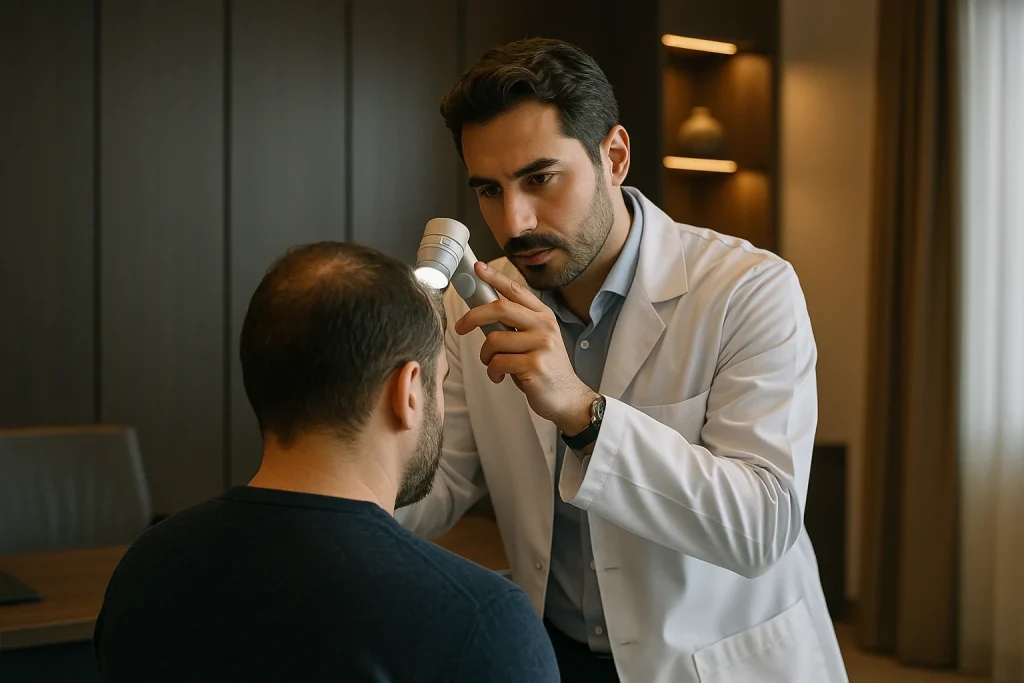
Permanent hair loss may be considered for transplantation when the cause has been diagnosed, the condition is stable, and there is enough healthy donor hair. A transplant does not treat every type of hair loss, so a doctor should first assess the scalp, donor area, medical history, and likely future pattern.
- A correct diagnosis is essential because temporary shedding, autoimmune loss, and scarring conditions need different care.
- Hair transplantation is most often considered for stable pattern hair loss with an adequate donor area.
- Active inflammation, rapidly changing hair loss, or uncontrolled scalp disease may require treatment before surgery is considered.
- A transplant redistributes existing donor follicles and does not create new hair or stop future native-hair thinning.
- Long-term planning should consider age, family history, donor capacity, hair characteristics, and future hair loss progression.
01How Permanent Hair Loss Develops
Permanent hair loss means that affected follicles may no longer be able to produce visible, normal hair growth. It can happen when follicles gradually become smaller through genetic sensitivity, when they are destroyed by scarring or injury, or when another condition causes lasting damage to the scalp. Although people often use the term after noticing more hair in the shower or brush, shedding alone does not confirm that the loss will be permanent. A clinical assessment helps separate temporary changes from conditions that may require longer-term planning.
The hair growth cycle has active growth, transition, and resting phases. It is normal to lose some hairs every day as part of this cycle. However, a visible widening part, receding hairline, thinning crown, or reduced density that continues over time can suggest a more persistent process. In androgenetic alopecia, often called male or female pattern hair loss, genetically sensitive follicles usually produce progressively finer and shorter hairs before some areas appear sparse.
Not every long-lasting concern affects the follicle in the same way. Hormonal changes, nutritional deficiencies, stress-related shedding, certain medicines, thyroid disorders, and recent illness can all alter density, but some causes may improve once the underlying issue is addressed. By contrast, scar-forming scalp disorders can replace follicles with scar tissue. This difference is important because treatment choices, timing, and whether transplantation may be appropriate depend on the diagnosis.
A person may notice changes slowly, especially when styling habits compensate for reduced coverage. Comparing photographs taken under similar lighting can sometimes show whether the hairline, part line, or crown has changed over months. Your doctor may examine the scalp closely, ask about family history and health events, and use trichoscopy to look at follicle and hair-shaft patterns. Early assessment can help preserve options, even if surgery is not currently recommended.
02Temporary Shedding and Lasting Follicle Change Are Not the Same
A sudden increase in shedding is often called telogen effluvium. It can occur several months after fever, surgery, childbirth, rapid weight change, significant emotional stress, restrictive dieting, or an illness. In many patients, the follicles remain present and can return to growth when the trigger has passed and contributing health factors are managed. The scalp may look less dense, but this is not automatically the same as permanent hair loss.
Pattern hair loss generally develops more gradually. In men, it may begin with temple recession, a changing frontal hairline, or crown thinning. In women, it often appears as a broader central part or reduced density across the top while the frontal hairline is relatively preserved. These patterns can overlap with temporary shedding, which is why a person may need an assessment rather than relying only on what they see in the mirror.
The duration, speed, and location of loss are useful clues, but they are not enough to diagnose the cause alone. Itching, burning, tenderness, scaling, broken hairs, smooth shiny areas, or patches of loss should be reported to a doctor. These signs may indicate inflammation, infection, an autoimmune process, hair-shaft damage, or a scarring condition that needs medical attention before any cosmetic procedure is discussed.
Blood tests may be considered when a clinician suspects a contributing medical issue, particularly if there are symptoms beyond hair loss or a sudden unexplained change in density. Testing is individual and should be guided by a medical professional. It is also helpful to mention recent illnesses, new medicines, dietary changes, menstrual or hormonal changes, family history, and hair care practices. A detailed history often provides important context for a safe treatment plan.
03Why the Top of the Head May Start to Look Thinner
Thinning on the top of the head is commonly linked to androgenetic alopecia. In this condition, certain follicles are genetically more sensitive to hormonal signals and gradually miniaturise. The hairs become finer, shorter, and less pigmented, so scalp visibility can increase even before a person notices substantial shedding. The pattern differs between individuals and may be influenced by family history on either side of the family.
Other possible causes include diffuse shedding after a physical or emotional stressor, iron deficiency or other nutritional concerns, thyroid disease, hormonal changes, some medications, and scalp conditions. Tight hairstyles, repeated chemical processing, heat damage, or traction can also contribute to breakage or loss in particular areas. In women, a wider part may also occur alongside hormonal or metabolic concerns, which should be assessed by an appropriate clinician.
A consultation should look beyond the top of the scalp. The donor region at the back and sides is assessed because these follicles may be more resistant to pattern loss in suitable candidates. However, donor hair is not unlimited, and its stability varies from person to person. A careful assessment considers both the area that currently looks thin and the possibility that nearby native hair may continue to miniaturise later.
Photographs and trichoscopy can help document baseline density and monitor change. This can be especially useful when the problem is subtle or when more than one type of hair loss may be present. A doctor may recommend a period of observation or medical management before deciding whether surgery is appropriate. This approach aims to avoid transplanting into an unstable pattern without a long-term plan.
04Scarring and Autoimmune Hair Loss Need Special Attention
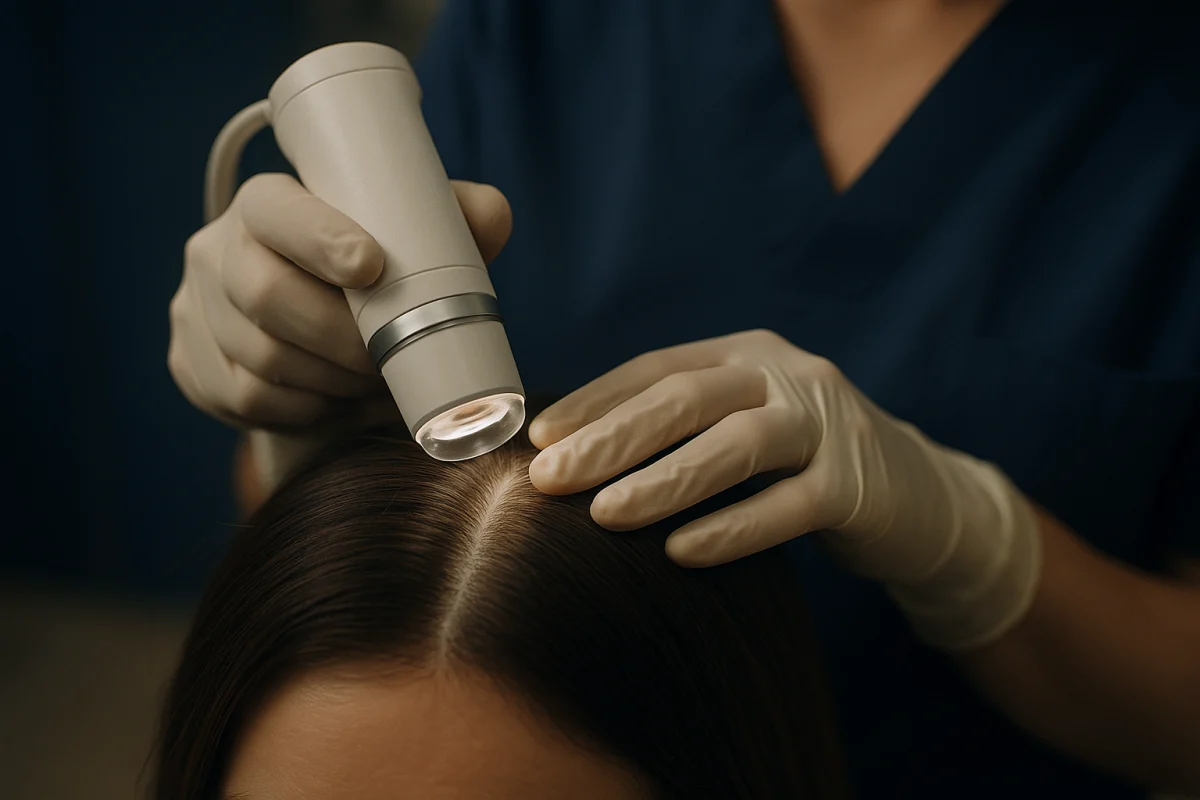
Scarring alopecia refers to a group of disorders in which inflammation damages follicles and may leave scar tissue behind. The scalp can appear smooth, shiny, pale, or uneven, and follicle openings may be reduced or absent. Some people experience discomfort, redness, scale, pustules, itching, or burning, while others notice few symptoms. Because early treatment may help limit further damage in some conditions, prompt dermatological assessment is important.
Alopecia areata is an autoimmune condition that can cause sudden, round or oval patches of hair loss. One possible clinical clue is the presence of short hairs that are narrower near the scalp and wider at the end. These are commonly called exclamation point hairs because of their shape. They can support a clinical diagnosis, but they are not something a person should use to diagnose themselves without examination.
Hair transplantation is usually approached with caution in active autoimmune or scarring conditions. Surgery may not be suitable while the disease is active because transplanted hairs and surrounding native hairs could be affected by ongoing inflammation or future recurrence. In selected cases where a specialist confirms stable disease over an appropriate period, a transplant may be discussed, but suitability is highly individual.
Infections and inflammatory scalp disorders can also affect scalp comfort and hair appearance. Treating the cause is more important than covering the result with a procedure. If you have patchy loss, scalp pain, rapidly spreading thinning, or visible inflammation, seek medical evaluation rather than waiting for the area to progress. A diagnosis creates the basis for safer, more realistic decisions.
05When Permanent Hair Loss May Be Considered for Transplantation
Hair transplantation may be considered when a person has a stable diagnosis, an adequate donor area, realistic expectations, and a pattern of loss that can be planned responsibly. It is most commonly discussed for androgenetic alopecia, where healthy follicles are moved from the donor region to areas with reduced density. The transplanted follicles retain many characteristics of their donor location, but results still depend on healing, scalp condition, hair characteristics, and ongoing hair loss.
Stability matters because a transplant does not stop surrounding native hair from thinning in the future. If a young patient has rapidly progressing loss, or if the current pattern is not yet clear, a doctor may suggest monitoring, medical treatment where appropriate, or delaying surgery. This can help protect donor resources and reduce the risk of an unnatural appearance if the hairline continues to recede after a procedure.
Donor assessment is a central part of candidacy. The surgeon considers density, hair calibre, curl, colour contrast between hair and skin, scalp flexibility, and the expected number of grafts that can be harvested conservatively. A large area of loss does not always mean that enough donor hair is available to restore dense coverage everywhere. For this reason, priority areas and a natural-looking design should be discussed openly.
Sapphire FUE and DHI are two techniques that may be used according to the treatment plan. Sapphire FUE involves extracting follicular units and placing them into prepared recipient channels, while DHI uses a specialised implantation approach for graft placement. Neither technique is automatically best for every person. Your doctor should explain the proposed method, its potential benefits and limits, and why it may suit your scalp and hair goals.
06What a Responsible Hair Transplant Assessment Includes
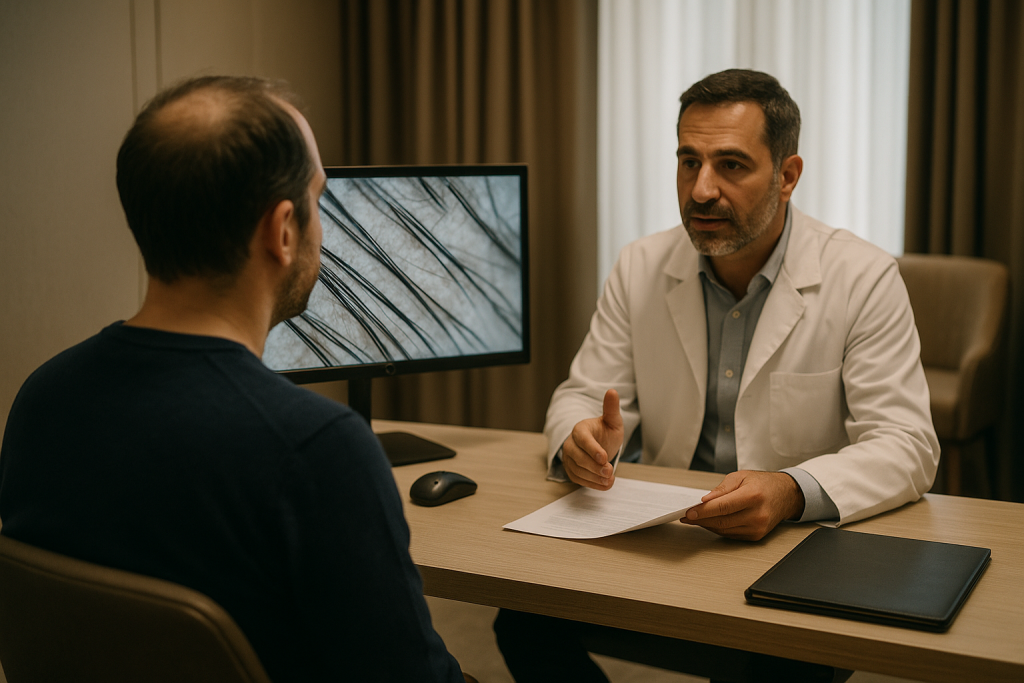
A responsible assessment starts with diagnosis rather than graft numbers alone. The clinician should ask when the loss began, whether it is progressing, whether there is a family pattern, and whether there have been medical events or treatments that could be relevant. Examination of the scalp and donor area helps identify miniaturisation, inflammation, scarring, and differences in hair density. Trichoscopy may support this evaluation by showing details not easily visible to the naked eye.
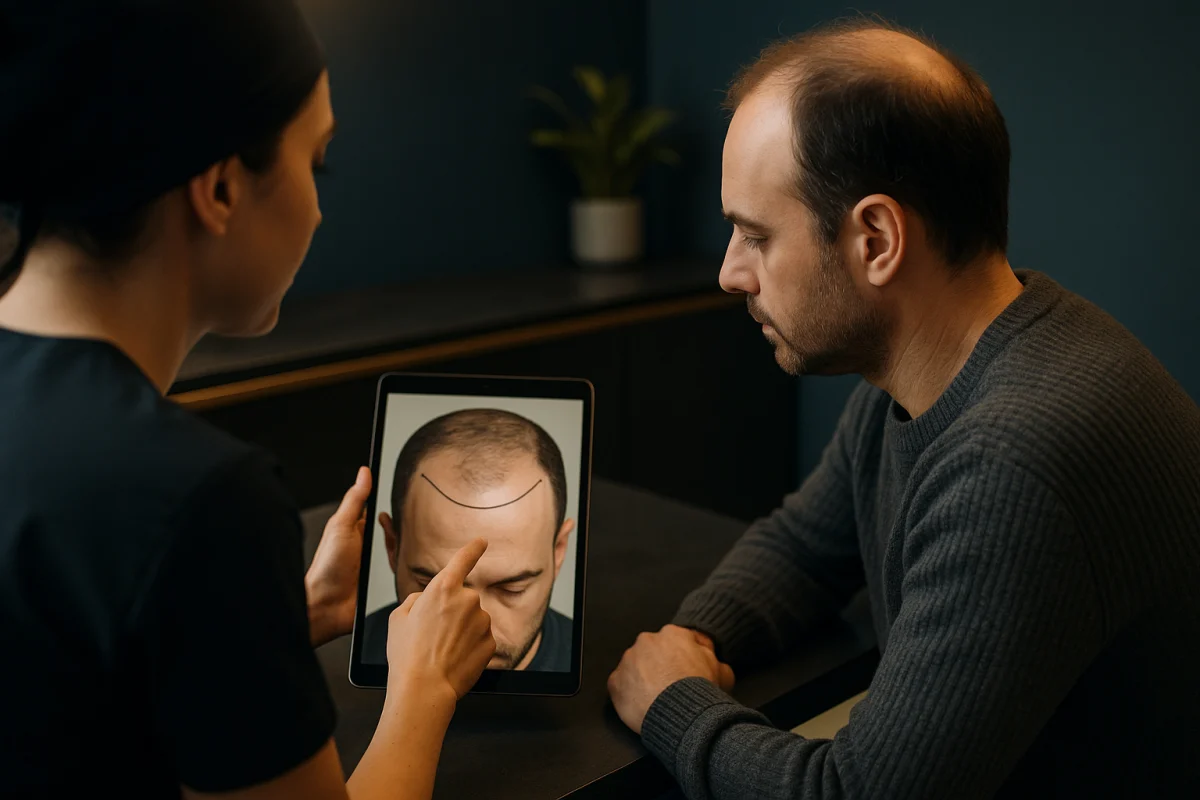
Hairline planning requires particular care. A low, dense hairline may sound attractive now but may not remain suitable if hair loss progresses. Most ethical planning aims for an age-appropriate design that uses donor hair carefully and allows for possible future needs. The frontal hairline, temples, mid-scalp, and crown compete for a limited donor supply, so the plan should reflect priorities and likely future change.
Patients should also understand what surgery can and cannot do. Transplanted grafts can improve coverage in selected areas, but they cannot recreate unlimited youthful density across a large bald scalp. Existing native hair may still require ongoing monitoring or treatment recommended by a doctor. The final appearance typically develops gradually, and the full visual result may take many months to mature.
Acibadem Hair Transplant Center is a dedicated hair restoration clinic in Istanbul, licensed by the Turkish Ministry of Health. The clinic offers a free online hair analysis reviewed by doctors, with WhatsApp replies typically available within around two hours. An online review can provide initial guidance, but it does not replace an in-person medical examination or the final decision made by the treating doctor.
07Recovery, Follow-Up, and Protecting Existing Hair
After a hair transplant, the scalp needs time to heal and the grafts need time to settle. Temporary scabbing, redness, swelling, and shedding of transplanted hair can occur during the early recovery period. This shedding is often part of the normal growth cycle after implantation and does not necessarily indicate graft failure. Your medical team should provide written aftercare instructions and explain which symptoms require contact with the clinic.
New visible growth usually develops gradually rather than immediately. Individual timing varies, and the cosmetic result should not be judged in the first weeks. Follow-up allows the team to review healing, discuss changes in native hair, and answer practical questions about washing, activity, sun exposure, and styling. It also supports realistic expectations throughout the recovery process.
Long-term care should focus on both transplanted and non-transplanted hair. A doctor may discuss evidence-based medical options when appropriate, particularly if pattern hair loss is still progressing. Gentle hair practices, adequate nutrition, management of diagnosed health conditions, and avoidance of unnecessary traction or chemical damage may also support general scalp and hair health. These measures cannot replace treatment for a medical cause, but they can form part of a sensible routine.
For international patients, practical support can make follow-up easier. Acibadem Hair Transplant Center provides all-inclusive packages that include VIP transfer, a 4-star hotel, a care kit, and 12 months of follow-up. The clinic has welcomed patients from 38 countries over 12 years. Results are measured by trichoscopic graft survival at month 12, with a documented 98% rate under written guarantee, while individual cosmetic outcomes can still vary.
08Frequently Asked Questions
What is the American Hair Loss Association?
The American Hair Loss Association is a consumer-focused organisation that shares educational information about hair loss and available treatment approaches. It is not a substitute for a medical diagnosis, and its information should be considered alongside advice from a qualified healthcare professional. If you are concerned about a change in your hair, a clinical scalp assessment is the appropriate next step.
What are exclamation point hairs in alopecia?
Exclamation point hairs are short hairs that are thinner close to the scalp and wider toward the tip, giving them an exclamation-mark-like appearance. They can be seen in alopecia areata and may suggest active disease, but they do not confirm a diagnosis on their own. A dermatologist or hair-loss doctor can examine the scalp and determine the cause of patchy loss.
What could cause thinning on the top of my head?
Common causes include androgenetic alopecia, temporary stress-related shedding, hormonal changes, thyroid conditions, nutritional issues, medication effects, and scalp disorders. Hair breakage from traction, heat, or chemical treatments can also make the top appear less dense. Because the causes can overlap, a doctor should assess the pattern, scalp health, medical history, and donor area before recommending treatment.
Are there home remedies for hair fall?
Gentle hair care, avoiding tight styles and excessive heat, eating a balanced diet, and managing diagnosed health conditions may support overall hair health. However, home remedies have limited evidence for treating genetic hair loss, autoimmune alopecia, or scarring conditions, and oils or supplements may irritate the scalp or interact with medicines. Persistent, sudden, or patchy hair loss should be evaluated medically rather than treated only at home.
Bu yazı yalnızca genel bilgilendirme amaçlıdır; profesyonel tıbbi tavsiyenin yerini tutmaz.
 06
 12