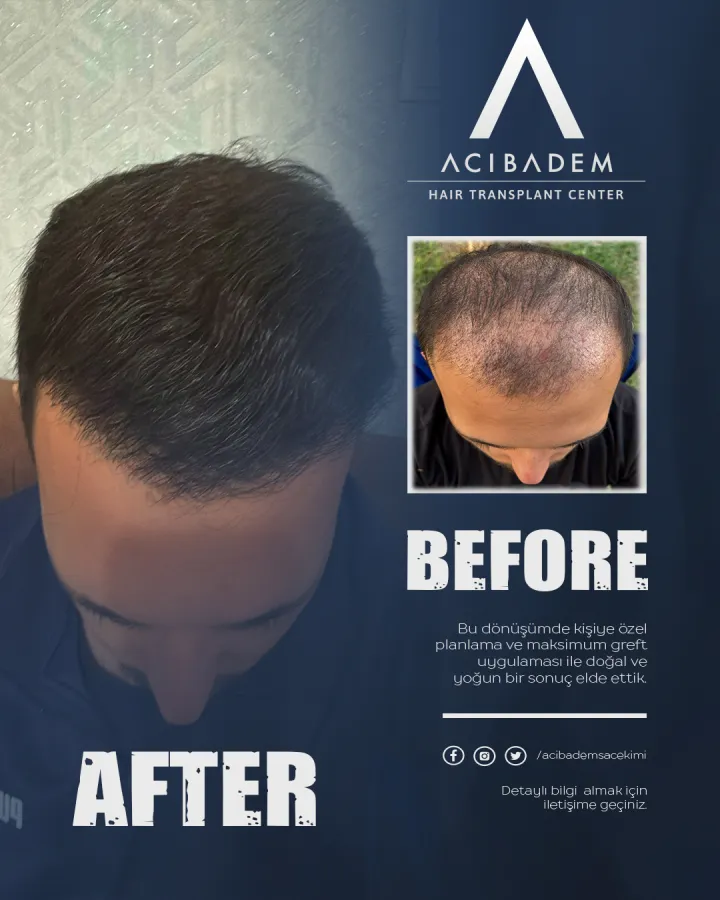
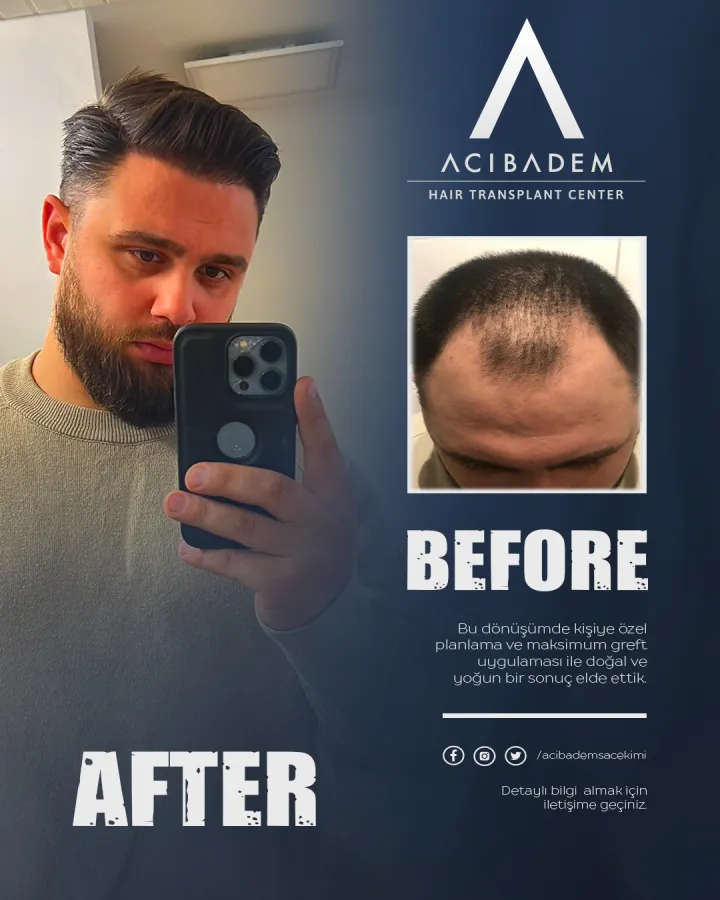
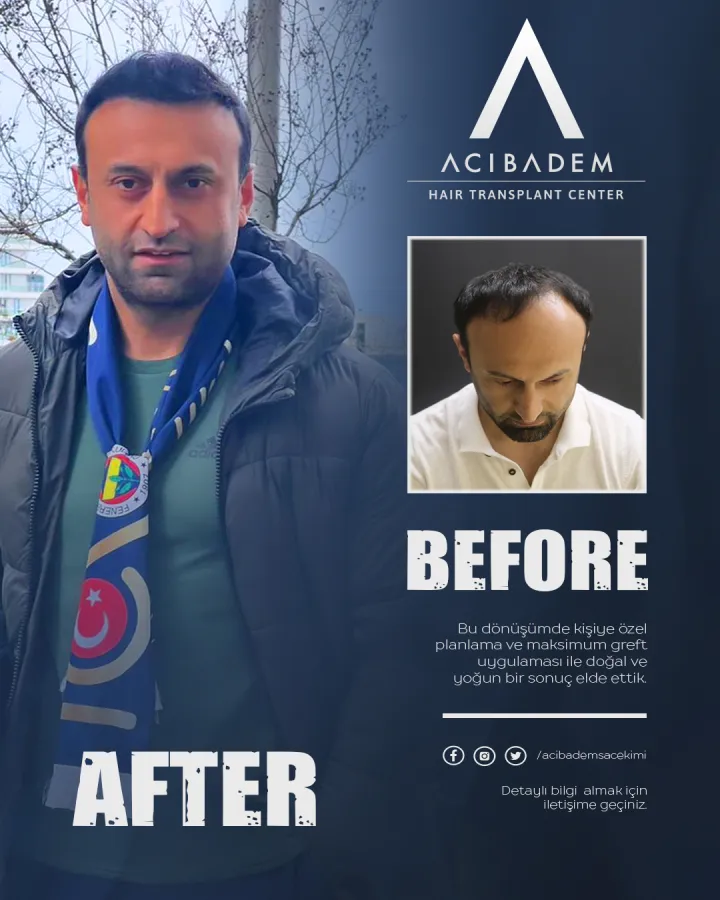
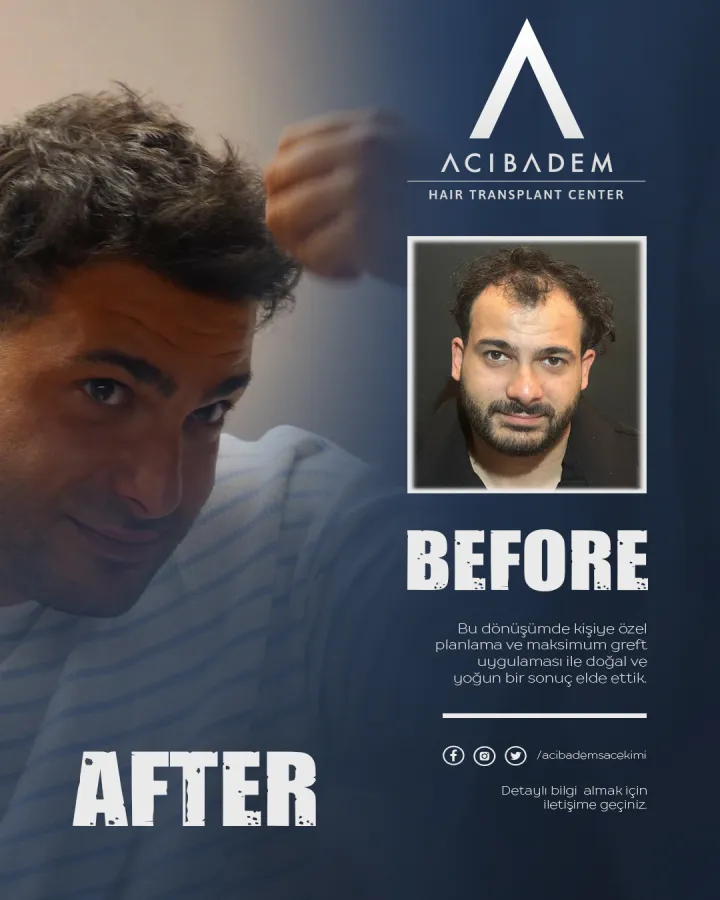
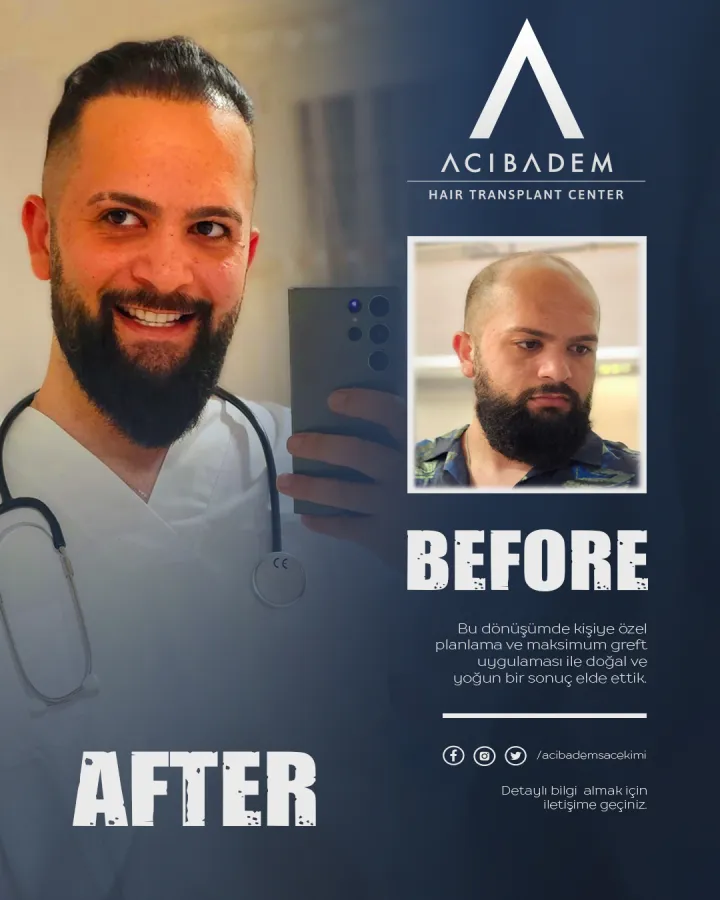
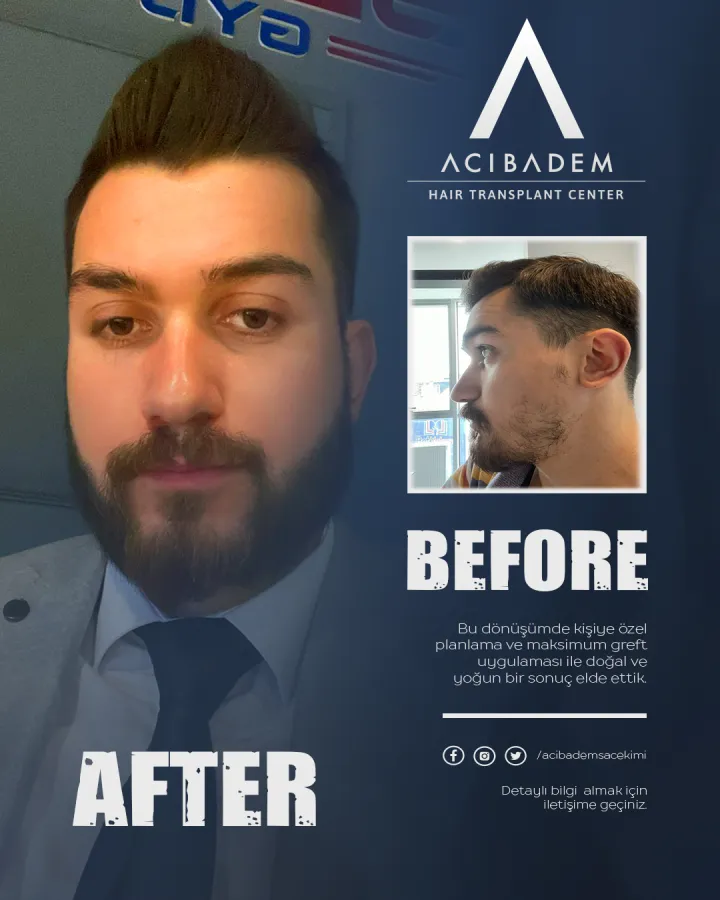
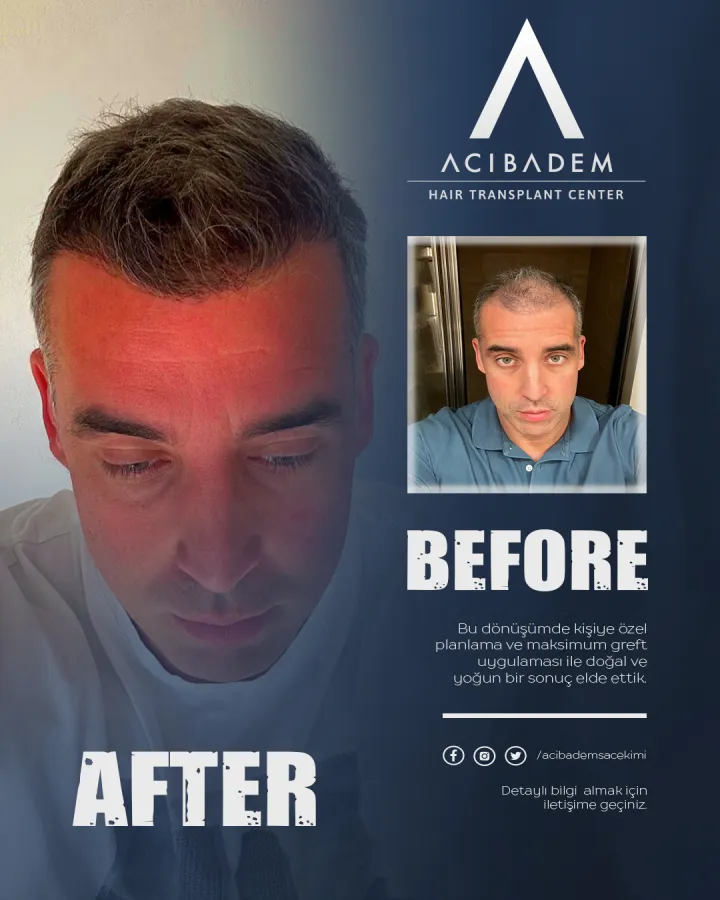
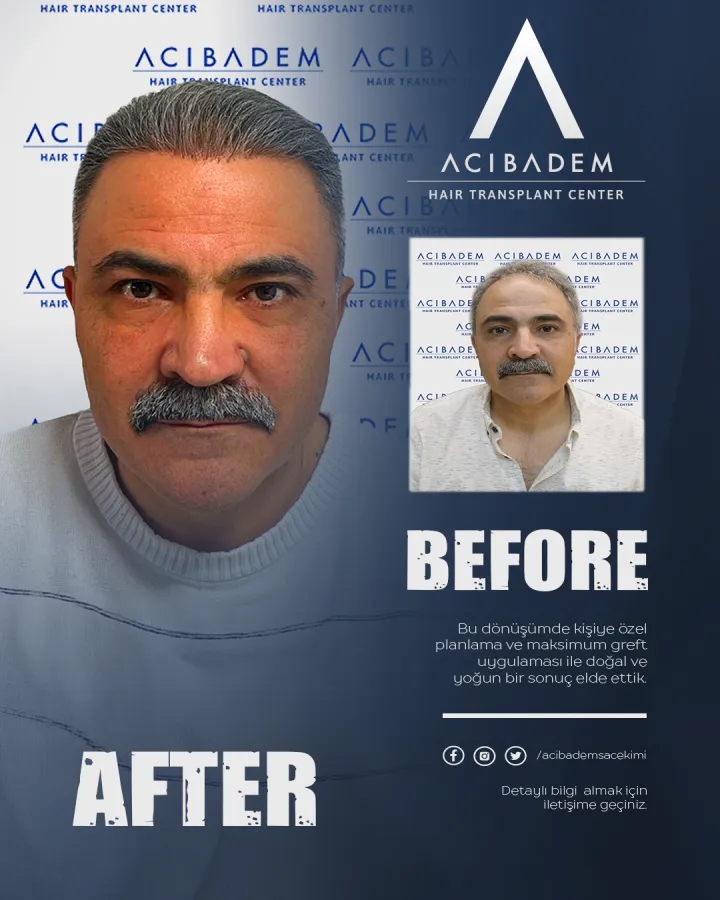
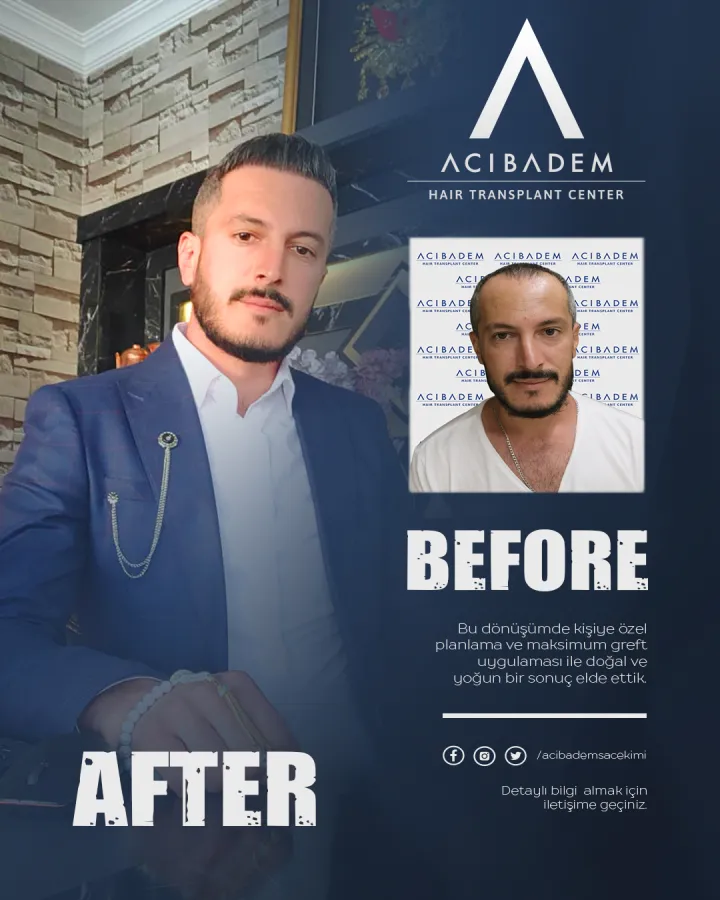
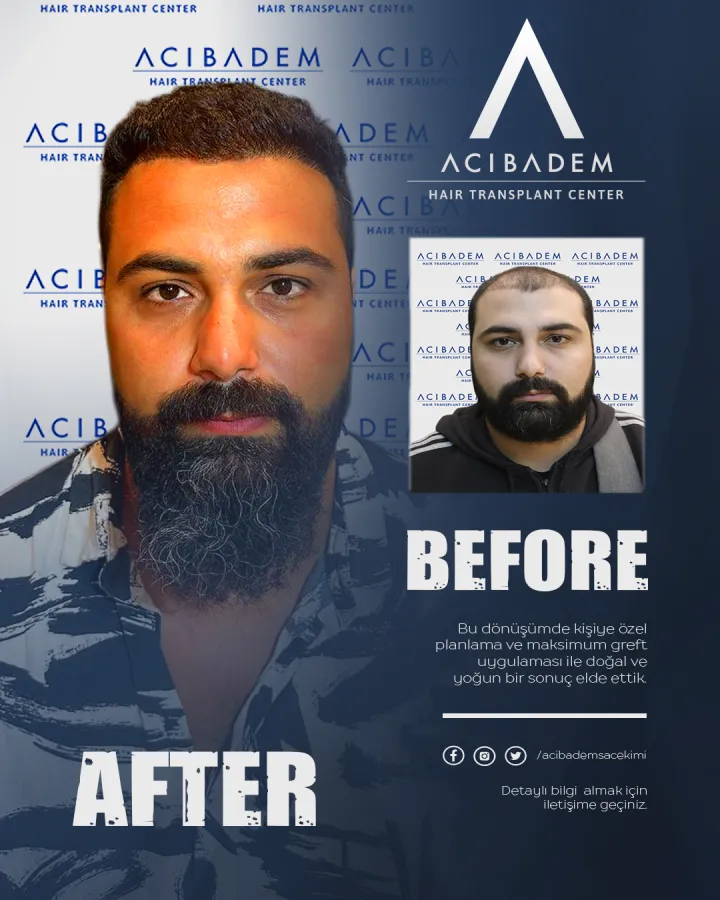
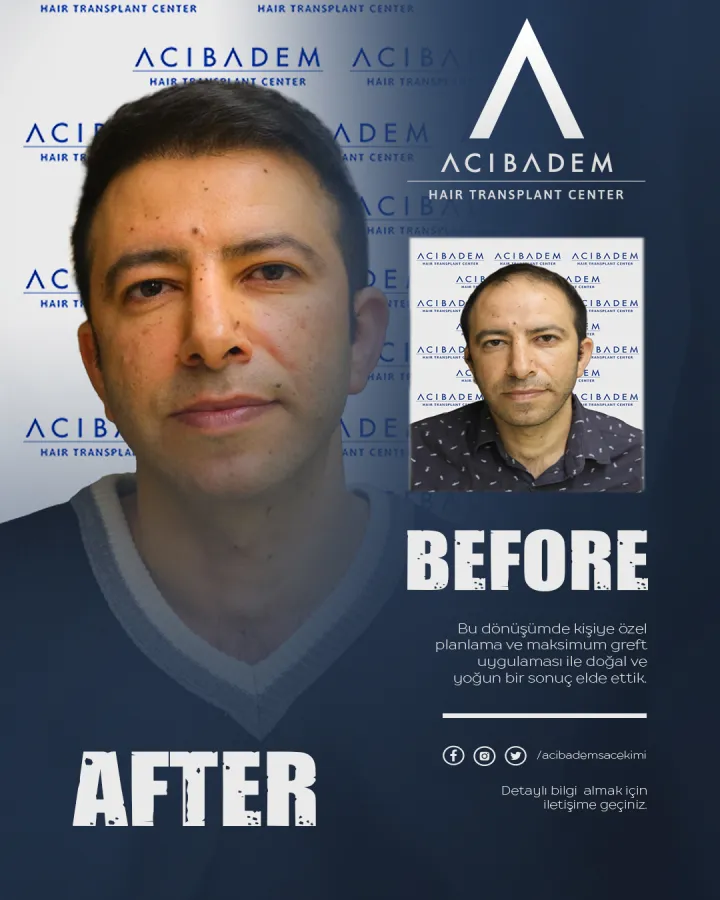
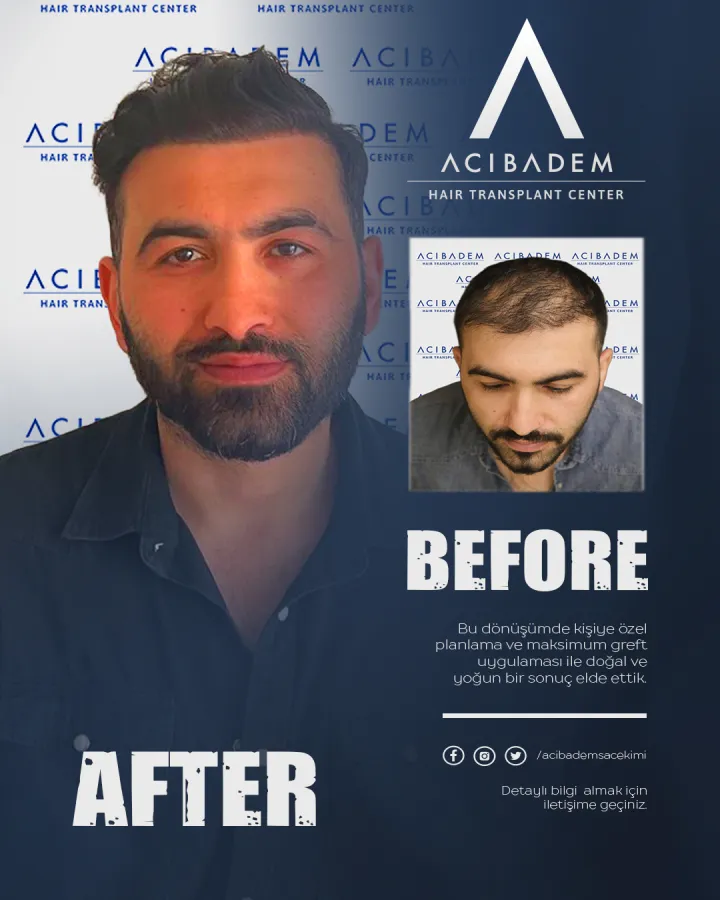
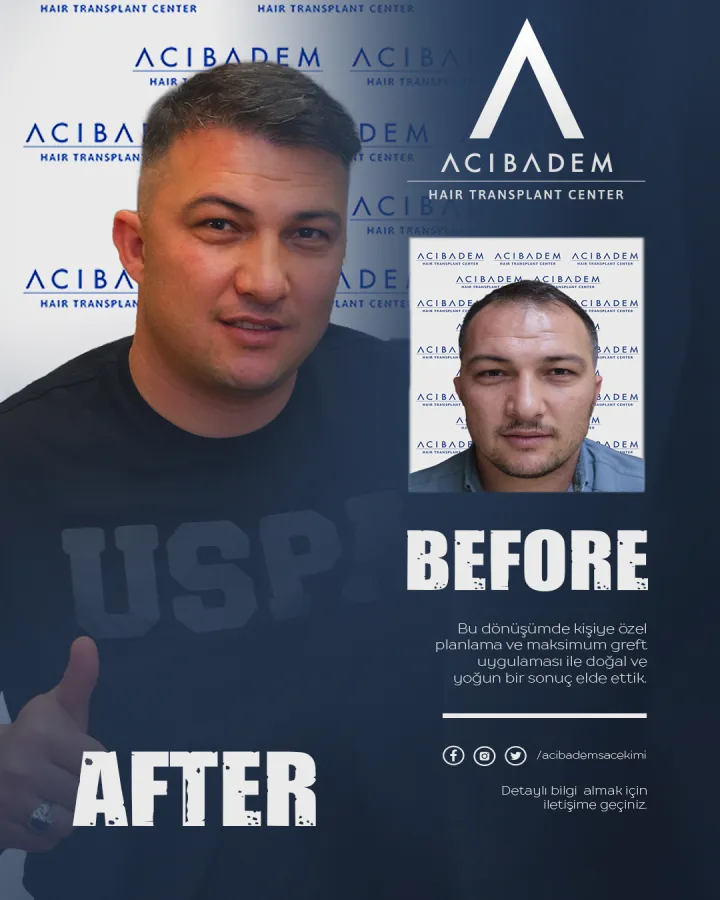
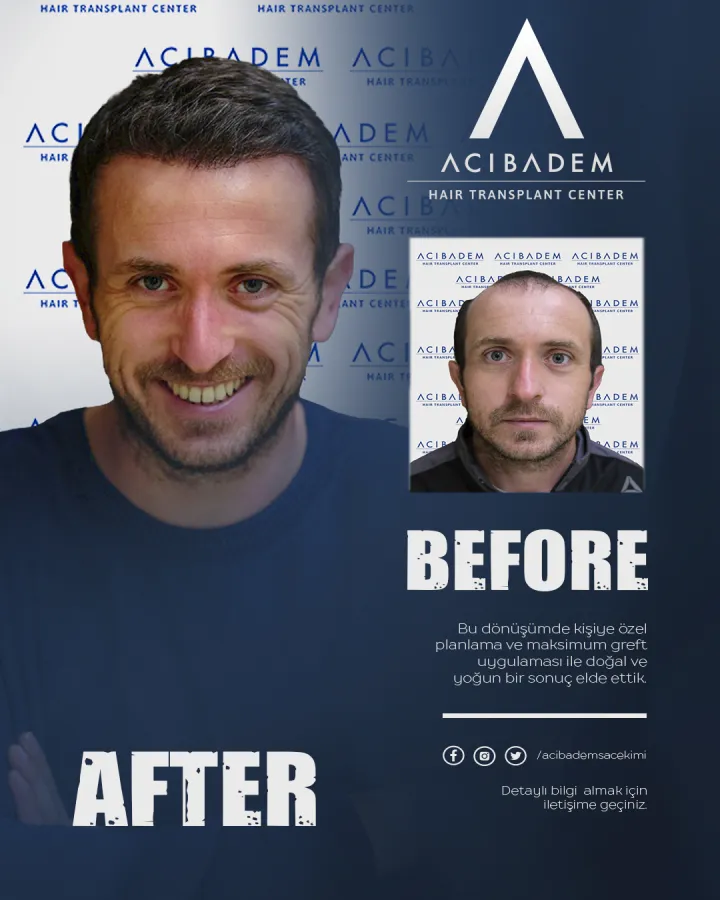
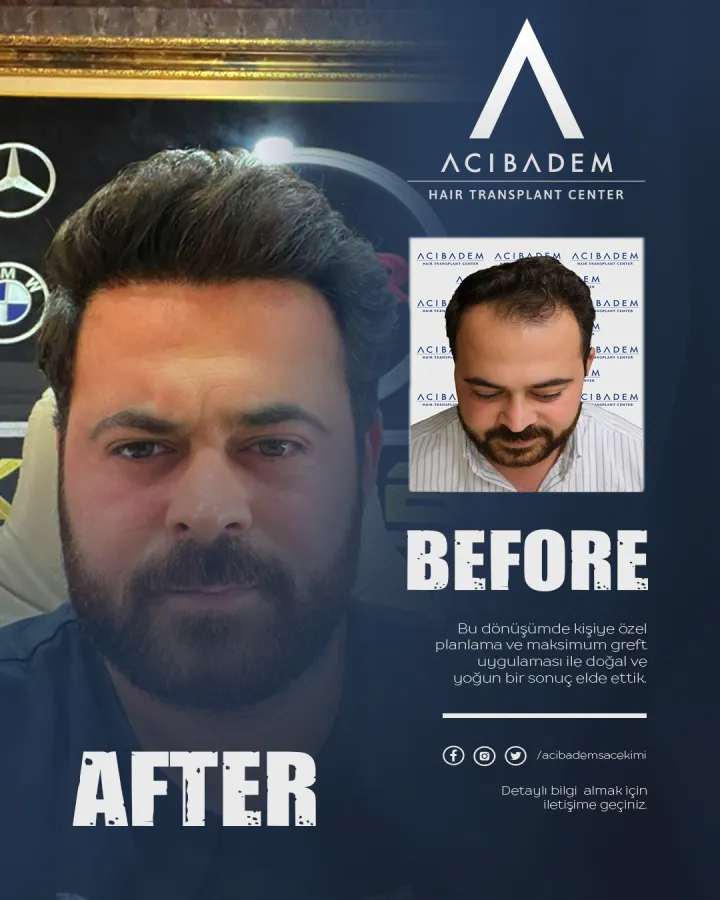
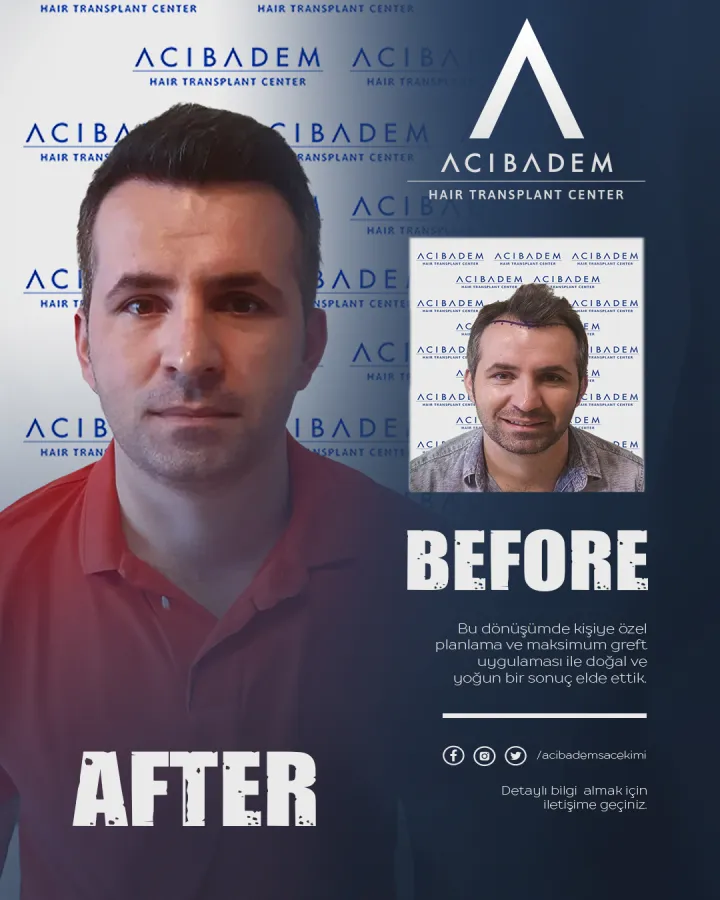
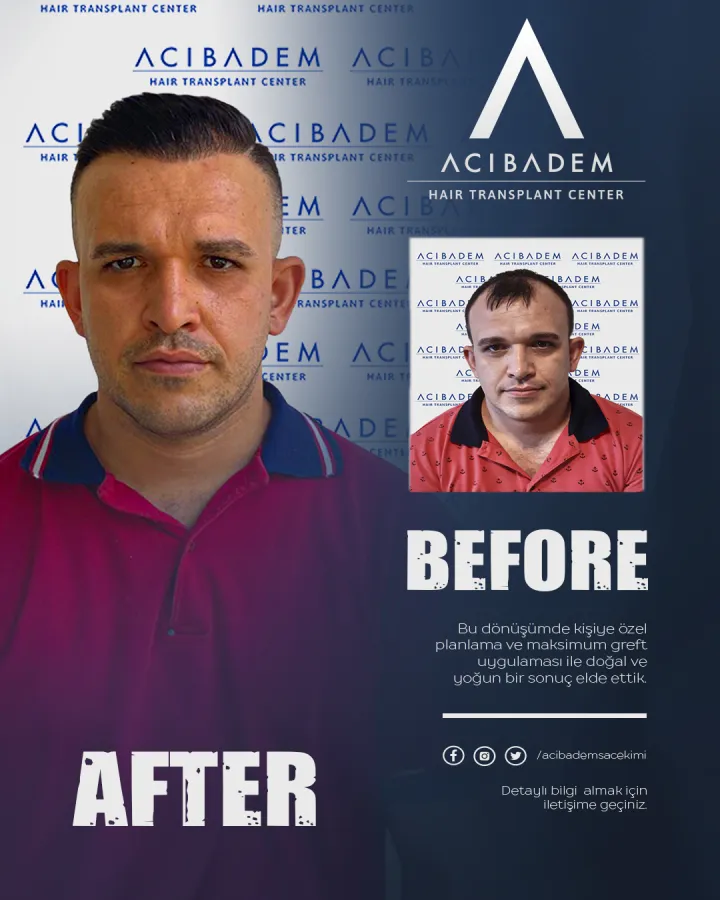
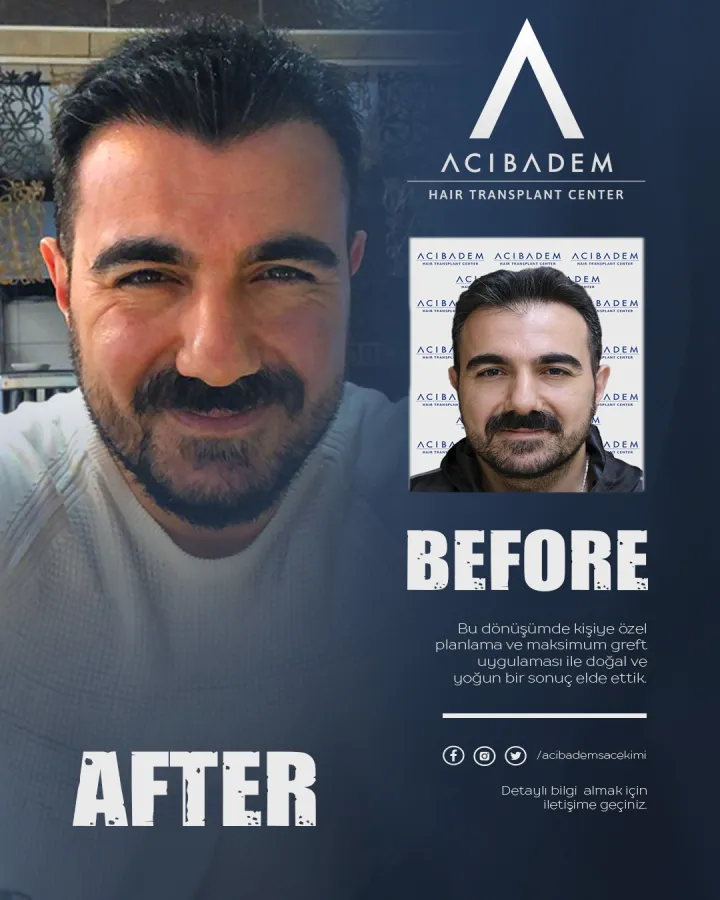
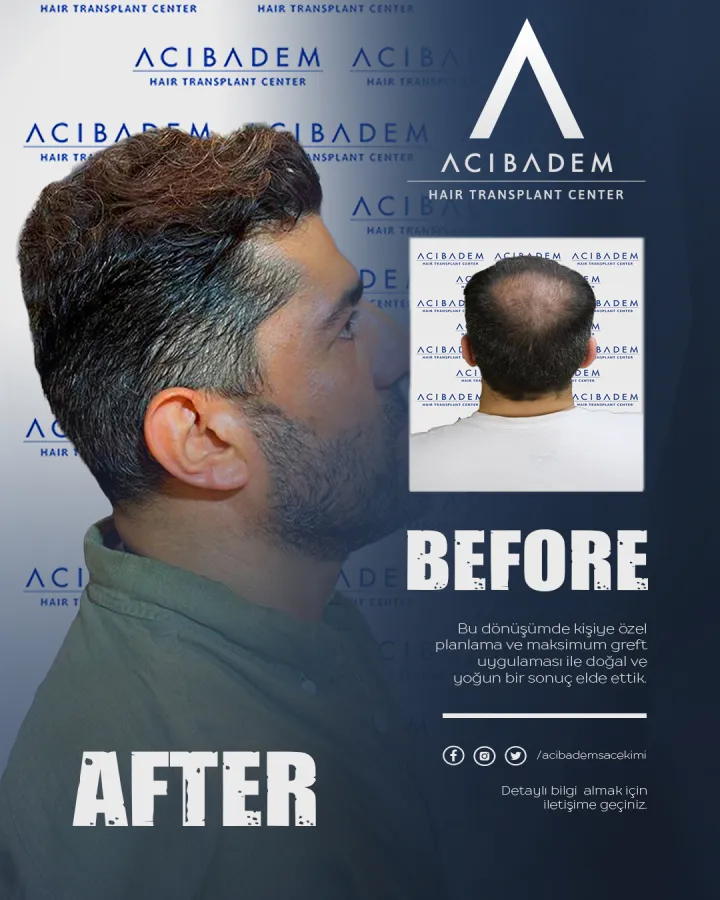
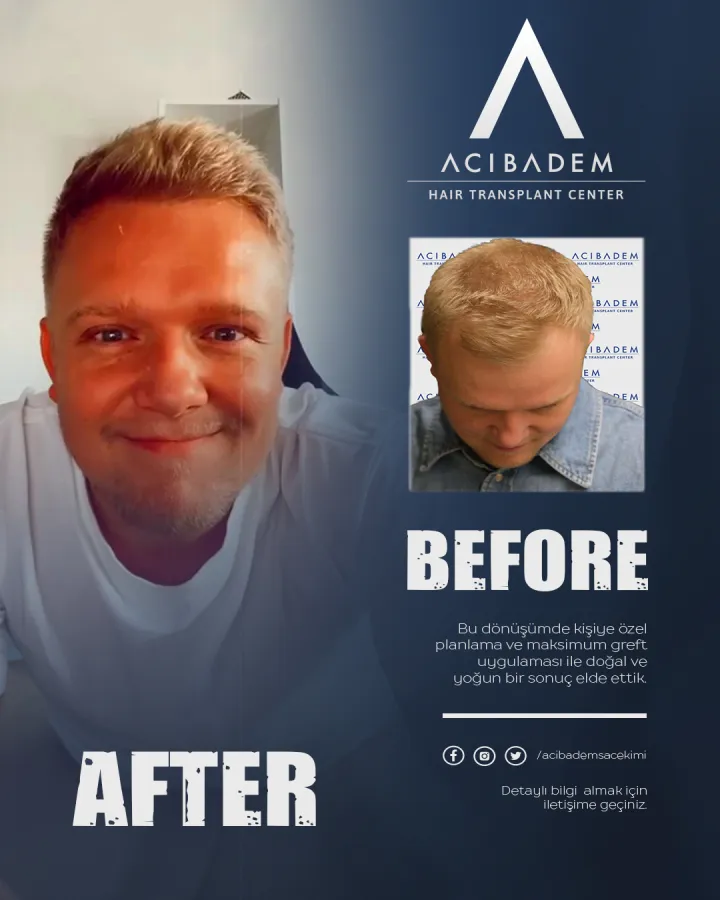
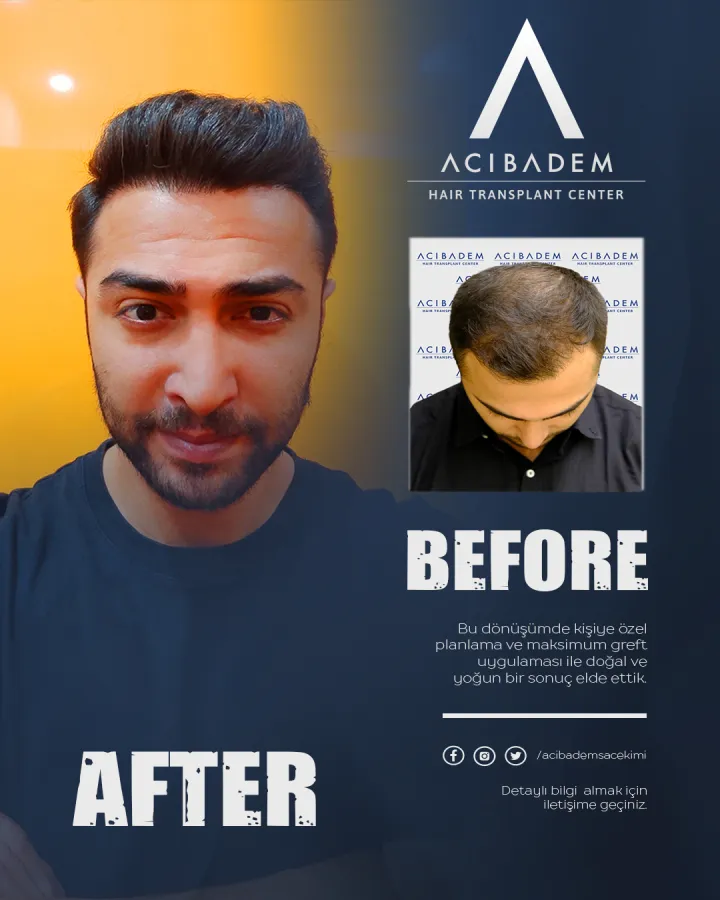
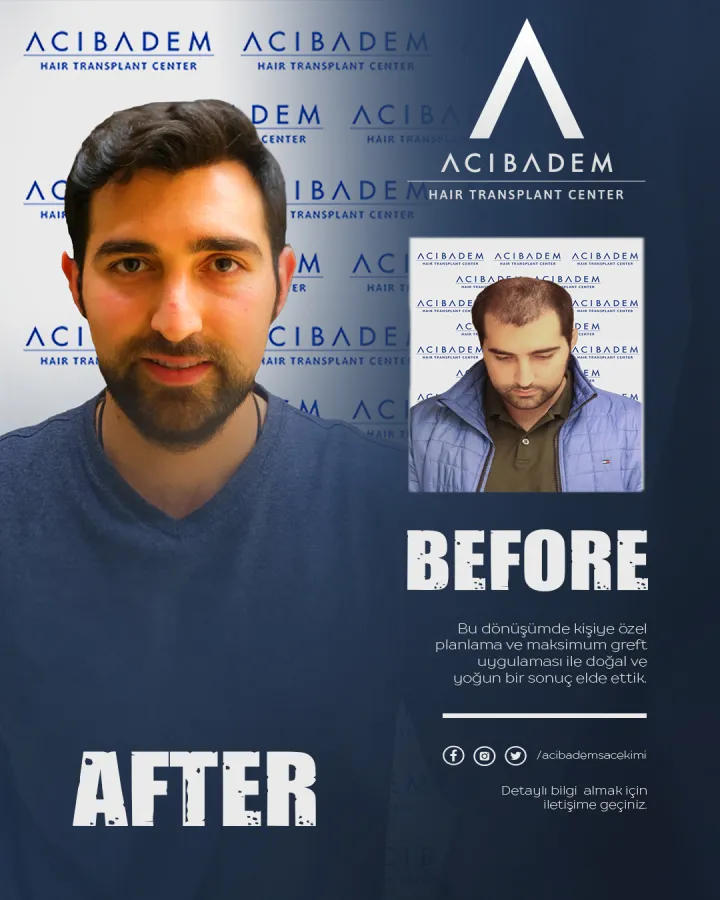
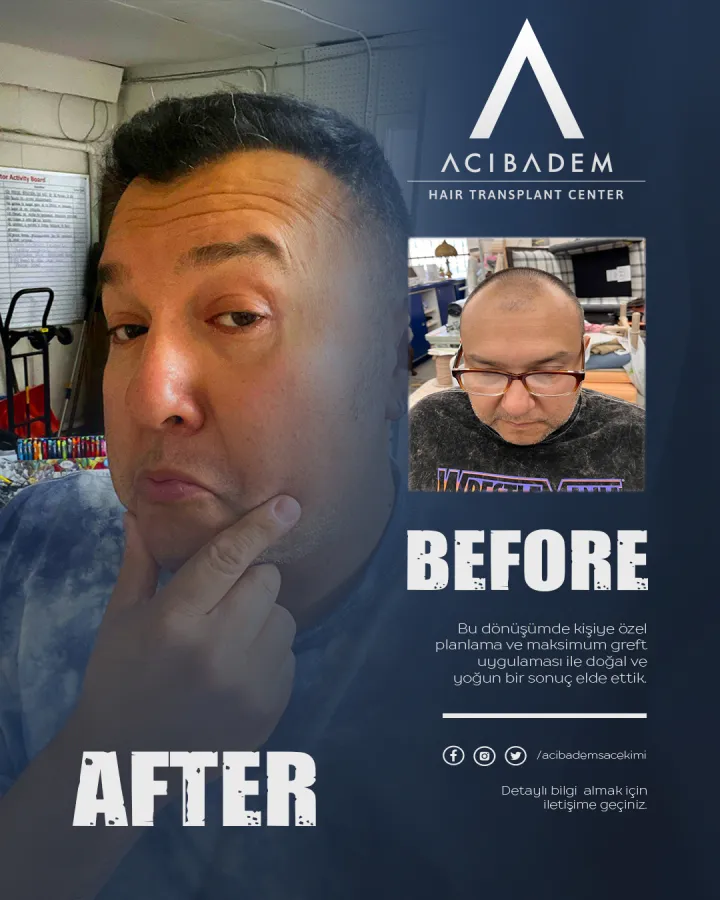
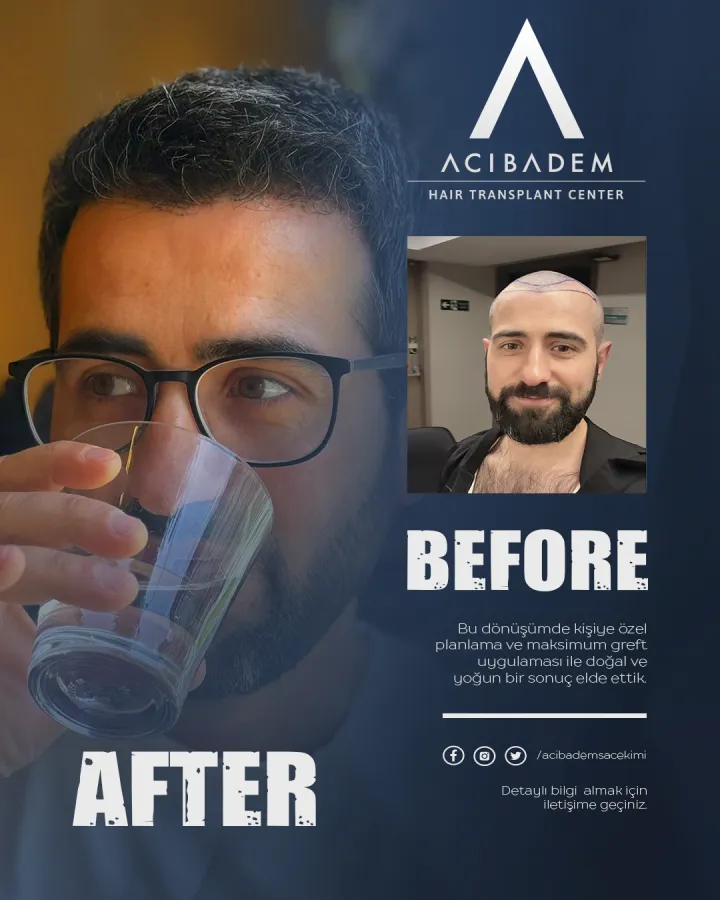
Where do I even begin? I want to express my deepest gratitude for your warm and welcoming atmosphere. The entire team were incredibly professional and supportive throughout the entire process. They coordinated all my appointments without any delays and even booked me an amazing hotel. I highly recommend this company for a hair transplant. They are the best of the best!
Published on GoogleAcibadem Hair Transplant Center · Istanbul
Hair Transplant in
Istanbul, Turkey
Every hair transplant begins with a hairline designed for your facial features. Our Istanbul clinic performs Sapphire FUE and DHI procedures in internationally accredited operating rooms, and documents your results for a full 12 months.
Step 1 · Get started
Online hair analysis
Answer a few quick questions and receive your personal plan, reviewed by our specialists.
Select your gender
Step 2 · Affected area
Where do you notice hair loss?
Select the area that concerns you most.
Not sure? Choose the closest area — your doctor will refine it during review.
Step 3 · History
Tell us about your hair loss
A short timeline helps us understand the pattern and pace.
When did your hair loss begin?
Is your hair loss still progressing?
Family history of hair loss?
Step 4 · Age
How old are you?
Helps us evaluate donor strength and long-term planning.
Step 5 · Contact
Where should we send your plan?
Your data stays with the clinic. No marketing, ever.
Please fill in all fields with a valid email.
Your plan is being prepared
Our specialists review your answers and reply on WhatsApp within 2 hours.
Your plan will include
Pattern analysis Estimated graft range Recommended techniqueWhy Acibadem
An Internationally Accredited Hair Transplant Center
Acibadem Hair Transplant Center is a dedicated hair restoration clinic in Istanbul, chosen by patients from 38 countries for 12 years. Every result is verified by a trichoscopic graft survival measurement at month 12, and the 98% rate is secured by a signed guarantee certificate — with your entire treatment planned as one all-inclusive package.
Our Techniques
Advanced Hair Transplant Technologies
Sapphire FUE
Sapphire FUE hair transplant uses sapphire-tipped blades to open micro channels that heal faster and allow denser graft placement.
DHI Plus
DHI hair transplant places grafts directly with the Choi implanter pen — no channel incisions, no shaving and no visible scarring.
Plus Pro FUE
An advanced FUE protocol developed at our Istanbul center, targeting the maximum graft count in a single session.
Beard & Moustache
Beard transplant grafts are placed one by one with the DHI technique, with density and angle matched to your facial lines.
Eyebrow Transplant
Eyebrow transplant with micro grafts; direction and angle are planned hair by hair for a natural, permanent result.
Results
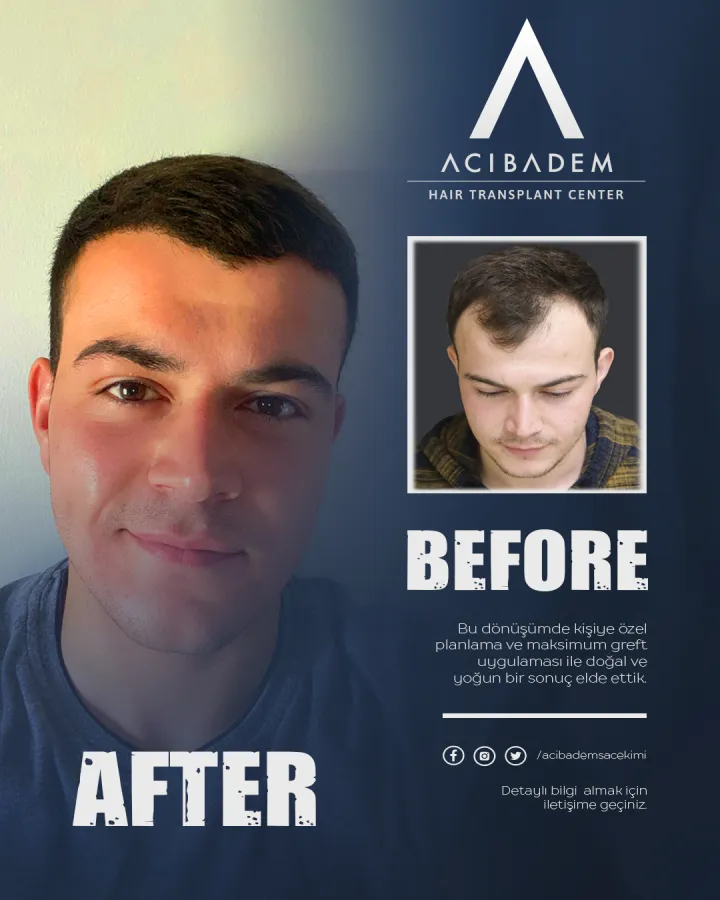
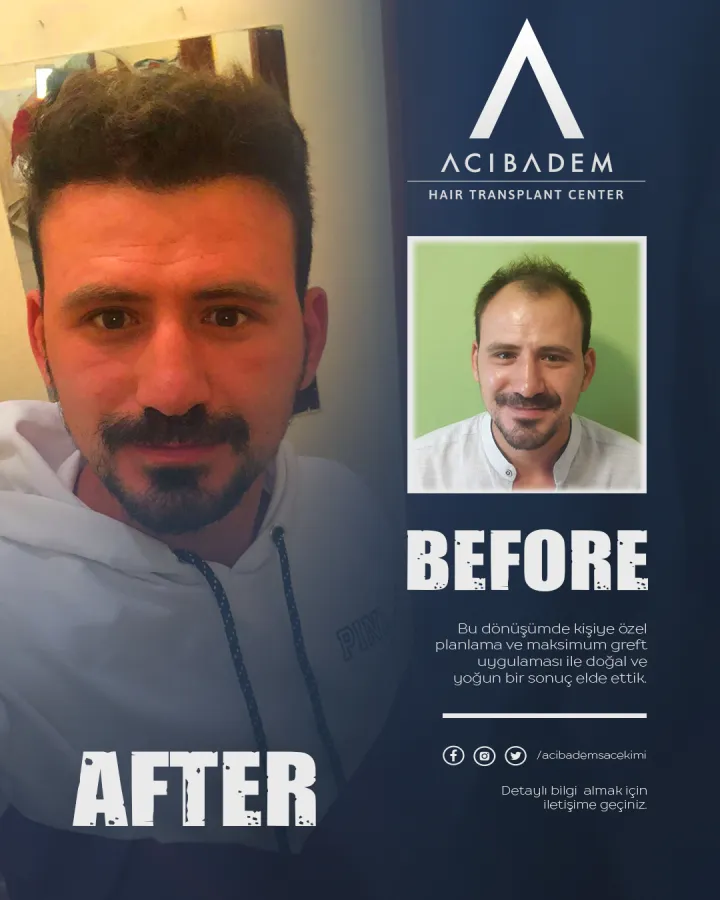
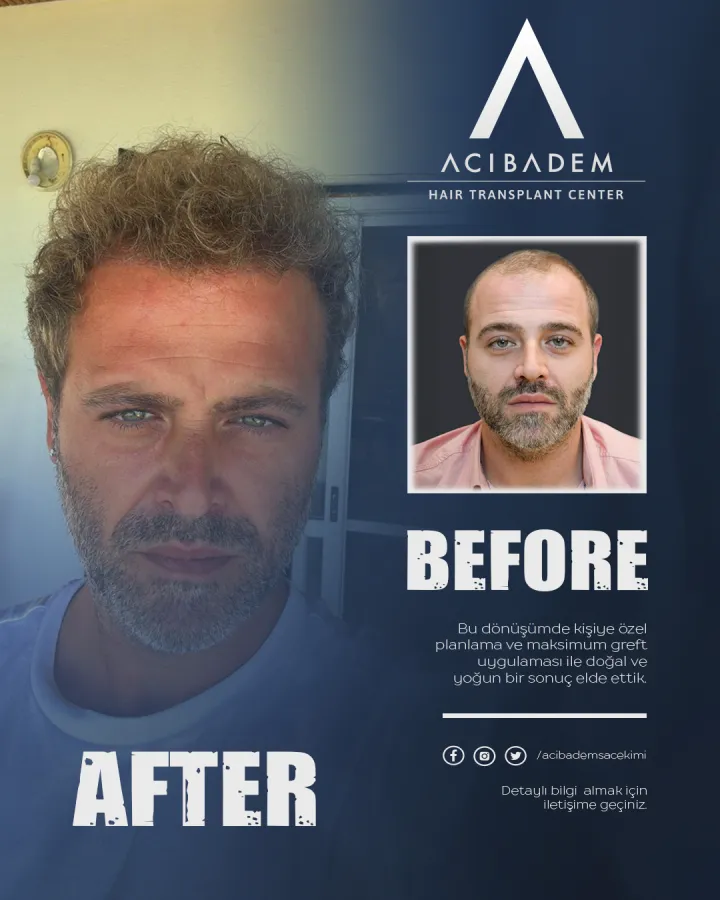
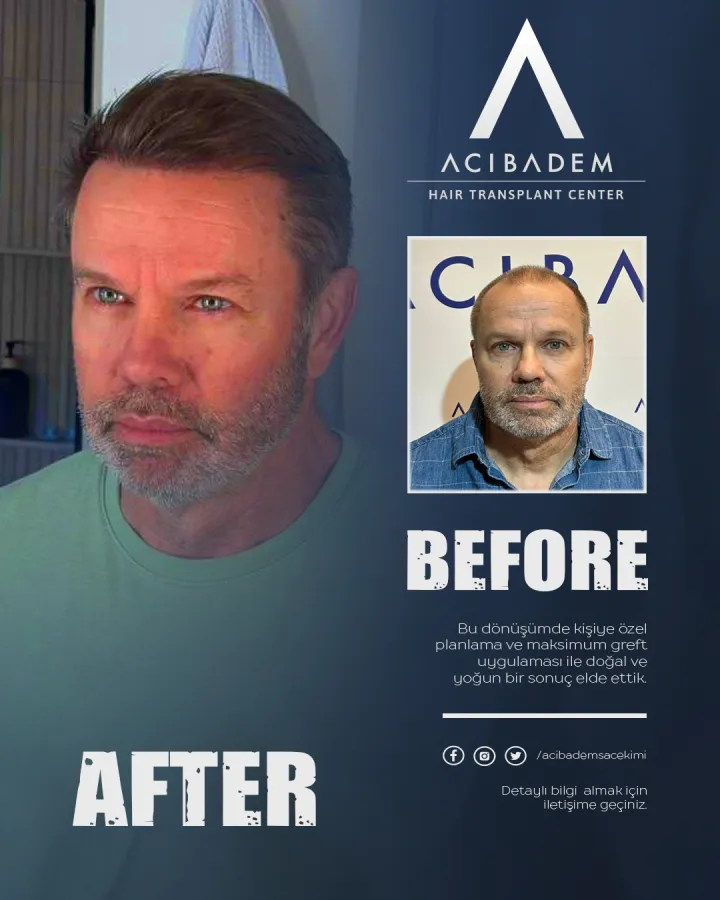
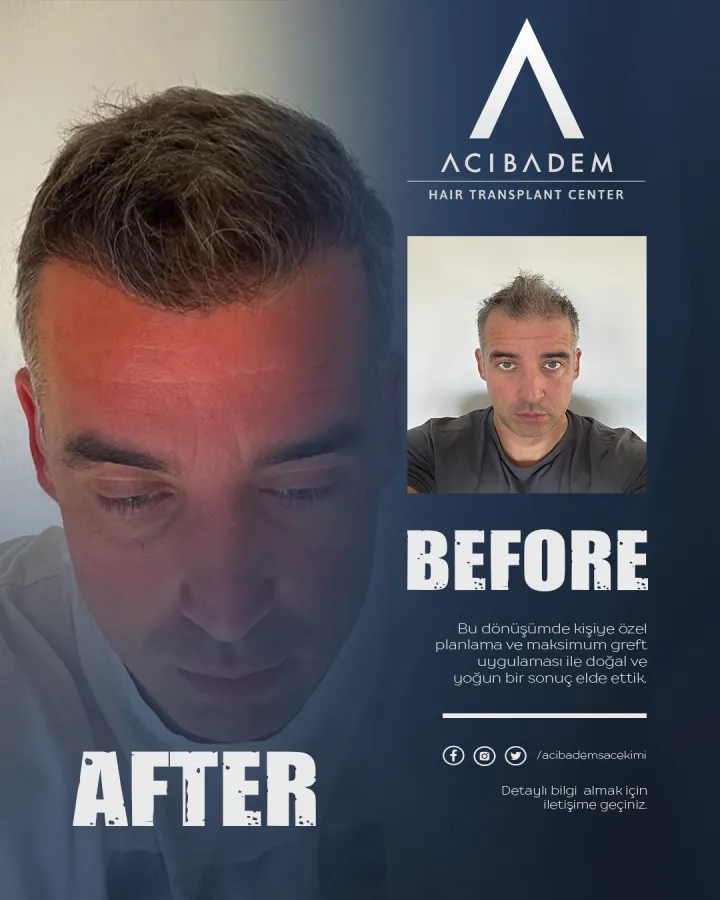
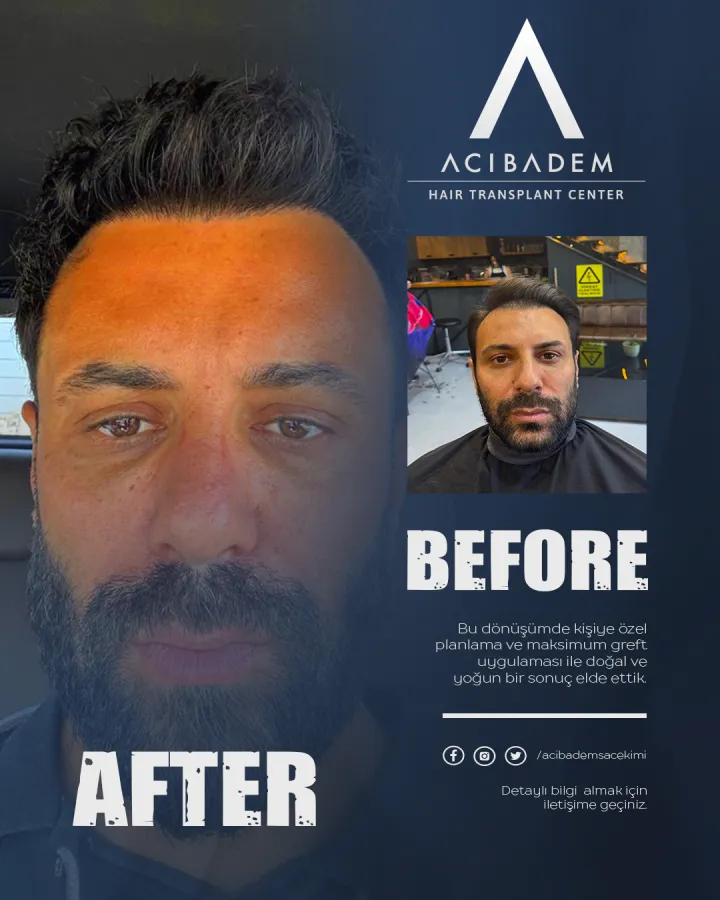
Hair Transplant Before & After
Could a similar result be possible for you?
Send your photos over WhatsApp and our expert team will return your personal assessment within 2 hours.
Patient Experiences
Verified Patient Reviews
I had a hair transplant at Acibadem Hair in August. It has been 9 months, there is no problem. I recommend here to all my friends who consider to have a hair transplant, I also thank you for your interest and smiling faces still today.
We travelled from Canada to Istanbul for a hair transplant, and the experience was excellent from start to finish. They handled everything from hotel and transportation to providing an interpreter, making the entire process smooth and stress-free. The hospital was very clean and modern and the staff were friendly, knowledgeable, and professional.
Published on GoogleMy experience at Acibadem in Istanbul for a hair transplant procedure was nothing short of exceptional. From the moment I decided to travel from Australia for this treatment, the entire process was seamless, professional, and remarkably well-organised. Even though it is still very early in my recovery, I am already seeing an improvement.
Published on GoogleForeign patient here — outstanding service from start to finish! My health consultant was available 24/7 via WhatsApp. I felt fully supported with seamless transport, clear communication, and translators arranged for me. The hospital is modern, well-equipped, and staffed with amazing professionals. Highly recommend!
Published on GoogleI had a hair transplant at Acibadem Hair in August. It has been 9 months, there is no problem. I recommend here to all my friends who consider to have a hair transplant, I also thank you for your interest and smiling faces still today.
Published on GoogleI went to Acibadem hair transplant center with my brother George. We both had a hair transplant operation, there really is not enough words to say about the care you receive from the center. This is an experience that you must see, Acibadem Hair is the best hair transplant center!
Published on GoogleI had a lovely experience. My medical assistant helped me with appointments and accommodation through WhatsApp. The driver they provided picked me up from the airport to my hotel and to all of my appointments. The staff was very warm and welcoming, and my doctor and the nurses answered all of my questions with patience.
Published on GoogleFirst of all, the team is very good and caring, you can ask any questions you may have. After the operation, they constantly monitor your hair growth and give you more useful advice when necessary. Considering the whole process, I recommend it to everyone.
Published on GoogleI had my hair transplant on 28 November 2025. The care, attention and friendly service were excellent. Special thanks to my consultant Kübra — she has been helping me constantly from day one until today. Acibadem does this job properly. The attention is truly ten out of ten; you can go to Acibadem without hesitation.
Published on GoogleI had my hair transplant on 05.06.2026. Everything has gone very well from the first consultation until today. I especially thank Taha Berke and Feyza for the care and attention they showed me. The transplant team was very professional too — the period after the procedure was very comfortable and painless.
Published on GoogleI had my hair transplant about 6 months ago. First of all, I can say the team was thoroughly professional from start to finish. Both the transplant team and our consultant Taha Berke were very attentive — they truly know their job. I am very satisfied and recommend them.
Published on GoogleThroughout my hair transplant process, the Acibadem Hair Transplant team was genuinely attentive and professional. All the staff were extremely kind, careful and meticulous in their work. They kept me informed at every stage and I felt very safe. Many thanks to the whole team for their effort and care.
Published on GoogleMy hair transplant process was very comfortable from beginning to end. I was informed at every stage, the team was very attentive and the check-ups were always regular. I am especially grateful to Hatice, who looked after me — she both put me at ease and took away my fears. The results have already made me very happy!
Published on GoogleI can say without exaggeration that Acibadem Hair is THE ONE in their field! An institution full of the best and highest quality staff in Turkey, Acibadem Hair, the exemplary name in hair transplantation, is the place for those who want to feel the real difference. It enables you to take a comfortable step towards a change that leads to happiness, with operations performed under sterile and hygienic conditions.
Verified patient storyBlog
Hair Transplant Guides From Our Experts
Treatment Journey
3 Days in Istanbul, A Documented Result in 12 Months
Welcome & Hairline Design
You are met by your VIP car and settled into your 4★ hotel. Your trichoscopic exam and graft map are completed in 2 hours; your hairline is drawn by hand and presented for your approval.
Operation Day
Your operation is completed in 6–8 hours under needle-free anaesthesia, with an anaesthesiologist present throughout. You rest at your hotel the same evening.
First Care & Discharge
Your first wash and aftercare training take place; you are sent to your flight with a full care kit. Your follow-up programme starts the same day.
First Growth
The first new hairs appear; progress is tracked together through monthly photo reviews, with visible thickening arriving in months 6–8.
Measured Result & Guarantee
A trichoscopic survival measurement is taken: the 98% rate is under written guarantee. Your signed certificate is archived together with your result.
The Complete Guide
Everything About Hair Transplant in Istanbul, Turkey
This guide answers the questions our medical team hears most often from international patients — how modern hair transplantation works, how Sapphire FUE and DHI differ, who makes a good candidate, what an all-inclusive treatment trip to Istanbul looks like, and what a documented, guaranteed result really means. Every section reflects the daily practice of our Ministry of Health licensed clinic, where patients from 38 countries have been treated over 12 years.
01
What Is a Hair Transplant and How Does It Work?
A hair transplant is a microsurgical procedure that moves healthy hair follicles from a donor area — usually the back and sides of the scalp, where hair is genetically resistant to shedding — to areas affected by hair loss. Because the transplanted follicles keep their genetic resistance, the new hair typically continues to grow for life, which is what makes the procedure a long-term answer to androgenetic alopecia rather than a temporary fix.
Modern techniques extract follicles one by one as individual grafts, each containing one to four hairs. The two steps that define the final result are how the recipient channels are opened and how each graft is placed: the angle, direction and density of every channel decide whether the result looks natural. This is why every treatment at our clinic begins with hairline design — your facial proportions, age and expectations are mapped before a single graft is touched.
A typical session lasts six to eight hours and is performed under local anaesthesia. With the needle-free anaesthesia option, even the numbing stage is comfortable; most patients watch films, use their phones or sleep through the operation. An anaesthesiologist is present throughout the procedure, which is one of the practical differences between a licensed surgical environment and a basic clinic room.
The number of grafts needed varies widely — from around 1,500 for a receded hairline to 4,000 or more for advanced loss. A trichoscopic examination of your donor and recipient areas is the only reliable way to plan this number, which is why we measure before we promise.
02
Sapphire FUE: How It Works and Who It Suits
Follicular Unit Extraction (FUE) is today's most widely performed hair transplant technique. Individual follicular units are extracted with a micromotor and fine punches, leaving no linear scar. In Sapphire FUE, the recipient channels are opened with blades made of single-crystal sapphire rather than steel.
Sapphire blades create smaller, smoother micro-channels. In our clinical experience this brings three practical advantages: channels heal faster, tissue trauma and crusting are reduced, and channels can be opened closer together — allowing denser packing of grafts where coverage matters most. The V-shaped sapphire tip also helps the surgeon control the angle of each channel precisely, which protects the natural flow of the hairline.
Sapphire FUE is usually the first choice for larger areas, first operations and patients who want maximum density in one session. It requires shaving the recipient area, so patients who cannot shave for professional reasons sometimes prefer DHI instead.
At Acibadem Hair Transplant Center, Sapphire FUE is performed in internationally accredited operating rooms, and every case is documented from the pre-operative trichoscopic exam to the month-12 measurement — so the density promised at planning can be verified in the mirror and in the data.
03
DHI: The Choi Implanter Technique Explained
Direct Hair Implantation (DHI) skips the separate channel-opening stage entirely. Each extracted graft is loaded into a fine Choi implanter pen and placed directly into the recipient area; the channel is created and the graft implanted in one movement.
The clinical consequences are distinctive. Because grafts spend less time outside the body and are handled less, graft survival is well protected. Because there are no pre-opened channels, bleeding and crusting are minimal. And because the implanter pen controls depth, angle and direction in a single motion, DHI excels at precision work — hairline refinement, filling between existing hairs, and cases where the surrounding hair is kept long.
DHI's signature advantage for many of our patients is that it can be performed without shaving the whole head. If you keep your hair long and want the procedure to remain private, unshaven DHI makes recovery discreet — most patients return to social life within days with no visible sign beyond the treated zone.
DHI sessions typically place somewhat fewer grafts per session than Sapphire FUE, so for very large areas your doctor may recommend Sapphire FUE, a staged plan, or a combination of both techniques in one operation.
04
Sapphire FUE vs DHI: How the Right Technique Is Chosen
Neither technique is universally better — they are tools with different strengths, and the honest answer to "which is best?" is always personal. Four factors decide the recommendation in our practice: the size of the area to be covered, the strength of your donor area, whether you can shave, and the design goals of your hairline.
Broadly: larger areas and first operations favour Sapphire FUE, because dense packing over a wide zone is its speciality. Unshaven treatment, hairline refinement and working between existing hairs favour DHI. Beard-to-scalp transfers, second operations and mixed cases often use both techniques in a single session — Sapphire FUE for the crown, DHI for the front line, for example.
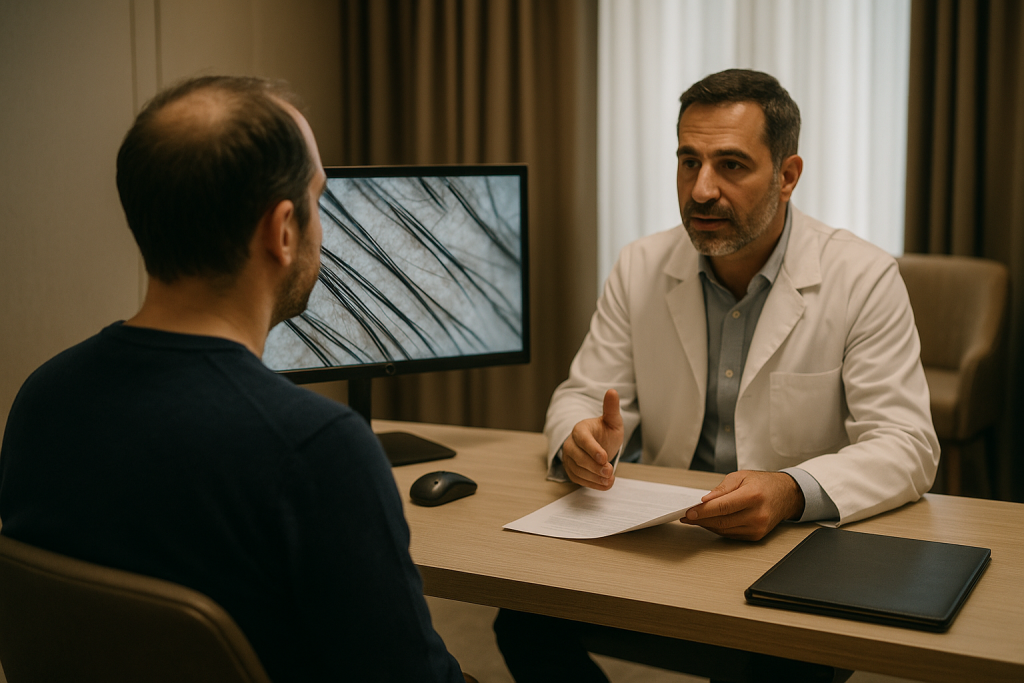
This decision is made after a trichoscopic exam, not before. A camera-based analysis of your scalp measures hair shaft thickness, follicular unit composition and donor capacity per square centimetre. Choosing a technique from a price list — without measurement — is one of the most common reasons patients elsewhere end up with unnatural density distribution or an exhausted donor area.
Our comparison guide covers this decision in more depth, and your free online analysis ends with a doctor-reviewed technique recommendation specific to your case.
05
Are You a Good Candidate? Age, Donor Area and the Norwood Scale
The best candidates share three characteristics: stabilised or predictable hair loss, a strong donor area, and realistic expectations shaped by a proper consultation. Age matters mostly through the first factor — in very young patients whose loss pattern is still evolving, an aggressive low hairline can look wrong a decade later, so responsible planning sometimes means waiting or designing conservatively.
Clinicians grade male pattern loss on the Norwood scale from stage 1 (minimal recession) to stage 7 (extensive loss). Stages 2 through 5 are the classic transplant range; stages 6 and 7 can still achieve meaningful, framing coverage when the donor area allows, but the goals are defined differently. Women's diffuse thinning is graded on the Ludwig scale and needs its own assessment logic, because the donor area itself may be affected.
The donor area is the true budget of any transplant. A healthy donor typically offers 4,000 to 6,000 safely extractable grafts over a lifetime — spending them wisely across present and possible future needs is central to good planning. This is why our doctors sometimes advise fewer grafts than a patient requests: protecting your donor is protecting your future options.
Certain conditions — uncontrolled diabetes, active scalp disorders, unstable alopecia areata — need medical management before surgery is considered. The free analysis includes these screening questions precisely so that unsuitable candidates are told so honestly, before they book a flight.
06
Why Patients Choose Istanbul, Turkey
Istanbul has become the world's most visited city for hair restoration, and the reasons are structural rather than accidental. Turkish clinics perform a very high volume of procedures, and in surgery, volume builds experience: teams that carry out transplants daily refine their extraction speed, graft handling and design judgement in ways that lower-volume centres cannot match.
The economics matter too, but not in the way many patients first assume. Costs in Turkey are lower primarily because of general cost levels and exchange rates — not because materials or standards are reduced. This is what makes the all-inclusive model possible: the same package that covers only the operation in many Western countries covers the operation, hotel, transfers and aftercare in Istanbul, often for a fraction of the price.
Regulation separates serious providers from the rest. Hair transplantation in Turkey is regulated by the Ministry of Health; licensed centres operate under inspection, with accredited operating rooms, sterilisation protocols and medical staffing requirements. Our clinic is a licensed centre and an International Health Tourism member — credentials we document, because patients should verify them wherever they go.
Practically, Istanbul is also simply easy: direct flights from most of Europe, the Middle East and beyond, e-visa entry for many nationalities, and a three-day treatment itinerary that fits into a long weekend. Our patient guide describes that itinerary hour by hour.
07
Hair Transplant Costs and the All-Inclusive Package
Hair transplant pricing confuses patients everywhere, because clinics quote in different units: per graft, per session, or per package. Per-graft pricing sounds precise but creates a perverse incentive to implant more grafts than a design needs; package pricing aligns the clinic's incentive with your result rather than your graft count.
We quote one all-inclusive package after your analysis. It covers the operation itself with the technique your case needs, VIP airport-hotel-clinic transfers, four-star accommodation, needle-free anaesthesia, your complete aftercare kit, and twelve months of structured follow-up ending in the trichoscopic result measurement. There is no deposit — payment is made at the clinic on the day of your operation.
When comparing quotes between clinics, the meaningful questions are rarely about the headline number. Ask instead: who performs and supervises the operation, and is an anaesthesiologist present? Is the centre licensed by the Ministry of Health? What exactly does aftercare include, and for how long? Is the promised result measured, and is any guarantee written? A low price that answers these questions badly is not a saving.
Beware of prices that look impossible — extraordinarily cheap offers usually economise on the things you cannot see on the day: staffing ratios, sterilisation, graft handling and follow-up. In a procedure whose result you wear for life, the cheapest option is rarely the least expensive.
08
Your Treatment Journey: From Free Analysis to Flying Home
Everything begins online. You complete the free hair analysis on this page — a few structured questions and photo uploads that take about 90 seconds — and our doctors review your case. Within around two hours you receive a personal plan on WhatsApp: your estimated graft range, the recommended technique and your package details. There is no obligation at this stage; it is a medical pre-assessment, not a sales script.
A typical treatment trip lasts three days. Day one: VIP transfer from Istanbul Airport to your four-star hotel, and a relaxed evening. Day two is operation day: final consultation and blood tests, hairline design agreed together in front of the mirror, then the procedure itself — six to eight hours with breaks, under needle-free local anaesthesia. Day three: first wash demonstration at the clinic, aftercare training with your take-home kit, your written guarantee certificate, and transfer back to the airport.
You fly home with more than a bandage: a documented plan for the next twelve months. Follow-up runs on WhatsApp with monthly photo reviews, so our medical team tracks your shedding phase, regrowth and density development against the expected timeline — and intervenes with advice when anything deviates.
Most desk-based patients return to work within three to five days of the operation. The complete day-by-day itinerary, including what to pack and how transfers work, is described in our Istanbul treatment trip guide.
09
Recovery Timeline: The First 12 Months
Recovery follows a well-mapped biological sequence, and knowing it in advance prevents the two classic moments of unnecessary worry. Days 1-10: mild redness and crusting around the grafts; daily washing according to the protocol we teach you removes the crusts gently, and by day ten the transplanted area already looks tidy.
Weeks 2-8 bring the phase every patient should be warned about: shock loss. The transplanted hair shafts shed — this is expected and temporary. The follicles beneath remain healthy and enter a resting phase before restarting growth. Patients who were not told about shock loss often panic in month two; patients who were told simply wait.
Months 3-6: new growth begins as fine, soft hairs that gradually thicken. Month 6 is typically the first point where the change is obvious in photographs. Months 6-9 add density and texture as more follicles cycle into growth, and hair begins to respond to styling.
Months 9-12 complete the maturation: shafts thicken to their final calibre and the design settles into its permanent look. At month 12 we perform the trichoscopic measurement that closes your file — comparing the surviving graft count against what was implanted. That number, not a mirror selfie, is what our 98% documented survival rate and your written guarantee refer to. The full month-by-month detail is in our recovery timeline guide.
10
Results You Can Verify: Trichoscopy and the 98% Guarantee
"Great results" is a claim every clinic makes; the question is how a result is defined and who verifies it. Our answer is measurement. Before your operation, trichoscopic imaging documents your baseline. At month twelve, the same imaging counts the transplanted grafts that survived and are producing hair.
Across our documented cases this survival rate is 98% — and the rate is not a marketing average but an individual promise: your certificate, signed and delivered on discharge day, puts it in writing for your specific operation. If a measured result ever fell short of the guaranteed threshold, the guarantee defines the remedy — in twelve years of archived case records, that written promise is what keeps our planning honest.
This is also why we photograph and archive every case month by month. Twelve years of archived records mean that when your doctor predicts how your crown will look at month nine, the prediction rests on hundreds of comparable documented cases, not optimism.
When researching any clinic — including ours — ask to see this system: how results are measured, when, by whom, and what happens if the measurement disappoints. Clinics that measure welcome the question.
11
Safety, Risks and How a Licensed Clinic Manages Them
Hair transplantation is a safe procedure when performed in a proper surgical environment — and honest information includes discussing risk. Common, temporary effects include swelling of the forehead for a few days, numbness of the scalp for some weeks, itching during healing and the shock loss described above. These resolve on their own or with simple care.
Rarer risks — infection, folliculitis, poor graft survival, visible scarring, unnatural design — are overwhelmingly associated with inadequate sterilisation, untrained staff, aggressive over-harvesting of the donor area, or planning that ignored the patient's long-term loss pattern. In other words: the serious risks are mostly clinic risks, not procedure risks.
A licensed centre manages them structurally. Operations take place in accredited operating rooms under sterilisation protocols; a specialist physician supervises and an anaesthesiologist is present throughout; your medical history is screened beforehand; and the donor area is harvested within safe density limits so it remains natural and usable for the future.
Aftercare completes the safety chain: your kit includes the washing products and medication you need, the first wash is taught in person, and the twelve-month follow-up exists so that any deviation from the normal healing pattern is caught early by a medical team that knows your case. Medical questions during recovery are answered on the 24/7 support line.
12
Beard, Eyebrow and Women's Hair Transplants
Hair restoration is not only for male scalps. Beard transplantation fills patchy growth, sculpts a defined line or rebuilds density after scarring — grafts are taken from the scalp donor area and placed at the precise flat angle beard hair requires. DHI's single-motion placement is particularly suited to this angle control.
Eyebrow transplantation is fine-detail work: single-hair grafts are placed one by one following the natural direction changes across the brow. The result restores frame and expression to the face, and because transplanted hair keeps growing, occasional trimming becomes part of the routine.
Women's hair loss usually presents differently — diffuse thinning and a widening parting rather than a receding line — and needs different assessment, because donor stability must be confirmed first. For suitable candidates, unshaven DHI is often the preferred approach: the procedure stays invisible under existing hair, which matters to many of our female patients.
All three procedures follow the same clinical framework as scalp transplants: trichoscopic assessment, doctor-designed plan, accredited operating room, and documented follow-up. The free analysis form includes options for beard and eyebrow cases.
13
Aftercare Essentials: Washing, Sleeping, Sport and Sun
The first two weeks of aftercare protect your investment, and the rules are simpler than most patients fear. Washing: the first wash happens at the clinic, where we teach the technique — special foam, lukewarm water, no pressure, patting dry. You repeat it daily at home; by around day ten the crusts have lifted and the routine relaxes.
Sleeping: for the first week, sleep on your back with your head elevated on a travel pillow so the grafted area touches nothing. Swelling, if it appears, drifts down the forehead around days three to five and disappears — the elevated position keeps it minimal.
Activity: walking is fine immediately. Heavy sport, heavy lifting and anything that causes sweating wait about a month; swimming pools, saunas and sea water wait at least a month because of both infection risk and chemical irritation. Smoking and alcohol slow microcirculation and healing — pausing them around the operation window measurably helps your grafts.
Sun is the quiet enemy of the first months: protect the area with a loose cap outdoors and avoid direct summer exposure. From month two onwards life is essentially normal — haircuts with scissors are allowed, and by month six even razors and styling products are back on the table. Every rule above is printed in your aftercare kit, and the support line answers the questions that always come up at 11pm on day three.
14
Frequently Asked Questions
How long does a hair transplant last — is it permanent?
Transplanted follicles come from the donor area, which is genetically resistant to hair loss, so they typically keep producing hair for life. Existing non-transplanted hair can continue thinning, which is why good planning accounts for your future loss pattern, not just today's.
How many grafts do I need?
It depends on the size of the area, your donor capacity and the density your design requires — from roughly 1,500 grafts for hairline recession to 4,000+ for advanced loss. The free online analysis gives you a doctor-reviewed estimated range before any commitment.
Does a hair transplant hurt?
The operation is performed under local anaesthesia, and with the needle-free option even the numbing stage avoids needles. During the procedure patients typically feel pressure at most; most watch films or sleep. Mild soreness for a few days afterwards is managed with the medication in your kit.
How much does a hair transplant cost in Turkey?
Exact pricing depends on your case, which is why we quote after your free analysis rather than from a menu. Our quotes are all-inclusive packages — operation, VIP transfers, four-star hotel, aftercare kit and 12 months of follow-up — with no deposit; payment is at the clinic on operation day.
When will I see the final result?
First new growth appears around month three, visible thickening between months six and eight, and the mature result at month twelve — when we verify it with a trichoscopic measurement. Monthly photo reviews track your progress against this timeline throughout.
What is shock loss and should I worry about it?
Between weeks two and eight the transplanted hair shafts shed while the follicles beneath enter a resting phase — this is a normal, expected part of the cycle, not a failure. The follicles restart growth from around month three.
Can I have a hair transplant without shaving my head?
Often yes. Unshaven DHI places grafts with a Choi implanter pen without shaving the recipient area, keeping the procedure discreet under your existing hair. Suitability depends on the size of the area — your analysis will confirm whether your case qualifies.
Is it safe to travel to Istanbul for a hair transplant?
Istanbul is the world's busiest destination for hair restoration, and licensed clinics operate under Ministry of Health regulation with accredited operating rooms. Our packages include VIP transfers and hotel, and the three-day itinerary is managed end to end. Verifying a clinic's licence — including ours — is something we actively encourage.
What does the 98% guarantee actually cover?
It refers to graft survival measured by trichoscopic imaging at month twelve, and it is delivered as a signed written certificate on your discharge day — an individual promise for your operation, backed by twelve years of archived, documented case records.
When can I go back to work after the operation?
Most desk-based patients return within three to five days. Physically demanding jobs need around two weeks. Redness and crusting are largely gone by day ten, and unshaven DHI cases are often socially invisible even sooner.

Not sure which section applies to you? Your free analysis answers it for your specific case.
Free Hair AnalysisHave your plan ready before your flight ticket
Our 24/7 advisory line replies in your own language — one message covers dates, packages and every question you have.
Free Pre-Assessment
Free Online Hair Analysis
Upload your photos and answer a few short questions in 90 seconds; your personal hair transplant plan, reviewed by our specialists, is sent to you on WhatsApp within 2 hours.
Confidential · Doctor approved · Your data stays at the clinic and is never used for marketing.
06
12
13