In diesem Artikel9
- What Norwood 6 Hair Transplant Before and After Can Realistically Show
- Why Norwood 6 Requires a Different Restoration Strategy
- How Many Grafts May Be Needed for Norwood 6
- How Surgeons Plan Density, Hairline, and Crown Coverage
- What the Procedure and Early Recovery May Involve
- Understanding the Growth Timeline in Before-and-After Photos
- How to Read Before-and-After Results More Carefully
- Long-Term Planning, Follow-Up, and Choosing a Clinic
- Frequently Asked Questions
Norwood 6 hair transplant before and after results can show a meaningful improvement in frontal framing and upper-scalp coverage when the donor area is suitable and the plan is realistic. At this advanced stage, the goal is usually to create a natural-looking hairline and balanced visual density rather than restore the density of a full teenage head of hair.
- Norwood 6 hair loss can often be treated with a transplant if the donor area is healthy and sufficient.
- A Norwood 6 plan usually prioritises the hairline, frontal zone, and mid-scalp before lower-priority areas.
- Several thousand grafts may be required, but the final number depends on donor capacity, hair characteristics, and coverage goals.
- Before-and-after photographs should be assessed for lighting, hair length, angle, healing time, and long-term donor safety.
- Hair transplant growth is gradual, with the most meaningful cosmetic result commonly assessed around month 12.
01What Norwood 6 Hair Transplant Before and After Can Realistically Show
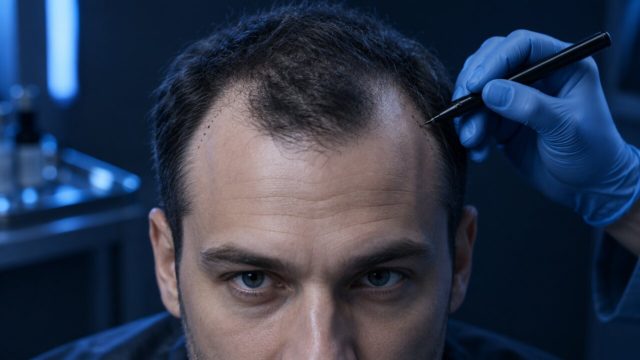
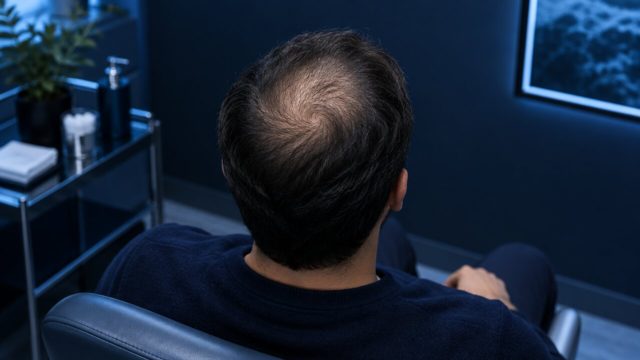
Norwood 6 hair transplant before and after photographs usually show the difference between extensive hair loss across the frontal scalp, mid-scalp, and crown and a more defined, balanced appearance after restoration. On the Norwood scale, stage 6 commonly involves a large connected area of thinning or baldness from the front to the vertex, while the remaining hair is mainly located on the sides and back of the head. This means that a successful-looking result depends as much on thoughtful distribution as on the number of transplanted grafts.
In most patients, the most visible change is the return of a facial frame. A carefully designed, age-appropriate hairline can soften the appearance of a high forehead, while graft placement through the frontal and central scalp can reduce the contrast between the top of the head and the stronger permanent-zone hair at the sides. The crown may also be treated, but it often requires a careful compromise because it is a large area and can use many grafts.
It is important to view before-and-after images with realistic expectations. A photo taken at 12 months or later may show mature growth, styling, and improved coverage, but it does not mean every area has identical density. Your doctor will consider the size of the bald area, the thickness and colour of your hair, scalp-to-hair contrast, curl pattern, donor quality, and likely future hair loss before confirming what can be achieved safely.
02Why Norwood 6 Requires a Different Restoration Strategy
Norwood 6 is an advanced pattern of androgenetic hair loss, often called male pattern hair loss. The bridge of hair that once separated frontal loss from crown loss has usually disappeared or become very thin. As a result, there is a broad surface to cover, but the donor supply at the back and sides of the scalp remains limited. Hair transplantation does not create new donor hair; it redistributes follicles from the more resistant donor zone.
For this reason, surgeons typically plan the scalp in priority zones. The frontal hairline and frontal third are often addressed first because they are seen most directly in conversation and photographs. The mid-scalp can then connect this area toward the crown. If donor availability allows, the vertex may receive coverage as well, usually with a density pattern that respects the natural crown swirl.
A responsible plan also protects the donor area. Taking too many grafts can leave visible thinning at the back or sides, particularly when hair is cut short. A conservative extraction strategy may provide a more natural long-term balance than trying to maximise coverage in one session. In some cases, the doctor may discuss staged treatment rather than placing all available grafts at once.
03How Many Grafts May Be Needed for Norwood 6
Many Norwood 6 patients need several thousand grafts to create visible coverage. A broad preliminary planning range may be around 3,500 to 6,000 or more grafts, but this is not a fixed prescription and should not be treated as a guarantee. The appropriate number can be lower or higher depending on the scalp area, existing miniaturised hair, donor density, graft quality, and the design agreed with the doctor.
Grafts are not the same as individual hairs. One graft may contain one, two, three, or sometimes more hairs. Fine single-hair grafts are commonly used at the leading hairline for a softer transition, while multi-hair grafts may be placed behind that zone to build visual fullness. This distribution helps the result look natural instead of appearing like a straight, dense line at the front with limited support behind it.
During a free online hair analysis, photographs can provide an initial indication of the pattern and likely donor area. However, an online review cannot replace an in-person assessment of scalp flexibility, hair calibre, miniaturisation, and donor density. Your doctor will confirm the treatment suitability and the planned graft range after a proper clinical evaluation.
04How Surgeons Plan Density, Hairline, and Crown Coverage
Density is one of the most misunderstood parts of a Norwood 6 restoration. The native scalp contains far more follicles than can usually be moved safely from a donor area. Therefore, the surgical aim is often cosmetic density: enough strategically placed hair to reduce scalp visibility and create the impression of fuller coverage under everyday conditions. This can look very effective even when the transplanted density is lower than natural childhood density.
Hairline design should match the patient’s facial proportions, age, and expected long-term pattern. A very low or very dense hairline may use grafts that would otherwise help the central scalp, and it may look less natural if hair loss progresses behind it. In many advanced cases, a slightly higher but well-shaped hairline offers a more balanced result and preserves donor resources for the areas that matter most.
The crown presents a separate planning challenge because the swirl pattern spreads hair in different directions and the area can appear larger under overhead light. Some patients choose stronger frontal and mid-scalp coverage with a lighter crown, while others prefer broader overall coverage. Norwood 6 hair transplant before and after images should be reviewed with this distribution in mind, rather than judging the result only by the hairline.
05What the Procedure and Early Recovery May Involve
Modern follicular unit extraction methods can be used to harvest individual follicular units from the donor area and implant them into carefully made recipient sites. At Acibadem Hair Transplant Center in Istanbul, Sapphire FUE and DHI techniques are available. The technique selected will depend on the clinical plan, the recipient area, hair characteristics, and the doctor’s assessment rather than on a one-size-fits-all preference.
Needle-free anaesthesia is also available for eligible patients who are concerned about injections. Your medical team will explain the anaesthesia approach, preparation instructions, expected sensations, and any relevant health considerations before treatment. A hair transplant is a medical procedure, so sharing a complete medical history and following pre-operative guidance are important parts of safety planning.
In the first days after surgery, small crusts, redness, and mild swelling can occur. The recipient area needs gentle care, and the donor area also requires protection while it heals. Patients are usually asked to avoid scratching, pressure, intense exercise, direct sun exposure, and other activities that could disturb the newly placed grafts during the early recovery period. Your clinic will provide individual aftercare instructions.
06Understanding the Growth Timeline in Before-and-After Photos
Immediate post-procedure photographs do not show the final result. They show graft placement and the outline of the planned design. In the weeks that follow, transplanted hairs commonly shed as part of the normal cycle, while the follicles remain beneath the skin. This temporary shedding phase can be worrying if it is unexpected, but it is commonly discussed during post-operative guidance.
New growth typically begins gradually over the following months. Early hairs may appear fine, uneven, or slower in some areas, particularly toward the crown. As the growth cycle continues, the hair can gain length and calibre. Meaningful visual change is often seen during the middle months, while the result is usually assessed more fully at around month 12.
When reviewing a norwood 6 hair transplant before and after comparison, check whether the after image was taken at a mature stage of growth. Compare the same angle, similar lighting, dry hair condition, and similar hair length where possible. Bright overhead lighting, wet hair, and a close camera angle can make the scalp look more visible, while styling can make coverage appear stronger.
07How to Read Before-and-After Results More Carefully
A useful before-and-after series should show more than one view. The front, both temples, top, mid-scalp, crown, donor area, and side profile can each tell a different part of the story. For Norwood 6 cases, top and crown views are especially important because these areas reveal how coverage has been distributed across a large surface.
Look for natural transitions rather than only maximum density. A good result should have a soft irregularity at the hairline, appropriate direction of growth, and a density pattern that does not suddenly stop behind the frontal zone. It should also maintain a donor area that appears acceptable for the patient’s usual haircut. No two patients have the same hair calibre, skin contrast, curl, or donor capacity, so one person’s visual result cannot predict another person’s outcome.
Ask whether the photographs represent a single session or a staged plan and whether medical hair-loss management was part of the overall approach. Existing non-transplanted hairs may continue to thin over time in some people. A consultation should include a discussion about protecting existing hair where medically appropriate, as well as the possibility that future treatment could be considered if hair loss progresses.
08Long-Term Planning, Follow-Up, and Choosing a Clinic
Advanced hair loss needs long-term thinking. The strongest plan is not necessarily the one that uses the largest possible number of grafts immediately. It is the one that creates an appropriate improvement today while preserving options for the future. This is particularly relevant for younger patients or for people whose family history suggests continued progression of hair loss.
Acibadem Hair Transplant Center is a dedicated hair restoration clinic in Istanbul licensed by the Turkish Ministry of Health. The clinic offers all-inclusive packages that can include VIP transfer, a 4-star hotel, a care kit, and 12 months of follow-up. Patients can start with a free online hair analysis reviewed by doctors, with WhatsApp replies typically provided within about two hours.
Follow-up gives patients an opportunity to discuss healing, washing routines, shedding, and gradual growth with the care team. At Acibadem Hair Transplant Center, results are measured through trichoscopic graft survival at month 12, with a documented 98% rate under a written guarantee. Individual cosmetic appearance can still vary because growth pattern, hair characteristics, healing, and the extent of pre-existing hair loss differ from person to person.
09Frequently Asked Questions
Can someone with Norwood 6 hair loss still have a hair transplant?
Yes, many people with Norwood 6 hair loss may be candidates for a hair transplant. Suitability depends mainly on the quality and supply of donor hair, scalp condition, medical history, and realistic coverage goals. Your doctor will confirm whether transplantation is appropriate after assessment.
How many grafts are usually planned for a Norwood 6 transplant?
Norwood 6 restoration often requires several thousand grafts, with an initial broad estimate frequently falling around 3,500 to 6,000 or more. The final number depends on the size of the area, donor density, hair thickness, existing hair, and the priority given to the front, mid-scalp, and crown. A safe donor strategy is more important than choosing a number in isolation.
Is Norwood 6 too late for hair restoration?
Norwood 6 is not automatically too late for a transplant, but it is an advanced stage that requires careful planning. It may not be possible to recreate full natural density across every area, especially if donor supply is limited. Many patients can still achieve a meaningful cosmetic improvement with a realistic, donor-conscious plan.
Can Norwood 6 hair loss be reversed?
The underlying pattern of androgenetic hair loss is generally progressive and cannot usually be fully reversed. A hair transplant can redistribute resistant donor follicles to improve coverage in selected areas, but it does not stop future thinning of non-transplanted hair. A doctor can discuss suitable long-term management options based on your medical situation.
Dieser Artikel dient nur der allgemeinen Information und ersetzt keine professionelle medizinische Beratung.
Dieser Ratgeber dient der allgemeinen Information und ersetzt keine ärztliche Beratung. Behandlungsentscheidungen werden nach einer persönlichen oder Online-Untersuchung durch einen Arzt getroffen.