
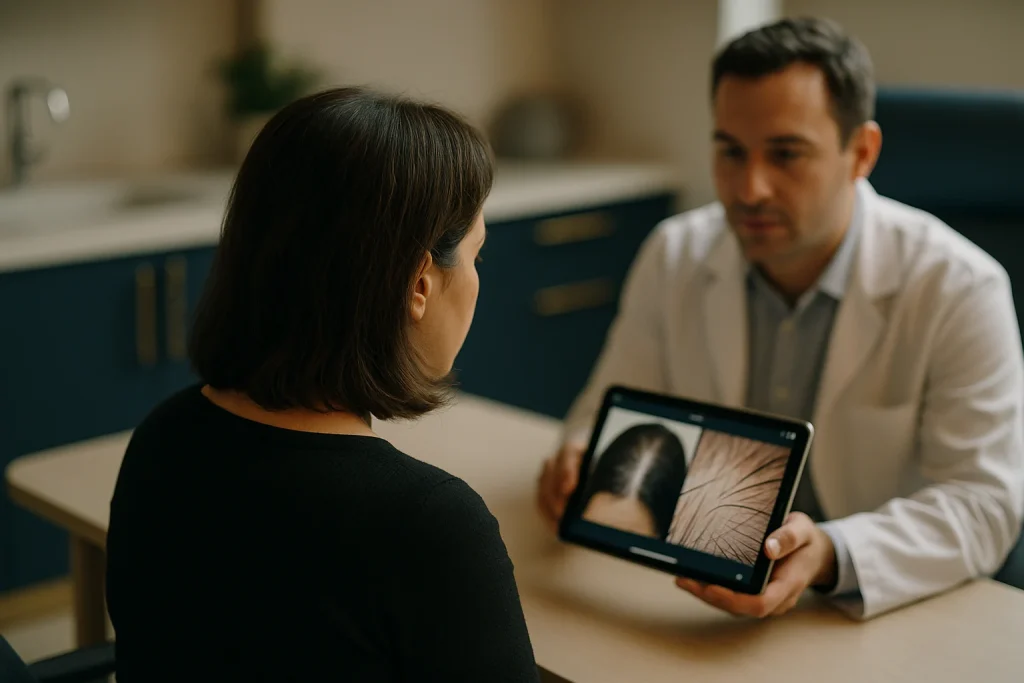
A female balding crown should be assessed carefully before a hair transplant because the cause, pattern, rate of loss, donor hair quality, and scalp health all affect suitability. In many patients, a doctor will first look for treatable medical, hormonal, nutritional, inflammatory, or traction-related causes before discussing surgical planning.
- Crown thinning in women can have hormonal, genetic, medical, nutritional, inflammatory, or styling-related causes.
- A scalp examination and medical history help distinguish stable hair loss from active shedding or scalp disease.
- Hair transplant surgery is usually considered only after the pattern of loss and donor area have been assessed carefully.
- PCOS-related hair loss often follows a wider central part or crown thinning pattern, but a doctor should confirm the cause.
- Some types of female hair thinning may improve when the underlying trigger is identified and managed early.
01Female Crown Thinning: Assessment Before Hair Transplant
A female balding crown can be emotionally difficult because the thinning may be most visible under overhead light, in photographs, or when the hair is parted. Before considering a hair transplant, the first priority is to understand why the crown looks less dense. Crown thinning is not one single diagnosis. It may reflect gradual pattern hair loss, temporary shedding, hormonal changes, scalp inflammation, hair breakage, or several factors occurring at the same time.
A careful assessment helps protect both your health and the long-term appearance of your hair. Transplanting hair into an area where active shedding, inflammation, or an untreated medical condition is present may not address the underlying problem. Your doctor will consider whether hair loss appears stable, whether native hairs are still miniaturising, and whether there is enough healthy donor hair for a conservative plan.
For international patients, a clear pre-treatment review is particularly important before arranging travel. A detailed history, clear scalp photographs, and a doctor-reviewed online hair analysis can help identify whether an in-person clinical assessment, medical investigation, non-surgical treatment, or transplant discussion is the most appropriate next step. At Acibadem Hair Transplant Center in Istanbul, online hair analyses are reviewed by doctors before surgical planning is discussed.
02Why a female balding crown needs a different assessment
Crown hair loss in women often differs from the more defined recession patterns commonly seen in men. Many women retain their frontal hairline but notice a widening part, reduced volume at the top, or more scalp visibility around the vertex. The affected area can be diffuse rather than sharply outlined, which makes density planning more complex and means the surrounding native hair must also be considered.
A hair transplant does not stop ongoing loss in untreated native hair. If the crown is thinning progressively, transplanted grafts may survive while nearby natural hairs continue to become finer over time. This can change the overall visual balance. For this reason, doctors typically assess the likely future pattern of loss, not only the area that looks thin today.
The donor area also requires special attention in female patients. Hair at the back and sides of the scalp needs to be examined for density, hair shaft thickness, calibre variation, and signs of diffuse thinning. A donor area that appears full at first glance may still need trichoscopic evaluation before it can be considered suitable for graft extraction.
03Common causes behind crown and central-part thinning
Female pattern hair loss is one of the most common reasons for gradual thinning over the crown and central scalp. It is usually influenced by genetic and hormonal factors and may develop slowly over years. Individual hairs may become progressively finer and shorter, creating less coverage even when the total number of visible hairs has not changed suddenly.
Telogen effluvium is another common cause of noticeable shedding. It can occur after physical illness, major stress, surgery, rapid weight change, childbirth, significant dietary restriction, or some medicines. This type of shedding often affects the scalp more widely, but the crown may look especially sparse because light reaches the scalp more easily in this area. A history of timing is important when assessing this possibility.
Other possible contributors include thyroid disorders, iron deficiency, low protein intake, inflammatory scalp conditions, autoimmune hair loss, and repeated tension from tight hairstyles or extensions. Hair breakage from frequent chemical processing or heat styling can also reduce the appearance of density. A doctor may recommend appropriate medical evaluation when symptoms, history, or scalp findings suggest an underlying cause needs to be investigated.
04What PCOS-related hair loss may look like
Polycystic ovary syndrome, often called PCOS, may be associated with hair thinning because hormonal changes can affect susceptible scalp follicles. The pattern can resemble female pattern hair loss, with a widening central part, reduced density across the crown, and finer hairs over the top of the scalp. Some women may also notice increased shedding, although hair loss patterns vary considerably between individuals.
PCOS-related hair changes may occur alongside other symptoms, such as irregular periods, acne, unwanted facial or body hair, or weight changes. However, these symptoms do not confirm PCOS on their own, and not every woman with crown thinning has a hormonal condition. Assessment by an appropriately qualified doctor is important, particularly if hair loss starts suddenly or is accompanied by other new symptoms.
When PCOS or another endocrine condition is suspected, addressing the broader health picture is usually more important than moving directly to surgery. Medical management may help reduce the factors contributing to ongoing thinning, depending on the diagnosis. A transplant consultation can then consider whether the hair loss has become sufficiently stable and whether donor hair is appropriate for a future procedure.
05How doctors assess scalp health and active hair loss
A proper assessment begins with your history. Doctors commonly ask when the thinning began, whether shedding has increased, whether there has been illness or stress, what medicines or supplements are used, and whether close relatives have similar hair loss. Menstrual history, recent pregnancy, dietary changes, and haircare practices can also be relevant when assessing female crown thinning.
The scalp itself should be examined for redness, scale, pain, itching, pustules, scarring, or areas where follicle openings appear reduced. These signs can point to conditions that need diagnosis and treatment before any elective hair restoration procedure is considered. A calm-looking scalp does not rule out all causes, but visible inflammation requires particular care.
Trichoscopy is a close examination of the scalp and hair shafts using magnification. It can help identify variation in hair diameter, miniaturised hairs, broken hairs, donor-area density, and other features that support clinical assessment. At Acibadem Hair Transplant Center, trichoscopic graft survival is also used to measure transplant results at month 12, providing an objective approach to follow-up.
06When a hair transplant may or may not be suitable
Hair transplantation may be considered for selected women with a confirmed, sufficiently stable pattern of hair loss and an adequate donor area. The aim is usually to improve the appearance of coverage rather than create unlimited density. Crown areas can require careful graft distribution because the natural direction of hair growth often changes in a circular pattern.
A transplant may be postponed when hair loss is recent, rapidly progressing, diffuse across the donor zone, or linked to an untreated scalp or medical condition. In these situations, surgery may be less predictable, and protecting existing hair is often the more immediate clinical priority. Your doctor will confirm whether further investigation or a period of observation is sensible.
If surgery is appropriate, the plan should be conservative and individualised. Factors such as hair colour contrast, hair texture, shaft thickness, curl, the size of the thin area, and expected future hair loss all influence the visual result. Sapphire FUE and DHI are available at our dedicated hair restoration clinic, but the technique should follow the assessment rather than determine it.
07Can existing crown hair improve before surgery?
Some female balding crown concerns can improve when a reversible trigger is identified and managed. For example, shedding related to a temporary physical stressor may settle as the hair cycle normalises, while nutritional or hormonal issues may require medical care. The potential for recovery depends on the cause, the duration of thinning, and whether follicles remain active, so no outcome can be guaranteed.
In female pattern hair loss, early management may help support existing hairs and slow further miniaturisation in some patients. A qualified doctor can discuss medically appropriate options based on your history and health profile. It is important not to self-diagnose from photographs alone, as different conditions can look similar but require different approaches.
During this stage, gentle haircare can help reduce avoidable breakage. Avoiding persistent traction, limiting harsh chemical processing, and using heat carefully may be useful for hair shaft protection. These measures do not treat every form of hair loss, but they can reduce additional cosmetic damage while the underlying cause is being assessed.
08Preparing for a well-informed transplant consultation
For an online consultation, provide recent, well-lit photographs of the front, top, crown, sides, and donor area, ideally with dry hair and without fibres or camouflage products. It is also helpful to describe how long the thinning has been present, whether it is worsening, and any relevant medical history. Clear information allows the reviewing doctor to make a more meaningful preliminary assessment.
A responsible consultation should explain the limitations as well as the potential benefits of transplantation. Ask how the donor area will be evaluated, whether active hair loss is suspected, how future thinning may affect the plan, and what follow-up will be provided. A hair transplant is a medical procedure, and realistic expectations are central to safe decision-making.
Acibadem Hair Transplant Center is a licensed Turkish Ministry of Health clinic in Istanbul that has treated patients from 38 countries over 12 years. Patients can request a free online hair analysis, with WhatsApp replies typically available within around two hours. Where surgery is considered appropriate, all-inclusive packages can include VIP transfer, a 4-star hotel, a care kit, and 12 months of follow-up.
09Frequently Asked Questions
Why might the crown be thinning in a woman?
Female crown thinning may be linked to genetic female pattern hair loss, hormonal changes, temporary shedding, nutritional concerns, thyroid conditions, scalp inflammation, traction, or hair breakage. More than one factor may be present at the same time. A clinical history and scalp assessment are needed to identify the most likely cause.
What pattern of hair loss can occur with PCOS?
PCOS-associated hair loss may appear as a widening middle part, reduced density on the crown, and increasingly fine hairs across the top of the scalp. Some women also report more shedding. This pattern can resemble other forms of hair loss, so a doctor should confirm whether PCOS or another condition is contributing.
Can hair return in a thinning crown area?
Hair may regrow or appear fuller when the cause is temporary or treatable and the follicles remain active. Recovery can take time because hair grows in cycles, and the outcome depends on the cause and duration of thinning. Long-standing follicle miniaturisation may be less likely to reverse fully without professional treatment.
Can female hair grow back after it has become thin?
In some cases, yes. Hair shedding linked to a temporary trigger, nutritional issue, illness, or certain hormonal changes may improve after the underlying issue is addressed. When thinning is due to female pattern hair loss, medical management may help maintain or improve existing hair in some patients, but individual results vary.
This article is for general information only and is not a substitute for professional medical advice.
 06
06 12
12