V tomto článku9
- What a Hair Transplant Graft Means in Practical Terms
- How the number of grafts needed for hair transplant Is Calculated
- Hairline and Temple Recession: Small Areas With High Visual Importance
- Frontal Scalp, Mid-Scalp and Crown: Why Area Changes the Plan
- How Hair Type, Colour and Contrast Affect Visual Coverage
- Donor Capacity and the Safety Limits of Extraction
- Planning for Future Hair Loss Instead of One-Day Numbers
- From Online Assessment to 12-Month Graft Evaluation
- Frequently Asked Questions
The number of grafts needed for hair transplant depends on the size of the thinning area, the density you can safely achieve, your hair type, and the strength of your donor area. A graft estimate is therefore a planning guide, not a fixed rule; your doctor confirms the appropriate range after examining your scalp and donor supply.
- A graft is a naturally occurring follicular unit that may contain one to several hairs.
- Hairline, frontal scalp, mid-scalp and crown areas usually require different density strategies.
- Curly, wavy, thick and light-coloured hair can often create more visual coverage than straight, fine or high-contrast hair.
- A safe donor-area assessment is more important than choosing the highest possible graft number.
- A doctor-reviewed hair analysis helps match graft planning to your hair loss pattern and long-term goals.
01What a Hair Transplant Graft Means in Practical Terms
A graft estimate begins with understanding what is being counted. The number of grafts needed for hair transplant refers to follicular units, not individual hairs. A follicular unit is a small natural grouping of hair follicles removed from the donor area, usually at the back and sides of the scalp. One graft may contain one hair, two hairs, three hairs, or occasionally more. For this reason, two patients receiving the same number of grafts may not receive the same total number of hairs.
Grafts with one hair are often valuable when creating a soft, natural-looking hairline. Grafts containing two or more hairs may be placed behind the hairline or within areas where more visual fullness is needed. During planning, the medical team considers not only graft quantity but also the distribution of single-hair and multi-hair grafts. This distribution can influence how natural the transition from the forehead to the denser scalp appears.
It is also important to separate coverage from density. Coverage means placing hair across a larger thinning area, while density means placing grafts closer together in a smaller area. A limited donor supply may support good coverage but not the same density across every region. In most patients, the plan prioritises a balanced and age-appropriate result that uses the available donor hair responsibly.
02How the number of grafts needed for hair transplant Is Calculated
Doctors estimate graft needs by combining scalp measurements with an assessment of your hair loss pattern, donor capacity, hair characteristics and expectations. The number of grafts needed for hair transplant is not determined by a single chart because two scalps with a similar visible bald area can have very different needs. Existing miniaturised hair, scalp contrast, future hair loss risk and the desired hairline position can all change the estimate.
The size of the recipient area is a major starting point. A small recession at the temples may need a very different approach from diffuse thinning across the frontal scalp and crown. Doctors also look for existing native hair that should be protected. Adding too many grafts too close to fragile hair may not always be appropriate, particularly if ongoing hair loss is likely. A staged plan may sometimes be discussed instead of attempting every area in one session.
Recipient density is planned in grafts per square centimetre, but the appropriate density varies across the scalp. The frontal hairline typically needs careful irregularity and softness rather than uniformly high density. The crown may require a wider distribution because of its circular growth pattern. Your doctor will confirm a suitable graft range after reviewing close scalp images, medical history and the quality of the donor area.
03Hairline and Temple Recession: Small Areas With High Visual Importance
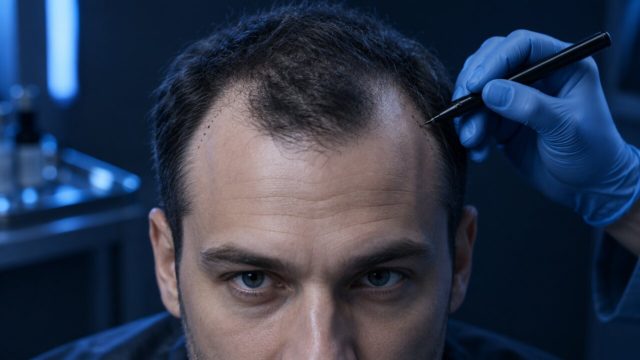
The frontal hairline is often the most visible part of a transplant, even when the total treated area is relatively small. For this reason, hairline planning focuses on shape, facial proportions, hair direction and softness. A patient with mild temple recession may need fewer grafts than someone with extensive frontal loss, but the placement of each graft remains highly important. The goal is typically to avoid an overly straight, low or uniform-looking hairline.
A conservative hairline can help preserve donor grafts for future needs. Hair loss may continue over time, especially in younger patients or those with a family pattern of progressive thinning. Building a very low hairline can increase the number of grafts required now and later. Doctors commonly consider present appearance alongside how the hairline may look if surrounding native hair becomes thinner in the future.
Temple points and corners can add definition to the face, but they also require careful graft direction. Hair in these areas usually grows at a flatter angle and often needs finer single-hair grafts near the edge. Because the area is technically detailed, a graft estimate for temples is not simply based on size. A doctor will assess whether restoring both the frontal line and temples is realistic within the available donor supply.
04Frontal Scalp, Mid-Scalp and Crown: Why Area Changes the Plan
The frontal scalp and mid-scalp are often prioritised because they frame the face and are easily noticed in daily life. When hair loss extends backward from the hairline, the treated surface becomes much larger than it may appear in a mirror. A plan may aim to create useful frontal density first, then blend this into the mid-scalp. This approach can provide a natural visual improvement while keeping graft use within safer limits.
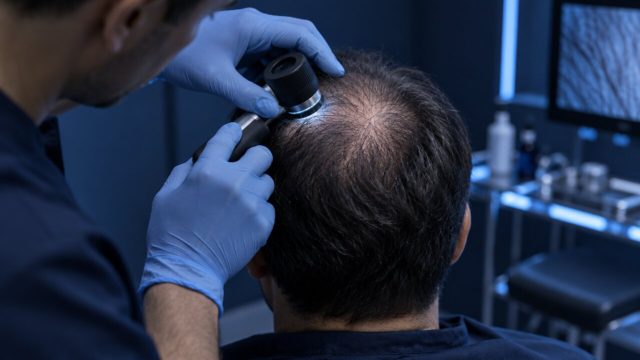
The crown can require a substantial number of grafts because it is a broad area with a spiral growth pattern. Hair is often seen from above under strong lighting, and coverage may need to be spread in several directions. In some patients, treating the crown fully in the first procedure may not be the best use of donor hair. The front and mid-scalp may be given priority, especially when these areas have more impact on the overall frame of the face.
When discussing the number of grafts needed for hair transplant, it is useful to ask which area is being counted. A figure that sounds high for isolated hairline work may be modest for combined frontal, mid-scalp and crown restoration. Conversely, a figure that sounds low may be suitable for a focused area if native hair is still present. A meaningful estimate always states the intended treatment zones and the expected distribution of grafts.
05How Hair Type, Colour and Contrast Affect Visual Coverage
Hair type can strongly affect the appearance of fullness after a transplant. Curly and wavy hair may cover more scalp because each hair shaft bends and creates visual volume. Straight hair may lie flatter against the scalp, so more grafts may be needed to create a similar appearance of coverage. This does not mean one hair type is better than another; it means the design and graft range should reflect the way your hair naturally behaves.
Hair shaft thickness also matters. Coarser hair usually produces more visual impact per strand than very fine hair. Patients with fine hair may still achieve a natural-looking improvement, but the doctor may recommend a realistic density goal based on donor capacity. The number of hairs within each graft is relevant as well, although graft quality and safe extraction are more important than simply aiming for a high hair count.
Scalp-to-hair colour contrast can change how much thinning is visible. Dark hair against a light scalp, or light hair against a darker scalp, can make gaps appear more noticeable. Grey hair, lower contrast, waves and styling habits may make coverage look stronger with the same graft number. During an online assessment, clear photographs in natural light can help the doctor understand these visual factors more accurately.
06Donor Capacity and the Safety Limits of Extraction
The donor area is the foundation of hair transplant planning. It is usually located at the back and sides of the scalp, where follicles may be more resistant to pattern hair loss. However, donor hair is not unlimited. A safe estimate depends on donor density, hair thickness, scalp characteristics, the size of the safe donor zone and the number of grafts that may be needed in the future.
Overharvesting occurs when too many follicles are extracted from a donor area or when extraction is poorly distributed. It can leave the donor region looking visibly thin, uneven or patchy, especially when the hair is cut short. A large graft number is not automatically unsafe, and a smaller number is not automatically safe. The key issue is whether the proposed extraction is appropriate for that individual donor area and carried out with careful spacing.
At Acibadem Hair Transplant Center, doctors review free online hair analyses before discussing suitable treatment options. The clinic is licensed by the Turkish Ministry of Health and offers Sapphire FUE and DHI techniques. The technique is selected according to clinical planning rather than as a substitute for donor assessment. Needle-free anaesthesia may also be available for eligible patients, with suitability confirmed by the medical team.
07Planning for Future Hair Loss Instead of One-Day Numbers
A graft estimate should support a long-term appearance, not only an immediate change. Pattern hair loss can progress after transplantation because transplanted follicles and native hair do not always respond in the same way over time. If existing hair continues to thin behind a newly restored hairline, another area may become more visible. This is why doctors often discuss future risk when designing the hairline and deciding how widely to distribute grafts.
Some patients may be suitable for a single procedure, while others may benefit from a staged strategy. For example, an initial procedure may focus on the hairline and frontal scalp, with the crown reviewed later if donor availability permits. This can help preserve options while allowing the result to mature. It also avoids treating a very large area with density that may be too sparse for the patient’s expectations.
Your goals matter, but they need to be balanced with anatomy and safety. A request for maximum density, a very low hairline or full coverage of advanced hair loss may require more grafts than the donor area can safely provide. In most cases, the most satisfactory plan is one that creates an appropriate frame for the face, preserves the donor area and sets clear expectations about coverage.
08From Online Assessment to 12-Month Graft Evaluation
An accurate preliminary estimate can begin with a free online hair analysis. Patients are generally asked to share clear photographs of the hairline, top, crown and donor area, along with basic information about their hair loss history. At Acibadem Hair Transplant Center, doctors review these submissions and replies are typically provided on WhatsApp within around two hours. An online review is useful for planning, but the final clinical assessment remains important before treatment.
The clinic provides all-inclusive packages that can include VIP transfer, a 4-star hotel, a care kit and 12 months of follow-up. Follow-up is important because transplanted hair does not show its final growth immediately. Early shedding can occur, and growth usually develops gradually. Patients should follow the post-procedure instructions provided by their medical team and contact the clinic if they have concerns during recovery.
At month 12, Acibadem Hair Transplant Center measures results through trichoscopic graft survival assessment. The clinic documents a 98% graft survival rate at month 12 under its written guarantee. Individual cosmetic appearance can still vary according to healing, hair characteristics, the treated area and ongoing native hair loss. The purpose of graft planning is therefore not to promise a specific look, but to create a medically considered and sustainable restoration plan.
09Frequently Asked Questions
Is 3,000 grafts considered a large hair transplant?
For many patients, 3,000 grafts is a substantial procedure, but whether it is a large number depends on the treatment area and donor strength. It may be used for broader frontal and mid-scalp work, while it could be more than needed for limited recession. Your doctor should confirm whether this number is appropriate for your donor area and coverage goals.
Does a 4,000-graft procedure always mean overharvesting?
No. A 4,000-graft procedure is not automatically overharvesting, because safety depends on the individual donor density, safe extraction zone and distribution of extractions. However, it can be too high for some patients. A proper donor examination is needed before deciding whether this graft range can be performed responsibly.
Is 6,000 grafts a high number for hair restoration?
Yes, 6,000 grafts is generally a high total and may be considered only in selected cases with strong donor availability or as part of a staged treatment plan. It is often discussed when several large areas, such as the hairline, mid-scalp and crown, need coverage. The medical team should assess whether enough donor hair can be preserved for future needs.
Can 7,000 grafts be too much for a hair transplant?
For many patients, 7,000 grafts may exceed what can be safely extracted in one procedure from the scalp donor area. In certain cases, a high total may be planned across more than one session, but this depends on careful medical assessment. The priority should be protecting the donor area and achieving realistic coverage rather than reaching a particular number.
Tento článok slúži len na všeobecné informačné účely a nenahrádza odbornú lekársku radu.
Tento sprievodca slúži na všeobecné informovanie a nenahrádza lekársku konzultáciu. O liečbe sa rozhoduje po osobnom alebo online posúdení lekárom.