
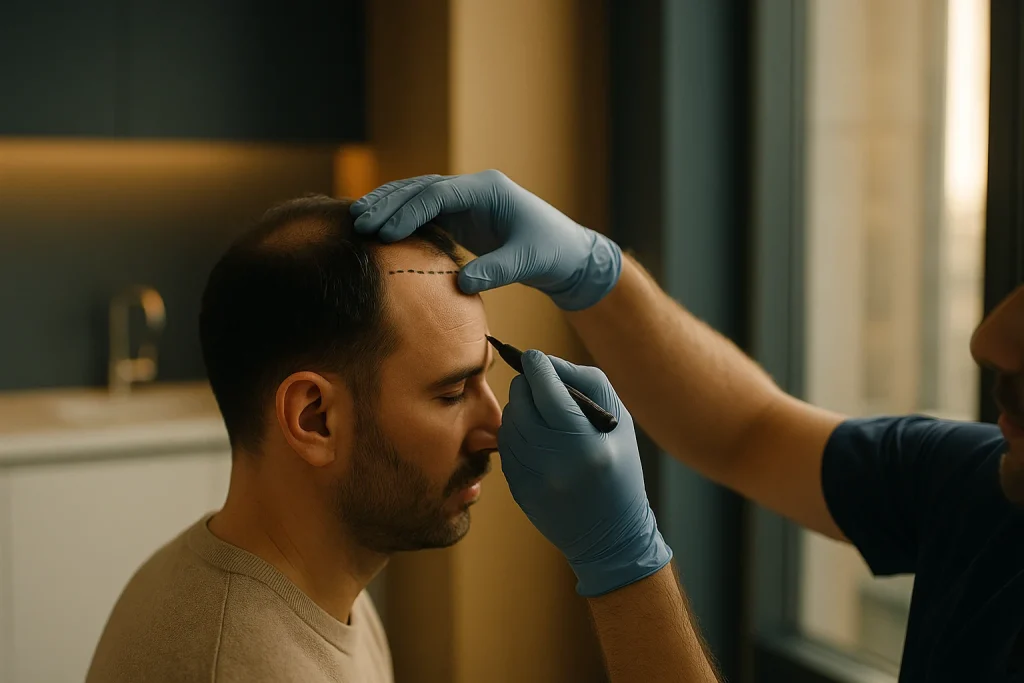
A natural male transplant hairline is designed around your facial proportions, age, existing hair pattern and likely future hair loss. For hairline mens planning, surgeons typically avoid a low, straight line and use carefully selected single-hair grafts to create a soft, irregular and age-appropriate result.
- A natural-looking male hairline is usually conservative, irregular and planned for future hair loss.
- Facial shape, forehead height, age and family history all influence the safest hairline position.
- Single-hair grafts are typically placed at the front edge to create a softer transition.
- The donor area must be assessed carefully because graft supply is limited.
- A doctor-led consultation and long-term follow-up help patients make informed decisions about hair restoration.
01Designing a Natural Male Hairline for Transplantation
A male hair transplant hairline should look as though it has always belonged to the person, rather than appearing newly drawn or overly perfect. This is why hairline mens design is not simply about lowering the frontal line. It is a detailed planning process that considers the forehead, temples, facial proportions, hair characteristics and the expected direction of future hair loss. The goal is usually to create a result that looks natural both in close conversation and from a distance.
In most patients, the best design is one that respects the person’s current age and may continue to suit them over time. A hairline that appears appropriate at age 28 may not look equally natural at age 45 if hair loss continues behind it. For this reason, doctors generally take a conservative approach, especially for younger patients or those with an unstable pattern of thinning. Your doctor will confirm whether transplantation is suitable and discuss what can realistically be achieved with the available donor hair.
At Acibadem Hair Transplant Center in Istanbul, free online hair analysis is reviewed by doctors before treatment planning begins. Clear photographs can help the team make an initial assessment of the frontal hairline, temple recession, existing density and donor area. An online review cannot replace an in-person medical assessment, but it can help international patients understand the next steps before travelling.
02Hairline mens planning: position, proportion and maturity
The position of the hairline is one of the most important decisions in male transplantation. A hairline is normally measured in relation to the forehead and central facial features, not according to a single fixed distance. Doctors assess the upper, middle and lower facial thirds, while also considering natural expression lines, scalp laxity and the individual’s original hair pattern. A balanced result should support the face without making the forehead look artificially short.
Many adult men naturally have some recession at the temples and a more mature frontal shape. This does not necessarily mean that the hairline is abnormal. In fact, retaining a degree of temple recession often helps a transplant look more believable. A very low, rounded or sharply horizontal line can sometimes look unnatural on a male face, particularly if density behind the transplanted area later becomes reduced.
Planning also takes account of future hair loss. Male pattern hair loss may progress gradually, and a transplant does not stop further thinning in untreated areas. A doctor may recommend preserving grafts for the mid-scalp, temples or crown where appropriate. This long-term approach is intended to reduce the risk of a disconnected appearance, where a dense front remains while the hair behind it becomes noticeably thinner.
03Why a soft, irregular edge looks more natural
Natural hairlines are rarely perfectly straight or symmetrical. They contain small variations in height, spacing and direction that soften the transition between forehead skin and hair-bearing scalp. During design, the surgeon may create a gentle zone of micro-irregularity rather than a hard line. This is a controlled process, not random placement, and it is important for avoiding an artificial or “plugged” appearance.
The leading edge usually requires the finest grafts available. Follicular units containing one hair are typically chosen for this area because they resemble the naturally delicate hairs found at the front of a mature hairline. Grafts with two or more hairs can then be placed behind the first rows to build visual density. The exact approach depends on the patient’s hair calibre, curl, colour contrast and donor supply.
Hair direction is equally important. The front hairs should emerge at angles and directions that follow the natural pattern of the surrounding scalp. If grafts are placed too upright, too uniformly or against the existing hair direction, the result may be less convincing. Sapphire FUE and DHI are available techniques at our dedicated hair restoration clinic, and your doctor will determine which approach may be appropriate for your hair and treatment plan.
04Creating natural temple points and frontal corners
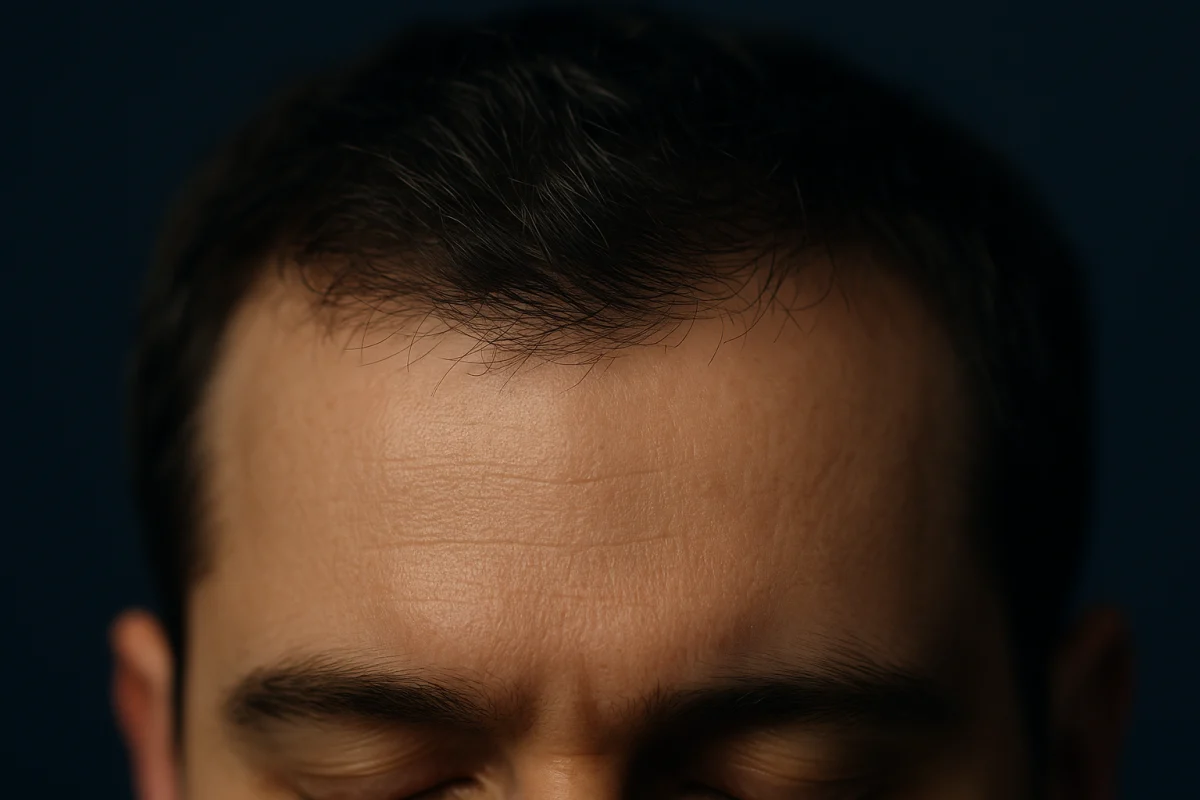
Temple points are the small triangular areas where the front hairline meets the side of the head. They play a major role in framing the face, but they need careful handling. Strongly rebuilt temple points can make a hairline appear too youthful or too sharply defined, particularly in men who have had significant recession. In selected patients, subtle temple restoration may improve facial balance; in others, leaving the area more conservative may be the better choice.
The frontal corners should usually connect naturally to the temporal areas rather than forming abrupt right angles. A gradual transition often matches the way male hairlines mature. Doctors look at the original pattern where possible, as well as photographs from before hair loss if a patient has them. However, old photographs are used as a reference, not as a promise that every previous feature can be recreated.
For hairline mens restoration, the aim is generally harmony rather than maximum lowering. The shape needs to work with the patient’s forehead width, eyebrow position, side profile and hairstyle. A natural result often has restrained asymmetry because the two sides of the face and scalp are not identical. Over-correcting every small difference can make the hairline look less realistic rather than more refined.
05Choosing grafts and density for the front hairline
Donor hair is a limited resource, so graft allocation must be planned carefully. The donor area is usually located around the sides and back of the scalp, where hair may be more resistant to pattern-related loss. Before recommending a procedure, doctors assess donor density, hair shaft thickness, scalp condition and the extent of the area needing coverage. Not every patient has enough donor supply for a very low hairline and high density across a large scalp area.
Fine, single-hair grafts are valuable for the first rows because they can create a gradual, feathered appearance. Behind this zone, grafts may be arranged to provide coverage and visual fullness without wasting valuable donor hair. Density is not only about the number of grafts used. It is also influenced by hair texture, curl, colour contrast between hair and skin, and the width of the thinning area.
A dense front may look appealing immediately after growth, but density must be balanced against future needs. If a person is likely to require work in the mid-scalp or crown later, using too many grafts at the hairline can limit later options. During consultation, the doctor should explain the priorities of the treatment plan and whether the desired coverage is medically realistic.
06Age, hair loss stability and realistic expectations
Age is an important consideration when planning a male hairline transplant. Younger patients may still be developing their long-term pattern of hair loss, even when the frontal recession already feels noticeable. In these situations, a lower or juvenile-style hairline may carry a greater risk of looking out of place if loss progresses. Doctors commonly consider a mature design that can remain credible over the years.
Family history and the pattern of current thinning can provide useful context, although they cannot predict the future with certainty. A doctor may ask about hair loss in close relatives, the speed of your own hair changes and any previous hair treatments. Examination of the miniaturisation pattern can also help with planning. Your doctor will confirm the significance of these findings after a proper assessment.
Medication, medical history, scalp health and lifestyle factors may also be relevant to eligibility and planning. Some patients may be advised to monitor their hair loss or consider non-surgical management before, alongside or instead of transplantation. This is individual clinical guidance rather than a standard rule. A responsible plan should place safety, donor preservation and natural appearance ahead of a short-term cosmetic target.
07From consultation to 12-month hairline assessment
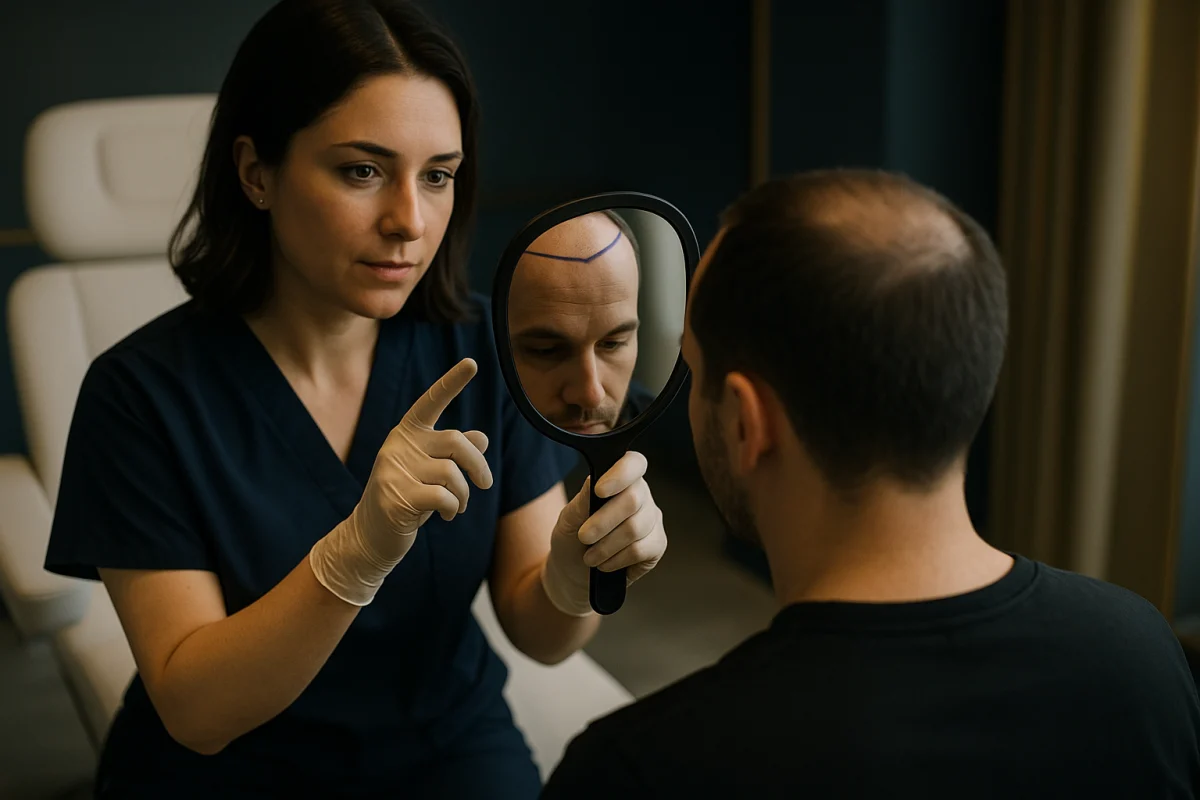
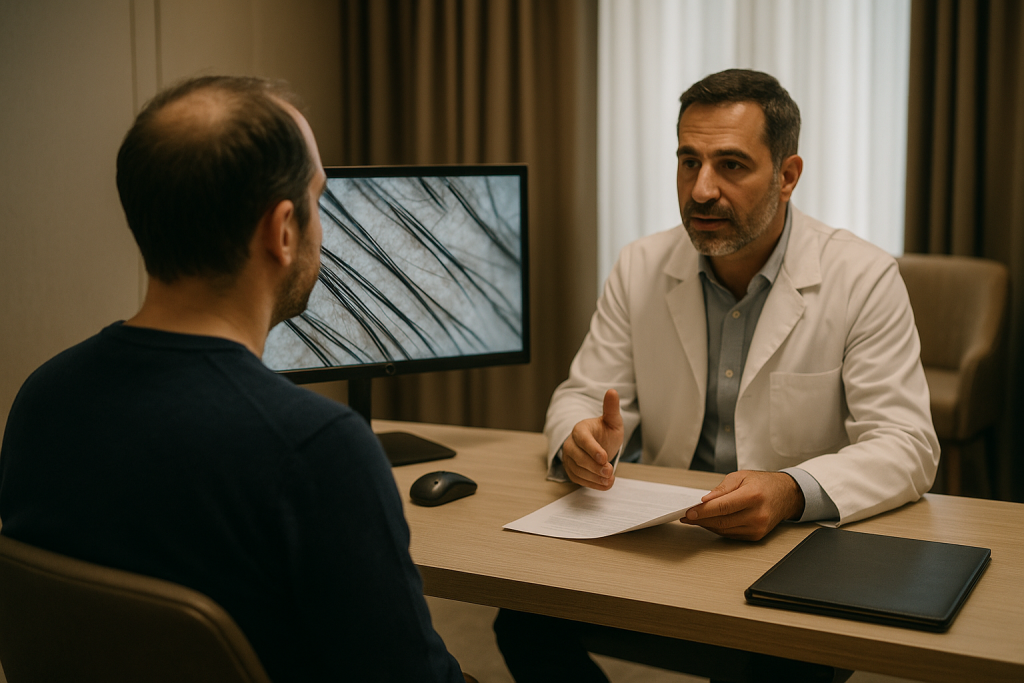
A well-organised consultation starts with listening to the patient’s concerns and understanding what they mean by a natural result. Some patients want to reduce a high forehead, while others want to restore a receded front or improve asymmetrical corners. Photographs, scalp assessment and discussion of hairstyle preferences can all support the planning process. The doctor should explain the proposed outline and why it has been chosen before any procedure takes place.
On the day of surgery, the hairline is normally drawn and reviewed again before graft implantation. Patients should feel comfortable asking questions about the design at this stage. Needle-free anaesthesia is available at Acibadem Hair Transplant Center for eligible patients. The clinic is licensed by the Turkish Ministry of Health and provides all-inclusive packages that may include VIP transfer, a 4-star hotel, a care kit and 12 months of follow-up.
Hair growth after transplantation takes time and varies between individuals. Early shedding of transplanted hairs can occur before new growth becomes visible, and the final cosmetic impression is generally assessed over many months. At our clinic, results are measured by trichoscopic graft survival at month 12, with a documented 98% rate under written guarantee. This measurement relates to graft survival and should not be interpreted as a guarantee of a particular cosmetic result for every individual.
08Protecting the result with aftercare and long-term review
Aftercare supports healing and helps patients protect the transplanted area during the early recovery period. Your care team will provide instructions on washing, sleeping position, activity and avoiding friction or trauma to the scalp. These instructions should be followed closely because the first days after surgery are important for graft stability. If unexpected symptoms occur, patients should contact their clinical team promptly rather than relying on general online advice.
Long-term review matters because native hair may continue to change after a transplant. Follow-up allows the team to review growth, scalp condition and the relationship between transplanted and existing hair. Acibadem Hair Transplant Center provides 12 months of follow-up as part of its all-inclusive package approach. For patients travelling from abroad, communication can also be arranged remotely as advised by the clinic.
A successful male hairline design is not defined by making the forehead as low as possible. It is defined by a result that fits the individual, uses donor hair responsibly and continues to look appropriate as time passes. Patients from 38 countries have visited our Istanbul clinic over 12 years, and a doctor-led assessment remains the best starting point for anyone considering a natural hairline restoration.
09Frequently Asked Questions
Can a man’s hairline grow back naturally?
In male pattern hair loss, a receded hairline does not typically grow back fully on its own. The cause of hair loss, the duration of thinning and the condition of the follicles all matter. A doctor can assess whether medical management, hair transplantation or another approach may be appropriate for your situation.
What does a normal male hairline look like?
There is a wide normal range in male hairlines. Many men have a slightly higher or more recessed mature hairline with gentle temple recession, while others naturally retain a lower line. A normal hairline should be assessed in the context of age, facial proportions, family pattern and whether there is active thinning.
What type of hairline is considered attractive for men?
An attractive male hairline is usually one that looks balanced and natural for the individual rather than one fixed shape. Soft irregularity, appropriate temple recession and a position that suits the face often create a more convincing result than an overly low or perfectly straight line. Personal preference is important, but donor supply and future hair loss must also be considered.
How can men correct a receding or uneven hairline?
Options may include medical assessment, monitoring, non-surgical treatment where clinically appropriate, or a hair transplant for suitable candidates. A transplant can redistribute donor follicles to improve the frontal hairline, but it does not stop future loss in untreated hair. A doctor should assess scalp health, donor availability and long-term goals before recommending a plan.
This article is for general information only and is not a substitute for professional medical advice.
 06
06 12
12