
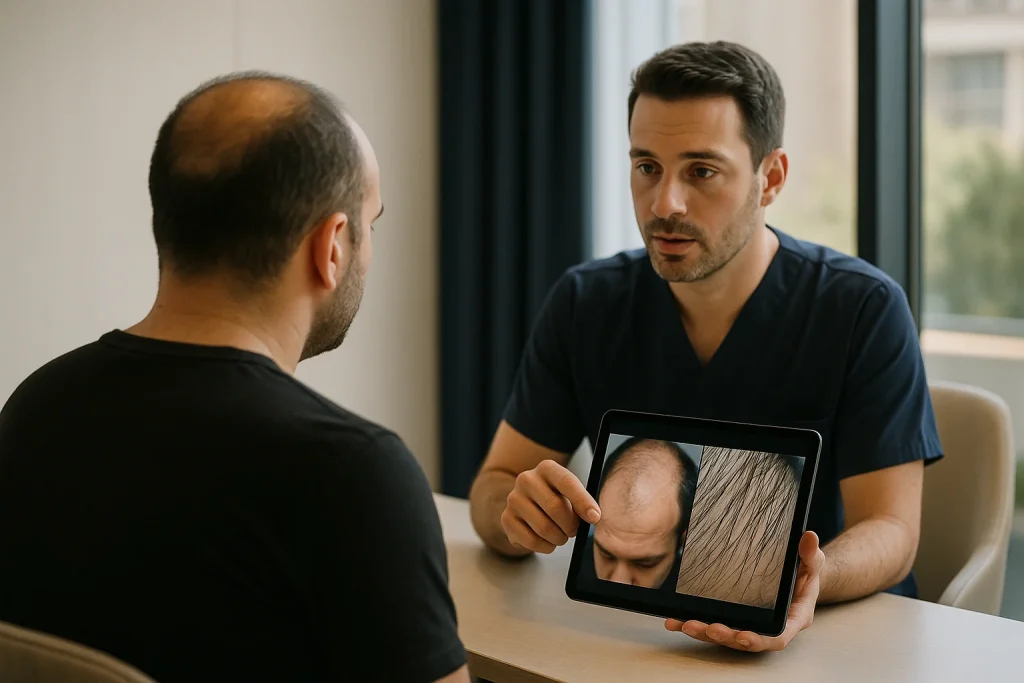
DHT alopecia can continue to miniaturise susceptible native hairs before and after a hair transplant, so it has an important role in planning. A doctor should assess the pattern, progression, donor area and future risk before deciding whether transplantation, medical management or both are appropriate.
- DHT-related hair loss affects susceptible follicles, not every follicle on the scalp.
- A hair transplant redistributes resistant donor follicles but does not stop thinning in untreated native hair.
- A stable, age-appropriate hairline and careful graft budgeting help protect the long-term result.
- Women can also have androgenetic hair loss, but the diagnosis and transplant plan may differ from those for men.
- A doctor-led scalp and donor assessment is essential before any hair restoration procedure.
01Understanding DHT Alopecia and Follicle Miniaturisation
DHT alopecia is a common term for androgenetic hair loss linked to the action of dihydrotestosterone, often called DHT, in genetically susceptible hair follicles. DHT is a hormone made from testosterone in the body. In people with a genetic sensitivity, it can gradually shorten the growth phase of scalp hair. The affected follicles produce finer, shorter and less pigmented hairs over time. This process is called miniaturisation, and it is central to planning a safe, natural-looking hair transplant.
The condition does not mean that every hair on the scalp will be lost. Follicles at the temples, frontal hairline, mid-scalp and crown are commonly more sensitive in men, although the pattern can vary widely. The back and sides of the scalp are often relatively resistant. This difference is the biological basis of modern transplantation: follicles selected from a suitable donor zone may retain much of their resistance after they are moved to a thinning area.
Miniaturisation usually develops gradually, which is why people may first notice extra scalp visibility, a wider part, a receding hairline or less density in bright light. A transplant can improve visible coverage in selected areas, but it cannot change the underlying tendency of susceptible native hair to thin. For this reason, a good plan looks beyond the current hairline and considers what the scalp may look like as hair loss progresses.
02Why DHT Sensitivity Changes the Timing of a Transplant
The timing of a transplant matters because androgenetic hair loss may still be active. If grafts are placed densely into a frontal area while nearby native hair continues to miniaturise, the result can later look uneven. A person may see transplanted hairs remaining behind while the original hairs around them become thinner. This does not necessarily mean the grafts have failed; it can reflect ongoing loss in untreated, DHT-sensitive follicles.
A doctor will usually consider age, family history, the speed of change, hair calibre and the current distribution of thinning. These factors help estimate whether the pattern appears stable or is likely to expand. No assessment can predict future loss with complete certainty. However, thoughtful timing and a conservative design can reduce the need to chase hair loss with repeated procedures over many years.
In some patients, the best first step is observation, medical evaluation or a period of non-surgical treatment rather than immediate transplantation. This is especially relevant when hair loss has changed quickly, when diffuse thinning is present or when the donor supply is limited. Your doctor will confirm whether waiting may help create a clearer pattern and a safer long-term surgical plan.
03Confirming the Cause Before Graft Planning
Not all shedding or thinning is androgenetic hair loss. Stress-related shedding, nutritional problems, thyroid conditions, inflammatory scalp disease, certain medicines and traction can all affect hair density. These causes may occur alongside androgenetic hair loss as well. A transplant should not be planned from photographs alone when the history or pattern suggests another condition, because the priority may be to identify and manage the cause first.
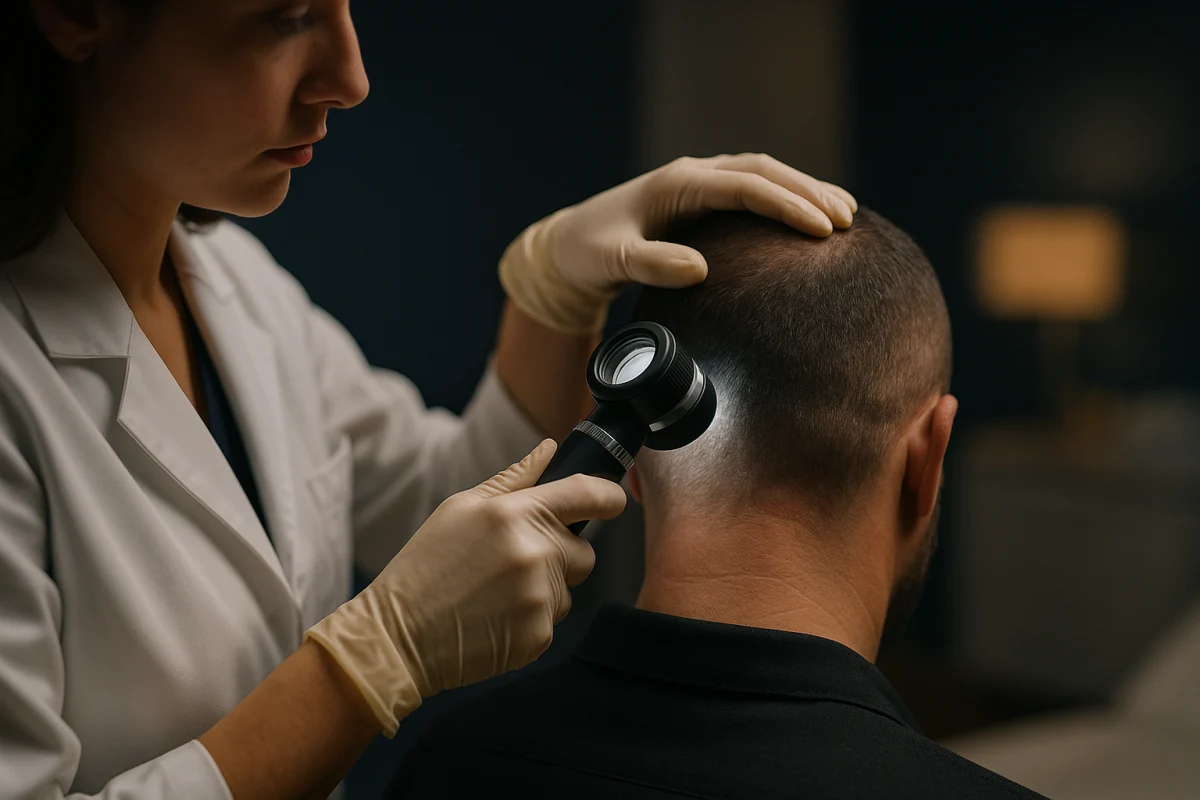
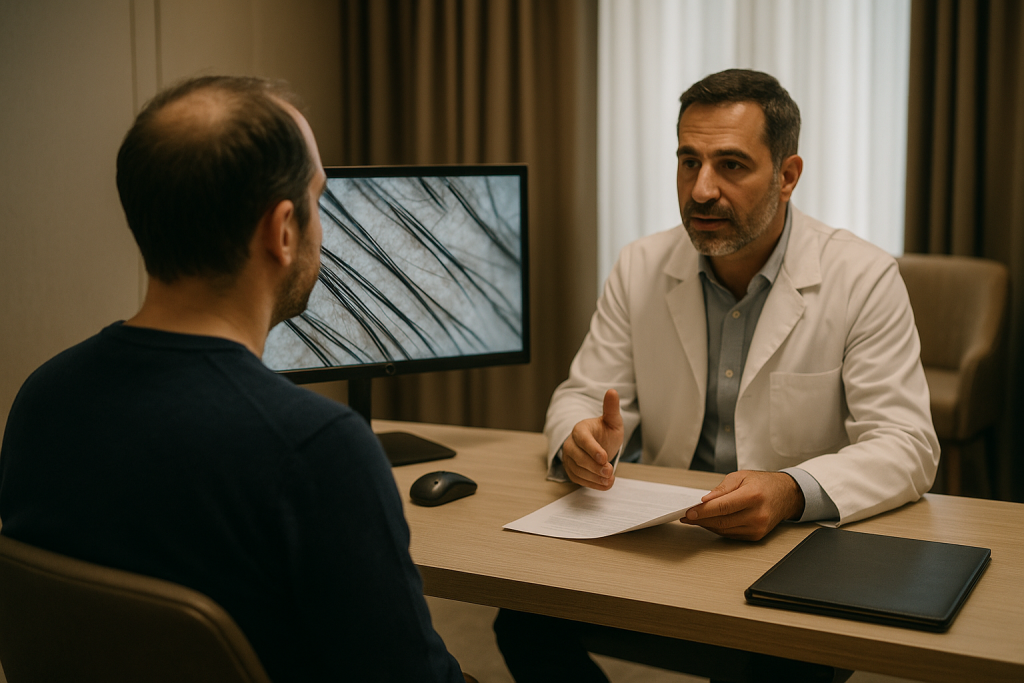
A clinical assessment commonly includes questions about when the loss began, how quickly it changed, family history, previous treatments and general health. The scalp is examined for distribution, inflammation, scaling, scarring and variation in hair shaft diameter. Trichoscopy, which magnifies the scalp and hairs, can help identify miniaturisation and assess the donor area. A doctor may also recommend further medical investigations where clinically appropriate.
The donor area needs the same careful attention as the thinning area. Some people have diffuse miniaturisation that also involves the back and sides of the scalp. If donor hairs are affected, harvesting must be approached cautiously or may not be advised. A responsible recommendation depends on the quality, density and stability of the donor zone, not only on the number of grafts a patient hopes to receive.
04DHT Alopecia and the Donor Area: What Can Be Moved Safely
In dht alopecia, the concept of donor dominance is important. It describes the tendency of follicles from a more resistant donor zone to continue growing after transplantation into a balding area. This tendency is useful, but it is not a blanket promise that every hair at the back of the head is permanently resistant. The safe donor zone must be assessed individually, especially in people with extensive thinning or a strong family history of advanced loss.
Harvesting too heavily from one small area can make the donor region look thin, even if the implanted area appears improved. Surgeons therefore need to distribute extraction appropriately, preserve enough surrounding density and retain grafts for potential future needs. Hair characteristics also matter. Coarser hair, curlier hair and a strong contrast between hair and scalp may create more visual coverage per graft than fine, straight hair with high contrast.
The available donor supply places a practical limit on the coverage that can be achieved. A large area of loss often cannot be restored to the density of an unaffected adolescent scalp. In most patients, the priority is a balanced visual result: a natural hairline, useful frontal framing and gradual coverage toward the mid-scalp or crown. This approach helps protect both the donor area and future treatment options.
05Designing a Hairline for Present and Future Hair Loss
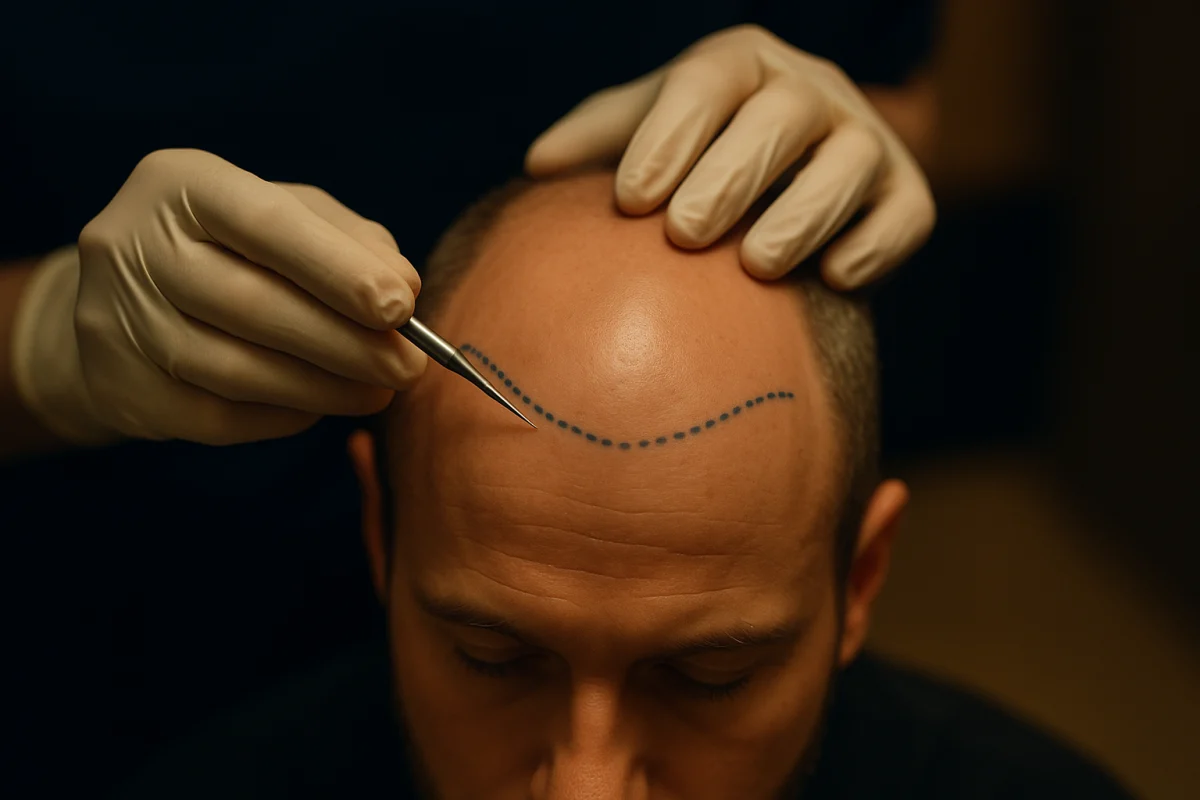
A natural hairline is not simply a low straight line with many grafts. It should suit the person's facial proportions, age, ethnic background, hair characteristics and likely future pattern of loss. When ongoing androgenetic loss is possible, a mature and slightly conservative hairline is typically safer than an aggressive design. It leaves room for later thinning and reduces the risk of an isolated island of transplanted hair at the front.
Single-hair grafts are commonly used at the leading edge to create softness and irregularity, while grafts containing more hairs can contribute density behind the hairline. The direction, angle and distribution of implanted hairs are equally important. They should follow the natural flow of the existing hair, including any whorl in the crown. These details affect how believable the result appears in everyday light, not only immediately after styling.
The crown requires particular caution because it can consume a large number of grafts and may continue to widen over time. Some patients benefit most from prioritising the frontal third before the crown. Others may be candidates for a staged approach. The right order depends on donor capacity, the degree of loss, styling goals and the doctor's assessment of likely progression. A good plan explains these trade-offs openly.
06Surgery Choices and the Role of Ongoing Medical Care
Hair transplantation relocates follicles; it does not directly remove DHT from the scalp or cure androgenetic hair loss. Medical management may be discussed to support susceptible native hairs where appropriate. Options can include doctor-prescribed treatments that influence androgen pathways or promote hair growth, as well as treatment of scalp conditions that affect comfort or hair quality. Suitability, side effects, pregnancy considerations and medical history must all be reviewed by a qualified doctor.
Sapphire FUE and DHI are two implantation approaches that may be considered after the diagnosis and design have been established. With Sapphire FUE, follicles are extracted individually and recipient channels are created before placement. With DHI, implanted follicles may be placed using a specialised implanter. Neither technique alone can overcome poor donor quality, active diffuse loss or an unrealistic density target. Technique selection should follow the clinical plan rather than marketing claims.
At Acibadem Hair Transplant Center, a dedicated hair restoration clinic in Istanbul licensed by the Turkish Ministry of Health, doctors review online hair analyses before advising on next steps. Needle-free anaesthesia is available for suitable patients. A consultation should also cover recovery expectations, existing medicines, the possibility of temporary shock shedding and the importance of long-term follow-up. These discussions support informed consent and realistic expectations.
07Female Pattern Hair Loss Requires a Different Assessment
Female androgenetic alopecia often presents as diffuse thinning across the top of the scalp, widening of the central part or reduced volume rather than a sharply receding hairline. DHT can play a role, but female hair loss has a broader range of possible contributors and patterns. Hormonal changes, iron status, thyroid disorders, recent illness and traction may need consideration. For this reason, women should not assume that a plan designed for male-pattern loss will apply to them.
A transplant may be appropriate for selected women with stable pattern loss, a strong donor area and a clear diagnosis. However, diffuse thinning in the donor area can reduce suitability. Where native hair is still present throughout the recipient zone, surgeons also need to consider the risk of temporary shock shedding and how to place grafts without harming the existing appearance. Medical assessment and expectation setting are particularly important.
A successful plan may focus on improving density around a widened part, framing the hairline where appropriate or restoring a localised area of loss. The goal is usually improved coverage rather than complete restoration of former density. Your doctor will confirm whether transplantation is reasonable, whether medical treatment should be considered first or whether further investigation is needed before making a surgical decision.
08Planning Follow-Up Around Continuing Hair Loss
DHT alopecia planning does not end when graft placement is complete. Transplanted follicles need time to settle and grow, while nearby native hairs may continue their own cycle of thinning. Early shedding of implanted hairs can occur after surgery and is commonly temporary. Visible new growth typically develops gradually, so meaningful assessment takes months rather than weeks. Your clinic should explain the expected recovery timeline and when to contact the medical team.
Long-term follow-up helps distinguish normal recovery from ongoing native-hair loss, scalp irritation or other concerns. At Acibadem Hair Transplant Center, all-inclusive packages include VIP transfer, a 4-star hotel, a care kit and 12 months of follow-up. Graft survival is measured trichoscopically at month 12, with a documented 98% rate under a written guarantee. Individual cosmetic density and appearance can still vary because they depend on hair characteristics, scalp condition and continuing native-hair loss.
Patients from 38 countries have been treated at the clinic over 12 years, and a free online hair analysis is reviewed by doctors before travel plans are made. Replies on WhatsApp are typically provided within around two hours. An online review cannot replace a full in-person medical assessment, but it can help identify key questions about donor supply, hair loss pattern, technique suitability and the value of an individualised plan.
09Frequently Asked Questions
Can hair lost through DHT grow back?
Miniaturised hairs may sometimes become thicker if the follicles are still active and an appropriate medical treatment is started early, but this is not guaranteed. Follicles that have been inactive for a long time are less likely to recover meaningful growth. A hair transplant can move suitable donor follicles into an area of permanent loss, but it does not restore every original follicle.
What signs can suggest higher androgen activity or DHT sensitivity?
Scalp hair thinning alone cannot confirm high DHT levels, because follicle sensitivity is often more important than the amount of hormone in the blood. In some people, signs such as progressive temple recession, crown thinning, increased facial or body hair, acne or menstrual changes may justify a medical review. These signs have many possible causes, so laboratory testing and diagnosis should be guided by a doctor.
Is female androgenetic hair loss reversible?
Female pattern hair loss can sometimes be improved or stabilised, particularly when it is identified early and contributing conditions are addressed. Complete reversal is not typical, and the response to treatment varies between individuals. A doctor should confirm the diagnosis before discussing medication, lifestyle factors or transplantation.
What can reduce DHT activity on the scalp?
Certain prescription treatments can reduce DHT production or its effect on susceptible follicles, but they are not suitable for everyone and can have side effects. Some topical and oral options require particular caution in women who are pregnant, trying to conceive or breastfeeding. Cleansing products alone do not usually stop androgenetic hair loss, so speak with a qualified doctor before starting any treatment.
This article is for general information only and is not a substitute for professional medical advice.
 06
06 12
12