
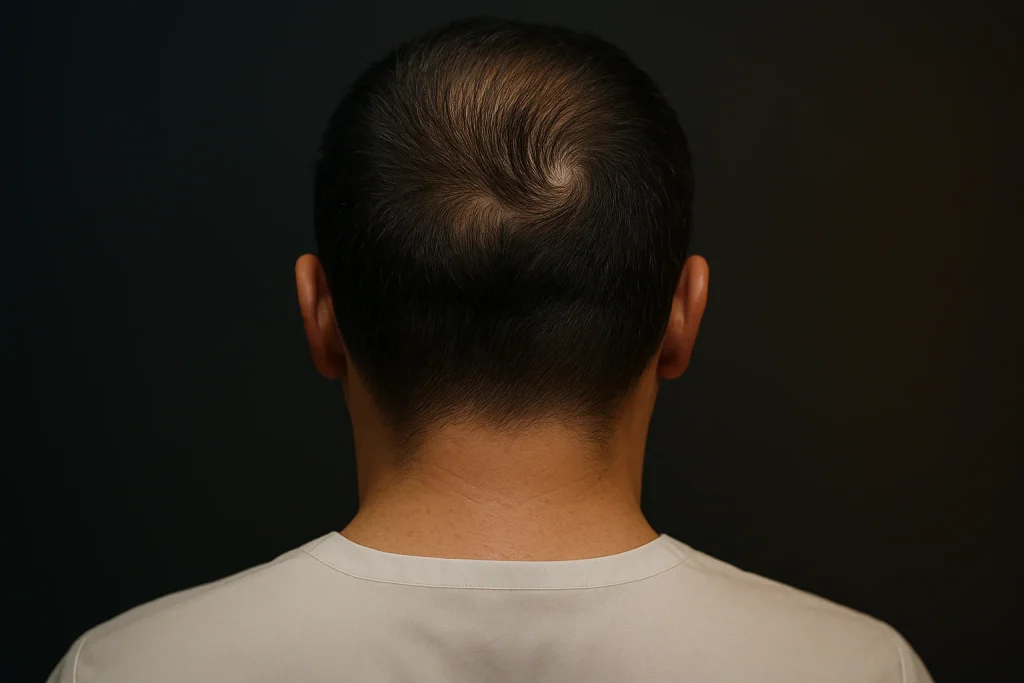
A double crown pattern requires careful graft planning because each crown has its own natural direction, angle, and visual centre. A double crown hairline assessment should distinguish the frontal hairline from the crown pattern, then map both areas before surgery. In most patients, natural-looking coverage depends more on correct direction and sensible density distribution than on simply placing more grafts.
- A double crown is a natural hair-growth variation in which two whorls are present near the back or upper part of the scalp.
- Each whorl should be mapped separately so transplanted grafts follow the existing direction of hair growth.
- The crown can use a high number of grafts, so donor capacity and future hair-loss risk should be considered before treatment.
- Density planning usually prioritises the frontal area when donor supply is limited, while the crown is designed for balanced coverage.
- A doctor-led scalp assessment can help confirm whether a double crown is a stable growth pattern, thinning hair, or both.
01Double Crown Patterns and Hair Transplant Graft Planning
A double crown hairline is often searched as though it describes one feature, but the hairline and crown are separate areas of the scalp. The hairline is the front border of the hair, while the crown is usually on the upper back of the head. A person with two crown whorls may also have a naturally uneven hairline, but one does not automatically cause the other. For hair transplant planning, both areas need to be assessed as part of the whole scalp rather than treated as one simple pattern.
A crown, also called a hair whorl or cowlick, is the point where hairs grow outward in a circular or spiral direction. With a double crown, there are two centres of rotation. The hair between them may grow in opposite, crossing, or changing directions. This can make the area look less dense in bright light or when the hair is short, even when there is no active hair loss. It can also make early thinning more difficult to judge without a close examination.
Hair transplant graft planning for a double crown is highly individual. The medical team considers the size and position of both whorls, the direction of existing hair, the degree of thinning, hair calibre, scalp contrast, and the available donor area. The objective is typically to support a natural pattern while using grafts responsibly. A plan that looks appropriate for a single circular crown may not suit two separate whorls.
It is also important to look beyond the visible crown. Pattern hair loss may progress over time, and the crown is often an area where future thinning can become noticeable. For this reason, a responsible consultation discusses long-term appearance as well as the immediate cosmetic goal. Your doctor will confirm whether transplantation is suitable, how much coverage may be realistic, and whether preserving grafts for future needs should be part of the plan.
02How a Double Crown Hairline Differs From a Receding Hairline
The phrase double crown hairline can be confusing because a double crown does not usually sit at the frontal hairline. Two whorls most often appear at the vertex, which is the crown region toward the back of the scalp. By contrast, a receding hairline involves loss or miniaturisation around the forehead and temples. A full assessment separates these features so that the cause of each visual change is not assumed incorrectly.
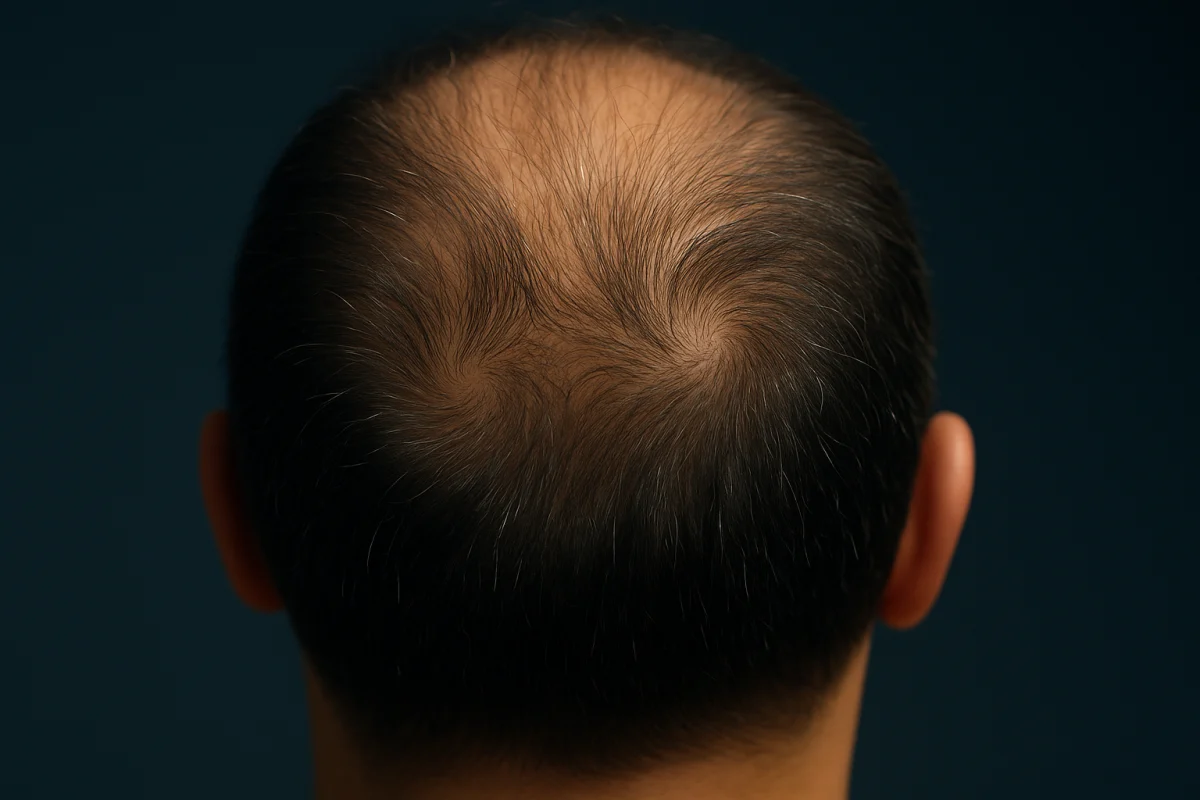
A normal double crown can create visible scalp lines because the hair parts around two centres. These lines may widen when the hair is wet, flattened, very short, or exposed to strong overhead light. This appearance is not, by itself, proof of baldness. However, if the scalp show-through has increased over time, or if hairs within the area appear finer than surrounding hairs, an assessment may be useful to check for thinning alongside the natural whorl pattern.
The position of the double crown matters. In some people, the whorls are close together and form a figure-eight-like flow. In others, they are more widely spaced, with a bridge of hair between them. The direction may be clockwise in one whorl and counterclockwise in the other. These details affect where grafts can be placed and how they should be angled to blend with native hair.
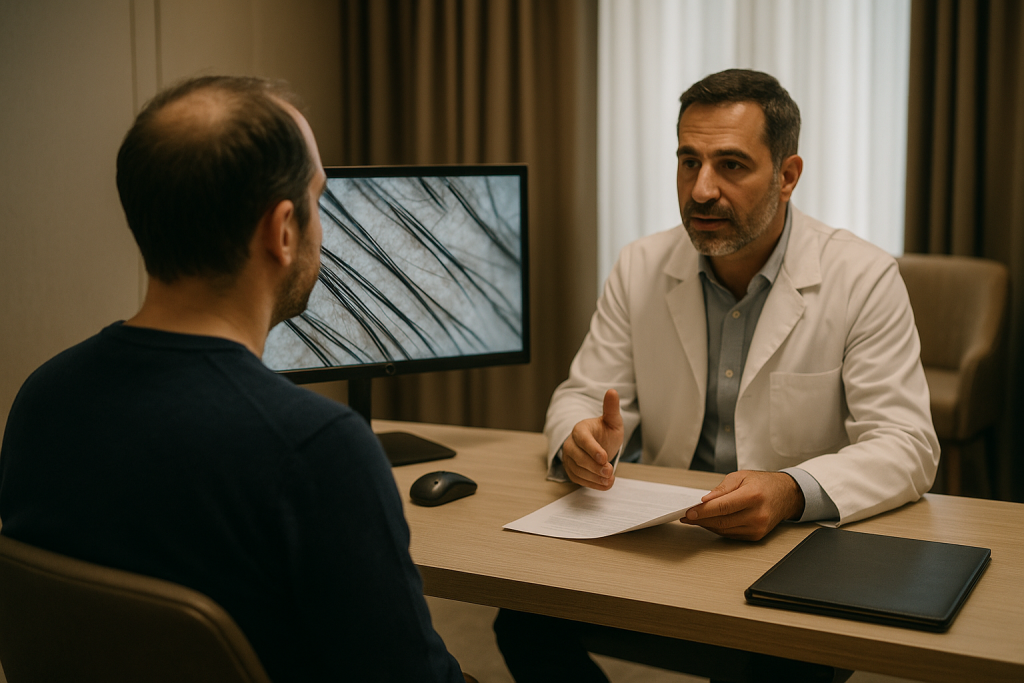
During a hair restoration consultation, photographs and a scalp examination can help identify the true borders of each whorl. Trichoscopic assessment may help the doctor examine hair shaft variation and scalp visibility in more detail. This provides a more reliable basis for planning than judging the crown from one photograph or from the way hair appears after styling.
03Assessing Whether Two Whorls Need Treatment
Not every double crown needs treatment. Many people are born with two whorls and have a stable, healthy-looking density throughout life. Treatment is generally considered only when there is a concern such as progressive thinning, a visible gap that affects confidence, scar tissue, or a previously transplanted area that does not match the natural growth pattern. A natural variation alone is not a medical problem.
The first question is usually whether the appearance has changed. A long-standing double crown that looks the same in older photographs may simply be a normal growth pattern. If the area has become wider, the hairs have become shorter or finer, or the surrounding crown is losing density, this may suggest an additional hair-loss process. Your doctor may ask about family history, general health, medications, and the timing of hair changes before discussing a procedure.
A close examination also helps distinguish between hair direction and hair density. A strong double whorl can expose small lines of scalp despite good density, while a less obvious whorl can still be affected by substantial thinning. Planning should address the actual issue. Adding grafts to a naturally open spiral without respecting its direction may make the pattern look artificial rather than improve it.
For international patients, a free online hair analysis can be a useful first step for discussing photographs and concerns. At Acibadem Hair Transplant Center, submitted images are reviewed by doctors, and WhatsApp replies are typically provided within around two hours. An online review cannot replace an in-person medical examination, but it can help indicate the questions that should be considered before travel or treatment.
04Mapping Graft Direction Across Two Crown Centres
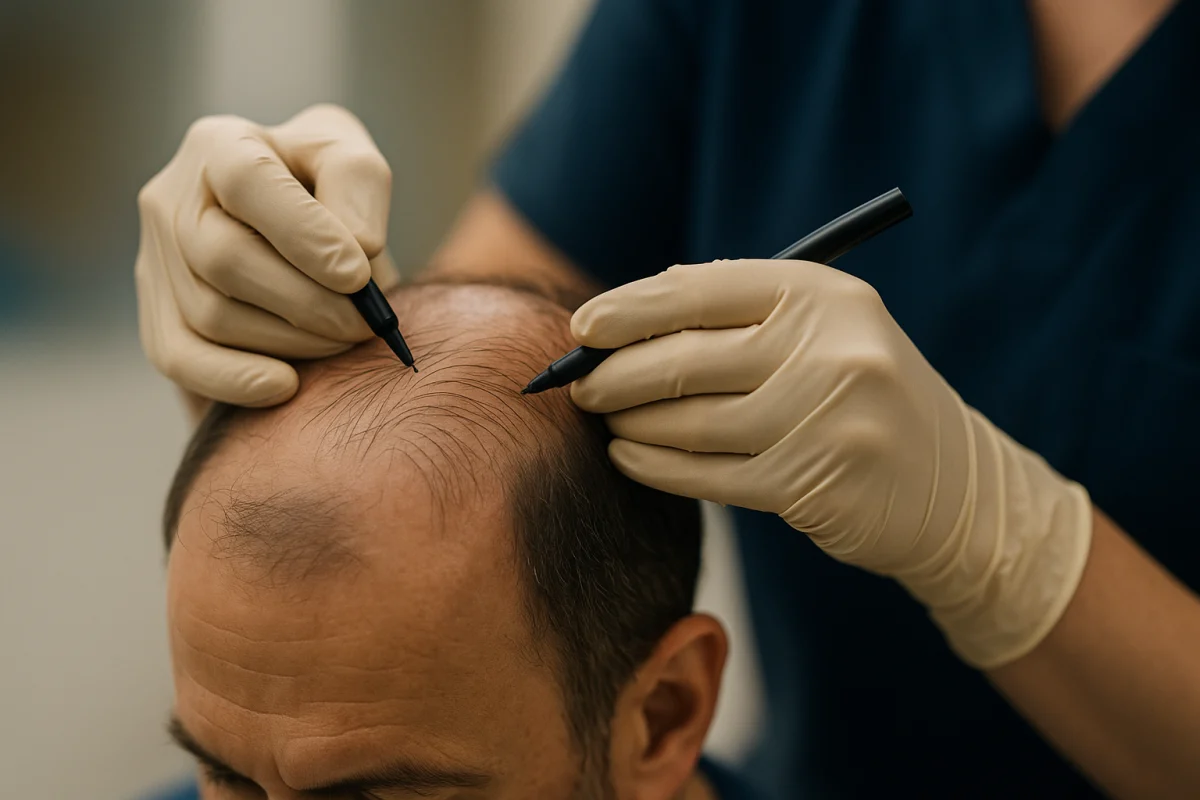
Direction is one of the most important elements of crown work. Native crown hairs usually emerge at a shallow angle and then sweep away from the centre of a whorl. With two crowns, the directions change across the scalp more often than they do in a single-whorl pattern. The surgeon therefore maps each centre and the transition zone between them before creating recipient sites.
Grafts are normally placed to copy the angle, direction, and rotation of nearby native hairs. Around the central point of a whorl, this may involve a gradual change in placement direction over a small area. Between two whorls, grafts may need to blend into a dividing ridge or a crossing flow. A simplified straight-line placement can interrupt the natural movement of hair and may remain noticeable after the hair grows longer.
The visual centre of a crown does not always need the highest density. In fact, attempting to close every natural spiral line can use many grafts and may reduce the realistic appearance of the pattern. The aim is typically to create balanced coverage and reduce unwanted scalp visibility while retaining a believable whorl. Hair calibre, curl, colour contrast, and hairstyle can all influence how much density is needed for this effect.
Recipient-site planning is performed with attention to the safety of existing hairs. When native hair remains in the crown, the team needs to work around it carefully. This is particularly relevant in areas of diffuse thinning, where many fine but living hairs may still be present. The proposed approach should be reviewed with the patient so that the expected coverage, the limits of density, and the natural double-crown shape are clearly understood.
05Balancing Crown Grafts With Donor Supply and Future Loss
The crown can require a substantial number of grafts because it covers a broad, circular area and because hair grows in several directions. A double crown may increase the complexity of distribution, especially if both whorls are thinning. However, the total graft number should not be decided from crown size alone. Safe donor capacity, the quality of donor hair, and the possibility of future loss in untreated areas are central to responsible planning.
In many patients, the frontal hairline and frontal third of the scalp have a stronger effect on facial framing and day-to-day appearance than the crown. When donor resources are limited, a doctor may recommend prioritising these frontal areas first and planning a moderate crown improvement rather than attempting maximum density everywhere. This is not a fixed rule, but it is a common long-term planning principle.
A donor assessment examines the density and characteristics of hair in the permanent donor zone, usually at the back and sides of the scalp. Taking too many grafts can leave the donor area visibly thin, so extraction must remain within an appropriate range. The best plan aims to balance the recipient-area goal with preservation of the donor region. Your doctor will confirm what may be safely achievable after examining your scalp and medical history.
Age and the stability of hair loss are also relevant. A younger person with early crown thinning may have many years in which additional hair loss could develop. A conservative design can leave options open for the future. Conversely, a person with stable loss and a strong donor area may have different priorities. Neither scenario can be judged accurately from a generic graft chart, because graft needs vary considerably from one scalp to another.
06Technique Choices for Detailed Crown Placement
Both Sapphire FUE and DHI can be considered in a hair transplant plan, depending on the patient’s hair characteristics, the recipient area, and the doctor’s clinical assessment. Sapphire FUE involves extracting follicular units and preparing recipient channels with sapphire instruments before placement. DHI uses an implantation approach that can support controlled placement in selected cases. Neither technique automatically guarantees a better result for every double crown.
For crown restoration, the planning and execution of direction are usually more important than the name of the technique. The team must maintain a low, natural emergence angle and follow the changing rotation around both whorls. Graft handling, recipient-site design, and appropriate spacing are all important. The chosen method should be based on what helps meet the individual plan safely and predictably, rather than on a general claim that one method is always superior.
Local anaesthesia is commonly used during hair transplantation. Needle-free anaesthesia is available at Acibadem Hair Transplant Center for eligible patients who prefer to discuss this option. Suitability depends on the person’s medical background and the planned procedure, so it should be confirmed during the medical evaluation. The clinic is a dedicated hair restoration clinic in Istanbul and is licensed by the Turkish Ministry of Health.
It is sensible to ask how the crown will be designed before proceeding. Useful discussion points include where each whorl centre will sit, how the transition between the two patterns will look, whether the plan preserves native hair, and how grafts will be allocated between the hairline, mid-scalp, and crown. Clear planning does not create a guaranteed result, but it helps set realistic expectations and supports informed consent.
07Healing, Growth Timeline, and Reviewing the Crown Result
After a hair transplant, the recipient area typically develops small crusts and temporary redness as it heals. The crown may look different from day to day during the early period because hairs lie in changing directions and because the two whorls become more obvious when the hair is very short. Patients should follow their clinic’s washing, activity, and aftercare instructions carefully, as the first days are important for protecting newly placed grafts.
Transplanted hairs commonly shed during the early weeks before new growth begins. This temporary shedding phase can be expected and does not by itself mean that grafts have failed. Visible growth generally develops gradually over the following months, while crown maturation may take time because the area is broad and hair direction affects coverage. Final assessment is often more meaningful when sufficient growth and styling length have developed.
A double crown should be reviewed in more than one direction and under consistent lighting. Looking only from directly above can overemphasise the natural spiral lines. Standardised photographs, scalp examination, and trichoscopic review can provide a clearer picture of density and graft survival. At Acibadem Hair Transplant Center, results are measured by trichoscopic graft survival at month 12, with a documented 98% rate under a written guarantee. Individual cosmetic appearance can still vary according to healing, hair characteristics, and ongoing native hair loss.
Acibadem Hair Transplant Center has welcomed patients from 38 countries over 12 years. Its all-inclusive packages include VIP transfer, a 4-star hotel, a care kit, and 12 months of follow-up. Follow-up is especially valuable for a crown procedure because it allows the team to review growth over time, answer aftercare questions, and discuss whether the planned coverage is developing as expected.
08Frequently Asked Questions
How uncommon is it to have two crowns on the head?
Two crown whorls are a recognised natural variation in hair growth. They are less commonly seen than a single crown, but there is no single reliable percentage that applies to every population or assessment method. Having two crowns alone does not indicate a health problem or a need for treatment.
What does having two cowlicks usually mean?
Two cowlicks usually means there are two natural centres where the hair rotates or grows outward in different directions. This pattern is commonly present from birth and may make styling more challenging or create visible scalp lines in the crown. It does not automatically mean that you are losing hair.
Can a double crown disappear over time?
The underlying double-crown growth pattern typically does not disappear, because it is determined by the direction of the hair follicles. Its visibility can change with hair length, styling, density, and hair loss. If the area appears newly different or wider, a doctor can assess whether thinning is also present.
Is a double crown considered lucky?
Some cultural traditions attach symbolic meanings, including luck, to different hair-whorl patterns. There is no medical or scientific evidence that a double crown predicts luck, personality, or future health. From a clinical perspective, it is simply a variation in hair growth direction.
Can a hair transplant make a double crown look natural?
In suitable candidates, a hair transplant can potentially improve coverage in a thinning double-crown area. A natural appearance depends on accurately following both whorl directions, using donor grafts carefully, and setting realistic density goals. Your doctor will confirm whether your donor area and hair-loss pattern are appropriate for treatment.
This article is for general information only and is not a substitute for professional medical advice.
 06
06 12
12