
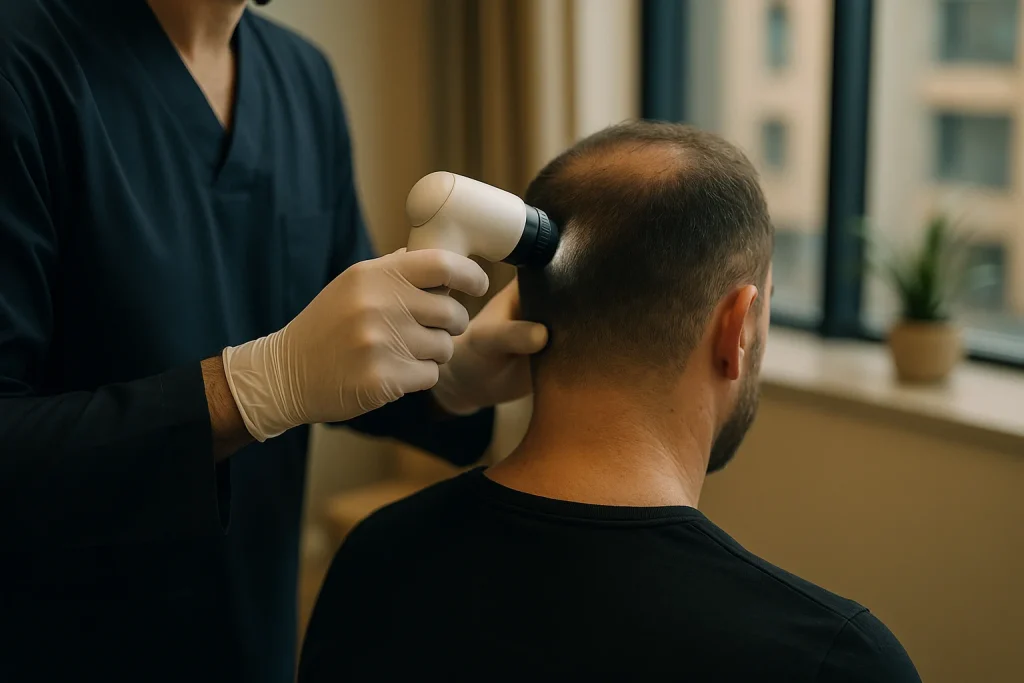
For patients asking how far back does a hair follicle go, the visible hair shaft is only the outer part of a much deeper living structure. On the scalp, the lower part of a growing follicle commonly sits a few millimetres beneath the skin, while its exact depth and angle vary by area, hair type, and growth phase. These details help the surgical team plan graft extraction carefully and protect the donor area.
- A hair follicle is a living mini-organ below the scalp surface, not simply the strand of hair that can be seen.
- Follicle depth, exit angle, density, and hair calibre can vary across the donor area and affect extraction planning.
- The permanent donor zone is assessed individually because not every hair on the back and sides is equally stable over time.
- Safe donor planning aims to retain enough hair for a natural-looking donor area as well as the recipient area.
- A doctor-reviewed assessment and trichoscopic examination can help determine whether hair restoration is suitable.
01Hair follicle structure beneath the scalp
To understand how far back does a hair follicle go, it helps to separate the visible hair from the tissue that produces it. The hair shaft is the fibre that emerges through the scalp. Beneath the surface, the follicle is a narrow, angled skin structure that surrounds the growing hair and extends into the dermis and, during active growth, sometimes toward the fatty layer under the skin. It is a living unit with cells, connective tissue, blood supply, nerves, and small muscles around it. During hair restoration, the surgeon works with this complete follicular unit rather than only with the hair that is visible above the scalp.
At the deepest end of an actively growing follicle is the bulb. This is where rapidly dividing cells form the hair shaft. The bulb surrounds the dermal papilla, a small area of specialised tissue that sends signals supporting hair growth. The follicle also includes the outer and inner root sheaths, which help guide and protect the developing hair. A sebaceous gland releases oil into the upper section of the follicle, while the arrector pili muscle is the tiny muscle associated with goosebumps. These structures explain why follicles need to be approached with accurate depth and angle during graft extraction.
Follicles do not all sit at the same depth. Thick terminal hairs in the donor region may have relatively deep bulbs, while finer hairs and follicles in different growth phases may be positioned differently. Curly or tightly curved hair can also continue in a curve under the skin even when it appears to emerge at a modest angle. For this reason, the external direction of a hair is useful but does not show the full path of the follicle. Careful magnification, experience, and conservative instrument settings are important for reducing unnecessary trauma during a hair transplant.
02How far back does a hair follicle go? Depth, angle, and graft anatomy
How far back does a hair follicle go is not answered by one fixed measurement for every person. In most scalp areas, a follicle extends only a few millimetres below the skin, but depth changes with the phase of the growth cycle, the thickness of the hair, scalp characteristics, and the individual’s biology. The lower follicle is generally deepest in anagen, the active growing phase. In telogen, the resting phase, the club hair is positioned more superficially before it sheds. A clinical team therefore plans around variation rather than assuming every graft has identical anatomy.
A transplant graft usually contains one to several hairs growing naturally together in a follicular unit. It can also include surrounding protective tissue, which helps support safe handling. The aim in follicular unit extraction is to separate that unit from nearby tissue without damaging the follicle bulb or cutting across the hair root. Because the follicle may angle away from the apparent hair direction beneath the scalp, extraction must follow the estimated subcutaneous path rather than simply moving straight downward. This is especially relevant when hair has a pronounced curl or when the donor scalp has uneven density.
Follicle anatomy also matters after extraction. Grafts require gentle placement into recipient channels that match the intended direction, angle, and density pattern of the new hairline or thinning area. Recipient channels should be designed according to the existing hair and the available blood supply of the scalp. Placing too many grafts into a small area may not be suitable for every patient. Your doctor will assess the scalp, pattern of hair loss, medical history, and available donor reserve before recommending a treatment plan.
03The hair growth cycle and the meaning of dormant follicles
Each scalp follicle moves through repeating phases: anagen, catagen, telogen, and exogen. Anagen is the active production phase, when the hair shaft grows longer and the follicle is fully developed. Catagen is a short transition stage in which growth stops and the lower follicle regresses. Telogen is often called the resting phase. During exogen, the old hair is released, after which a new anagen hair may begin to grow from the same follicle. These cycles occur independently, which is why healthy scalp hair does not usually shed all at once.
A dormant-looking follicle is not necessarily permanently lost. In a typical telogen phase, the follicle remains present and may later re-enter active growth. The timing differs between people and body sites, but scalp telogen commonly lasts several months. Hair shedding can become more noticeable after illness, major stress, nutritional change, childbirth, some medicines, or other health factors. When shedding is sudden or extensive, clinical assessment is important because the cause may be unrelated to male or female pattern hair loss.
In progressive pattern hair loss, follicles may gradually miniaturise. They produce shorter, finer hairs with a shorter growing phase, rather than becoming inactive immediately. Over time, some areas may look bare even though miniaturised follicles can still be present. Trichoscopic examination can help a doctor identify variation in shaft diameter, density, and signs of miniaturisation. This information is useful when distinguishing a potentially stable donor area from a region affected by ongoing thinning.
04Finding the stable donor zone on the back and sides
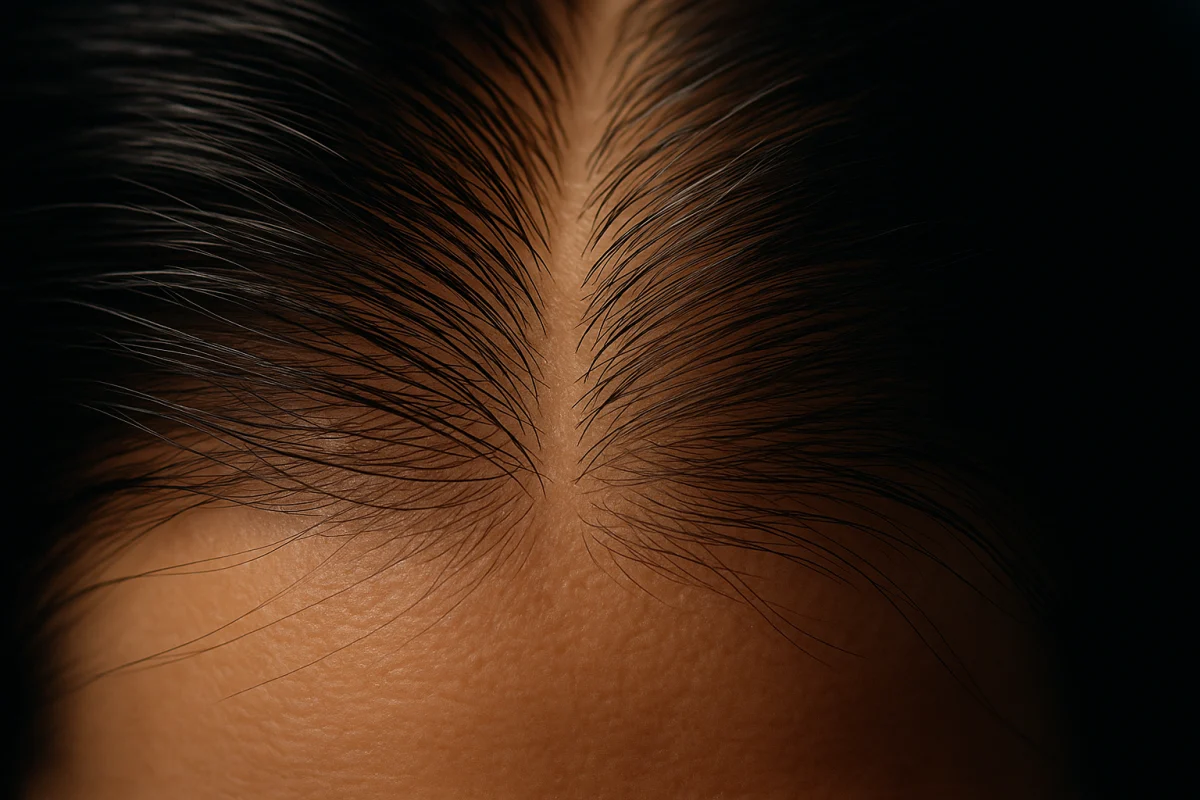
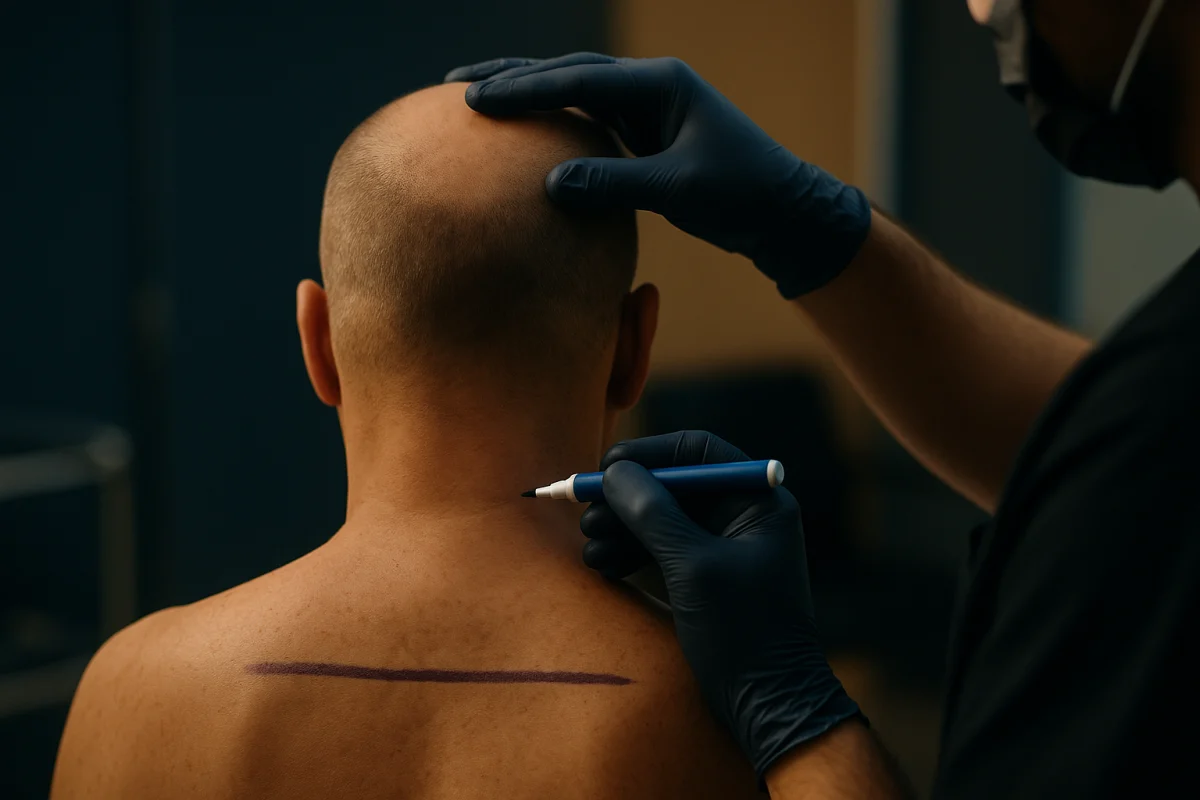
The donor area is commonly located on the back and sides of the scalp because hair in these regions is often more resistant to pattern hair loss. However, “resistant” does not mean that every hair below a certain line is permanently stable. The donor zone has to be mapped for the individual patient. Family history, age, current pattern of thinning, scalp examination, and the possibility of future hair loss all influence whether a particular area is appropriate for extraction.
When considering how far back does a hair follicle go, donor planning also considers how broadly the follicle population is distributed across the scalp. The safest approach is generally to harvest in a dispersed pattern within the assessed stable zone, instead of concentrating removal in one narrow location. This can help maintain a more even appearance after the surrounding hair grows out. The team should also avoid relying too heavily on areas that may become less stable in the future, including zones close to the upper margins of the donor region in some patients.
Donor mapping is not only about drawing a boundary. It includes examining hair density, hair shaft thickness, the average number of hairs per follicular unit, skin laxity where relevant, scalp colour contrast, and the natural styling preferences of the patient. A person with fine hair or low donor density may have fewer grafts available than a person with dense, coarse hair. A responsible plan balances the desire for coverage in the recipient area with preserving an undetectable and healthy-looking donor region.
05Density, hair calibre, and scalp characteristics in graft planning
Graft numbers alone do not define a good result. Two people can receive a similar number of follicular units and see different visual coverage because their hair calibre, curl, colour contrast, and existing density are different. Coarser hairs often provide more visual bulk than very fine hairs. Wavy or curly hair can create the impression of greater coverage than straight hair because it occupies more space above the scalp. Conversely, high contrast between dark hair and light scalp can make thinning more visible and may affect how density is planned.
Trichoscopy is a useful method for examining the scalp at magnification. It can help measure or document hair density, shaft diameter variation, and the proportion of single- and multi-hair follicular units in selected areas. At Acibadem Hair Transplant Center, results are measured by trichoscopic graft survival at month 12, with a documented 98% rate under written guarantee. This type of assessment supports objective follow-up, although individual cosmetic appearance can still vary according to hair characteristics, healing, and ongoing hair loss.
Scalp condition is another practical factor. Inflammation, scaling, scarring, infection, or certain dermatological conditions may need assessment and management before elective hair restoration. Previous transplant procedures can also change the available donor reserve and affect the way grafts are distributed. A careful examination helps identify situations in which transplantation should be postponed, modified, or not recommended. Patients should disclose medicines, chronic health conditions, allergies, prior procedures, and recent changes in shedding during their consultation.
06How Sapphire FUE and DHI relate to follicle handling
Sapphire FUE and DHI are techniques used within modern hair restoration, but neither technique removes the need for detailed anatomical planning. In Sapphire FUE, follicular units are extracted individually and recipient channels are created using sapphire blades before placement. Channel direction, angle, and spacing are planned to follow the patient’s natural hair pattern. The approach may be considered when a doctor determines it is appropriate for the area being restored and the available graft supply.
DHI also involves individual follicular unit extraction, followed by implantation with a specialised placement tool. This can allow the team to place grafts while controlling the angle and direction of each graft. It may be useful in selected clinical situations, including work between existing hairs, but suitability depends on many factors. The technique itself does not guarantee density, growth, or a particular visual outcome. Donor quality, recipient scalp condition, graft handling, and realistic design remain central in either approach.
During the procedure, anaesthesia is needed to improve comfort. Needle-free anaesthesia is available at our dedicated hair restoration clinic in Istanbul. Your doctor and clinical team will explain the process, expected sensations, aftercare steps, and any medical considerations before treatment. The priority is to protect grafts from prolonged handling, drying, compression, and mechanical injury while maintaining a design that can remain appropriate if native hair continues to thin in future years.
07Avoiding overharvesting and protecting future donor reserve
Overharvesting occurs when too many follicular units are removed from a donor area or when extraction is concentrated too closely together. It can leave the scalp looking patchy, overly sparse, or visibly altered when the hair is cut short. These changes may be difficult to correct because the removed follicles do not naturally regenerate in the same location. Conservative planning is therefore a key part of ethical hair restoration, especially for younger patients and people with signs of ongoing pattern hair loss.
A long-term plan estimates not only the grafts needed today but also the possible needs of the future. The front hairline is often prioritised because it frames the face, yet an aggressively low or dense hairline may require more grafts than the donor supply can safely provide. A mature, proportionate hairline and an appropriate transition into the mid-scalp may preserve donor resources more effectively. The best design is usually one that suits the person now and still looks plausible if further thinning develops.
Some patients are not suitable candidates for a transplant at a particular time. Diffuse thinning in the donor area, active scalp disease, unrealistic expectations, or insufficient donor supply can change the recommendation. A responsible clinic should explain these limits clearly. At Acibadem Hair Transplant Center, patients can request a free online hair analysis reviewed by doctors, with WhatsApp replies typically available within around two hours. Online review is a useful starting point, but your doctor will confirm suitability after a proper clinical assessment.
08Assessment, recovery, and 12-month graft evaluation
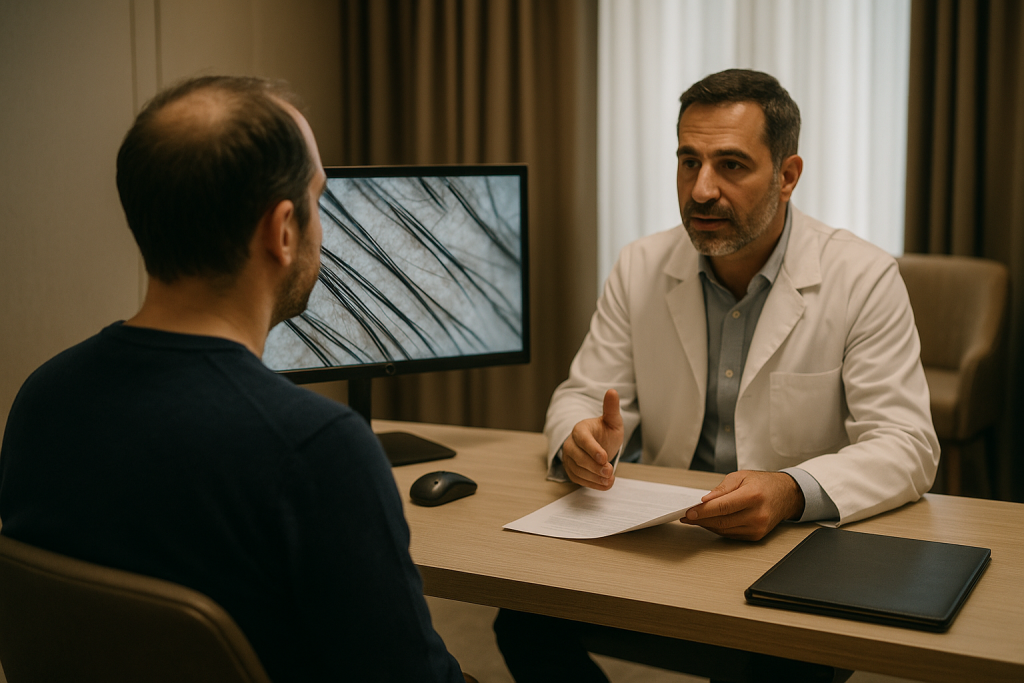
A thorough assessment begins with the patient’s hair loss history and goals. The clinical team reviews photographs, donor and recipient characteristics, previous treatments or surgeries, medications, and general health information. The proposed graft range, design, technique, and aftercare should be explained in understandable terms. Patients from 38 countries have visited Acibadem Hair Transplant Center over 12 years, and planning is adapted to each person’s scalp findings rather than based on a standard template.
After a transplant, the scalp needs time to heal and the grafts need time to move through their normal cycle. Temporary shedding of transplanted hairs can occur in the early period, while visible new growth usually develops gradually. Results are not immediate, and the final appearance is commonly assessed around month 12. Follow-up supports monitoring of healing, scalp health, and hair growth. Our all-inclusive packages include VIP transfer, a 4-star hotel, a care kit, and 12 months of follow-up for eligible treatment arrangements.
Understanding follicle anatomy helps patients make sense of this timeline. A graft must establish itself in the recipient scalp, then produce a new hair through its biological cycle. Careful donor selection, appropriate technique, gentle graft handling, and adherence to the clinical aftercare plan can all support the process, but outcomes differ between individuals. If you are considering hair restoration, a doctor-reviewed assessment can clarify the condition of your donor area, the likely limits of treatment, and whether Sapphire FUE or DHI may be appropriate.
09Frequently Asked Questions
What factors can affect the reliability of a hair follicle drug test?
Hair testing can be affected by sample collection, laboratory methods, cosmetic treatments such as bleaching or repeated chemical processing, external contamination, and the amount and condition of available hair. Laboratories use washing and confirmation procedures to reduce the effect of contamination, but interpretation should be performed by the testing laboratory or an appropriately qualified professional. Do not change medicines or attempt to alter a sample without medical or legal guidance.
How long can a hair follicle stay dormant?
A scalp follicle in the telogen, or resting, phase commonly remains there for several months before shedding and returning to a new growth cycle. The exact duration varies by person, scalp location, health factors, and the cause of shedding. In pattern hair loss, miniaturised follicles may produce progressively finer hairs over a longer period, so a doctor may use trichoscopy to assess the situation.
Is there one standard cutoff level for a hair drug test?
There is no single universal cutoff level for all hair drug tests. Cutoffs depend on the substance being tested, the laboratory’s validated method, whether the test is screening or confirmation, and the legal or workplace standard that applies. For an official result, the laboratory or organisation requesting the test is the appropriate source for its specific cutoff policy.
What is the usual lifespan of a hair follicle?
A healthy scalp follicle can cycle through growth, transition, rest, and shedding repeatedly for many years, often throughout a person’s life. The individual hair shaft has a limited lifespan, but the follicle can produce replacement hairs unless it is damaged, scarred, or affected by progressive miniaturisation. Genetics, ageing, hormones, health conditions, and scalp disease can influence how long follicles continue to produce robust hairs.
This article is for general information only and is not a substitute for professional medical advice.
 06
06 12
12