
How fast does minoxidil work varies between patients, but visible changes typically need at least 3 to 6 months of consistent use. Before hair transplant planning, doctors usually assess whether your hair loss is stable and whether medical treatment may help preserve existing hair.
- Minoxidil usually works gradually, and meaningful visible improvement often takes several months.
- An early shedding phase can occur as follicles move into a new growth cycle and does not always mean treatment is failing.
- Fine, short new hairs may be an early sign of activity, although they need time to become thicker and more noticeable.
- Minoxidil may support existing hair, but it does not replace a professional assessment of donor area, hair loss pattern, and transplant goals.
- Before changing or stopping minoxidil around a hair transplant, follow the instructions given by your treating doctor.
01How fast does minoxidil work before a transplant consultation?
Many people ask how fast does minoxidil work when they are considering a hair transplant. In most patients, minoxidil is not a quick solution. It works by supporting the hair growth cycle over time, so visible changes usually develop slowly across several months rather than days or weeks. A transplant consultation can still take place while you are using it, but your doctor will consider how stable your hair loss appears and how your existing hair is responding.
Some people notice less daily shedding first, while others do not see a clear change until new hairs begin to grow. This difference is normal because hair follicles do not all follow the same cycle at the same time. Factors such as the cause and duration of hair thinning, family history, scalp condition, consistency of use, and general health can affect the timeline.
For hair transplant planning, the main question is not only whether new hair appears quickly. Doctors also need to understand which areas are likely to keep thinning, how strong the donor area is, and whether your current native hair can be protected. A well-planned approach aims to create a natural-looking result while using donor grafts carefully for the long term.
02What changes can happen during the first six months?
During the first few weeks, some patients see little or no visible change. This can be frustrating, but it is usually too early to judge whether the treatment is helpful. Minoxidil does not create an immediate cosmetic improvement because hair growth is naturally slow. Consistent application according to the product instructions and your doctor’s advice is important during this period.
Between roughly 2 and 8 weeks, some users experience increased shedding. This may happen when weaker hairs are released as follicles shift into a growth phase. Shedding is not always seen, and its presence does not prove that the treatment will work. However, a sudden, severe, or persistent increase in hair loss should be discussed with a qualified healthcare professional.
At around 3 to 4 months, early changes may become easier to notice for some patients. These can include small fine hairs, slightly improved coverage in certain areas, or reduced visibility of the scalp under bright light. By 6 months, a doctor may have a clearer basis for reviewing progress, although fuller improvement can continue beyond this point.
03How minoxidil supports the hair growth cycle
Minoxidil is a topical treatment applied to the scalp. Its exact mechanism in hair growth is not fully understood, but it is thought to help support follicle activity and prolong the active growth stage of the hair cycle in suitable patients. It does not create new follicles, and it cannot fully restore every type or stage of hair loss.
Hair follicles move through growing, transition, and resting phases. In common pattern hair loss, susceptible follicles may gradually produce thinner, shorter hairs over time. Treatment may help some follicles produce stronger hairs for a period, particularly where the follicles are still active. Results can be more limited in areas that have been smooth and bald for a long time.
When asking how fast does minoxidil work, it helps to remember that the visible hair shaft is only the final part of a longer biological process. A follicle may respond before the change can be seen above the scalp. Regular photographs taken in the same lighting and angle can be more useful than checking the mirror every day.
04Baby hairs, regrowth, and realistic expectations
Fine, soft, short hairs are often called baby hairs. After starting minoxidil, they can be an encouraging sign that some follicles are becoming active. However, not every fine hair will become thick terminal hair, and it may take additional months before you can tell whether these hairs are maturing.
It is also important to distinguish true regrowth from hairs that were already present but difficult to see. Improved length, colour, and thickness can make existing hairs appear more noticeable. A scalp examination can help a doctor assess miniaturisation and determine whether the area contains hairs that may respond to medical management.
Realistic expectations are especially important before surgery. Medical treatment may improve the appearance of native hair, but it does not guarantee that a future transplant will be unnecessary. Conversely, a person may still be a suitable transplant candidate even if minoxidil provides limited benefit. The right plan depends on individual hair characteristics, available donor supply, and the anticipated progression of hair loss.
05Applying topical minoxidil accurately to the scalp
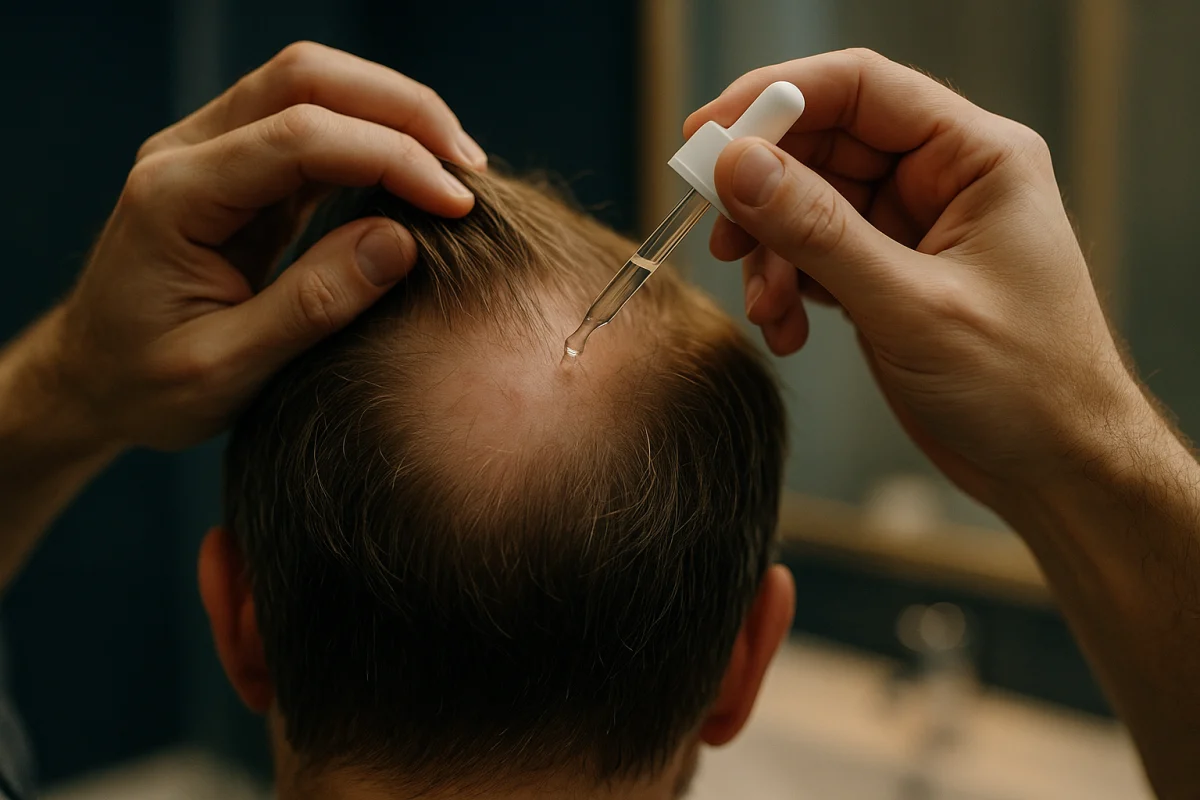
The goal is to place the solution or foam on the scalp rather than coating the hair lengths. Part your hair with clean fingers or a comb to expose the thinning area, then apply the advised amount in small sections directly to the skin. This can reduce waste and may help the product reach the intended area more effectively.
Let the scalp and hair dry fully before application unless the instructions from your clinician or the product leaflet say otherwise. After applying, wash your hands and allow the area to dry before lying down, wearing a hat, or using styling products. Avoid using more than the recommended quantity in an attempt to speed up results, as this does not usually improve effectiveness and may increase the risk of unwanted effects.
Some people find it easier to apply treatment at a regular time each day, such as after an evening shower once the scalp is dry. If you develop persistent irritation, itching, redness, dizziness, chest symptoms, swelling, or other concerning effects, stop self-managing the issue and seek medical advice promptly. Your doctor can advise whether another formulation or a different approach is appropriate.
06Using minoxidil while planning a hair transplant
Minoxidil can be part of a broader hair loss management plan before a transplant. In selected patients, doctors may recommend a period of medical treatment before surgery to see whether existing hair can be maintained or improved. This may help define the pattern of thinning more clearly and support planning that protects the appearance of the native hair around transplanted grafts.
At Acibadem Hair Transplant Center, a dedicated hair restoration clinic in Istanbul licensed by the Turkish Ministry of Health, doctors can review your hair pattern through a free online hair analysis. This assessment is useful for discussing whether Sapphire FUE or DHI may be suitable, but the final recommendation depends on a proper clinical evaluation of your donor area, scalp, and expectations.
Do not start, stop, or change a treatment schedule solely because you are thinking about surgery. Your surgical team may give specific instructions about topical products before and after the procedure, including when to pause or restart them. These instructions can differ depending on your scalp condition, the technique used, healing progress, and any other medical factors.
07When to seek a professional hair loss assessment
Not all hair loss is the same. Gradual thinning at the hairline, crown, or parting area may have a different cause from sudden shedding, patchy hair loss, scaling, or scalp inflammation. A professional assessment is particularly important if hair loss begins rapidly, follows illness or major stress, comes with discomfort, or affects eyebrows or body hair.
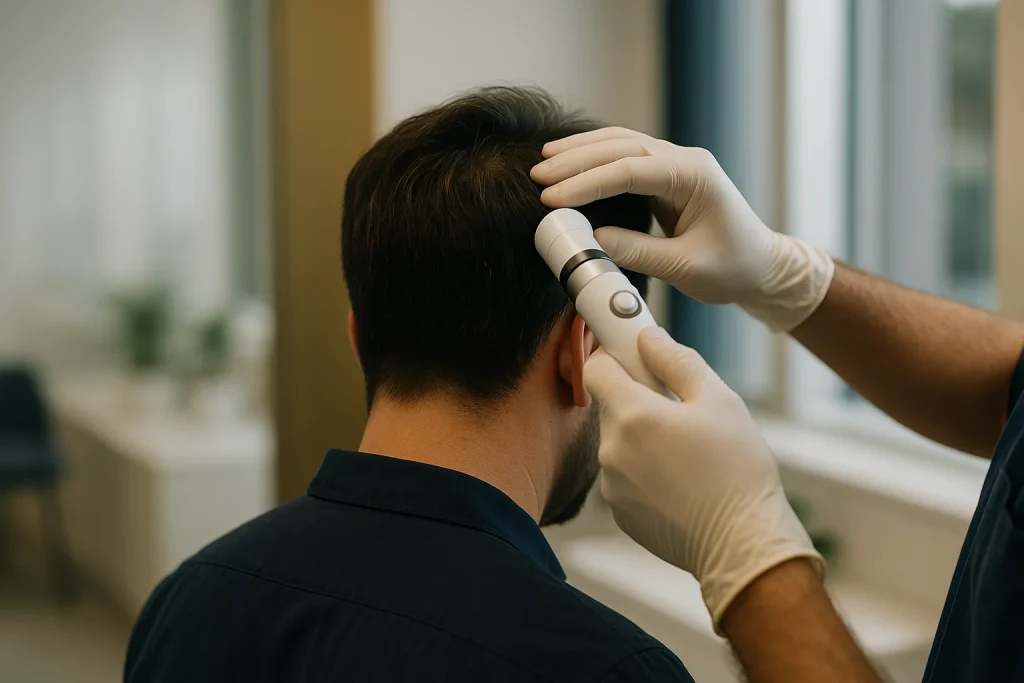
A doctor may use clinical history, scalp examination, and sometimes trichoscopic assessment to look at hair density, shaft thickness, and signs of miniaturisation. This helps separate potential pattern hair loss from other conditions that may need different care. It also provides a more reliable foundation for deciding whether a hair transplant should be considered now, later, or not at all.
For international patients, an online review can be a practical first step, but it cannot replace medical judgement where an in-person assessment is needed. Acibadem Hair Transplant Center provides free online hair analysis reviewed by doctors, with WhatsApp replies typically within about two hours. If surgery is suitable, all-inclusive packages can include VIP transfer, a 4-star hotel, a care kit, and 12 months of follow-up, while your doctor confirms the appropriate clinical plan.
08What is the usual minoxidil timeline after a hair transplant?
After a hair transplant, the priority is protecting the newly placed grafts while the scalp heals. Your surgical team will tell you exactly when topical minoxidil can be restarted, if it is appropriate for you. It is not usually advisable to apply topical products to a freshly treated scalp without clinical approval, because the skin may be sensitive and the grafts need time to settle securely.
In the early healing period, temporary redness, scabbing, tightness, and shedding of the transplanted hair shafts can occur. This shedding is often part of the normal post-transplant process and does not necessarily mean the grafts have failed. The roots remain under the scalp and typically enter a resting phase before new growth begins. Minoxidil does not prevent every stage of this natural timeline.
Many patients begin to see early transplanted growth from around month 3 or 4, although the timing varies. New growth is often fine and uneven at first. Density and hair calibre usually develop gradually over the following months, with the final result commonly assessed at month 12. At Acibadem Hair Transplant Center, results are measured by trichoscopic graft survival at month 12, with a documented 98% rate under written guarantee.

09How to track hair changes without judging results too early
Hair changes are easier to assess when you compare consistent photographs rather than relying on daily mirror checks. Take images before starting a treatment plan and then at planned intervals, such as every 3 months. Use the same room, lighting, hairstyle, camera distance, and angles each time. Include the hairline, temples, top, crown, and donor area where possible.
It can be helpful to record more than appearance alone. Note when you started or paused a topical treatment, any period of increased shedding, scalp symptoms, major illness, stress, changes in medication, or a recent transplant procedure. These details can give your doctor important context if your hair density seems to change unexpectedly.
Try not to assess progress from a single short hair or one day of shedding. Hair grows in cycles, and coverage can look different when hair is wet, cut shorter, exposed to overhead light, or styled differently. A trichoscopic examination can provide a more clinical comparison by looking at follicle density, hair shaft diameter, and miniaturisation over time.
10Who may need further assessment before using minoxidil or booking surgery?
Minoxidil and hair transplantation are not appropriate solutions for every form of hair loss. A careful medical review is particularly important for people with sudden diffuse shedding, clearly defined bald patches, scalp pain, burning, heavy scaling, sores, or signs of infection. These features can suggest conditions that require diagnosis and treatment before transplant planning is considered.
Suitability for surgery also depends on whether there is enough stable donor hair at the back and sides of the scalp. A person may have visible thinning in the recipient area but still have a limited donor supply, widespread miniaturisation, or an evolving pattern of loss. In these situations, a conservative design, medical management, delayed surgery, or no surgery may be the safer long-term recommendation.
It is important to tell the doctor about relevant health conditions, previous scalp procedures, allergies, medicines, and any treatment that affects bleeding, healing, or the immune system. Women who are pregnant, planning pregnancy, or breastfeeding should seek clinician guidance before using hair-loss treatments. Your doctor will confirm whether minoxidil, transplantation, or another approach is suitable for your circumstances.
11Planning an Istanbul hair transplant journey while using hair-loss treatment
International patients can begin planning before travelling by sending clear, recent photographs for an online review. Images are most useful when they show the front hairline, both temples, top, crown, donor area, and a full side view in good light. Avoid heavy styling fibres, wet hair, filters, or very bright flash where possible, as these can make density harder to assess accurately.
Before travel, ask the clinic what information is needed about your current hair-loss routine. This includes topical products, oral medicines, supplements, allergies, and previous procedures. Do not assume that you should stop minoxidil before flying or before the procedure; the timing should be confirmed by your treating team. It is also sensible to arrange enough time away from demanding work, exercise, swimming, sun exposure, and social events while the scalp heals.
Acibadem Hair Transplant Center is a dedicated hair restoration clinic in Istanbul, licensed by the Turkish Ministry of Health. Its all-inclusive packages can include VIP transfer, a 4-star hotel, a care kit, and 12 months of follow-up. Patients can use the free online hair analysis to discuss their initial options, and WhatsApp replies are typically provided within about two hours. The final treatment plan, travel timing, and aftercare instructions are confirmed by the clinical team.
12Frequently Asked Questions
Can minoxidil make hair grow faster, as people often discuss online?
Minoxidil may help some active follicles stay longer in the growth phase, but it does not make hair grow dramatically faster overnight. The main visible benefit, when it occurs, is often improved density or thicker-looking hair over months. Online experiences vary widely, so they should not replace advice from a qualified clinician.
How can I apply minoxidil without getting too much on my hair?
Part the hair to expose the scalp, then place the recommended amount directly onto the thinning skin in small areas. Using a dropper, nozzle, or clean fingertips can help you target the scalp more accurately. Allow it to dry and wash your hands after application.
Is it normal to see baby hairs after using minoxidil?
Fine new hairs can occur and may indicate that some follicles are active. They may need several months to lengthen and thicken, and not all will mature into thicker hairs. A clinician can assess changes more accurately with a scalp examination or standardised photographs.
How does topical minoxidil work for hair thinning?
Topical minoxidil is thought to support follicle activity and extend the active growing stage of the hair cycle in some patients. It does not create new follicles or reverse every cause of hair loss. Results depend on the individual, the underlying cause of thinning, and consistent use as directed.
This article is for general information only and is not a substitute for professional medical advice.
 06
 12