
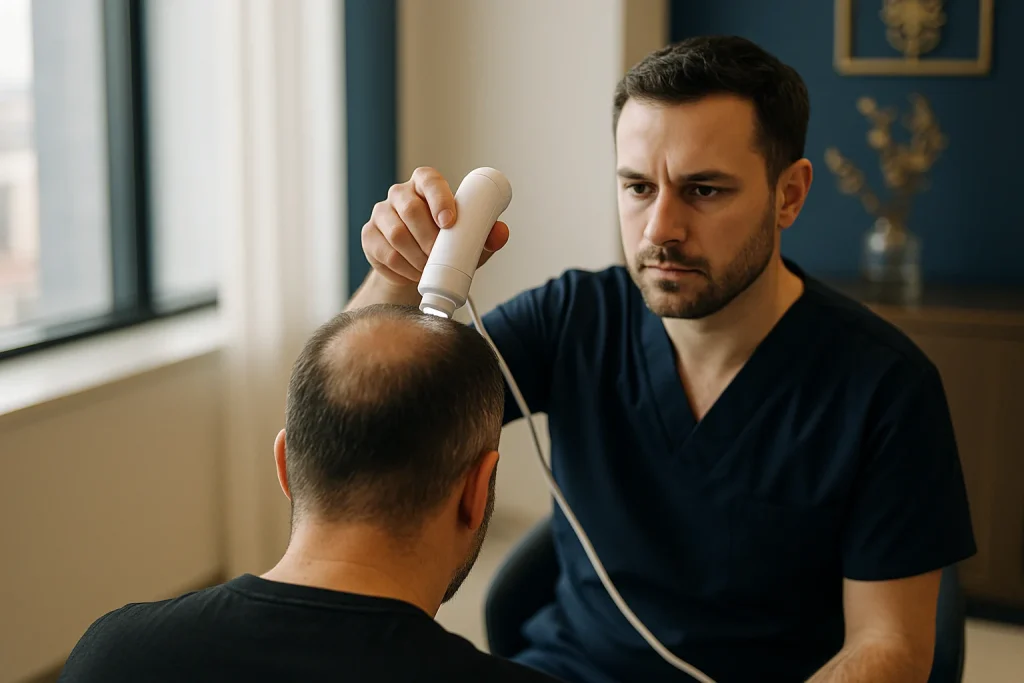
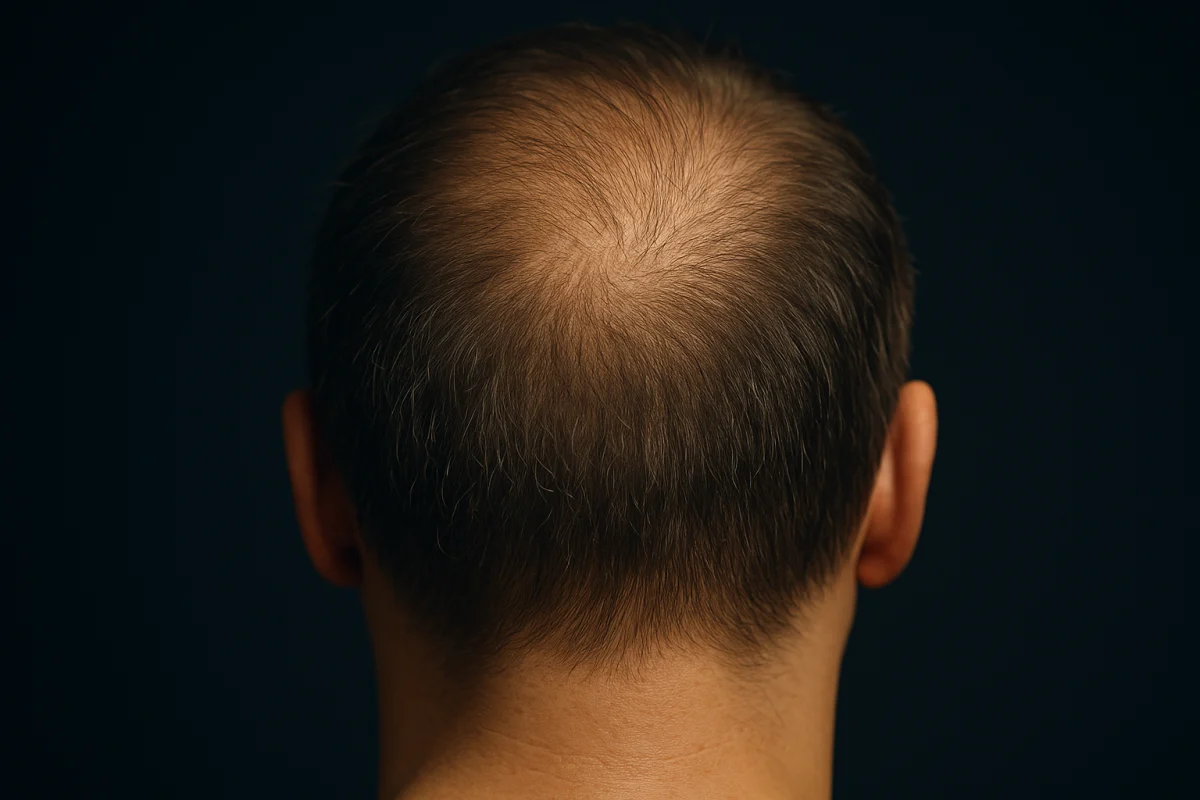
Vertex hair loss affects the crown area at the top and back of the scalp, where thinning can gradually form a widening circular pattern. Transplantation may improve coverage for suitable candidates, but planning must protect the donor area and consider the likely future progression of hair loss.
- The vertex is the crown area where hair changes direction in a natural spiral pattern.
- Crown thinning is commonly linked to genetic pattern hair loss, but a medical assessment can help rule out other causes.
- A transplant plan for the vertex should consider donor supply, existing hair, future loss, and the natural crown whorl.
- Medical treatment may help preserve existing hair and can be considered before or alongside surgery when clinically appropriate.
- Visible transplant growth develops gradually, while final graft survival assessment is typically performed over a longer follow-up period.
01Vertex Hair Loss: Planning Coverage With Transplantation
Vertex hair loss is thinning or balding at the crown, the upper-back area of the scalp. It can be one of the more challenging areas to treat because hair naturally grows in a circular, changing direction pattern there. A successful coverage plan is not only about placing grafts into an empty area; it is also about creating a result that follows the patient’s natural hair direction and remains balanced if further thinning develops.
For many people, crown thinning starts subtly. They may notice more scalp under bright overhead light, a larger visible whorl, or reduced density in photographs taken from above. Others first see a small round area that becomes wider over time. Because the vertex is difficult to inspect without mirrors or photos, changes may be noticed later than recession at the hairline.
A doctor-led assessment is important before considering transplantation. The consultation should examine the crown, mid-scalp, frontal hairline, and donor area together. This wider view helps determine whether surgery is appropriate now, whether non-surgical treatment should be considered first, and how many grafts can be allocated without compromising future options.
02Understanding the Vertex and Its Natural Hair Pattern
The vertex scalp is the crown region near the top-back of the head. It is usually located behind the mid-scalp and in front of the upper occipital area, although its exact position differs slightly from person to person. The area often contains a whorl, where hairs radiate and rotate outward from a central point.
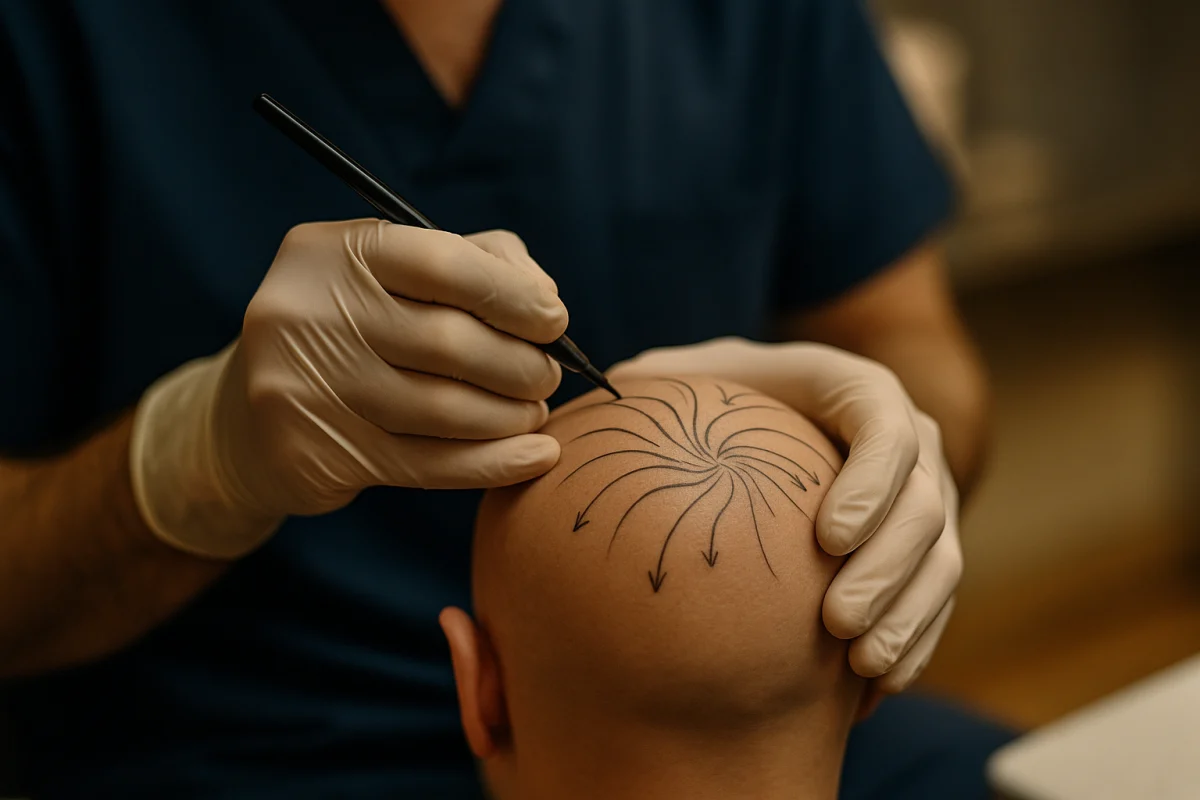
This whorl is clinically important in transplantation planning. Hair in the crown does not grow straight forward like hair at the frontal scalp. Instead, it follows curved, circular, and sometimes double-whorl directions. Grafts need to be placed at carefully selected angles and orientations so the transplanted hair can blend with existing hair as it grows.
The apparent size of a vertex concern can also be misleading. A small reduction in density may look larger when surrounding hair is fine, short, wet, or affected by light contrast. During an assessment, doctors consider the quality of existing hairs, scalp visibility, the shape of the thinning area, and whether miniaturised hairs are still present.
03Why Crown Thinning Develops
The most common reason for thinning on the crown is androgenetic alopecia, also called genetic pattern hair loss. In people with this tendency, susceptible follicles gradually produce finer, shorter hairs over time. The process may involve the temples, frontal hairline, mid-scalp, vertex, or a combination of these areas, and the pattern does not progress at the same speed in every patient.
Other factors can contribute to diffuse shedding or make an existing crown concern more noticeable. These may include a recent illness, major physical or emotional stress, nutritional deficiency, thyroid disorders, inflammatory scalp conditions, certain medicines, or traction from repeated tension on the hair. These causes require appropriate medical evaluation because a transplant does not treat every type of hair loss.
Family history can offer useful context, but it cannot predict an individual’s pattern with certainty. Some patients maintain a limited crown area for many years, while others develop more extensive thinning across the top of the scalp. Your doctor will review the pattern and may recommend that the cause of hair loss is clarified before any surgical decision is made.
04Recognising Pattern Changes Before They Expand
Early crown thinning may appear as a more visible scalp around the central whorl rather than a completely bare patch. Hair can still be present, but the strands may become finer and offer less coverage. Comparing consistent photographs over time can be helpful, especially images taken with the same hair length, lighting, and camera angle.
In a stage 3 vertex pattern, there is usually visible thinning or a distinct bald area at the crown in addition to changes at the temples or frontal hairline. The exact appearance varies, and classification systems are only guides rather than a diagnosis. A clinical examination is needed to assess whether the area contains active miniaturisation, stable loss, or another condition affecting density.
It is sensible to seek an assessment if crown thinning is sudden, patchy, painful, itchy, scaly, or accompanied by substantial shedding elsewhere on the scalp. These signs do not automatically indicate a serious problem, but they may point to a cause other than typical genetic hair loss. Treating an underlying scalp or medical condition may be more important than planning a transplant at that stage.
05Medical and Lifestyle Support for Vertex Hair Loss
For patients with ongoing vertex hair loss, a doctor may discuss medical options designed to support existing follicles and slow further miniaturisation. Suitability depends on medical history, examination findings, current medicines, and personal goals. These treatments require medical guidance, and their benefits, limitations, possible side effects, and follow-up needs should be discussed clearly before starting.
A healthy scalp and realistic hair-care routine can support overall hair appearance, although lifestyle measures alone do not reverse genetic follicle miniaturisation. Avoiding repeated traction, harsh chemical processing, and aggressive brushing may reduce avoidable breakage. Adequate nutrition and management of relevant health conditions are also important, particularly where testing identifies a contributing issue.
Non-surgical care can be especially valuable when native hair is still present in the crown. Preserving these hairs may improve the overall visual density and reduce the amount of transplant coverage needed. In many cases, doctors consider whether hair loss is stable enough for surgery or whether a period of monitoring and medical management would offer a safer long-term strategy.
06Planning a Vertex Hair Loss Transplant
A vertex hair loss transplant plan begins with priorities, not simply the largest possible graft number. The donor area has a limited supply of hairs that should be used thoughtfully over a lifetime. If a patient also has frontal recession or mid-scalp thinning, the surgical team must consider which areas need coverage now and which may need to be protected for the future.
The crown can require a significant number of grafts because it is broad, rounded, and often viewed under direct overhead light. However, the aim is usually an appropriate cosmetic improvement rather than an unrealistic promise of the density seen before hair loss began. Existing hair quality, scalp-to-hair colour contrast, hair curl, shaft thickness, and the size of the area all influence how full the vertex can appear.
Surgeons generally create the crown pattern from the central whorl outward, using placement angles that follow the natural rotation of the hair. Lower density may be planned at the outer edges to blend into native hair, while careful distribution can provide a gradual transition across the area. This artistic and technical planning helps avoid an isolated circular patch that looks disconnected from the rest of the scalp.
07Selecting Technique and Protecting the Donor Area
Sapphire FUE and DHI are hair restoration techniques that may be considered for suitable patients. With FUE, follicular units are extracted individually from the donor area and placed into prepared recipient sites. DHI involves implanting grafts with a specialised implanter after extraction. The most appropriate method depends on the scalp, hair characteristics, treatment plan, and the doctor’s clinical judgement.
Technique alone does not determine a natural result. For crown work, the direction, angle, distribution, and safe handling of grafts are particularly important. The team must also avoid overharvesting the donor area, as uneven removal can reduce its appearance and limit the patient’s options if further hair loss occurs later.
At Acibadem Hair Transplant Center, patients can receive a free online hair analysis reviewed by doctors before travelling. The dedicated hair restoration clinic in Istanbul is licensed by the Turkish Ministry of Health and offers Sapphire FUE and DHI techniques. An online review cannot replace an in-person medical assessment, but it can help patients understand whether a consultation and personalised treatment discussion may be appropriate.
08Recovery, Growth and Long-Term Expectations
After a crown transplant, temporary redness, scabbing, swelling, and shedding of transplanted hairs can occur during the healing process. Patients receive individual aftercare instructions and should follow them closely, particularly regarding washing, activity, sun exposure, and avoiding friction on the recipient area. Needle-free anaesthesia is available at the clinic for appropriate patients, subject to clinical assessment.
New growth usually develops gradually, and the crown may seem slower to show visual density than some other areas because of its broad surface and changing hair direction. Existing non-transplanted hair may also continue to thin if genetic hair loss progresses. For this reason, patients should view transplantation as one part of a longer-term hair restoration plan rather than a permanent stop to all future hair changes.
Acibadem Hair Transplant Center provides all-inclusive packages that include VIP transfer, a 4-star hotel, a care kit, and 12 months of follow-up. The clinic measures trichoscopic graft survival at month 12 and documents a 98% rate under its written guarantee. This measurement relates to graft survival under the guarantee terms; the visible cosmetic outcome can still vary according to individual hair characteristics, healing, existing hair loss, and adherence to aftercare guidance.
09Who May Be a Suitable Candidate for Crown Transplantation?
Suitability for a vertex transplant depends on more than the visible size of the crown area. Doctors usually assess whether the pattern of loss is reasonably understood, whether the donor area has sufficient stable density, and whether there is enough existing hair across the mid-scalp and frontal area to create a balanced long-term plan. A patient with an early crown concern may be advised to monitor the pattern or consider medical support before surgery, particularly if thinning appears to be progressing quickly.
Age alone does not decide candidacy. However, patients with an uncertain or rapidly changing hair-loss pattern may need especially careful planning. If future loss is likely to extend from the crown into the mid-scalp or hairline, using a large share of donor grafts in the vertex first may not be the most suitable approach. Your doctor will consider present needs alongside the possibility of future coverage requirements.
Donor characteristics also affect planning. Hair shaft thickness, curl, colour contrast between hair and scalp, and donor density can all influence the appearance of coverage. For example, thicker or wavy hair may provide more visual coverage than very fine, straight hair when the same number of grafts is used. These factors help set realistic expectations about what a single procedure may achieve.
10Crown Transplant Aftercare: Protecting the Recipient Area
The first days after a vertex transplant are important because the newly placed grafts need time to settle. Patients should avoid touching, scratching, rubbing, or putting pressure on the crown unless their clinical team has instructed them otherwise. Clothing that pulls tightly over the head may also create unnecessary friction, so patients are usually advised to choose loose, front-opening garments in the early recovery period.
Washing instructions should be followed exactly as provided by the clinic. Typically, the care routine is gentle and designed to soften scabs without dislodging grafts. Patients should not use their fingernails, direct high-pressure water onto the recipient area, or apply non-approved products during the initial healing phase. If there is bleeding, increasing pain, unusual swelling, discharge, fever, or another concern, the clinic should be contacted promptly for guidance.
Strenuous exercise, swimming, saunas, and activities that cause heavy sweating are commonly restricted for an initial period. Direct sun exposure should also be avoided while the scalp is healing, as advised by the medical team. The exact timing for returning to normal exercise, haircuts, headwear, and styling products can vary, so patients should rely on their personalised aftercare plan rather than a general timeline from the internet.
11Travel Planning for Hair Transplant Patients Visiting Istanbul
International patients should plan their visit around the procedure and the early follow-up appointment, allowing enough time in Istanbul for the clinic’s recommended schedule. It is helpful to avoid arranging important business meetings, strenuous sightseeing, long outdoor activities, or rushed travel immediately after the procedure. A calm schedule can make it easier to rest, follow washing guidance, and attend any planned check-up before departure.
Acibadem Hair Transplant Center offers all-inclusive packages with VIP transfer, a 4-star hotel, a care kit, and 12 months of follow-up. Before travelling, patients should confirm their itinerary, passport and visa requirements where applicable, flight details, current medications, allergies, and any health information requested during the pre-travel review. The clinic’s free online hair analysis is reviewed by doctors, and replies are generally available on WhatsApp within approximately two hours.
For the journey home, patients should follow the clinic’s instructions on protecting the recipient area during airport transfers and flights. They may need to avoid contact between the crown and a headrest, luggage, or tight headwear. Keeping the care kit and relevant documents accessible can also be useful. Once home, patients should send follow-up photographs at the intervals requested so the clinical team can monitor healing and provide appropriate guidance throughout the 12-month follow-up period.
12Frequently Asked Questions
What can cause hair loss at the vertex?
Genetic pattern hair loss is a common cause of thinning at the vertex or crown. Other possible contributors include diffuse shedding after illness or stress, nutritional issues, thyroid conditions, scalp inflammation, certain medicines, and hair-care practices that create traction. A doctor can assess the pattern and help identify whether further medical investigation is needed.
How can vertex balding be treated or improved?
Treatment depends on the cause, the amount of existing hair, the stability of hair loss, and donor area availability. A doctor may discuss medical treatment to help preserve native hair, management of an underlying condition where relevant, or transplantation for suitable candidates. A transplant can improve coverage, but it should be planned with future hair loss and realistic density expectations in mind.
Where exactly is the vertex on the scalp?
The vertex is the crown area on the upper-back part of the scalp. It is usually where the hair forms a natural whorl or spiral pattern. It sits behind the mid-scalp and above the back of the head, although its exact position varies between individuals.
What are typical signs of stage 3 vertex baldness?
A stage 3 vertex pattern generally describes noticeable thinning or a bald spot at the crown, often together with temple recession or frontal changes. The crown may look more open around the hair whorl and become more visible under overhead light. Hair-loss stages are descriptive guides, so an examination is needed to confirm the pattern and rule out other causes.
This article is for general information only and is not a substitute for professional medical advice.
 06
06 12
12