
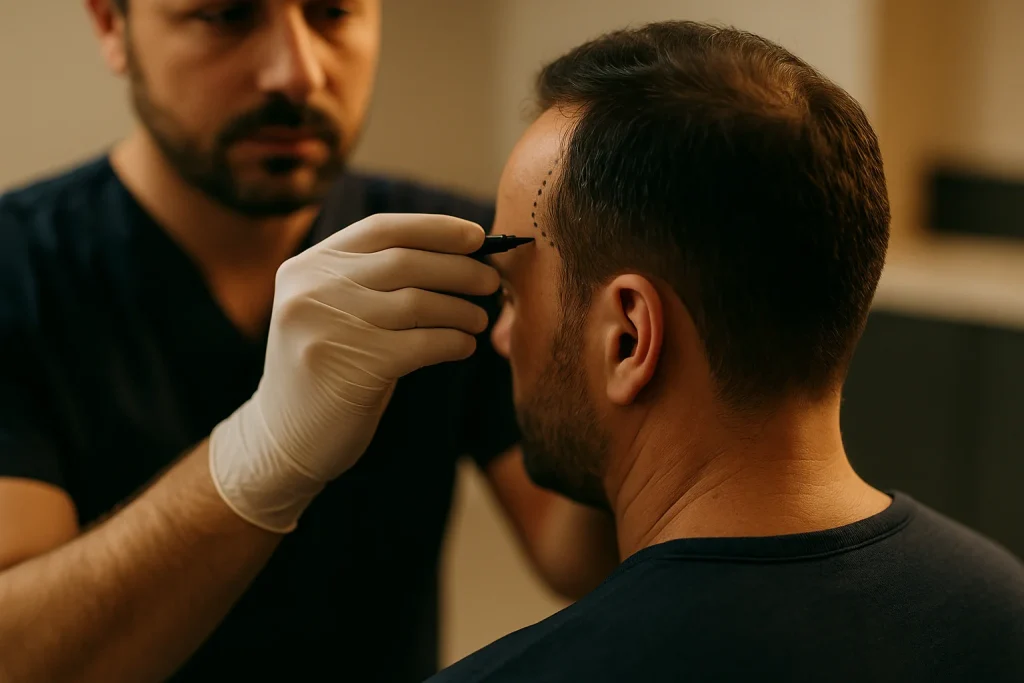
A widow’s peak is a small V-shaped point of hair that extends down at the centre of the forehead. For people searching whats a widows peak in transplant design, it is an important natural feature that may be preserved, softened or recreated only when it suits the person’s facial proportions and future hair-loss pattern.
- A widow’s peak is a normal hairline variation, not a medical condition or a sign of hair loss.
- A successful transplant design considers the full hairline, temple areas, facial proportions and likely future hair loss.
- Not every patient benefits from adding or strengthening a central V-shaped point.
- Fine single-hair grafts, careful angle control and conservative density are typically important around the frontal hairline.
- A doctor-led assessment is needed to decide whether preserving, rebuilding or avoiding a widow’s peak is appropriate.
01Whats a Widows Peak in Hairline Design?
When people ask whats a widows peak, they are usually describing a hairline that comes slightly forward in a soft V shape at the middle of the forehead. The point can be very subtle or more clearly defined. It is a common inherited hairline pattern and is seen in people of different sexes, ages and backgrounds. A widow’s peak does not automatically indicate thinning hair, nor does it mean that a person needs a hair transplant.
In hairline transplant design, a widow’s peak is not treated as an isolated detail. It is part of the overall frame of the face. The doctor assesses its width, depth, position, surrounding frontal hair, temple recession and the way the hair naturally grows from the scalp. The aim is generally to create a design that looks believable from close range, in bright light and as the person ages.
Some patients naturally have a widow’s peak that remains strong while the hair recedes around it. Others lose density across the front, including the central point, and may wish to restore a smoother hairline contour. There is no single ideal shape. During a consultation, the best plan usually depends on the existing hairline, donor-area quality, hair characteristics and realistic long-term goals.
02The Anatomy of a Natural Central Hairline Point
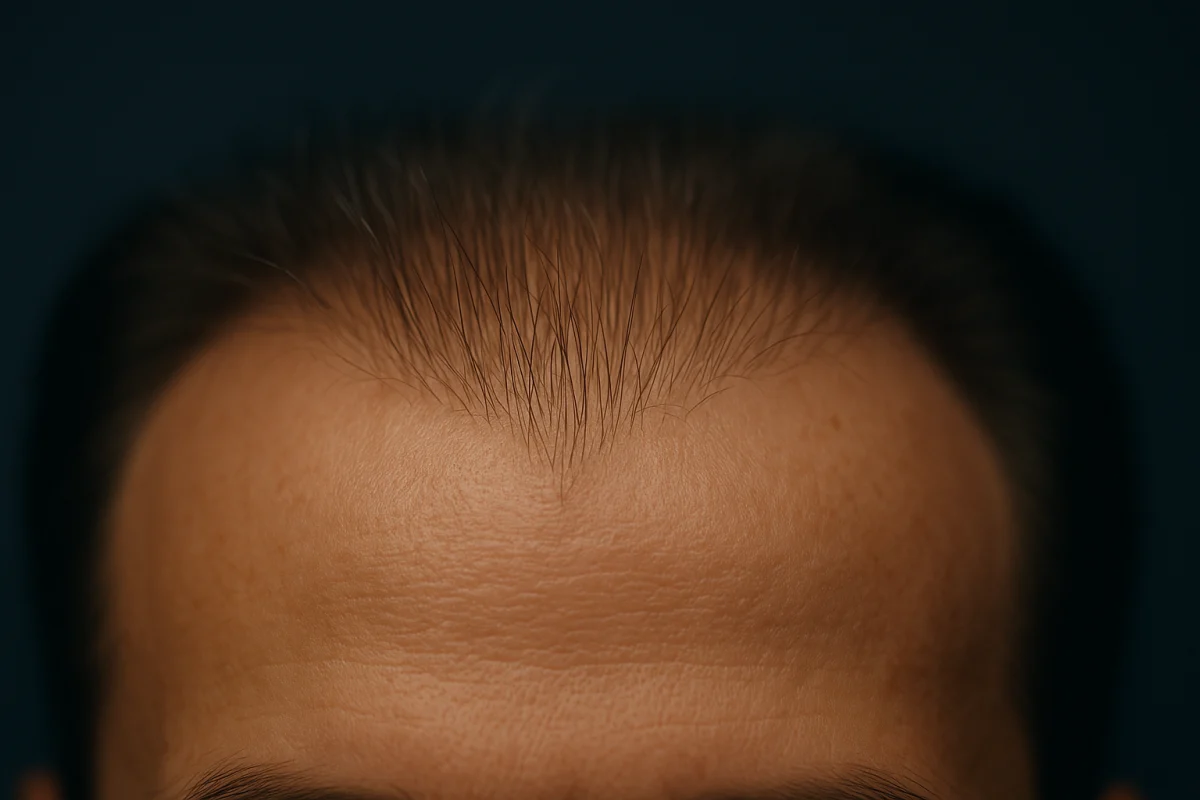
A natural hairline is rarely a perfectly straight line. It normally includes small changes in height, irregularities and fine hairs at the leading edge. A widow’s peak is one possible feature within this pattern. It sits at the central frontal hairline, where the left and right sides of the hairline meet. Its appearance is influenced by genetics, forehead shape and the direction in which nearby hairs emerge.
The point should not be confused with a triangular patch of thinning hair or an uneven hairline caused by hair loss. In a natural widow’s peak, hair usually grows consistently through the central point. When thinning is present, the area may look sparse, transparent or disconnected from the denser hair behind it. Trichoscopic examination can help a doctor assess hair calibre, density and signs of miniaturisation before planning treatment.
Hair angle is especially important at the front. Frontal hairs generally leave the skin at a very acute angle and follow a forward or slightly diagonal direction. If grafts are placed too upright, in a dense straight row or with a direction that conflicts with native hair, the result may appear less natural. For this reason, the smallest details of recipient-site creation matter as much as the number of grafts used.
03Why a Widow’s Peak Needs Individual Assessment
A visible central point may suit one person’s face very well and look out of place on another. Hair transplant planning should therefore begin with observation rather than a copied template. The doctor usually reviews old photographs when available, as they may show the patient’s earlier hairline shape before significant recession began. This can provide useful guidance, although it is not the only factor in the final design.
People searching whats a widows peak may assume that a sharper V shape always creates a more youthful appearance. In practice, an overly low or overly sharp point can draw attention to the hairline. A conservative, softly irregular design is often more appropriate, particularly where future hair loss is possible. The central feature must also connect naturally to both corners and temple areas.
The quality and amount of donor hair place practical limits on every transplant plan. Donor follicles are limited and should be distributed thoughtfully. A doctor may recommend prioritising coverage in areas that will have the greatest visual benefit rather than using too many grafts on a very low or dramatic central point. This approach can help preserve options if hair loss progresses later.
04Facial Proportions, Forehead Height and Hairline Balance
Hairline design is usually based on proportions rather than face-shape labels alone. The doctor considers forehead height, the position of the eyebrows, facial length, temple structure and the balance between the upper, middle and lower face. A central point can make the forehead appear slightly shorter in the middle, while a rounded or flatter hairline may create a different visual effect.
Oval, heart-shaped, round, square and longer faces can all have a widow’s peak. The feature is not exclusive to one facial shape. In broad terms, a gentle central point may complement some heart-shaped or oval faces, but this does not create a rule for treatment. Natural hairline patterns and individual preferences are more useful than trying to match a person to a fixed face-shape formula.
In transplant design, symmetry is considered carefully, but perfect geometric symmetry is usually not the goal. Real hairlines have minor differences from one side to the other. A skilled plan may include controlled micro-irregularity at the leading edge so that the hairline does not look artificial. The degree of irregularity should remain subtle and should fit the patient’s native pattern.
05How Sapphire FUE and DHI Can Support Hairline Detail
Both Sapphire FUE and DHI can be used in appropriately selected hair restoration cases. With Sapphire FUE, follicles are commonly extracted one by one from the donor area and then placed into carefully created recipient sites. Sapphire blades may support precise channel creation, helping the surgical team control the angle, direction and distribution planned for the frontal hairline.
With DHI, extracted follicles are implanted using a specialised implanter tool. This technique may be useful in selected cases where detailed placement between existing hairs or in smaller frontal areas is planned. However, a natural-looking widow’s peak depends on clinical planning, graft handling, hair direction and surgeon oversight, not on the technique name alone. Your doctor will confirm which approach is suitable for your scalp and goals.
For the very first rows of a hairline, surgeons typically select finer single-hair follicular units when available. These can create a softer transition from forehead skin to denser hair behind it. Multi-hair grafts may be placed farther back to build density, depending on the design. This gradual change in hair calibre and density is often important when reconstructing a subtle central point.
06Design Differences for Women, Men and Diverse Hair Patterns
Yes, girls and women can naturally have a widow’s peak. It is a normal genetic variation and may be visible from childhood or become more noticeable with certain hairstyles. In female hair restoration planning, the doctor will usually assess whether the concern is a naturally high hairline, traction-related loss, diffuse thinning, a stable mature hairline or another cause. Identifying the cause is important before considering surgery.
Men may develop the appearance of a stronger widow’s peak when recession affects the frontotemporal corners but the central forelock remains. This pattern can be associated with androgen-related hair loss in some patients. However, the speed and extent of future loss vary considerably. A transplant design should not simply follow the remaining central hair without assessing whether it is stable and whether the donor supply can support a long-term strategy.
There is no reliable clinical basis for saying that one race has the most widow’s peaks. Hairline shape is influenced by individual and family genetics, and broad racial categories do not predict a person’s hairline design accurately. Curly, wavy, straight, coarse and fine hair can each create a different visual effect at the front. Hair texture, curl direction and contrast between hair and skin are all relevant during planning.
07Planning for Future Hair Loss and Protecting Donor Hair
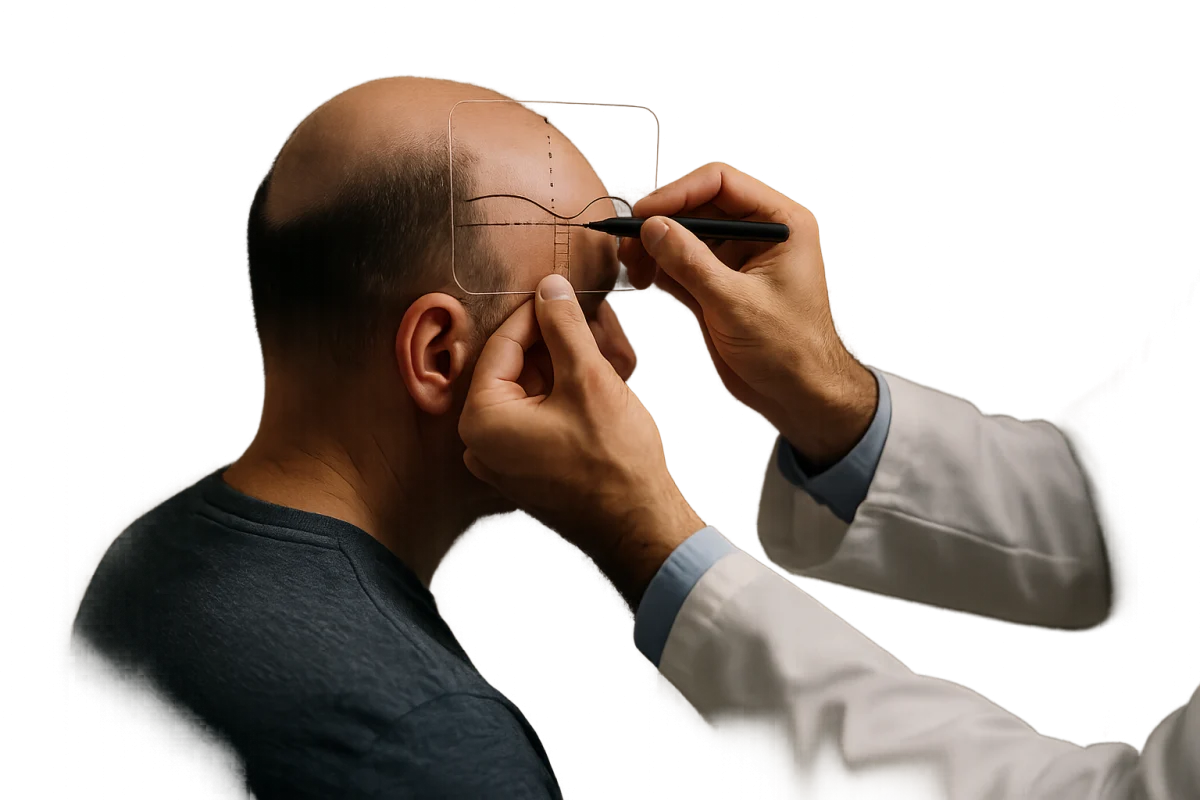
A hair transplant may provide a lasting redistribution of resistant donor follicles, but it does not stop ongoing loss in non-transplanted hair. This is particularly important near a widow’s peak because a newly reconstructed point may appear isolated if surrounding native hair thins later. Doctors therefore typically evaluate age, family history, current pattern, scalp examination findings and the likely need for a conservative hairline position.
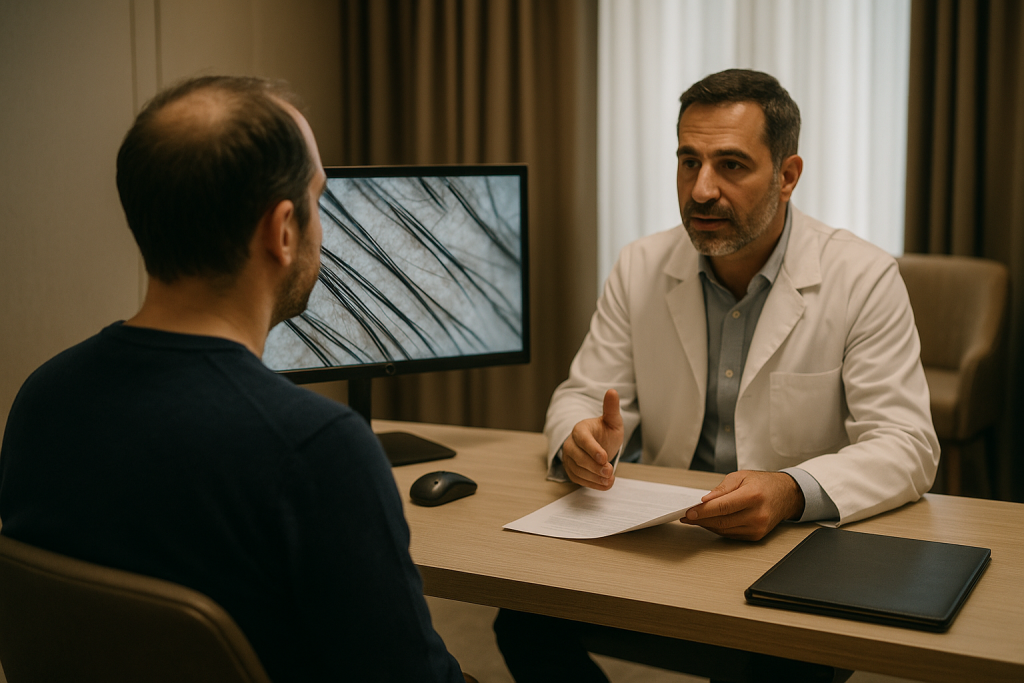
If you are asking whats a widows peak because your hairline has changed recently, a medical assessment can distinguish a natural pattern from active hair loss. The consultation may include review of the scalp, photographs and trichoscopic examination. Some people may be advised to monitor stability or discuss medical options with a qualified doctor before making a surgical decision. Suitability always needs individual confirmation.
Overharvesting the donor area or using too many grafts in a small frontal zone can limit future options. Responsible planning considers not only how the hairline may look after growth, but also how it could look if further recession occurs. A more mature, age-appropriate design can often be easier to maintain visually over time than an aggressively low hairline created to meet a short-term preference.
08Recovery, Growth Expectations and Follow-Up
After a hair transplant, the recipient area may have temporary redness, small scabs and mild swelling. The clinic provides aftercare instructions covering washing, sleeping position, physical activity and protection of the grafts. Patients should follow these instructions closely and contact the clinical team if they have concerns. Recovery experiences differ, and your medical team will explain what is expected in your own case.
Transplanted hairs commonly shed during the early phase after surgery before new growth begins. Early growth can be fine and uneven, especially along the delicate frontal edge. Density and cosmetic coverage generally develop gradually over several months. Final maturation is often assessed around month 12, although timelines can vary according to the person, hair characteristics and the extent of the procedure.
At Acibadem Hair Transplant Center in Istanbul, patients can request a free online hair analysis that is reviewed by doctors, with WhatsApp replies usually provided within about two hours. The clinic offers Sapphire FUE and DHI, as well as needle-free anaesthesia where appropriate. All-inclusive packages include VIP transfer, a 4-star hotel, a care kit and 12 months of follow-up. The clinic measures results by trichoscopic graft survival at month 12 and documents a 98% rate under its written guarantee; individual outcomes can still vary.
09Frequently Asked Questions
Which face shapes can have a widow’s peak?
A widow’s peak can occur with any face shape, including oval, round, square, heart-shaped and long faces. It is a natural hairline variation rather than a feature linked to one specific facial structure. In transplant planning, doctors assess overall proportions and native hairline characteristics instead of relying on face shape alone.
Is it normal for a girl or woman to have a widow’s peak?
Yes. Girls and women can naturally have a widow’s peak, and it is usually simply an inherited hairline pattern. If the shape has changed recently or hair density is reducing around the front, a doctor can assess whether hair loss or another scalp concern may be involved.
Which race is most likely to have a widow’s peak?
There is no dependable medical evidence that identifies one race as having the most widow’s peaks. Hairline shape varies widely between individuals and families within every population. A personal assessment is more meaningful than racial categories when considering hair restoration.
What is the opposite of a widow’s peak?
The opposite is generally described as a straight, rounded or flat frontal hairline without a central V-shaped point. Natural hairlines often fall somewhere between these descriptions and may have small irregularities. A doctor can explain which contour is most likely to look balanced for an individual transplant plan.
This article is for general information only and is not a substitute for professional medical advice.
 06
06 12
12