

Where does baldness come from? In most cases, it develops through a combination of inherited sensitivity in the hair follicles and normal hormone activity, but health conditions, stress, nutrition, medicines, and scalp problems can also contribute. A hair transplant can move permanent-looking follicles into thinning areas when you are a suitable candidate and your hair loss is stable enough to plan safely.
- Pattern hair loss is usually linked to genetics, hormone-related follicle sensitivity, and ageing rather than one single cause.
- You can inherit a tendency for baldness from either side of your family, so your father's hair pattern alone cannot predict your future.
- Sudden or patchy shedding needs medical assessment because it may have causes other than inherited baldness.
- Hair transplants redistribute your own healthy follicles; they do not stop future thinning in untreated areas.
- A professional hair and scalp review helps determine whether medical treatment, a transplant, or both may be appropriate.
01Where does baldness come from? The main biological explanation
Most people asking where does baldness come from are referring to gradual thinning at the hairline, temples, crown, or part line. This is commonly called androgenetic alopecia, or pattern hair loss. It happens when genetically sensitive hair follicles react to normal androgen hormones over time. The follicles become smaller, each growth phase becomes shorter, and the hair strands produced gradually become finer. In men, this often creates a receding hairline or crown thinning. In women, it more often causes widening of the central part and overall reduced density, although patterns vary considerably.
Hair loss is not always permanent baldness. It is normal to shed some hairs every day because each follicle moves through growth, transition, resting, and shedding phases. New hair usually replaces a shed hair. With pattern hair loss, however, the replacement hairs may become progressively thinner and shorter. This process is called miniaturisation. It can begin subtly, which is why comparing photographs over several months or years may show change more clearly than looking in the mirror each day.
The timing and speed of visible thinning differ from person to person. Some notice changes in their late teens or twenties, while others maintain good density until later life. Family tendency matters, but it does not work as a simple one-gene rule. Your age, sex, hormone environment, general health, scalp condition, and lifestyle can all influence how hair loss appears. A doctor can help distinguish a typical pattern from another cause that may need different care.
02How follicles miniaturise and why the donor area matters
In pattern hair loss, follicles in certain scalp zones are more likely to be sensitive to androgen activity. For many men, these zones include the frontal hairline, temples, mid-scalp, and crown. The follicles around the sides and back of the head are often more resistant. This difference is important because resistant follicles may be used as donor hair in transplantation, provided the donor area is sufficiently dense and healthy.
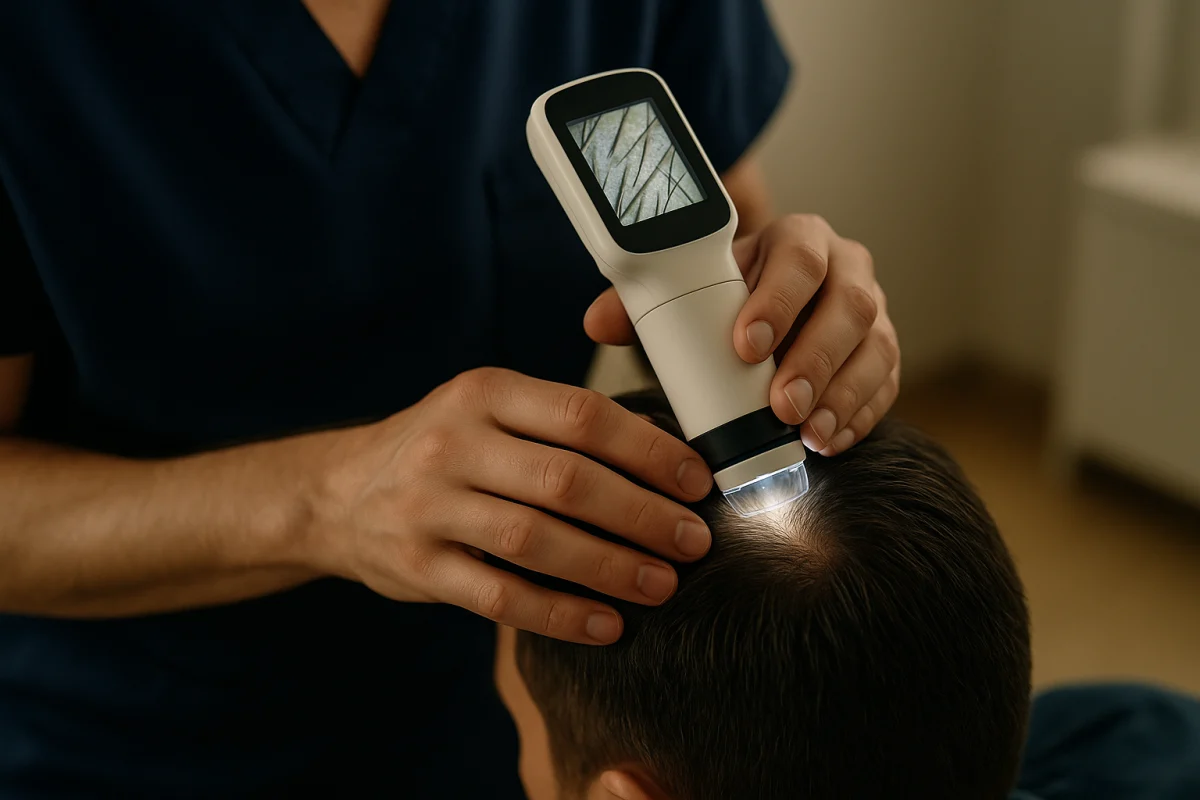
Miniaturisation does not necessarily mean that every follicle has disappeared. Early in the process, hairs may still grow but look lighter, shorter, or less able to cover the scalp. A trichoscopic examination can magnify the scalp and help a clinician assess differences in hair shaft diameter, follicle density, and signs of inflammation. This information can support a more accurate diagnosis and a safer long-term plan.
Not every thinning area should be treated as a transplant area immediately. If loss is actively progressing, placing grafts without considering future changes can leave an unnatural-looking distribution later. Doctors generally assess the likely pattern of future loss, the quality of the donor area, and the patient's expectations before recommending a procedure. Preserving donor follicles is especially important because this supply is limited.
03Baldness can be inherited from both parents
Genes play a major role in androgenetic alopecia, but baldness can be inherited through both maternal and paternal family lines. Some genetic factors related to androgen sensitivity are associated with the X chromosome, which is inherited by men from their mothers. However, many other genes involved in hair characteristics and follicle sensitivity come from both parents. This is why looking only at your mother's father or only at your father does not provide a reliable prediction.
When people ask where does baldness come from in their own family, it is more useful to consider the wider family picture. Hair density, age at onset, recession patterns, and thinning on both sides of the family may offer clues, but they still cannot forecast exactly what will happen to one person. A father with advanced baldness may increase the likelihood of a family tendency, yet his child may experience mild thinning, later thinning, or no obvious pattern loss.
Genetics influence risk rather than destiny. Two relatives can carry similar tendencies but have different visible outcomes due to age, hormones, health conditions, and other biological differences. For this reason, a consultation should focus on your present hair and scalp findings rather than assumptions based only on family photographs. Early assessment can be useful when you first notice progressive changes, particularly if you are considering future treatment or transplantation.
04Factors that can speed up shedding or reveal thinning
Pattern hair loss may be made more noticeable by temporary shedding. Emotional strain, severe illness, fever, surgery, rapid weight change, restrictive diets, childbirth, and some medicines can shift more follicles into a resting phase. This type of shedding is often called telogen effluvium. It may occur several weeks or months after the trigger and can make existing genetic thinning seem suddenly worse. A clinician should review significant shedding, especially when it is rapid or persistent.
Nutritional deficiencies, thyroid disorders, iron-related problems, autoimmune conditions, fungal scalp infections, and inflammatory scalp diseases can also affect hair growth. Hair loss may be diffuse, patchy, accompanied by itching or scaling, or associated with other symptoms. These features are not typical reasons to self-diagnose inherited baldness. Blood tests, scalp examination, or referral may be appropriate depending on the clinical picture.
Many younger adults feel that hair loss is starting earlier, leading to questions about where does baldness come from for Gen Z. Greater awareness, social media images, frequent close-up photography, and earlier attention to grooming can make mild thinning more visible. Genetic pattern loss can begin in young adulthood, but stress, restrictive eating, sleep disruption, scalp irritation, and untreated medical issues may also contribute to shedding. A proper assessment is more useful than assuming that age alone explains the change.
05Recognising when hair loss needs a medical check
A gradual, symmetrical change in density or hairline shape may fit pattern hair loss, but sudden changes deserve attention. Seek medical assessment if you notice round bald patches, a rapidly expanding area of loss, scalp pain, redness, scaling, pustules, scarring, eyebrow loss, or shedding with fatigue and other general symptoms. These signs can indicate conditions that need diagnosis before any cosmetic hair restoration is considered.
It is also sensible to arrange a review before taking supplements or using strong hair treatments. Supplements are not automatically beneficial and can be inappropriate when there is no confirmed deficiency. Similarly, some over-the-counter approaches may irritate the scalp or delay evaluation of a treatable condition. Your doctor can discuss possible causes, review your medical history, and explain whether tests or dermatology input are needed.
Understanding where does baldness come from begins with identifying the type of loss rather than choosing a procedure first. At Acibadem Hair Transplant Center in Istanbul, a free online hair analysis can be reviewed by doctors to provide an initial opinion based on your photographs and history. This is not a replacement for an in-person medical examination, but it can help you understand what questions to ask and whether transplant planning may be relevant.
06How a hair transplant helps restore thinning areas
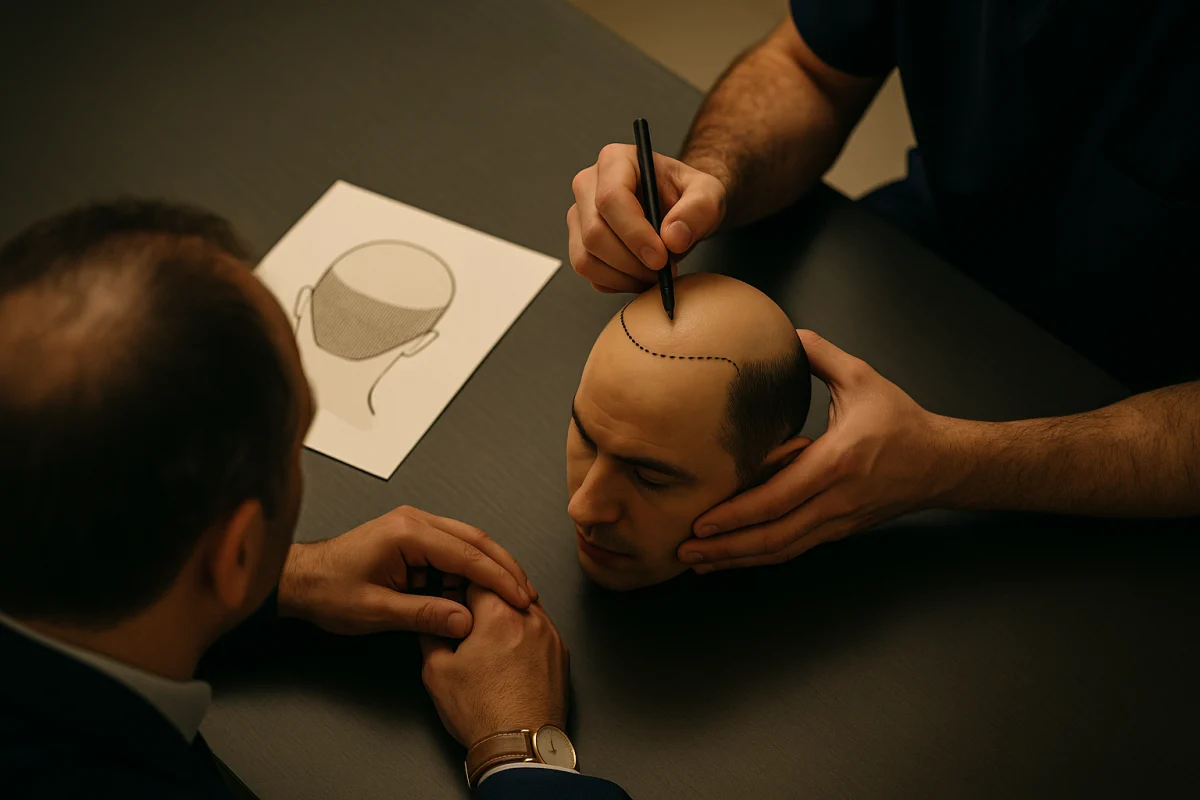
A hair transplant does not create new follicles. Instead, it redistributes your own follicles from a donor area, usually at the back and sides of the scalp, to areas with reduced density. Once transplanted follicles heal and grow, they generally keep many of the characteristics of their original donor site. This makes transplantation a potential option for selected patients with pattern hair loss and an adequate donor supply.
Sapphire FUE and DHI are commonly used approaches for extracting and placing grafts. In Sapphire FUE, follicles are typically extracted individually and recipient channels are created before implantation. In DHI, grafts are placed using an implanter device, allowing placement without creating all channels separately in advance. Neither technique is automatically best for every person. The recommended method depends on the hair-loss pattern, donor characteristics, hair type, scalp condition, coverage goals, and the medical team's assessment.
The aim is usually natural-looking distribution and sensible use of donor hair, not simply placing the highest possible number of grafts. A conservative hairline and appropriate density plan can be important for long-term appearance, particularly for younger patients whose native hair may continue to thin. At our dedicated hair restoration clinic, treatment planning is based on medical review rather than a one-size-fits-all graft number. Needle-free anaesthesia may also be available for suitable patients.
07Planning for results, recovery, and future hair loss
Hair transplantation is a process with a timeline. Small scabs and temporary redness can occur after the procedure, and transplanted hairs commonly shed during the early healing period before new growth begins. Visible growth develops gradually, with final maturation usually assessed over many months. Your doctor will explain aftercare, activity restrictions, washing instructions, and realistic timing according to your procedure and scalp condition.
A transplant may improve the appearance of areas that already have reduced density, but it does not prevent untreated native hair from changing in the future. Some patients may be advised to discuss medical management of ongoing pattern loss with a qualified doctor. Long-term planning can include monitoring, preserving the donor area, and considering how the hair pattern may evolve. This approach helps avoid making a short-term decision that does not suit future needs.
Acibadem Hair Transplant Center is licensed by the Turkish Ministry of Health and has welcomed patients from 38 countries over 12 years. Our all-inclusive packages can include VIP transfer, a 4-star hotel, a care kit, and 12 months of follow-up. Graft survival is measured trichoscopically at month 12, with a documented 98% rate under written guarantee. Individual cosmetic outcomes still vary, and your doctor will confirm whether transplantation is suitable for you.
08Frequently Asked Questions
If my father has significant baldness, will I definitely lose my hair too?
No. Your father's hair pattern may indicate a family tendency, but it cannot predict your outcome with certainty. Pattern hair loss involves many genes inherited from both sides of the family, as well as age, hormones, and other factors. If you notice progressive thinning, a medical hair assessment can clarify what type of loss is present.
Is baldness passed down through the mother or the father?
It can be inherited from both parents. Although some relevant genetic factors are linked to the X chromosome inherited from the mother, many other genes come from either side of the family. Looking at hair loss among several relatives can provide context, but it is not a precise forecast.
Why do many Gen Z adults seem to be losing hair earlier?
Genetic pattern hair loss can begin in early adulthood, while increased awareness and close-up online images may make early thinning easier to notice. Stress, rapid dieting, illness, poor sleep, scalp problems, and nutritional or hormonal issues may also increase shedding. Sudden or marked hair loss should be reviewed by a doctor rather than assumed to be genetic.
Which ethnic group has the lowest rate of baldness?
There is no simple or clinically useful answer based on race alone. Hair-loss patterns vary widely within every population, and published comparisons can be affected by age, definitions of baldness, genetics, environment, and access to diagnosis. An individual scalp assessment is far more informative than ethnic background when considering hair-loss risk or treatment.
Can a transplant stop my hair loss permanently?
A transplant can redistribute resistant donor follicles into thinning areas, but it does not stop native hair in other areas from continuing to thin. Your doctor may discuss medical management and long-term planning if ongoing pattern loss is likely. Suitability depends on donor supply, diagnosis, age, and the stability of your hair-loss pattern.
This article is for general information only and is not a substitute for professional medical advice.
 06
 12