
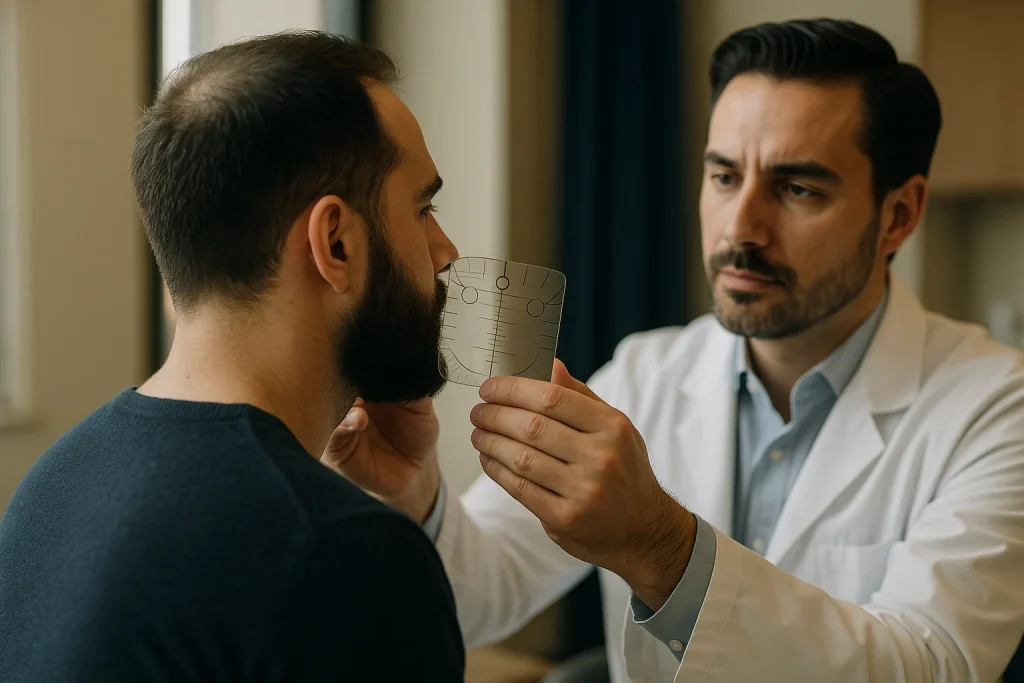
A beard hair transplant can add facial hair to sparse areas, improve beard symmetry, or rebuild selected areas after scars when a suitable donor area is available. Natural-looking results depend on careful facial design, appropriate graft placement, and a realistic density plan confirmed by your doctor.
- A successful beard plan considers facial proportions, existing growth direction, skin characteristics, and personal grooming goals.
- Most beard procedures use individual follicular units taken from the scalp donor area and placed at carefully selected angles.
- Creating a natural result usually involves staged-looking density, soft borders, and lower graft concentration at transition zones.
- Early shedding after transplantation is expected in many patients, while visible growth develops gradually over several months.
- A medical assessment is important to confirm donor suitability, exclude active skin conditions, and discuss realistic coverage.
01How a beard hair transplant creates density without losing balance
A beard hair transplant is a surgical restoration procedure that moves healthy hair follicles, usually from the scalp donor area, into selected beard, moustache, sideburn, or goatee zones. It may be considered by people with naturally patchy facial hair, uneven growth, areas affected by injury or previous procedures, or limited beard development. The aim is not simply to place the highest possible number of grafts. It is to create facial hair that appears appropriate for the person’s face, existing hair pattern, age, and preferred style. Your doctor will assess whether transplantation is suitable and what level of coverage can be planned safely.
Facial balance matters because a beard changes the visual proportions of the jaw, chin, cheeks, mouth, and neck. A broad, dense beard may suit one face but look too heavy on another, while a focused chin or jawline design may provide definition without covering large areas. During planning, the medical team should look at the face from the front and side, as well as at close range. This helps avoid a design that looks acceptable in one angle but artificial in daily movement, photographs, or different beard lengths.
Density is also relative. A naturally convincing beard does not usually have identical density everywhere. Many men have stronger hair concentration around the chin and jaw, with lighter cheeks or connecting areas. Reproducing these small variations can make the final result look more believable than filling every space uniformly. The surgical plan should therefore define priority zones, estimate the available donor supply, and set expectations about the amount of coverage that can reasonably be achieved in one session.
02Facial mapping: choosing the right beard shape and borders
A good consultation begins with listening to what the patient wants to see in the mirror. Some people want a fuller version of their existing beard, while others want to create a goatee, reinforce the moustache, connect the sideburns, or disguise a small scar. These are different goals and require different graft distribution. Reference images can help communicate style preferences, but the final design should be adapted rather than copied. Bone structure, facial width, natural hair texture, and the existing growth pattern all influence what may look harmonious.
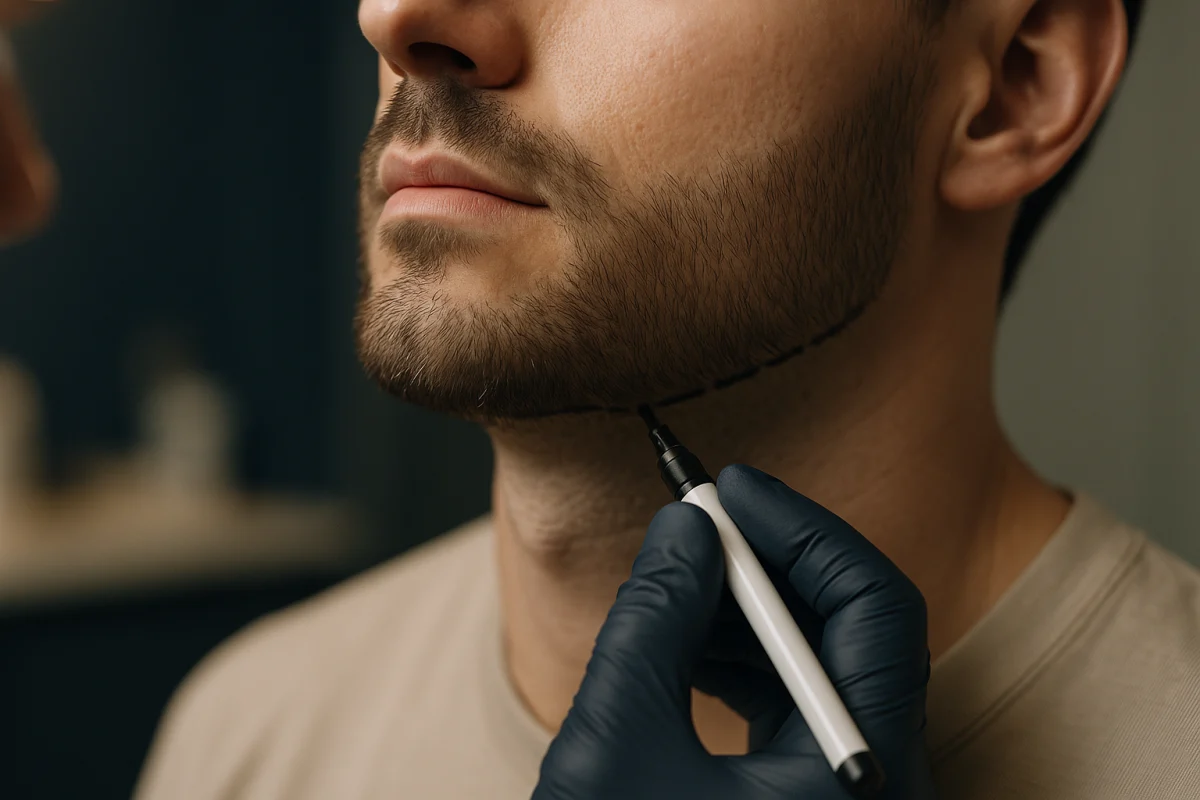
The upper cheek line deserves particular attention. A line placed too high or too sharply can look drawn on, especially when the beard is short. In many cases, a softer and slightly irregular transition is more natural because real facial hair does not grow in a perfectly straight border. The lower cheek and jaw areas also need a gradual build-up of density. Single-hair grafts are often useful at visible edges, while follicular units with more than one hair may be considered deeper within a fuller zone when clinically appropriate.
The neckline is another important design decision. It should support the jaw without extending too far down the neck or creating an abrupt horizontal line. The ideal location varies with neck length, beard style, and how the person normally shaves. A doctor may mark the planned zones while the patient is sitting upright, since facial contours change with posture. Reviewing the design before the procedure gives the patient an opportunity to discuss the width, symmetry, and degree of fullness planned.
03Graft selection, donor management, and realistic coverage
Most facial hair restoration procedures use follicular units harvested from the back or sides of the scalp, where hair is often more resistant to thinning. However, scalp hair and beard hair do not always match perfectly in thickness, curl pattern, colour, or growth speed. The doctor evaluates these characteristics before recommending a plan. Fine grafts may be particularly helpful for visible borders, while somewhat stronger grafts may offer useful visual coverage in central beard areas. This matching process is one reason that an individual assessment is more reliable than a standard graft package.
Donor management is essential because donor follicles are a limited resource. Harvesting should be planned conservatively to preserve a natural appearance in the scalp donor area and to keep options available for future needs. The number of grafts required depends on the size of the recipient area, existing facial hair, desired density, hair calibre, and whether the goal is complete creation or selective reinforcement. A patient with existing beard coverage may need fewer grafts than someone building a broad beard pattern from very sparse growth.
It is useful to think of graft count as a planning tool, not as a direct measure of quality. More grafts do not automatically create a better result if the design, angle, or hair selection is unsuitable. In some cases, focusing available follicles on the moustache, chin, jawline, or scar border can create a stronger visual improvement than trying to cover every area lightly. Your doctor will confirm the donor assessment and explain whether one procedure is likely to meet the agreed goal or whether future refinement may be discussed.
04Why angle and direction matter as much as density
Natural facial hair lies close to the skin and changes direction across the face. On the cheeks, hairs often point downward and slightly outward. Along the jaw, they may follow the curve of the mandible, while chin and moustache hairs can grow in more varied patterns. For this reason, recipient sites must be created with very shallow angles and with direction matched carefully to surrounding hairs. If grafts are placed too upright, the beard may appear spiky or may be difficult to trim and style naturally.
A beard hair transplant requires detailed placement because facial hair is viewed at close distance. The surgeon considers not only where each graft is placed, but also how it will emerge through the skin after growth. Fine single-hair grafts can soften leading edges and transition areas. Within denser regions, placement can be adjusted to avoid a uniform, plug-like appearance. Existing hairs guide the direction where present; in completely bare areas, the planned direction should blend smoothly into nearby zones such as the sideburns, moustache, or chin.
Skin texture and scar tissue can affect site creation and growth conditions. In scar restoration, blood supply, scar thickness, and stability of the skin should be assessed carefully before a procedure is advised. Some scars may be suitable for transplantation, while others may require further evaluation or may not be appropriate at that time. A cautious plan can be especially important in these areas, where lower initial density or a later touch-up may be preferable to overloading the tissue with grafts.
05The procedure day: technique, comfort, and placement sequence
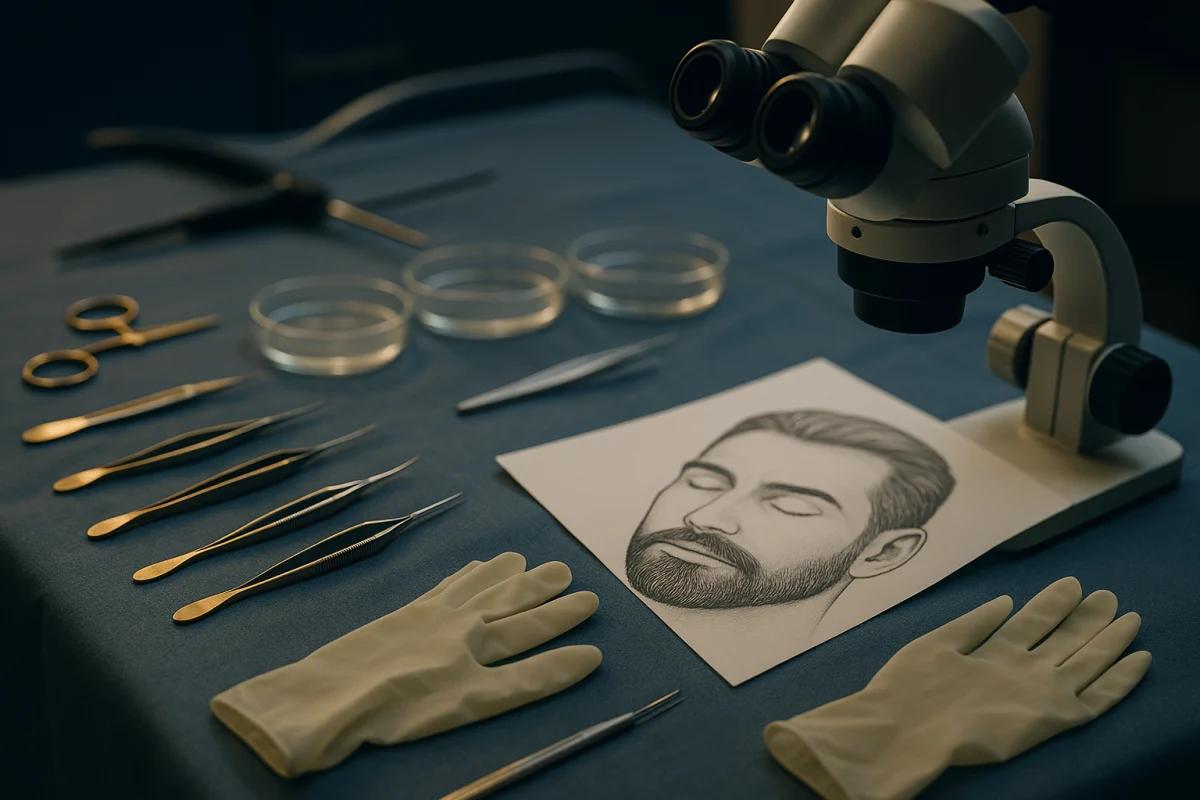
The procedure commonly starts with final confirmation of the facial design, photographs for medical documentation, and preparation of the donor and recipient areas. Follicles are generally harvested individually using a follicular unit extraction approach. At Acibadem Hair Transplant Center, Sapphire FUE and DHI techniques are available, and the appropriate approach depends on the clinical plan and the doctor’s assessment. The chosen method should support careful handling of follicles and controlled placement rather than being selected only by name.
Local anaesthesia is typically used so that the patient remains awake while the treated areas are numb. Needle-free anaesthesia is available at the clinic for suitable patients, although your medical team will confirm whether it is appropriate for you. Patients may feel pressure or brief sensations during parts of the day, but significant pain is not usually expected once effective local anaesthesia has taken effect. Medical history, allergies, medications, and any relevant health conditions should be discussed honestly before treatment.
Placement often proceeds from the most visible borders toward the areas of greater density, although the exact sequence can vary. The team protects the harvested grafts and places them according to the agreed design. Procedure length is influenced by the number of grafts and the complexity of the area being restored. Patients travelling to Istanbul can also ask about the clinic’s all-inclusive arrangements, which include VIP transfer, a 4-star hotel, a care kit, and 12 months of follow-up, subject to the selected treatment plan.
06Healing timeline and the beard 3-month rule
Immediately after the procedure, tiny crusts, redness, and mild swelling can occur in the recipient area. These effects are usually temporary, but recovery varies between individuals and according to the size of the treatment area. The care team will give specific washing and protection instructions. In general, avoiding rubbing, scratching, shaving too early, intense exercise, and direct friction can help protect newly placed grafts during the initial healing period. Patients should contact their medical team if they are concerned about unusual pain, spreading redness, discharge, fever, or other unexpected symptoms.
The phrase beard 3-month rule is often used informally to describe the early waiting period after a transplant. In many patients, transplanted hairs shed within the first few weeks before the follicles begin a new growth cycle. At around three months, early new hairs may start to become visible, but they are often fine, uneven, and not yet representative of the final appearance. This does not mean the procedure has failed; it is a common part of the normal growth timeline, although individual timing differs.
More noticeable maturation typically develops over subsequent months as hairs become longer and thicker. The pattern may look irregular at first because not every follicle enters active growth at the same time. Final assessment is generally delayed until sufficient time has passed for growth and maturation, often around 12 months. Follow-up appointments and clear photographs can help the medical team monitor progress. At Acibadem Hair Transplant Center, results are measured through trichoscopic graft survival at month 12, with a documented 98% rate under written guarantee.
07Long-term grooming, permanence, and when to seek assessment
Once transplanted follicles have healed and established growth, they generally continue to grow like hair from their original donor area. This means they usually need ongoing trimming, shaving, or beard grooming according to the patient’s preferred look. They may retain some donor-hair characteristics, including growth rate, texture, or curl. A transplant can provide a lasting improvement in suitable candidates, but it is not possible to promise an identical result for every patient because healing, skin condition, future health changes, and individual biology can influence outcomes.
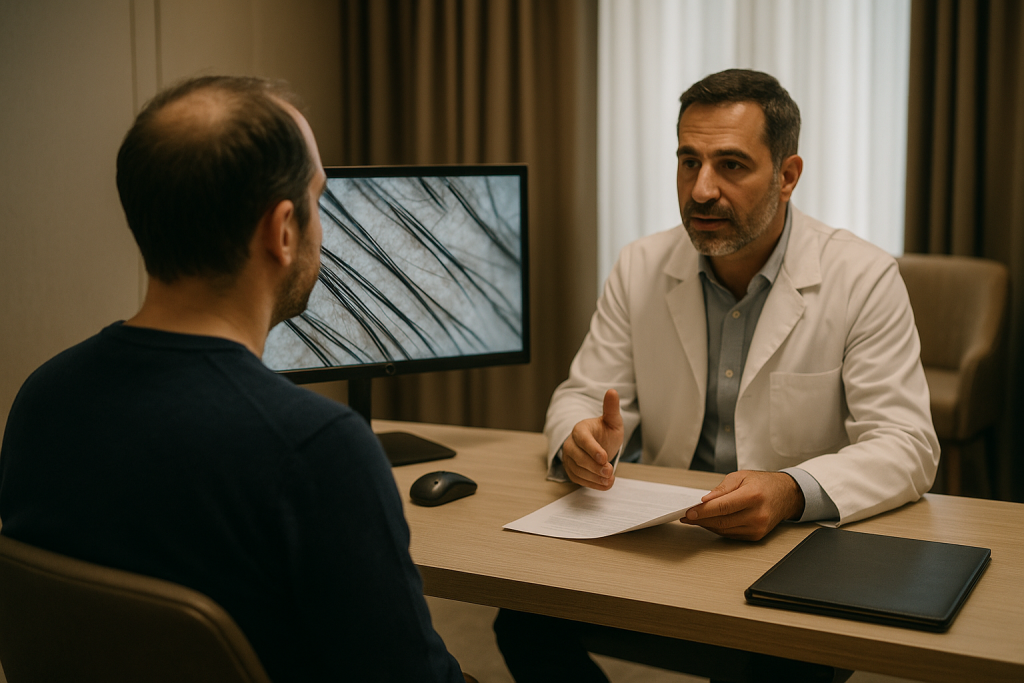
A stable result also depends on protecting the skin and addressing conditions that affect facial hair. Active acne, folliculitis, dermatitis, uncontrolled skin inflammation, or unexplained hair loss should be evaluated before transplantation. If facial hair loss began suddenly or is associated with scaling, pain, scarring, or patches elsewhere on the body, a dermatological assessment may be needed. Transplantation should not replace investigation of a possible underlying medical cause. Your doctor will advise on the appropriate sequence of care.
For international patients, a free online hair analysis can be a practical first step before travelling. At Acibadem Hair Transplant Center, doctor-reviewed online hair analyses are available, and WhatsApp replies are typically provided within about two hours. Images should be clear and include the donor area as well as the beard from several angles. The review can outline general suitability and planning considerations, but the final medical decision, design, and treatment recommendation must be confirmed through a proper clinical assessment.
08Frequently Asked Questions
What does a beard transplant usually cost?
The cost depends on the number of grafts, the size and complexity of the area, donor assessment, technique, travel arrangements, and follow-up included in the plan. A safe quote should be based on a medical review rather than a fixed price advertised for every patient. Ask for a clear written explanation of what is included and whether post-procedure follow-up is provided.
What does the three-month rule mean after a beard transplant?
This phrase usually refers to the fact that early visible growth may only begin around the third month after initial shedding. New hairs can still look thin or uneven at this stage, so three months is generally too early to judge the final density. Growth and maturation commonly continue for many more months.
Will transplanted beard hair last permanently?
Established transplanted follicles generally continue to grow long term because they retain characteristics of the donor area. However, no clinic can guarantee the same outcome in every person, as healing and individual biological factors vary. The hair will still require normal grooming, trimming, or shaving.
How much do 3,000 hair grafts cost in the USA?
There is no single reliable price for 3,000 grafts in the USA because quotes vary substantially by location, surgical team, technique, case complexity, and what services are included. The number may also be inappropriate for a beard procedure if it exceeds the actual design or donor needs. Request an itemised medical quote and compare the treatment scope, safety standards, and follow-up rather than considering graft count alone.
This article is for general information only and is not a substitute for professional medical advice.
 06
06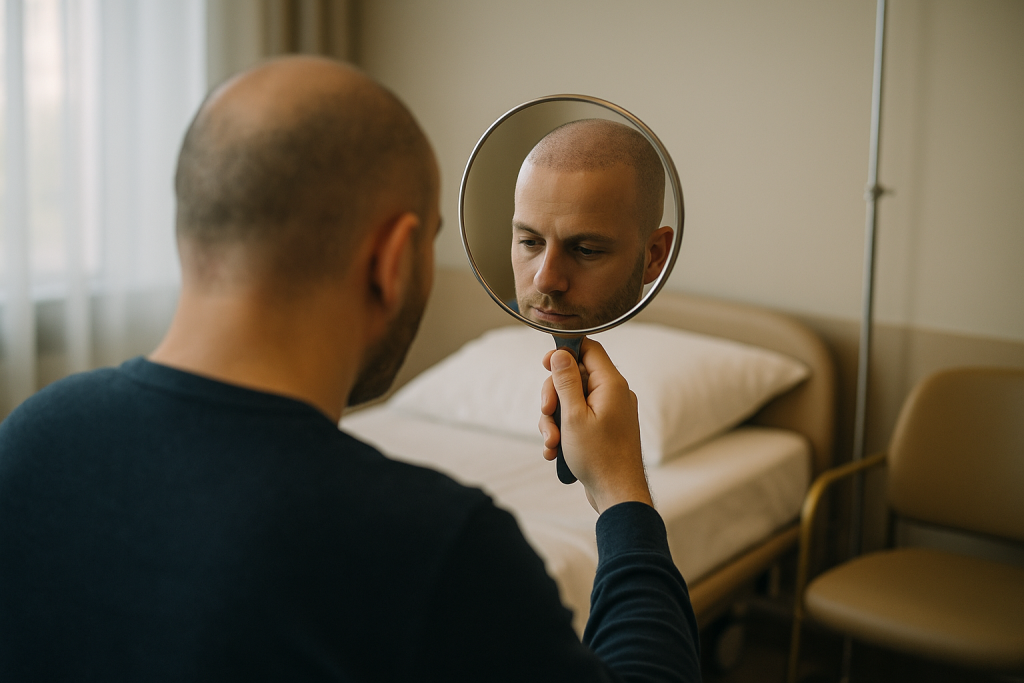 12
12