
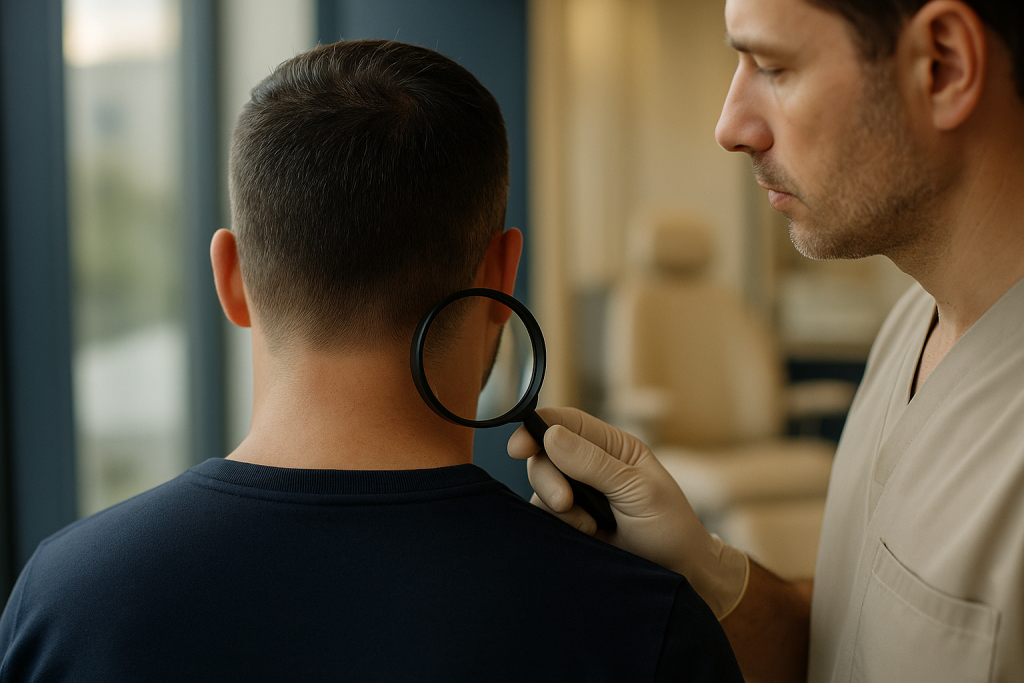
In a fue hair transplant vs fut comparison, the main donor-area difference is how grafts are collected. FUE removes individual follicular units and leaves small dot-like scars, while FUT removes a narrow strip of scalp and leaves a linear scar; the better option depends on your donor density, hairstyle, scalp features and long-term hair plan.
- FUE collects individual grafts across the donor zone, while FUT removes a carefully planned strip of donor scalp.
- FUE usually leaves tiny scattered scars, whereas FUT creates one linear scar that may be visible with very short hair.
- Neither method is automatically best for every patient; donor quality and surgical planning are more important than the technique name alone.
- Both FUE and FUT require careful donor preservation because the available permanent donor hair is limited.
- A doctor-reviewed assessment should consider scalp laxity, hair density, hair calibre, future hair loss and your preferred haircut.
01Why the donor area matters before any hair transplant
The fue hair transplant vs fut decision is often described as a choice between two extraction methods, but it is also a long-term decision about the donor area. This is the region, usually at the back and sides of the scalp, where follicles are taken for transplantation. Hair in this area is commonly more resistant to pattern hair loss, yet it is not unlimited. A safe plan aims to take enough grafts to improve the recipient area while keeping the donor region natural-looking now and in the future.
Doctors assess more than the number of visible hairs in the donor zone. They typically examine density, hair shaft thickness, colour contrast between the hair and scalp, curl pattern, scalp condition and the size of the stable donor area. They also consider whether hair loss may continue in non-transplanted areas. A person with dense, thicker hair may achieve useful coverage with fewer grafts than someone with finer hair and strong scalp-to-hair contrast.
It is important to understand that transplanted grafts are a resource rather than an unlimited supply. Removing too many follicles can make the back or sides look thin, particularly in bright light or with a short haircut. For this reason, a responsible treatment plan considers the present concern, such as a receding hairline or crown thinning, alongside likely future needs. Your doctor will confirm whether the donor area appears suitable after a clinical assessment.
02fue hair transplant vs fut: how grafts are removed
With FUE, or follicular unit extraction, the clinical team removes naturally occurring follicular units one by one using a small punch instrument. A follicular unit may contain one, two, three or sometimes more hairs. The extraction sites are distributed through a selected donor zone, rather than being concentrated in one long section. The grafts are then prepared and placed into recipient-area channels or sites according to the surgical plan.
With FUT, also called follicular unit transplantation or strip surgery, a narrow strip of scalp is removed from the donor area. The surrounding scalp is then closed with sutures or staples, depending on the clinical approach. Under magnification, the strip is dissected into individual follicular-unit grafts for placement. This method can preserve the tissue around neighbouring follicles outside the strip, but it creates a linear donor scar.
Both methods can provide grafts containing natural follicular groups. The quality of the final appearance depends on several factors, including donor characteristics, careful graft handling, recipient-site design and realistic graft allocation. It is not accurate to assume that one technique always produces better growth or a more natural result. In most patients, the most appropriate method is the one that can meet the treatment goal without compromising donor-area safety.
03FUE donor scars: small marks spread across the zone
FUE extraction leaves many small circular wounds where follicular units were removed. These sites usually heal into tiny pale marks that are scattered through the donor area. Once the hair has grown around them, they are often difficult to notice at ordinary hair lengths. However, all surgical extraction can leave some degree of permanent scarring, and visibility varies between individuals.
The pattern of FUE harvesting is especially important. If too many grafts are taken from a limited region, the remaining donor hair can look uneven or see-through. Experienced planning generally spreads extraction across suitable parts of the safe donor zone while avoiding excessive removal from any one area. The aim is to retain an even appearance when the surrounding hair is worn at the patient’s usual length.
Skin tone, healing tendency, hair length and the number of grafts needed can affect how noticeable FUE scars become. People who prefer a closely shaved style should discuss this clearly during the consultation, because tiny dots may be more visible when the donor hair is clipped extremely short. A previous scalp procedure, skin condition or a history of unusual scarring may also influence whether FUE is appropriate.
04FUT donor scars: understanding the linear strip scar
FUT produces a linear scar in the area where the donor strip was removed and the scalp was closed. The scar is usually positioned within the permanent hair-bearing zone so that longer surrounding hair can cover it. Its final appearance depends on factors such as the width of the strip, scalp laxity, closure technique, healing response and how much tension is present during closure.
For some patients, the advantage of FUT is that a substantial number of grafts may be obtained from a defined strip while the adjacent donor area is not individually punched. This can be useful in selected cases, particularly when the person has suitable scalp laxity and is comfortable keeping the back and sides of the hair longer. It does not mean FUT is automatically the correct method for a large session, because donor safety still needs individual evaluation.
A linear scar can widen in some patients during healing, especially if there is tension, reduced scalp elasticity or individual scar-related factors. It may be more apparent with a very short fade, shaved sides or certain hairstyles. Before choosing FUT, patients should ask how the scar may fit with their current and future haircut preferences. Your doctor can explain the expected placement and the factors that may affect visibility, but no scar outcome can be guaranteed.
05Haircut choices and the visibility of donor evidence
Haircut preference is one of the clearest practical differences between the two methods. FUE is often considered by people who want flexibility to wear the back and sides short because it does not create one long line. Yet short hair does not make FUE scars invisible in every case. If the area is shaved very closely, the small extraction marks or reduced donor density may still be noticeable.
FUT may suit people who normally wear their hair at a medium or longer length and are willing to keep enough coverage over the linear scar. Many patients can conceal a well-healed strip scar with surrounding hair, but a high fade or very short clipper cut may reveal it. Lifestyle, work requirements, sporting activities and the likelihood of changing hairstyle should all be part of the conversation before surgery.
In a fue hair transplant vs fut consultation, photographs alone cannot fully predict scar visibility. Donor density, hair colour, scalp colour, hair texture and healing biology all change how the area looks after recovery. A doctor should inspect the donor region directly or through clear clinical images and discuss the trade-offs honestly. The most suitable method is usually the one that supports both the transplant goal and the hairstyle you expect to maintain over time.
06Graft numbers, donor density and future hair loss
A request for a specific graft number should always be assessed in the context of donor capacity. For example, 3,000 grafts may be appropriate for one person but overly demanding for another. The same graft count can also create different cosmetic effects depending on hair thickness, curl, recipient-area size and the desired density. Doctors normally estimate how many grafts can be extracted while leaving enough hair behind to avoid an overharvested appearance.
FUT and FUE can both be used in staged treatment plans, but each affects future options differently. An FUT procedure leaves a strip scar and changes the scalp tissue in that area. FUE reduces the number of available follicular units across the donor region. If further treatment may be needed later, the first procedure should be designed conservatively enough to protect future choices.
Hair loss can progress after a transplant because non-transplanted native hair may continue to thin. This is particularly relevant for younger patients or those with a strong family pattern of extensive hair loss. A low, dense hairline or aggressive crown plan may look attractive initially but can use grafts that may be needed later. A careful clinician will discuss age, pattern stability, family history and medical options where appropriate before recommending the scope of surgery.
07Recovery, discomfort and donor-area care
Both methods involve a recovery period, and the donor area needs protection while it heals. After FUE, patients commonly experience small scabs, redness, mild swelling or temporary sensitivity in the extraction zone. After FUT, there may be tightness or tenderness along the closure line, and sutures or staples usually require removal at the time advised by the clinical team. Individual experience of discomfort differs, so it is not possible to predict it precisely for one person.
FUT is often described as more uncomfortable because it involves an incision and closure under tension, while FUE involves many small extraction sites. However, pain perception is personal, and appropriate anaesthesia and aftercare can help manage discomfort with either technique. Acibadem Hair Transplant Center offers needle-free anaesthesia as an available option. Your clinical team will explain the anaesthesia approach, prescribed medication and care instructions relevant to your procedure.
Patients are generally asked to avoid rubbing, scratching or exposing the healing donor area to unnecessary trauma. Strenuous exercise, direct sun exposure, swimming and tight headwear may need to be limited for a period advised by the clinic. Following the aftercare plan matters because it supports normal wound healing and reduces avoidable irritation. Contact the clinical team promptly if you develop increasing pain, spreading redness, discharge, fever or any concern about healing.
08How doctors choose between FUE and FUT
There is no universal winner between FUE and FUT. FUE may be considered when a patient values avoiding a linear scar, prefers shorter hairstyles or has donor characteristics that allow safe distributed extraction. FUT may be considered when scalp laxity is good, a larger number of grafts is clinically suitable from a strip approach, and the patient accepts the need to keep enough hair length to conceal a linear scar.
Some patients may be candidates for either technique, while others have clear reasons to avoid one of them. Limited donor density, previous surgery, scalp tightness, a tendency toward visible scarring, occupational requirements and haircut choices may all change the recommendation. In certain long-term cases, a clinician may discuss a combination or sequence of methods, but this should only be considered after careful evaluation of donor reserves and future hair-loss risk.
At Acibadem Hair Transplant Center in Istanbul, a free online hair analysis can be reviewed by doctors before travel planning. Clear images of the front, top, sides and donor area help the team make an initial assessment, although an in-person examination remains important for confirming suitability. The clinic is licensed by the Turkish Ministry of Health and offers Sapphire FUE and DHI techniques; your doctor will explain whether a procedure is clinically appropriate and which donor approach best fits your goals.
09Protecting the donor area for a natural long-term plan
The best donor-area result is not simply one that looks good immediately after healing. It should also leave sufficient coverage and reserves for the years ahead. Conservative extraction, realistic density goals and a design that respects future hair loss can help reduce the chance of a mismatch between transplanted and native hair. This principle applies whether a patient chooses FUE or FUT.
When comparing fue hair transplant vs fut, it is helpful to focus on questions that are personal but not purely cosmetic: How short do you want to wear your hair? Is your donor density sufficient for the intended coverage? Is the scalp flexible enough for strip surgery? Could you need a second procedure later? An open discussion of these points can lead to a safer and more sustainable choice than selecting a technique based on a general trend.
International patients should also consider how follow-up will be arranged after returning home. Acibadem Hair Transplant Center provides all-inclusive packages with VIP transfer, a 4-star hotel, a care kit and 12 months of follow-up. Results are measured through trichoscopic graft survival at month 12, with a documented 98% rate under written guarantee. These details do not replace individual medical assessment, but structured follow-up can support patients as the donor and recipient areas recover.
10Frequently Asked Questions
Which technique is usually more successful: FUE or FUT?
Neither FUE nor FUT is always more successful for every patient. Both can provide successful graft growth when donor selection, surgical handling, recipient-site planning and aftercare are appropriate. Your doctor will recommend the method that can meet your goals while protecting the donor area.
Is FUT generally more painful than FUE?
FUT may cause more tightness or tenderness in the donor area because it involves a strip incision and closure. FUE involves many small extraction sites and may feel different during the early healing period. Anaesthesia and prescribed aftercare are used to manage discomfort, but each person’s experience varies.
What is the cost of 3,000 FUE grafts?
The cost of 3,000 FUE grafts cannot be confirmed from graft number alone. It can depend on donor assessment, the complexity of the case, technique, travel arrangements and what is included in the treatment plan. A doctor-reviewed online analysis can provide a more accurate quotation after your suitability and treatment needs are assessed.
Does a FUT hair transplant last forever?
FUT grafts are usually taken from hair that is more resistant to pattern hair loss, so transplanted hair can be long-lasting in many patients. However, no procedure can guarantee lifelong results, and native hair around the transplant may continue to thin over time. Long-term planning and follow-up are important for maintaining a natural overall appearance.
This article is for general information only and is not a substitute for professional medical advice.
 06
06 12
12