
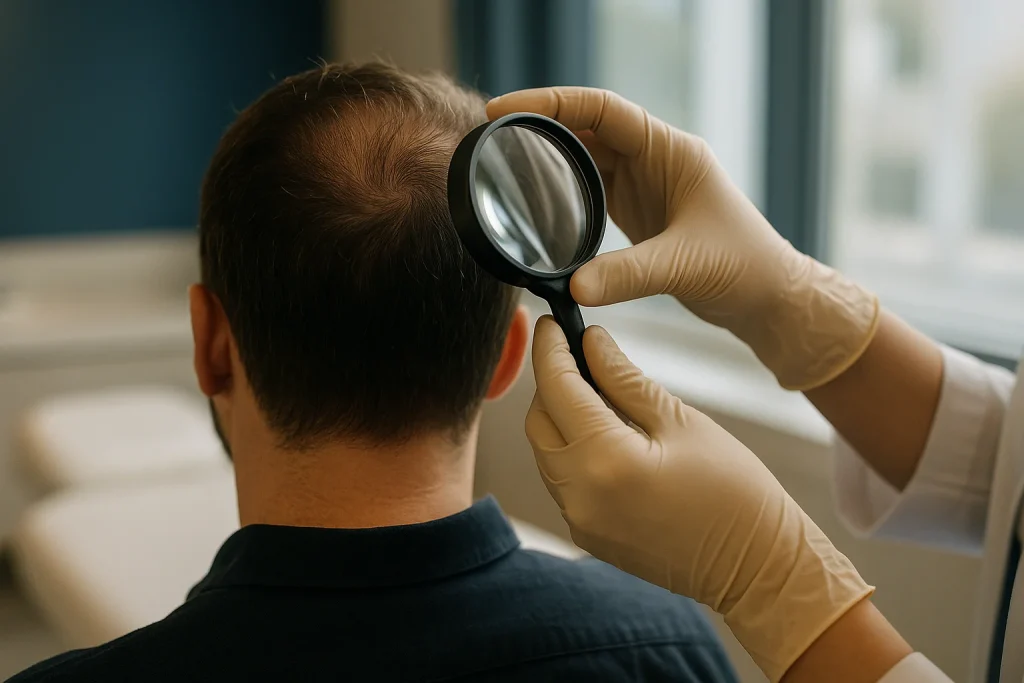
A crown hair transplant can improve visible thinning at the vertex when the donor supply, hair-loss pattern and long-term plan are suitable. Surgeons typically place grafts in a spiral direction and prioritise natural-looking coverage over attempting to recreate very high density in one session.
- Crown restoration requires careful planning because the area is large and hair grows in a circular pattern.
- The number of grafts needed depends on crown size, existing hair, hair characteristics and donor availability.
- Grafts are usually placed to follow the natural crown whorl for a softer and more realistic result.
- A transplant does not stop future hair loss, so doctors plan with the long-term pattern in mind.
- Visible growth develops gradually, while the result is commonly assessed around 12 months after surgery.
01Crown Hair Transplant: Why the Vertex Needs a Different Plan
A crown hair transplant focuses on thinning in the vertex, the rounded area at the upper back of the scalp. This region often needs a different strategy from the frontal hairline because it covers a broad surface and contains a natural spiral, sometimes called a whorl. The aim is usually to reduce scalp visibility and create balanced coverage that fits the patient’s existing hair, rather than to make the crown look unnaturally dense.
For many people, crown thinning develops gradually and may continue over time. A doctor will therefore assess not only the area that is thin today, but also the surrounding hair that could become weaker later. This wider view is important because a well-filled central crown can look isolated if hair loss progresses around it. Planning may include preserving donor grafts for future needs, especially when the frontal and mid-scalp areas also show thinning.
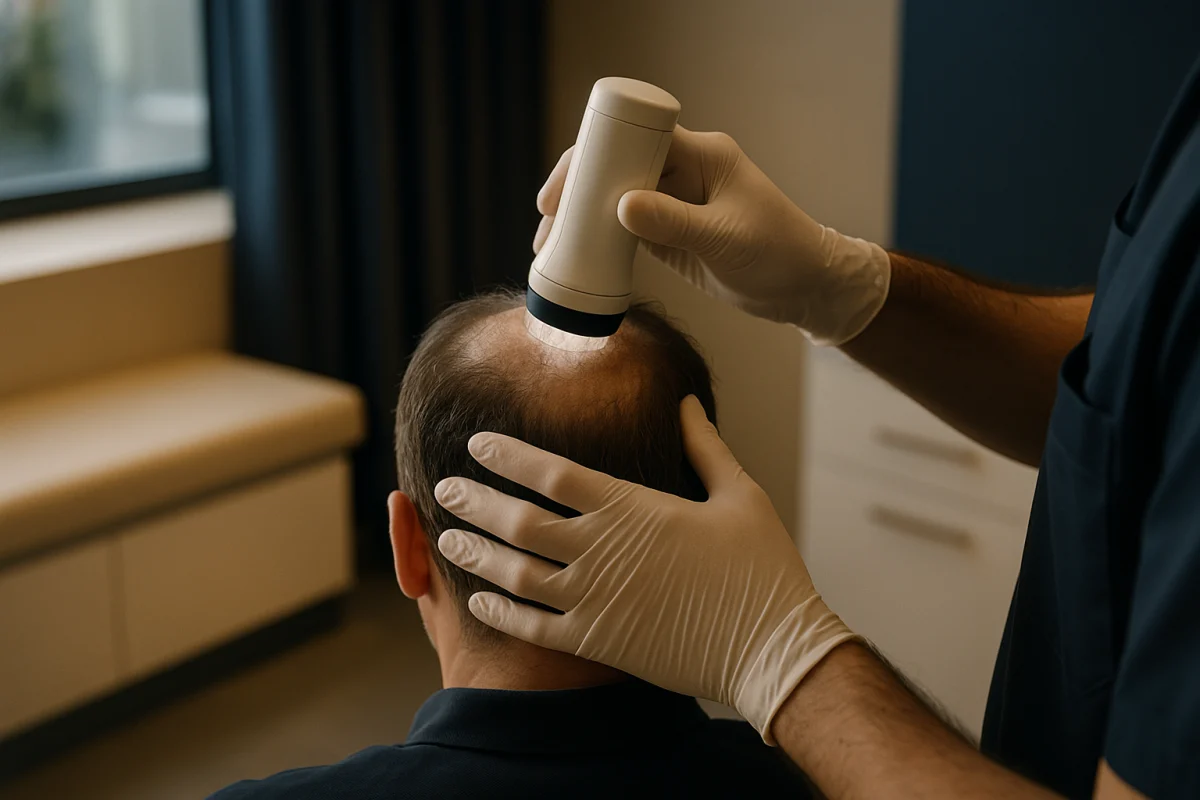
The crown can appear more open than its actual size because light reaches the scalp from above. Wet hair, short haircuts, strong lighting and dark hair-to-scalp contrast can make this effect more noticeable. For this reason, consultation photographs and trichoscopic assessment are useful tools. They help the medical team understand the density of existing hairs, the direction of growth and the realistic level of coverage that may be possible.
02Assessing the Crown Pattern and Donor Area
Before recommending surgery, doctors generally examine the shape and size of the thinning zone. Some patients have a small circular opening around a stable whorl, while others have diffuse thinning that extends into the mid-scalp. These patterns need different approaches. A small crown may be addressed with a focused number of grafts, whereas a larger area may require staged treatment or a priority plan that includes other parts of the scalp.
Donor assessment is equally important. Follicular units are commonly taken from the back and sides of the scalp, where hair is usually more resistant to pattern hair loss. The doctor considers donor density, hair shaft thickness, curl, colour contrast and the safe number of grafts that can be harvested. A strong donor area may support more coverage, but every harvesting plan should protect the appearance of the donor region as well.
Existing crown hair is not ignored during planning. When miniaturised hairs are still present, placing grafts between them requires accuracy and appropriate spacing. This can help retain a natural transition, but it also means the team must work carefully to avoid unnecessary trauma to native follicles. Your doctor will confirm whether the current density and scalp condition are suitable for implantation.
03How Many Grafts May Be Needed for Crown Coverage?
The graft requirement for a crown hair transplant varies widely. It cannot be reliably decided from one number alone because a graft may contain one, two, three or more hairs, and the visual effect depends on the size of the area. A person with thick, wavy hair and low contrast between hair and scalp may achieve useful coverage with fewer grafts than someone with very straight, fine hair and a strong colour contrast.
For a limited crown opening, 2,000 grafts may be enough to improve coverage in some patients, particularly when there is still healthy hair around and within the area. However, 2,000 grafts may not be sufficient to provide high density across a large or extensively thinned crown. Doctors usually discuss graft numbers as part of an overall design, not as a promise that a certain number will create the same result for everyone.
A plan involving 3,000 grafts can cover a moderate area or contribute to a larger area, depending on the desired density and the number of hairs carried by each graft. In some cases, those grafts are allocated between the crown and mid-scalp rather than concentrated in one location. This is often done to create a more even appearance from different viewing angles and to use the available donor supply responsibly.
04Creating the Natural Spiral With Graft Placement
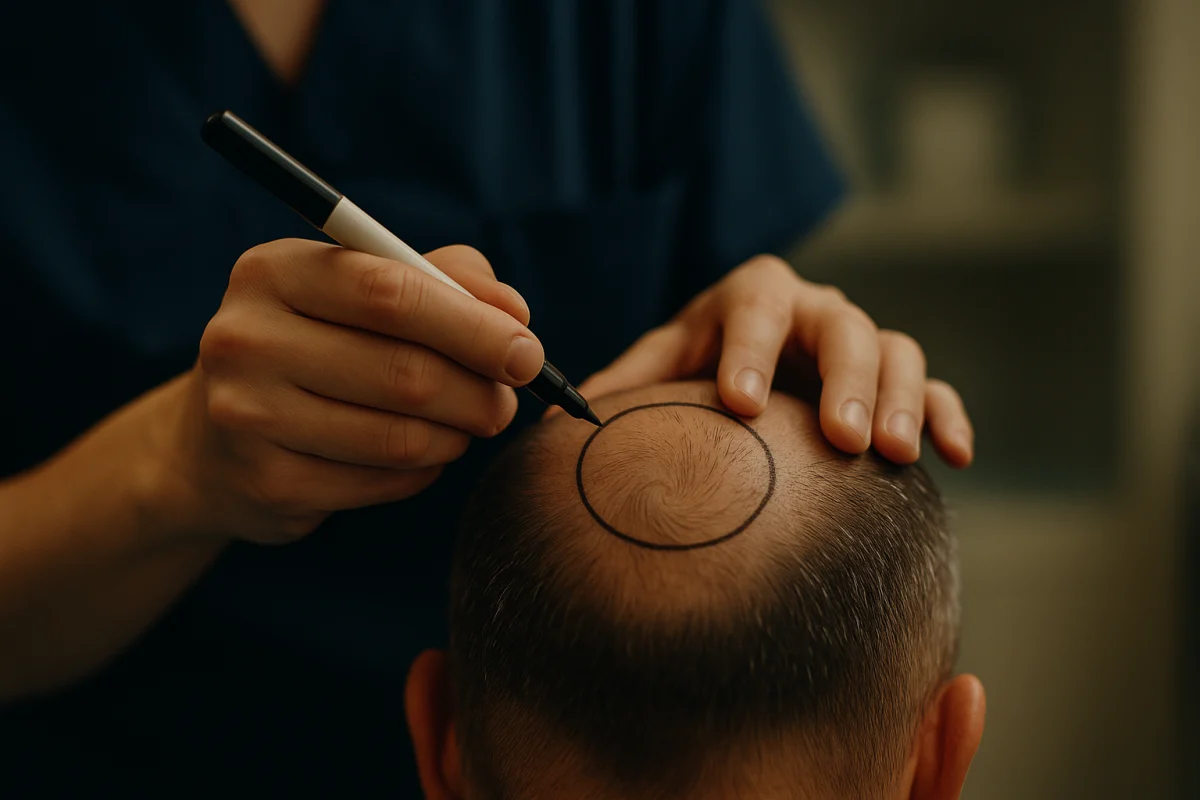
The direction of placement is one of the defining technical details in crown restoration. Natural crown hairs do not simply point forward or backward; they radiate and turn around a central point. The surgeon studies this pattern and creates recipient sites at changing angles around the whorl. When this is planned well, the implanted hair can blend more naturally with the patient’s own growth pattern.
Density is normally graduated across the region. The central point of the whorl may need particular attention, but building very high density in a small spot while leaving the surrounding area thin can look unbalanced. A broader distribution may give a better cosmetic effect because it reduces the contrast between the central crown, the mid-scalp and the adjacent native hair. This is also a more realistic way to work within the available graft supply.
Hair calibre and follicular-unit composition can influence placement decisions. Grafts with multiple hairs may be useful for producing coverage behind the most visible areas, while finer single-hair grafts can support a softer transition where needed. The final approach is individual. It depends on the scalp, the character of the donor hair, the existing crown direction and the agreed treatment priorities.
05Choosing Sapphire FUE or DHI for the Crown
Sapphire FUE and DHI are both techniques that may be considered for crown restoration. With Sapphire FUE, follicular units are harvested individually and recipient channels are created before graft placement. With DHI, grafts are commonly implanted using an implanter tool. The appropriate method is not determined by the crown location alone; the doctor considers the patient’s scalp, hair characteristics, extent of thinning and treatment plan.
For crown work, precise control of angle and direction is important whichever technique is used. The medical team needs to follow the changing orientation of the spiral while placing grafts at a suitable depth and spacing. A technique should be selected because it supports safe, careful graft handling and the planned design, not because it is presented as a universal solution for every patient.
At Acibadem Hair Transplant Center in Istanbul, Sapphire FUE and DHI techniques are available after medical evaluation. The clinic is licensed by the Turkish Ministry of Health. International patients can start with a free online hair analysis reviewed by doctors, which allows an initial discussion of crown size, donor appearance and potential treatment options before travel arrangements are considered.
06What Happens During a Crown Procedure
On the procedure day, the team confirms the treatment plan, photographs the scalp and reviews the intended implantation area. The donor area is prepared, and local anaesthesia is used so that the procedure is typically comfortable. Needle-free anaesthesia is also available at the clinic for eligible patients. Your medical team will explain the process and confirm whether this option is appropriate for you.
During follicular unit extraction, grafts are removed individually from the donor region and kept under controlled conditions before implantation. The harvesting pattern is planned to avoid taking too many grafts from one small area. After recipient sites are prepared or implantation begins, the team places grafts according to the crown’s spiral and the agreed density distribution.
Procedure length can vary according to the number of grafts, the chosen technique and the complexity of the design. A crown-only session may be different from a session that also treats the hairline or mid-scalp. Rather than focusing only on speed, a responsible treatment plan prioritises graft handling, appropriate placement and a donor strategy that supports the patient’s longer-term hair restoration needs.
07Recovery, Shedding and the Growth Timeline
After a crown hair transplant, small scabs and temporary redness are common in the recipient area. Patients are normally given written aftercare instructions about washing, sleeping, exercise and protecting the scalp from friction or direct sun exposure. Following these instructions carefully supports healing. If you notice unexpected symptoms or have concerns after the procedure, you should contact your medical team promptly.
Transplanted hairs often shed during the first weeks after surgery. This is a common part of the growth cycle and does not necessarily mean that the follicles have been lost. New growth typically begins gradually over the following months. Because crown hair grows in multiple directions and lies flat against the scalp, early changes may be subtle before coverage becomes easier to see.
Results are usually assessed over a longer period, with the most meaningful evaluation commonly taking place around month 12. At Acibadem Hair Transplant Center, graft survival is measured trichoscopically at month 12, with a documented 98% rate under a written guarantee. This figure relates to the clinic’s documented graft-survival measurement and should not be interpreted as a guaranteed cosmetic outcome for every individual crown case.
08Long-Term Planning for Ongoing Hair Loss
A transplant redistributes resistant donor follicles; it does not prevent future thinning in non-transplanted hair. This is particularly relevant at the crown, where hair loss may expand gradually into the mid-scalp. Doctors may discuss medical management options where clinically suitable, but recommendations must be based on your medical history, examination and individual risk factors.
Good long-term planning often means setting priorities. For some patients, establishing or maintaining the frontal frame of the face may come first because it has a strong visual impact. For others, the crown is the main concern. In patients with extensive loss, spreading grafts thoughtfully across the scalp may provide a more harmonious result than concentrating all available grafts in one zone.
Acibadem Hair Transplant Center has treated patients from 38 countries over 12 years and provides all-inclusive packages that can include VIP transfer, a 4-star hotel, a care kit and 12 months of follow-up. The follow-up period gives patients a structured way to share progress and ask non-urgent questions as growth develops. WhatsApp responses to the free online analysis are typically provided within about two hours, although response times can vary.
09Frequently Asked Questions
Can a transplant improve thinning in the crown?
Yes, a hair transplant can improve crown coverage when the donor area is suitable and the pattern of hair loss is carefully assessed. Results depend on factors such as the size of the thinning area, hair characteristics, graft survival, placement direction and future native-hair loss. A doctor should confirm whether crown treatment is appropriate for your situation.
Are 2,000 grafts sufficient for a crown procedure?
In some patients, 2,000 grafts can provide a meaningful improvement in a small or moderately thinning crown, especially where existing hair remains. It may not be enough for a large crown area or for very high-density expectations. The right number depends on the area to cover, donor capacity and the wider hair restoration plan.
What level of coverage can 3,000 grafts provide?
Three thousand grafts may provide coverage for a moderate crown or be distributed between the crown and mid-scalp, but the outcome varies significantly. Hair thickness, curl, colour contrast, scalp size and the number of hairs per graft all affect visible density. Your doctor can estimate a realistic coverage plan after reviewing clear scalp photographs or examining you in person.
What is the success rate for a crown area hair transplant?
There is no single crown-specific success rate that can accurately predict every patient’s cosmetic result. Success is influenced by graft handling, surgical planning, the health of the donor area, aftercare and ongoing hair loss. At Acibadem Hair Transplant Center, trichoscopic graft survival measured at month 12 has a documented 98% rate under a written guarantee, but this is not a guarantee of the same visual result in every crown procedure.
This article is for general information only and is not a substitute for professional medical advice.
 06
06 12
12