
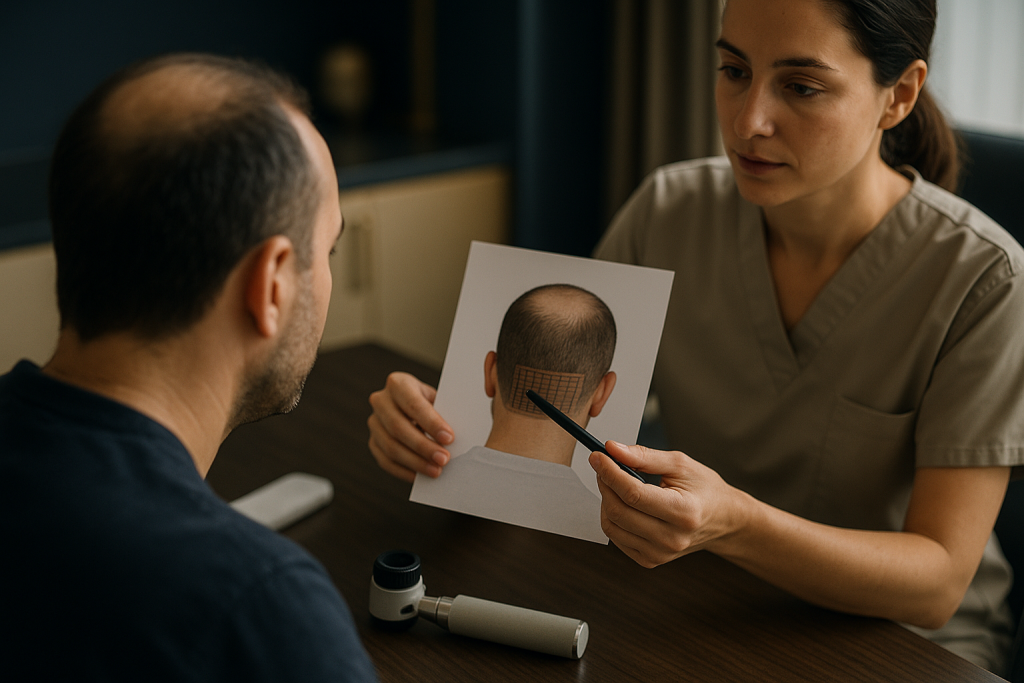
DHI and FUE usually use the same follicular unit extraction method to collect grafts, but they differ mainly in how the grafts are implanted. DHI uses a specialised implanter pen, while standard FUE commonly creates recipient channels before placement; the better option depends on your hair loss pattern, donor area and treatment plan.
- DHI and FUE can both use individually extracted grafts from the donor area.
- The main difference is usually the implantation method, not the way follicles are removed.
- DHI may allow direct graft placement with an implanter pen, while FUE commonly involves channel creation before placement.
- Recovery, comfort and final growth depend on several clinical and personal factors, not only the technique name.
- A doctor should assess your donor capacity, scalp condition and long-term hair loss before recommending DHI or FUE.
01dhi hair transplant vs fue: The Core Difference
When comparing dhi hair transplant vs fue, the most important point is that these terms are not always two completely separate procedures. In many treatment plans, follicles are extracted with the FUE method in both cases. The key distinction is often the implantation stage. With DHI, the medical team places grafts using a specialised implanter pen. With conventional Sapphire FUE planning, tiny recipient channels are typically prepared first, and the grafts are then placed into these channels. Your doctor will explain which approach is suitable after reviewing your hair and scalp.
FUE means Follicular Unit Extraction. It describes the process of removing naturally occurring groups of hair follicles, called grafts, one by one from the donor area. The donor area is usually located at the back and sides of the scalp, where hair may be more resistant to thinning in many patients. The extracted grafts are carefully handled, sorted and prepared before implantation. FUE is not a single result or design; it is one part of a wider surgical plan that includes donor management, hairline design, implantation and aftercare.
DHI means Direct Hair Implantation. In this approach, prepared grafts are loaded into an implanter pen and placed directly into the recipient area. The pen can create the opening and deliver the graft in a controlled movement. This may give the surgical team a different way to manage placement angles and spacing in selected areas. However, DHI is not automatically better for every person. The quality of donor hair, the number of grafts needed, scalp characteristics and the experience of the clinical team remain central to a safe and natural-looking plan.
02Graft Extraction: What Is Usually the Same
The extraction process is frequently similar in DHI and FUE procedures. The hair is normally trimmed in the donor area so individual follicular units can be seen and removed with precision. A small punch instrument is used to loosen each graft before it is extracted. Grafts may contain one, two, three or sometimes more hairs, so graft number and hair number are not the same thing. A doctor will assess donor density and hair characteristics before deciding how many grafts can reasonably be collected.
Careful donor-area planning matters because the donor supply is limited. Removing too many grafts, taking them too closely together or using an unsuitable extraction pattern may affect the appearance of the donor region. For this reason, a responsible plan considers not only the area that needs coverage today, but also possible future hair loss. A procedure should aim to preserve enough donor hair for the long term where possible. This is especially relevant for younger patients or people with progressive thinning.
Since extraction may be similar, it is not accurate to assume that DHI avoids FUE extraction altogether. Some clinics use the phrase DHI FUE to describe a combined workflow: FUE extraction followed by DHI-style implantation. Patients should ask clearly which steps are included in their proposed procedure. Useful questions include how the grafts will be extracted, how the recipient area will be prepared, who performs each stage and what donor-area assessment has been completed. Clear answers can make technique comparisons more meaningful.
03Implantation, Angles and Hairline Control
In dhi hair transplant vs fue comparisons, implantation is where the most practical differences are usually discussed. DHI uses an implanter pen to place a graft at a chosen depth and direction. Conventional FUE implantation commonly follows channel opening, where the medical team first creates tiny sites in the recipient area and then inserts the grafts. Both methods require close attention to depth, direction, distribution and the natural angle of existing hair. A technique alone does not create a natural result; careful planning and skilled placement are essential.
Hairline work requires particular care because it is highly visible. A natural hairline is normally irregular in a controlled way, rather than straight or overly dense at the front edge. Fine, single-hair grafts may be selected for the transition zone, while grafts with more hairs can be used behind this area to support coverage. The desired design should also suit facial proportions, age, existing hair and likely future hair loss. Your doctor may recommend a conservative hairline if a lower design could create an unnatural appearance later.
DHI may be considered when a doctor wants to place grafts among existing hair in selected areas, such as a smaller thinning zone. The implanter pen can support direct placement without the same channel-opening sequence used in conventional FUE workflows. Still, this does not mean that DHI always provides greater density or that it is always best for unshaven work. The number of available grafts, the calibre of the hair, scalp visibility and the safe handling of grafts are often more important than the technique label alone.
04Shaving, Anaesthesia and the Early Recovery Period
The amount of shaving needed can differ between treatment plans, but it should not be used as the only reason to choose DHI or FUE. Full shaving is often helpful when a larger number of grafts is planned because it gives the medical team clearer access to the donor and recipient areas. In selected cases, partial shaving or work around existing longer hair may be possible. However, these options can add practical limits and may not be appropriate when extensive coverage is needed. Your doctor will confirm what preparation is realistic for your case.
Comfort during a hair transplant is influenced by local anaesthesia, the duration of the procedure, scalp sensitivity and individual anxiety levels. Both DHI and FUE involve donor extraction and recipient-area work, so neither method should be described as pain-free. Most patients feel pressure, movement or mild discomfort rather than sharp pain after effective local anaesthesia, but experiences vary. Needle-free anaesthesia is available at Acibadem Hair Transplant Center for suitable patients, and the medical team can explain how it fits into the treatment process.
Early recovery is also broadly similar because the scalp needs time to heal after graft extraction and placement. Small scabs commonly form in the recipient area, while the donor area may show temporary redness or sensitivity. Patients are usually given washing instructions and guidance about sleeping, exercise, headwear and sun exposure. Transplanted hairs may shed during the early weeks, which can be a normal part of the growth cycle. Visible growth develops gradually, and your doctor will advise on follow-up and expected milestones.
05Who May Benefit From Each Technique
A dhi hair transplant vs fue decision should start with medical suitability, not a preference for a popular name. A doctor generally reviews the pattern and stability of hair loss, donor density, hair shaft thickness, scalp condition, previous procedures and relevant health information. The consultation should also cover your expectations. A transplant can redistribute existing donor hair, but it does not stop future non-transplanted hair from thinning. A long-term plan is therefore important, particularly when there is ongoing hair loss around the target area.
DHI may be considered for carefully selected patients who need focused placement, work between existing hairs or a smaller area of refinement. It may also suit some patients who wish to discuss limited-shave planning, although this is not possible in every case. The implanter method can require a detailed workflow and may be less efficient for some very large sessions depending on the team, graft characteristics and treatment goals. Suitability is based on a clinical assessment rather than an online technique comparison alone.
Sapphire FUE may be considered when a broader area requires coverage or when the treatment plan involves creating a large number of recipient sites in advance. Sapphire blades are used to create fine channels during this technique. This can support organised placement when performed by an experienced medical team, but it does not guarantee a specific density or outcome. In most patients, the most appropriate method is the one that allows safe donor management and a realistic distribution of grafts across the areas of greatest need.
06Cost Planning and Why Graft Quotes Vary
Cost is an understandable part of dhi hair transplant vs fue research, but a graft number alone does not provide a complete comparison. The treatment plan may differ according to the size of the thinning area, donor quality, the number of grafts that can be safely extracted, the chosen implantation approach and the level of aftercare included. A lower price does not necessarily show what is included, while a higher quote does not by itself confirm better medical planning. Patients should request a clear written explanation of the proposed procedure and services.
In the United States, clinics may price hair transplantation in different ways, including per-graft fees, procedure-based fees or customised packages. Because there is no single verified national fee for 3,000 grafts, it is safer not to rely on a general online figure. The final quote can also change according to city, clinical setting, surgeon involvement, anaesthesia, medication, follow-up and whether the stated graft count is clinically appropriate. A written consultation plan is more useful than a headline price.
International patients should also consider the practical parts of travel care. At Acibadem Hair Transplant Center in Istanbul, all-inclusive packages can include VIP transfer, a 4-star hotel, a care kit and 12 months of follow-up. The clinic is licensed by the Turkish Ministry of Health and provides Sapphire FUE and DHI techniques. A free online hair analysis is reviewed by doctors, helping patients understand the likely plan before arranging travel. The final treatment recommendation is confirmed only after medical assessment.
07Choosing Between DHI and FUE With Realistic Expectations
For most suitable candidates, both DHI and FUE can be used to transplant grafts from the donor area to areas of thinning. The choice should be based on the clinical plan rather than claims that one procedure is universally superior. DHI may offer a direct implantation workflow that is useful in selected situations. Sapphire FUE may be a practical choice for broader coverage and structured channel placement. Your doctor should explain why a method is being recommended, what result is realistic and how the plan protects the donor area.
The final appearance depends on more than implantation technique. Hair texture, colour contrast between hair and scalp, curl pattern, donor density, graft survival, placement quality and future hair loss can all influence the visual result. It is also important to understand that density in a transplant is usually planned to create an improved cosmetic appearance, not necessarily the density of untouched teenage hair. Honest discussions about coverage, crown expectations and future treatment needs can help prevent disappointment.
At Acibadem Hair Transplant Center, results are measured by trichoscopic graft survival at month 12, with a documented 98% rate under written guarantee. This measurement approach focuses on graft survival rather than promising the same cosmetic result for every patient. The dedicated hair restoration clinic has welcomed patients from 38 countries over 12 years. For an initial discussion, patients can send photographs for a free online hair analysis reviewed by doctors; WhatsApp replies are typically provided within around two hours.
08Frequently Asked Questions
Is DHI usually less painful than FUE?
DHI is not necessarily less painful than FUE because both approaches commonly involve local anaesthesia, donor extraction and work in the recipient area. Comfort can vary according to the anaesthesia method, treatment duration, scalp sensitivity and the individual patient. Your medical team can explain what you may feel during and after the procedure.
What are the possible disadvantages of DHI?
DHI can be more technically demanding and may not be the most efficient approach for every large coverage plan. It may also have limits when extensive shaving, broad recipient-area preparation or a high graft number is needed. DHI does not guarantee greater density, faster growth or a better result than Sapphire FUE; suitability should be confirmed by a doctor.
What does 3,000 hair grafts cost in the USA?
There is no single reliable USA price for 3,000 grafts because clinics use different pricing models and include different services. The quote may depend on location, donor assessment, procedure type, clinical team, anaesthesia and aftercare. It is best to request an itemised written quote and confirm whether the planned graft number is medically appropriate.
Which is better: FUE or DHI?
Neither FUE nor DHI is automatically better for every patient. DHI may be appropriate for selected placement needs, while Sapphire FUE may suit broader coverage or other treatment goals. A doctor should assess your donor area, hair loss pattern, scalp condition and long-term expectations before recommending either option.
This article is for general information only and is not a substitute for professional medical advice.
 06
06 12
12