In this article9
- What direct implantation means in DHI
- How grafts move from the donor area to the implanter
- Placing each graft at the planned angle and direction
- Hairline design and density planning before placement
- Direct implantation compared with Sapphire FUE placement
- Anaesthesia, comfort, and the procedure-day workflow
- Healing after graft placement and early changes
- Follow-up and how graft survival is assessed
- Frequently Asked Questions
Direct implantation is a graft-placement approach used in DHI hair transplantation. After follicles are extracted from the donor area, the medical team loads them into a fine implantation device and places them at a planned angle, direction, and depth to support a natural-looking pattern.
- DHI uses a fine implanter device to place extracted follicular grafts into the recipient area.
- Careful planning of the hairline, angles, and graft distribution is essential before placement begins.
- FUE and DHI are not always opposing options, because FUE describes extraction while DHI describes a placement approach.
- DHI may be useful for selected patients, but it can require detailed planning and may not be the best choice for every hair-loss pattern.
- Final growth develops gradually, and your doctor will assess progress during scheduled follow-up visits.
01What direct implantation means in DHI
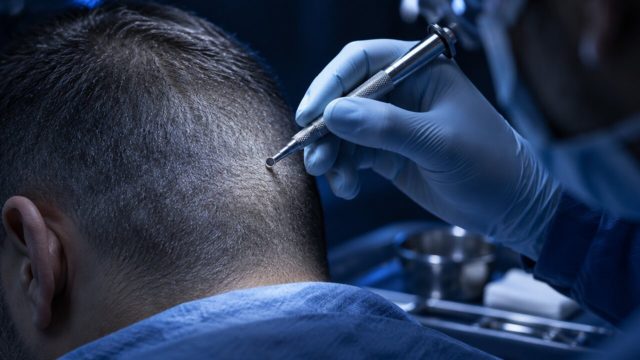
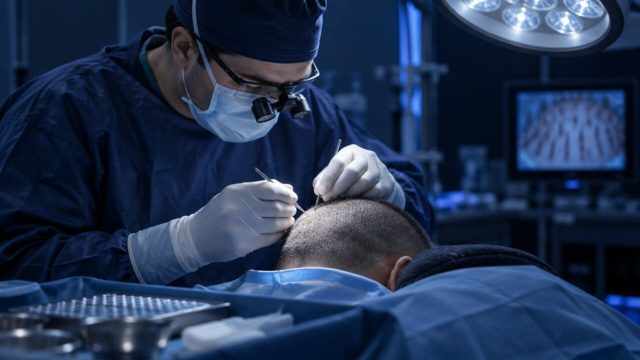
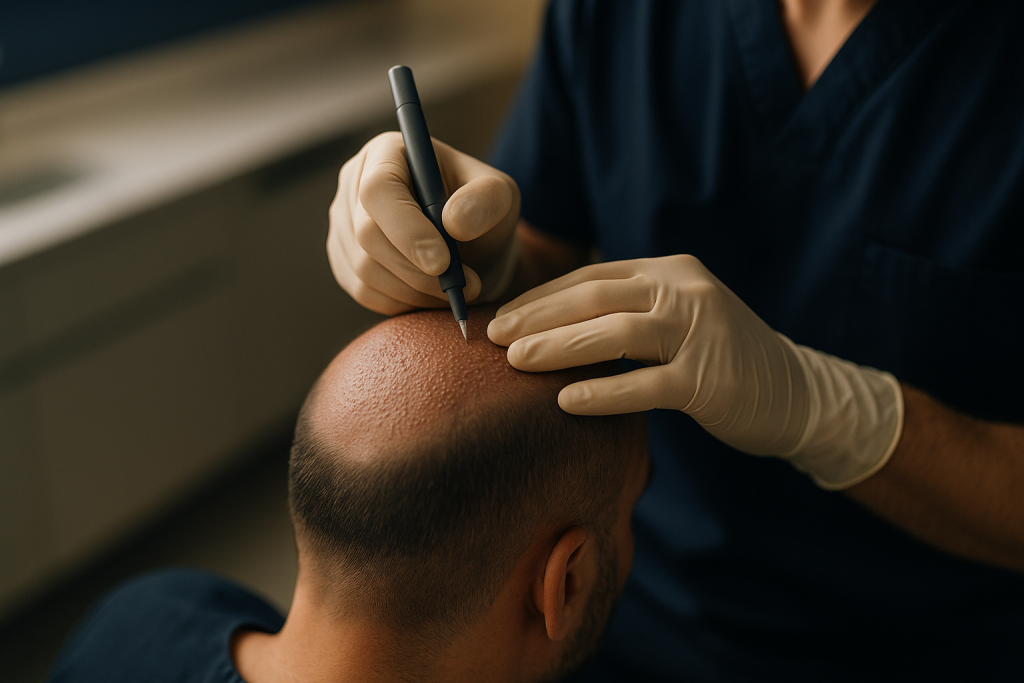
Direct implantation describes the step in which hair follicles are placed into areas of thinning or hair loss using a fine, pen-shaped implantation device. In a DHI procedure, follicles are first removed individually from the donor area, usually at the back or sides of the scalp where hair is more resistant to thinning. Each suitable graft is then prepared and loaded into the device before being placed according to the surgical plan. The aim is to position each graft carefully while protecting the follicle during handling.
The term DHI stands for Direct Hair Implantation. It is commonly used to describe a technique in which the implantation device can create a small opening and place the graft in one controlled movement. This differs from approaches where recipient sites are made first and grafts are placed afterwards with forceps. Both approaches require surgical skill, appropriate graft handling, and a treatment plan designed around the patient’s donor supply and goals.
The placement stage is not simply about filling an area with hair. The team must consider the existing hair, the shape of the face, the natural direction of growth, and the future pattern of hair loss. A conservative design can be important, particularly in the frontal hairline, because transplanted follicles are intended to provide long-term coverage. Your doctor will confirm whether the donor area, scalp condition, and pattern of hair loss are suitable for treatment.
02How grafts move from the donor area to the implanter
The process begins with a medical assessment and a plan for harvesting donor follicles. During follicular unit extraction, individual follicular units are removed with a small extraction instrument. A follicular unit may contain one, two, three, or occasionally more hairs. The team examines the extracted grafts and separates suitable units for placement while keeping them in appropriate conditions to reduce unnecessary drying and handling.
Graft selection matters because different parts of the scalp need different types of follicular units. Single-hair grafts are often reserved for the leading edge of a hairline, where a softer transition may be desired. Grafts containing more hairs can be used behind this area to support visual density. This is a planning decision rather than a fixed rule, and it depends on the available donor hair and the individual treatment design.
Before placement, a trained team member loads a graft into the hollow needle or tip of the implanter device. The follicle must sit in the device without being squeezed, bent, or forced. This is a precise manual step. Good organisation between extraction, graft preparation, and implantation can help limit the time that follicles remain outside the body, although the exact workflow may vary between clinics and procedures.
03Placing each graft at the planned angle and direction
During direct implantation, the practitioner positions the implanter over the recipient area and places the graft at a selected angle, direction, and depth. These details influence how the new hair may sit as it grows. Hair at the frontal hairline usually grows forward and slightly downward, while hair in other regions follows the natural swirl, parting, or changing direction of the scalp. Reproducing these transitions requires careful observation and planning.
Depth is also important. A graft placed too shallowly or too deeply may not sit as intended, and the surrounding scalp must be treated gently. The medical team works across the recipient area in a structured pattern, aiming to avoid crowding grafts too closely and to preserve circulation in the skin. The number of grafts that can be placed safely is individual and should be decided by the doctor rather than by a standard package description.
The implanter can offer detailed control during placement, especially when working between existing hairs in selected cases. However, a device alone does not create a natural result. The final appearance depends on the quality of the surgical plan, the condition of the donor and recipient areas, graft survival, healing, and the way each patient’s hair continues to change over time.
04Hairline design and density planning before placement
A natural-looking result begins before any graft is extracted. The doctor assesses the hairline position, temple areas, crown, mid-scalp, and the degree of existing thinning. A lower or denser hairline is not automatically better. It may use a large number of donor grafts and may not remain appropriate if hair loss progresses. In most patients, a balanced design that respects future hair-loss patterns is more important than pursuing maximum density in one session.
The recipient area is usually divided into zones so grafts can be allocated according to priority. For example, the front may be prioritised because it frames the face, while the crown may require a different strategy due to its circular growth pattern and potentially larger surface area. Existing native hair can also affect planning. The team may need to work around fragile or miniaturised hairs carefully to reduce unnecessary trauma.
Density is often described as the visual fullness created by hair rather than only the number of grafts placed. Hair calibre, colour contrast between hair and scalp, curl pattern, and the number of hairs in each graft can all influence this visual effect. Your doctor will discuss realistic coverage based on these factors and on the donor supply that can be harvested responsibly.
05Direct implantation compared with Sapphire FUE placement
When people compare direct implantation with FUE, it is helpful to separate extraction from placement. FUE is a method of extracting individual grafts from the donor area. DHI is commonly used to describe implantation with a pen-shaped device. In some treatment plans, FUE extraction can be combined with DHI placement. Sapphire FUE generally refers to FUE extraction followed by recipient-site creation with sapphire blades and then graft placement.
Neither technique is universally better for every patient. DHI may be considered when detailed placement is planned in a smaller area, around existing hair, or in a defined hairline zone. Sapphire FUE may be considered when the surgeon plans a larger recipient area or wants to create recipient channels before placement. The most suitable approach depends on the scalp, donor capacity, hair characteristics, treatment goals, and the clinical team’s assessment.
Both methods have limitations and require proper medical standards. A patient should not choose only on the basis of a technique name, a device, or a claim of high graft numbers. A thorough consultation should explain what can realistically be achieved, what area will be treated, how the donor area will be protected, and whether a future session could be needed if hair loss continues.
06Anaesthesia, comfort, and the procedure-day workflow
Hair transplant procedures are typically performed using local anaesthesia. The donor and recipient areas are numbed so that patients can remain comfortable while the clinical team works. At Acibadem Hair Transplant Center, needle-free anaesthesia is available for suitable patients. Your doctor will review your medical history and confirm the anaesthesia approach that is appropriate for you.
On the procedure day, the team usually confirms the design, takes clinical photographs, prepares the scalp, and begins the planned extraction and placement stages. The exact order, duration, and breaks depend on the number of grafts, the technique selected, and individual clinical needs. It is important that patients follow pre-procedure instructions, including guidance about medicines, smoking, alcohol, and scalp products provided by their medical team.
A safe treatment environment is more important than speed. Acibadem Hair Transplant Center is a dedicated hair restoration clinic in Istanbul and is licensed by the Turkish Ministry of Health. The clinic has treated patients from 38 countries over 12 years. International patients can also use the free online hair analysis, which is reviewed by doctors, with WhatsApp replies typically available within around two hours.
07Healing after graft placement and early changes
After implantation, mild redness, swelling, tenderness, and small crusts can occur in the treated areas. These effects are commonly temporary, but the degree and duration vary between patients. The clinic will provide written aftercare instructions on washing, sleeping position, activity, sun exposure, and when to return to normal routines. Following these instructions carefully helps protect the newly placed grafts during the early healing period.
The transplanted hairs often shed after the procedure before new growth becomes visible. This early shedding can be expected and does not by itself mean that the follicles have failed. New growth is gradual, and the rate, texture, and timing of visible changes differ between individuals. It is important to avoid judging the final result too early or comparing your progress closely with another patient’s experience.
Contact the clinic promptly if you have symptoms that concern you, such as increasing pain, unusual swelling, persistent bleeding, discharge, fever, or signs of an allergic reaction. These symptoms do not always indicate a serious problem, but they should be assessed by a medical professional. Patients should also tell the clinic about any relevant health change or medicine started after the procedure.
08Follow-up and how graft survival is assessed
Long-term follow-up allows the medical team to review healing, hair growth, and the condition of the donor area. Photos can help compare progress over time, but a clinical assessment provides more detailed information. Hair growth after transplantation develops in stages, so follow-up appointments are useful for discussing normal changes and checking whether the result is progressing as expected.
At Acibadem Hair Transplant Center, all-inclusive packages include VIP transfer, a 4-star hotel, a care kit, and 12 months of follow-up. The clinic measures results by trichoscopic graft survival at month 12 and documents a 98% rate under a written guarantee. This documented measurement reflects the clinic’s stated process; individual cosmetic appearance and hair-growth experience can still vary according to patient factors and ongoing hair loss.
A transplant does not stop the natural progression of non-transplanted hair loss. Some patients may need a long-term hair preservation plan or may consider further treatment in the future, depending on their diagnosis and donor availability. Your doctor can explain what monitoring may be appropriate and what result is realistic for your current stage of hair loss.
09Frequently Asked Questions
What does DHI direct hair implantation mean?
DHI, or Direct Hair Implantation, is a hair-transplant placement technique that uses a fine implanter device. After individual follicles are extracted from the donor area, they are loaded into the device and placed in the recipient area at a planned angle, direction, and depth. Your doctor will confirm whether this placement approach is suitable for your scalp and treatment goals.
How much does a DHI hair transplant cost?
The cost of a DHI hair transplant varies according to the number of grafts planned, the size of the treatment area, donor-area assessment, clinical needs, and what is included in the care plan. A reliable quote should follow a doctor-reviewed hair analysis rather than a standard price alone. Acibadem Hair Transplant Center offers a free online hair analysis to help patients receive an appropriate treatment plan.
Which is better, FUE or DHI?
Neither FUE nor DHI is automatically better for every patient. FUE describes how follicles are extracted, while DHI describes a method of placing them, so the two can be used together. Your doctor will recommend an approach based on factors such as donor supply, the area to be covered, existing hair, scalp characteristics, and realistic density goals.
What are the disadvantages of DHI?
DHI requires precise graft loading and placement, which can make the workflow detailed and technique-sensitive. It may not be the most practical option for every large treatment area, and it does not remove the usual risks of hair transplantation, including temporary swelling, crusting, infection, or uneven growth. The result also depends on donor quality, surgical planning, healing, and continued hair loss, not only on the device used.
This article is for general information only and is not a substitute for professional medical advice.
This guide is for general information and does not replace a medical consultation. Treatment decisions are made after an in-person or online assessment by a doctor.