
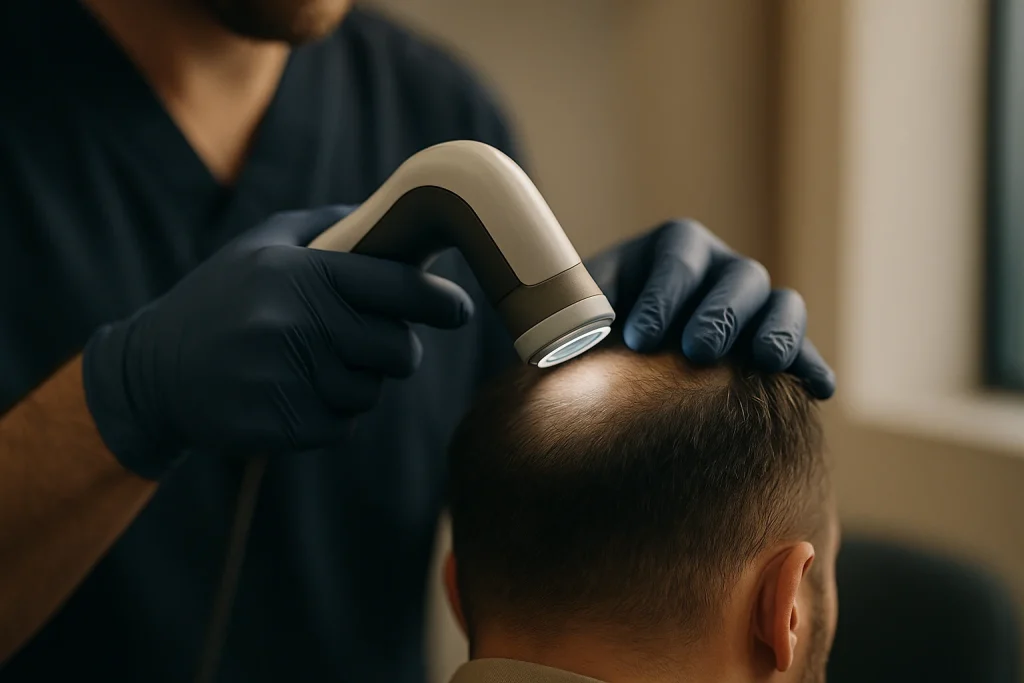
FUE hair implants involve removing individual follicular units from a donor area and placing them into carefully planned recipient sites. Healing usually occurs in stages over the first weeks and months, while visible new growth typically develops gradually after the initial shedding phase. Your doctor will assess whether FUE is suitable for your hair loss pattern, donor supply and health history.
- FUE removes individual follicular units rather than a strip of scalp tissue from the donor area.
- Natural-looking placement depends on graft handling, hairline design, angle, direction and density planning.
- Small scabs and temporary shedding are common parts of the early healing process.
- Most patients begin to see new growth after several months, with a fuller outcome commonly assessed around month 12.
- Long-term results depend on graft survival, ongoing native-hair loss and appropriate medical follow-up.
01How fue hair implants are extracted and placed
fue hair implants are a surgical hair restoration technique in which naturally occurring groups of hairs, called follicular units, are removed one by one from a donor area and transferred to areas of thinning or baldness. A follicular unit may contain one, two, three, or sometimes more hairs. The procedure is designed to redistribute permanent or relatively stable donor hair, most often from the back and sides of the scalp, to a recipient area such as the hairline, temples, mid-scalp, or crown. It does not create new hair follicles, so careful planning of the available donor supply is essential.
The letters FUE stand for Follicular Unit Extraction. During this approach, a clinician uses a very small instrument to separate each graft from the surrounding skin before removal. Unlike older strip-based approaches, FUE does not require a linear strip of scalp to be excised. Instead, it leaves many small dot-like extraction sites in the donor area. These normally heal over time, although the final appearance can vary with skin type, hair length, extraction pattern, healing response, and the number of grafts taken.
Successful treatment is not only about moving hairs. It requires a balanced decision about which areas should receive priority, how many grafts can be safely harvested, and what degree of density is realistic. The surgical team must protect the grafts throughout extraction, sorting, storage, and placement. A well-planned procedure also considers the likely progression of hair loss, because the transplanted area and the surrounding native hair should continue to look proportionate as the years pass.
02Who may be a suitable candidate for FUE
FUE may be considered for adults with patterned hair loss, selected cases of thinning caused by traction or scars, and some patients seeking refinement of a previous transplant. Suitability is individual. Your doctor will examine the scalp, assess the quality and density of the donor hair, review the pattern and stability of hair loss, and discuss your medical history. A person with a large area of hair loss but limited donor density may need a conservative plan or may not be suitable for the coverage they hope to achieve.
Hair characteristics influence planning. Coarser hair, wave or curl, colour contrast between hair and skin, and the number of hairs per graft can all affect the visual impression of coverage. The location of thinning matters as well. Rebuilding a frontal hairline uses grafts differently from adding coverage to a wide crown. In most patients, the frontal area is prioritised because it frames the face, but the most appropriate strategy should be confirmed after a clinical assessment.
Before surgery, doctors also consider factors that may affect healing or future loss. These can include active scalp inflammation, certain skin conditions, uncontrolled medical issues, medications, smoking, and a rapidly changing hair-loss pattern. A transplant should be viewed as one part of a long-term hair management plan. Where appropriate, a doctor may discuss medical treatment options to help preserve existing hair, but the choice and safety of any treatment require personal medical advice.
03Donor-area extraction: protecting every graft
The donor area is usually trimmed so the team can see the direction in which the hairs emerge from the scalp. Local anaesthesia is used to make the surgical area comfortable. Some clinics also offer needle-free anaesthesia as an option for the first stage of numbing. Once the area is prepared, the clinician follows the angle of each follicular unit with a fine punch instrument. This careful alignment helps reduce unnecessary trauma to the follicles and surrounding tissue.
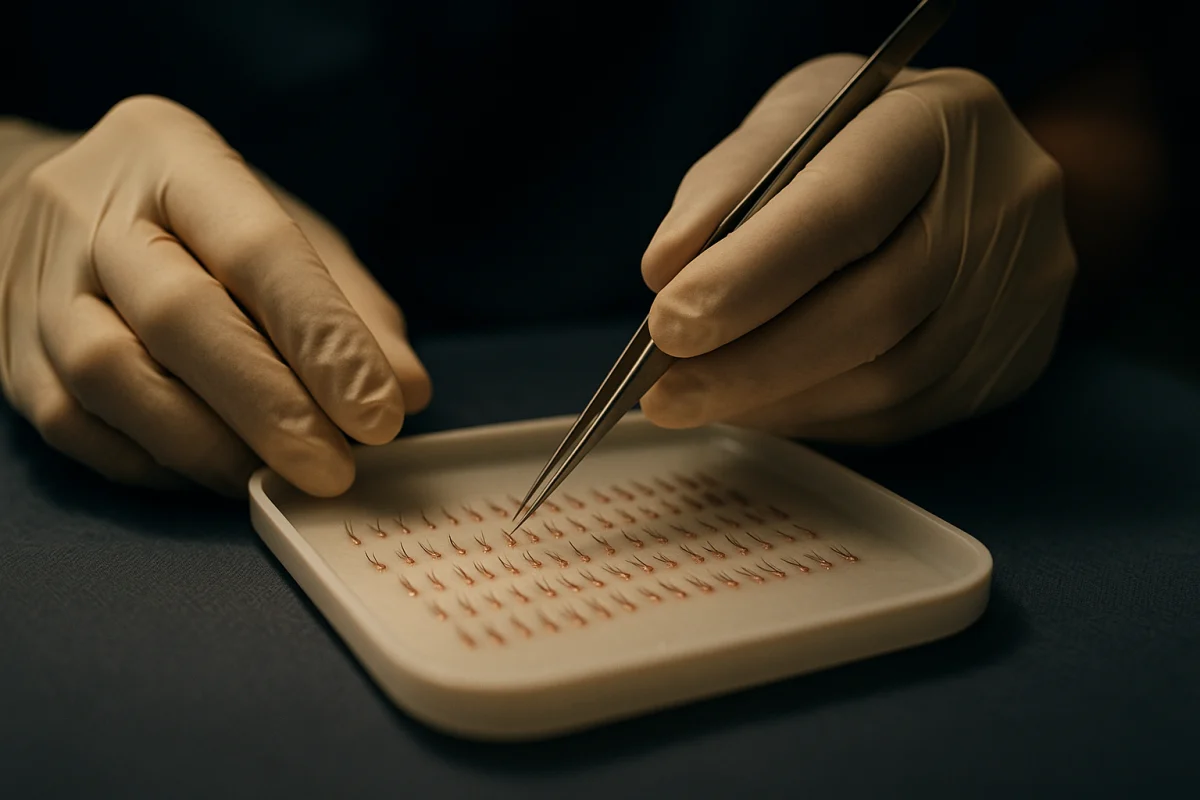
After a graft is loosened, it is gently removed and checked under magnification. The grafts are commonly organised by the number of hairs they contain, because single-hair units are often useful at a soft, natural hairline while multi-hair units can contribute to coverage behind it. Grafts must remain hydrated and be handled carefully outside the body. Excessive manipulation, drying, or prolonged time before placement can affect graft quality, which is why an organised surgical workflow is important.
Responsible extraction spreads removals across the donor area rather than concentrating too heavily in one small zone. This helps preserve an even appearance when the hair is worn short. Overharvesting can make the donor area look thin and can limit future options, so the number of grafts is not selected simply by request. It is based on donor safety, recipient needs, hair characteristics, and the long-term plan. Your doctor should explain the expected donor-area changes before treatment.
04Recipient-site design and precise graft placement
Before placement begins, the recipient area is designed according to facial proportions, age, current hair pattern, and likely future hair loss. A natural hairline is rarely a straight line. It normally includes gentle irregularity, softer transitions at the front, and appropriate recession at the temples where needed. An overly low or dense hairline may use too many grafts and can look less natural over time, particularly if native hair continues to thin behind it.
Small recipient sites are created in a planned pattern. Their angle, direction, depth, and spacing affect how the new hair will grow and how much coverage it can create. Hair at the frontal edge generally needs to lie forward at a low angle, while crown hair often follows a circular pattern. The surgeon must also avoid compromising the blood supply to the scalp. Density may be built gradually and safely rather than pursuing an unrealistic concentration of grafts in one session.
During placement, fue hair implants are inserted into the prepared sites with attention to the graft type and the local hair direction. Single-hair grafts may be placed at the hairline for a softer result, while grafts with more hairs are typically positioned farther behind for visual density. This stage requires patience because a graft that is rotated, compressed, or placed at an unsuitable angle may not blend as intended. A clinically appropriate design aims for a result that looks natural both immediately after growth and as the patient ages.
05What happens on the day of an FUE procedure
An FUE procedure generally starts with a consultation review, confirmation of the treatment plan, photographs, and hairline or recipient-area marking. The scalp is prepared, and local anaesthesia is administered. Extraction, recipient-site creation, and graft placement may take several hours, depending on the planned graft number and the complexity of the case. Patients are usually awake during the procedure and may take planned breaks, but the exact schedule varies by clinic and treatment plan.
You may feel pressure, movement, or brief sensations during some parts of the day, but the anaesthetised areas should not be painful during surgery. After the procedure, the donor area will have small extraction points and the recipient area will show tiny sites containing the newly placed grafts. A clinical team should provide written instructions covering sleep position, washing, activity, medication where prescribed, and the signs that require contacting the clinic.
It is sensible to arrange a calm recovery period rather than returning immediately to demanding work, exercise, or travel plans. The scalp needs protection from rubbing, impact, excessive sweating, and direct sun exposure during the early healing stage. Do not assume that another person's aftercare routine is right for you. Your surgeon's instructions take priority because they are based on the technique used, the extent of treatment, and your individual medical situation.
06FUE healing timeline: scabs, shedding and early recovery
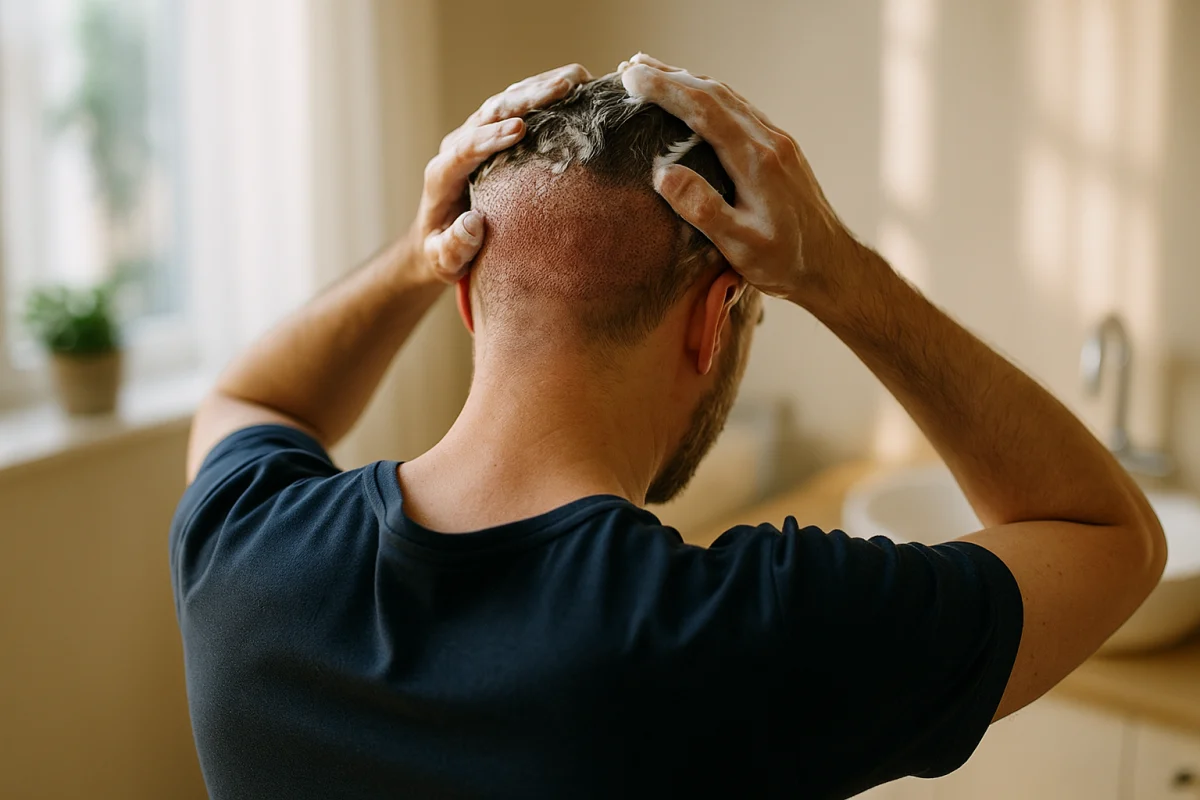
In the first few days, mild swelling, redness, tenderness, and small crusts can occur in the treated areas. These effects are usually temporary. The grafts are delicate at first, so patients are commonly asked to avoid touching, scratching, or rubbing the recipient area. Gentle washing normally begins according to the clinic's instructions. Scabs should be allowed to soften and release naturally rather than being picked, as forceful removal may disturb a healing graft.
During the first two to four weeks, many transplanted hairs shed from the follicles. This is often called shock shedding and is a commonly expected stage after transplantation. It can be worrying because the recipient area may temporarily look similar to how it did before surgery. In most cases, shedding of the visible hair shaft does not mean the implanted follicle has been lost. However, unusual pain, increasing redness, discharge, fever, or persistent swelling should be discussed with the treating clinic promptly.
After the initial shedding period, the follicles enter a resting phase. New hairs often start to become noticeable from around the third or fourth month, although timing differs between patients and scalp areas. Growth may initially be fine, uneven, or slow. It generally becomes more visible over subsequent months as hairs thicken and more follicles enter an active growth phase. For this reason, fue hair implants should be judged with patience rather than by the appearance in the first weeks.
Many clinics schedule follow-up contacts to review washing, healing, shedding, and early growth. Follow-up is also an opportunity to ask questions about returning to exercise, haircuts, colouring, headwear, or sun exposure. At Acibadem Hair Transplant Center in Istanbul, all-inclusive packages include a care kit and 12 months of follow-up. The clinic is licensed by the Turkish Ministry of Health, and the treating team should remain the first point of contact if a concern arises after treatment.
07When to expect growth and how results are assessed
Visible growth after FUE is gradual, not immediate. Between approximately months four and six, many patients see early new hairs, though the amount can vary. From months six to nine, coverage and hair calibre often improve. A more meaningful assessment is commonly made around month 12, when the majority of expected cosmetic change can be reviewed. Crown areas may appear slower to mature than the frontal scalp, and individual healing patterns can influence the timeline.
Final appearance depends on more than the number of grafts transplanted. Graft survival, hair shaft thickness, natural curl, scalp-to-hair colour contrast, recipient-area size, and the ongoing condition of native hair all matter. A procedure may improve coverage without recreating the density of untouched adolescent hair. A clear consultation should include realistic discussion of this difference, along with photographs and a plan for the areas that can be addressed safely.
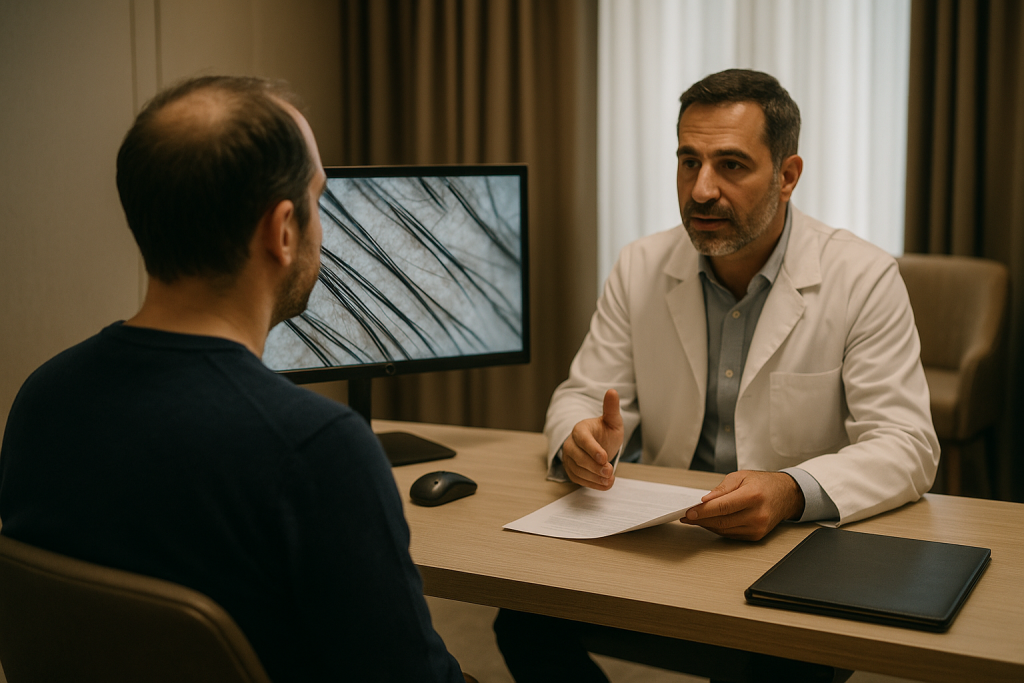
At Acibadem Hair Transplant Center, results are measured by trichoscopic graft survival at month 12, with a documented 98% rate under written guarantee. This is a clinic-specific documented measure, not a promise that every patient will have the same cosmetic appearance or density. Trichoscopic review can help evaluate the treated area in a structured way, while the patient's hair characteristics, healing response, and future native-hair loss remain important to the overall visual result.
08Long-term planning after an FUE transplant
Transplanted follicles taken from a stable donor zone are generally expected to retain many of their donor-area characteristics after they are moved. This is why an FUE transplant can provide long-lasting growth. However, hair loss can continue in the non-transplanted native hair around the grafts. Over years, this may change the balance between transplanted and existing hair, especially in people with progressive pattern hair loss. Long-term planning is therefore as important as the procedure itself.
At 10 years, many patients still have visible transplanted hair, but the appearance may have changed because native hair has continued to miniaturise or thin. Some people remain satisfied with one procedure, while others may consider additional treatment if donor supply and scalp health allow. No ethical clinic can predict exactly how an individual's hair loss will progress. A conservative hairline and sensible graft allocation can help preserve flexibility for the future.
Ongoing care may include regular clinical review and discussion of evidence-based options for maintaining existing hair where medically appropriate. Good scalp care, avoiding unnecessary traction or trauma, and seeking advice promptly for new shedding or scalp symptoms can also be helpful. Acibadem Hair Transplant Center offers a free online hair analysis reviewed by doctors, with WhatsApp replies typically within around two hours. An online review can provide preliminary guidance, while a final treatment decision should follow a proper medical assessment.
09Frequently Asked Questions
What is the usual cost of 3,000 FUE grafts?
The cost of 3,000 FUE grafts varies widely by country, clinic standards, surgical team, package inclusions, donor complexity, and the level of follow-up provided. A graft count alone does not show whether the procedure is clinically suitable or what quality controls are included. Ask for a written, personalised quotation after a doctor has reviewed your donor area and treatment goals.
How long can an FUE hair transplant last?
The transplanted follicles are generally selected from a donor area that is relatively resistant to pattern hair loss, so their growth can be long-lasting. However, surrounding native hair may continue to thin over time, which can change the overall appearance. Your doctor can discuss a long-term plan and whether ongoing treatment for existing hair may be appropriate.
Is DHT better than FUE for hair loss?
DHT and FUE are not alternative procedures. DHT, or dihydrotestosterone, is a hormone involved in many cases of pattern hair loss, while FUE is a surgical method for transplanting follicles. A doctor may discuss ways of managing DHT-related hair loss as part of a wider plan, while FUE may be considered when donor hair and the pattern of loss are suitable.
What may happen 10 years after a hair transplant?
Many transplanted hairs can still be growing 10 years later, but the result may look different if untreated native hair continues to thin. Some patients do not need further surgery, while others may consider additional treatment depending on donor availability and their evolving hair-loss pattern. Conservative planning from the beginning can help support a natural-looking result over the long term.
This article is for general information only and is not a substitute for professional medical advice.
 06
06 12
12