
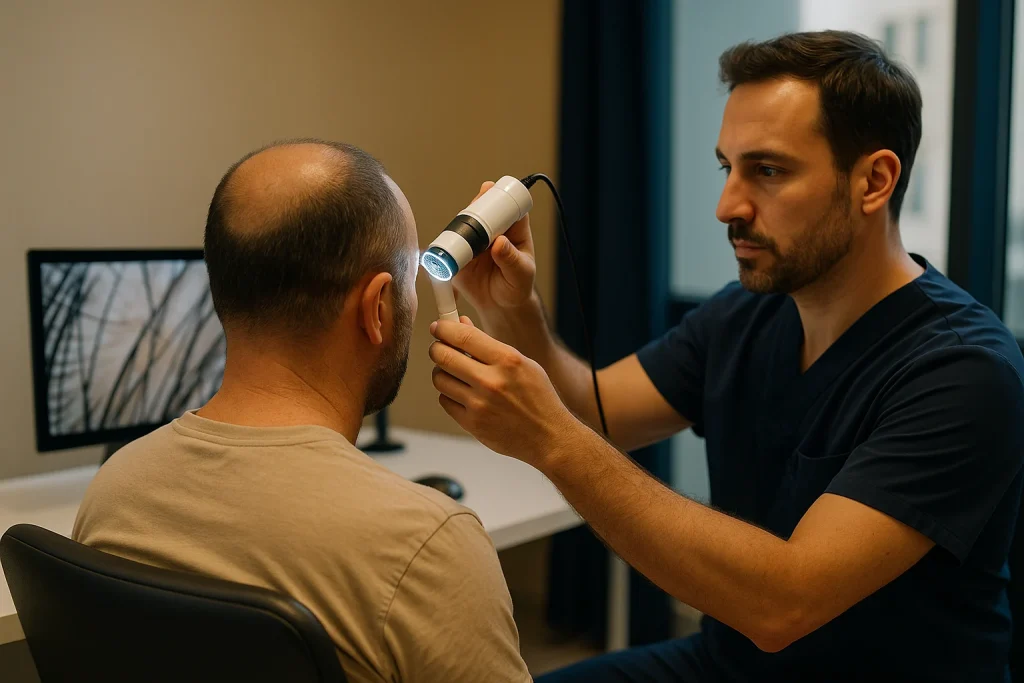
How do hair transplants work? A surgeon removes healthy, genetically resistant follicular units from a donor area, usually the back and sides of the scalp, and places them into thinning or bald areas. The transplanted follicles enter a healing phase before producing new hair gradually, with results commonly assessed over several months and at around month 12.
- Hair transplantation redistributes your own healthy donor follicles rather than creating new hair follicles.
- FUE and DHI are graft-handling and implantation approaches; the best option depends on your hair, goals and medical assessment.
- A natural-looking result depends on donor planning, graft survival, hairline design and careful placement direction.
- Temporary shedding after surgery is common, while visible new growth usually develops gradually over months.
- A hair transplant can have limitations and risks, so a doctor-led assessment is important before treatment.
01How Hair Transplants Work: From Donor Area to Growth
A hair transplant is a surgical method that moves living hair follicles from an area where hair is more stable to an area affected by thinning or baldness. For people asking how do hair transplants work, the central idea is simple: the procedure redistributes your own follicles; it does not make entirely new ones. The donor area is most often the back and sides of the scalp, where follicles may be less sensitive to the hormonal process linked with common pattern hair loss. Your doctor will examine whether this area has enough suitable hair before recommending treatment.
Hair grows in small natural groups called follicular units. Each unit may contain one, two, three or sometimes more hairs. During a transplant, these units are collected as grafts and then placed into tiny recipient sites in the thinning region. The team considers the size of each graft, the direction of existing hair and the available donor supply. This helps create a pattern that can blend with the surrounding hair rather than looking like rows of plugs.
A transplant is not an instant visual change. The follicles need time to settle into their new blood supply and normal growth cycle. In most patients, the transplanted hairs shed after the early recovery period, then begin to grow again later. The process requires realistic planning because a donor area has a limited number of grafts, and future hair loss may continue in non-transplanted hair. A careful consultation therefore looks at both your current appearance and your likely long-term needs.
02How do hair transplants work during planning and hairline design?
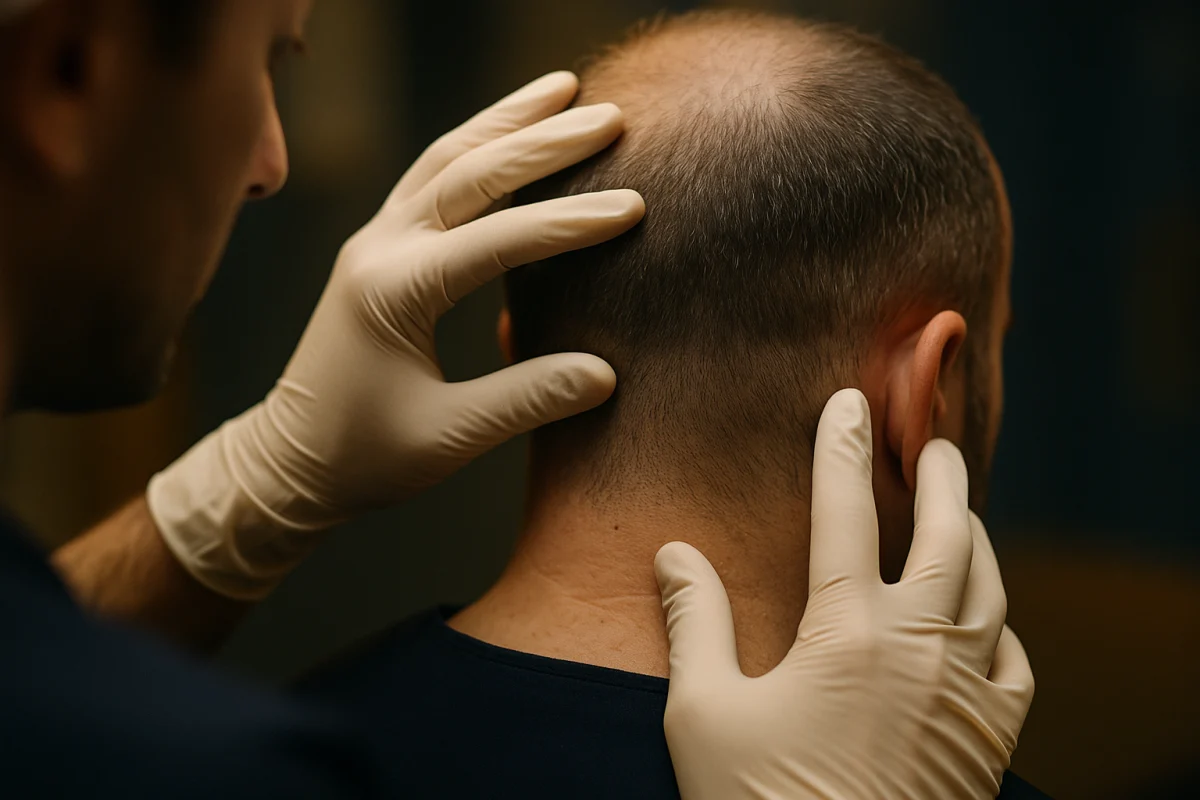
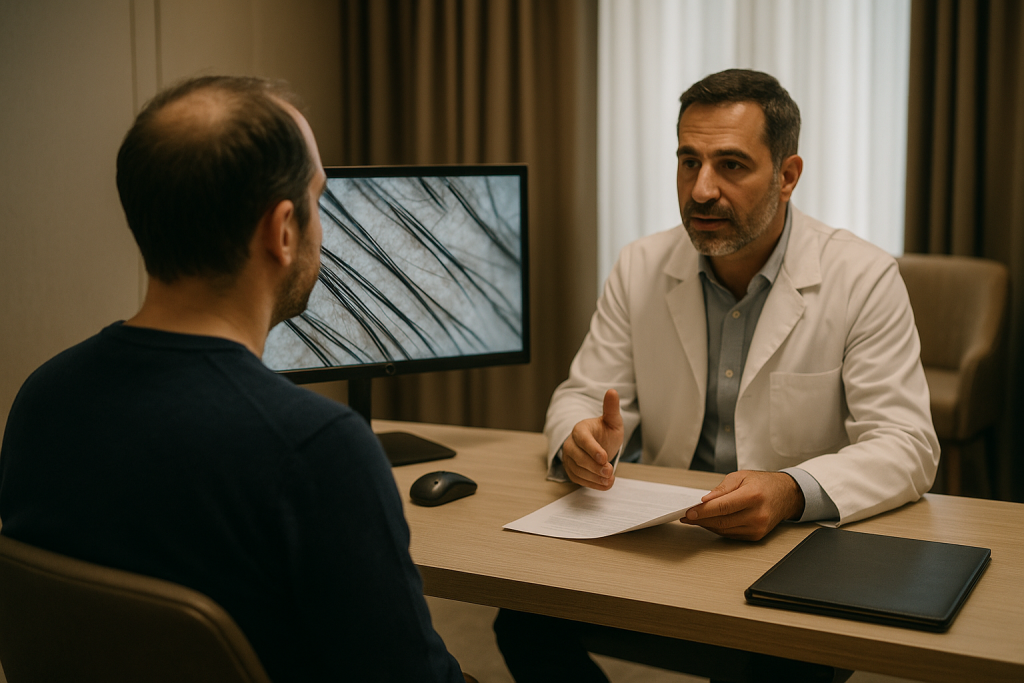
Planning begins before any graft is removed. A doctor reviews the pattern and cause of hair loss, scalp condition, medical history, family history and the quality of the donor hair. Not every type of hair loss is suitable for surgery. For example, active scalp disease, sudden unexplained shedding or unstable hair loss may need further assessment or treatment first. A free online hair analysis can be a useful first step, but an individual treatment decision should always be confirmed by a doctor.
Hairline design is one of the most important parts of the plan. A good hairline should suit the person’s facial proportions, age, sex, hair characteristics and expected future hair loss. A very low or dense hairline may use too many grafts and may not remain appropriate if hair loss progresses. For this reason, surgeons generally aim for a mature, balanced design that protects the donor supply and supports a natural appearance over time.
The number of grafts is not chosen only by looking at the size of a bald area. Graft requirements are influenced by hair thickness, curl, colour contrast between hair and scalp, donor density, the desired coverage and the amount of existing hair that needs protection. A graft containing several hairs can create more visual density than a single-hair graft, but single-hair grafts are often useful at the leading edge of a hairline. Your doctor will explain what level of coverage is realistically possible.
03The donor area: where transplant grafts come from
The donor area usually includes the scalp at the back and above the ears. In many patients with androgenetic hair loss, follicles from this zone retain their growth characteristics when moved to another scalp area. This concept is often called donor dominance. However, donor hair is not unlimited, and its stability cannot simply be assumed. The doctor checks density, hair calibre, scalp flexibility where relevant, and signs that thinning may also be affecting the donor zone.
Before extraction, the hair may be trimmed to allow clear access to individual follicular units. Local anaesthesia is typically used to make the procedure more comfortable. Some clinics also offer needle-free anaesthesia as an option for suitable patients. You may feel pressure, movement or occasional brief sensations during the day, but the exact experience differs between individuals and depends on the anaesthesia method, the length of the procedure and personal sensitivity.
The donor zone must be managed conservatively. Removing too many follicular units from one area can make the back or sides of the scalp look thinner. Skilled extraction aims to spread removals across the safe donor region, leaving enough surrounding hair to maintain an even appearance after healing. This is why a larger graft number is not automatically better. Good donor management is a long-term safety issue, especially for younger people or anyone whose future hair-loss pattern is uncertain.
04FUE and DHI: two ways to handle and place grafts
Follicular Unit Extraction, commonly called FUE, is a method in which individual follicular units are removed from the donor area using a small instrument. The grafts are then prepared and placed into recipient sites made in the thinning area. Sapphire FUE refers to the use of sapphire blades when creating these sites. The appropriate technique and instrument choice depend on the treatment plan, scalp features and the clinical team’s assessment, rather than on a single label alone.
Direct Hair Implantation, or DHI, is an implantation approach that uses a specialised implanter to place grafts into the recipient area. It may allow the team to create and implant in a controlled sequence. DHI can be considered for selected cases, including areas where existing hair needs careful work around it. Still, neither DHI nor FUE is universally best. Both approaches require good graft handling, sensible density planning and experienced clinical oversight to support a safe and natural-looking result.
When people ask how do hair transplants work with FUE or DHI, it is helpful to separate extraction from implantation. FUE describes how grafts are commonly extracted, while DHI mainly describes a way of implanting them. The final outcome is influenced by far more than the name of the technique. Donor quality, the way grafts are protected outside the body, the design of recipient sites, placement angles and appropriate aftercare all matter. Your doctor can explain which approach is suitable for your situation.
05Recipient-site creation and the importance of graft placement
The recipient area is the part of the scalp that will receive the transplanted follicles. Before graft placement, the surgeon plans the hairline, frontal zone, mid-scalp, crown or other areas being treated. Tiny channels or sites are created at carefully selected angles and directions. These details are important because natural hair does not grow straight upward or in one identical direction. It changes direction across the hairline, temples, top and crown.
Single-hair grafts are commonly used near the front of a hairline to create a softer transition. Grafts containing more hairs may be positioned behind this area to increase visual fullness. Placement should respect the natural pattern of the person’s hair, including any whorls in the crown. Very dense packing may not always be suitable, particularly when blood supply, scalp condition, donor limitations or existing hairs require a more conservative approach.
During implantation, grafts need careful handling to avoid drying, crushing or prolonged time outside the body. Each follicular unit is delicate. The clinical team works to keep grafts hydrated and organised before placement. While clinics may measure outcomes differently, graft survival is a key quality consideration. At Acibadem Hair Transplant Center, results are measured by trichoscopic graft survival at month 12, with a documented 98% rate under written guarantee. Individual cosmetic appearance can still vary with hair characteristics, healing and ongoing native hair loss.

06Healing after surgery: shedding, recovery and early care
After the procedure, small crusts and redness are common in both the donor and recipient areas. Mild swelling can also occur, usually around the forehead or upper face in some patients. Your clinical team will give specific instructions about washing, sleeping position, activity and medication if prescribed. Following these instructions matters because the early grafts need protection while they settle. Avoiding rubbing, scratching and pressure on the recipient area is typically advised during the initial recovery period.
The transplanted hairs often shed within the first several weeks. This can be worrying, but it is commonly part of the normal post-transplant cycle and does not necessarily mean that the follicles have been lost. The follicle remains beneath the scalp and enters a resting stage before beginning a new growth phase. Existing non-transplanted hair can also appear temporarily weaker after surgery in some patients, particularly where hair was already miniaturised. A doctor can discuss this possibility during planning.
Recovery is not the same for everyone. Some people return to non-strenuous activities relatively soon, while others prefer more time away from work because of visible redness or crusting. Strenuous exercise, swimming, sun exposure and certain headwear may need to be limited for a period advised by the medical team. Contact the clinic promptly if you develop worsening pain, spreading redness, fever, unusual discharge or any concern that does not match your aftercare guidance.
07From new sprouts to month 12: the hair growth timeline
New growth is gradual. In many patients, early fine hairs may begin to appear a few months after surgery, but this stage is often uneven and subtle. The hairs can initially look thinner or lighter than expected. As more follicles enter their active growth phase, coverage generally improves. Because each graft follows its own cycle, growth across the scalp does not happen at exactly the same speed. Comparing progress too early can lead to unnecessary worry.
Between the middle months after surgery and the one-year point, the hair typically becomes longer, thicker and easier to style. The crown may seem slower than the frontal area because of its natural growth pattern and the visual effect of the hair whorl. Doctors commonly use follow-up appointments and standardised photographs to review progress. Trichoscopic assessment may also help evaluate graft survival and scalp status. At Acibadem Hair Transplant Center, all-inclusive packages include a care kit and 12 months of follow-up support.
Transplanted follicles are generally expected to keep their donor-area characteristics, so they can provide long-lasting growth in suitable candidates. However, a transplant does not stop ongoing loss in existing, non-transplanted hair. Some patients may need medical management, continued monitoring or a future procedure depending on their condition and donor reserve. Long-term satisfaction is usually strongest when the original surgical plan leaves room for change and when patients understand that hair restoration is a continuing journey rather than a one-day solution.
08Frequently Asked Questions
How long can a hair transplant last?
In suitable candidates, transplanted follicles are generally expected to retain the characteristics of the donor area and can provide long-lasting growth. However, the surrounding non-transplanted hair may continue to thin over time. Long-term results depend on the donor area, the cause and progression of hair loss, surgical planning and follow-up care.
What does 3,000 hair grafts cost in the USA?
There is no single reliable price for 3,000 grafts in the USA because fees vary widely by city, clinic, technique, clinical team, donor complexity and what is included in care. Some providers quote per graft, while others quote a procedure package, so comparisons can be difficult. Ask for a written treatment plan that explains the graft estimate, medical fees, aftercare and any possible additional costs.
How painful is a hair transplant procedure?
Hair transplantation is typically performed with local anaesthesia, so most patients should not feel sharp surgical pain during graft extraction and placement. You may feel brief discomfort during anaesthesia administration, along with pressure or movement during the procedure. Tenderness, tightness or mild discomfort can occur during the early recovery period, and your clinical team will provide suitable aftercare guidance.
What are the possible disadvantages of a hair transplant?
A hair transplant involves surgery and has limitations, including a finite donor supply, recovery time, temporary shedding and the possibility that existing hair loss will continue. Potential complications can include swelling, infection, bleeding, scarring, numbness, uneven growth or an appearance that does not meet expectations. Results also take months to develop, and not everyone is a suitable candidate, so a doctor-led assessment is important.
This article is for general information only and is not a substitute for professional medical advice.
 06
06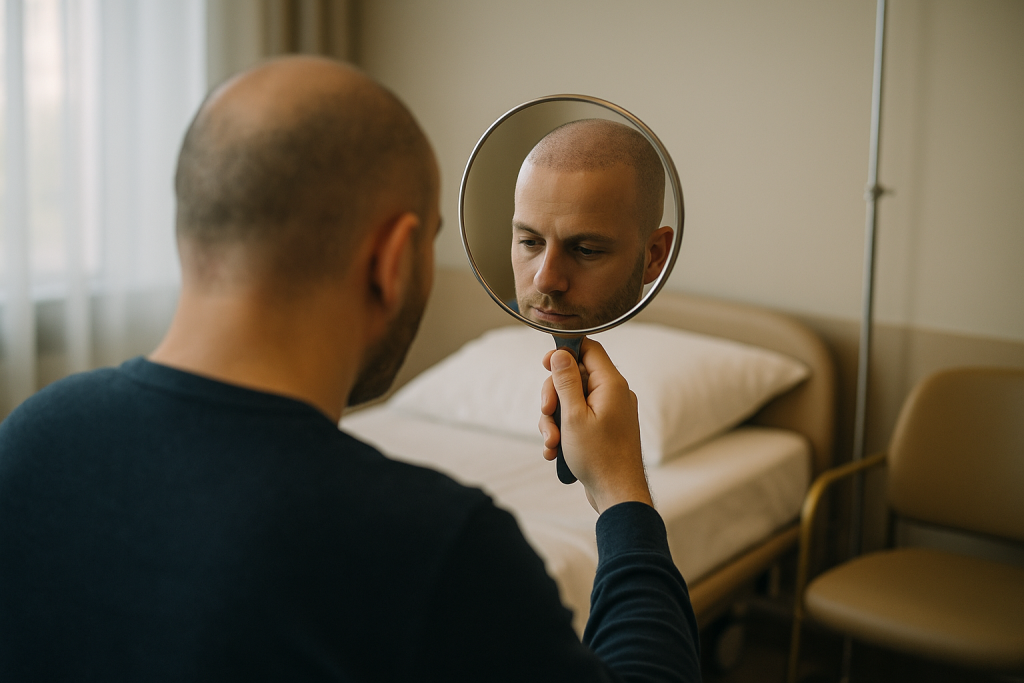 12
12