
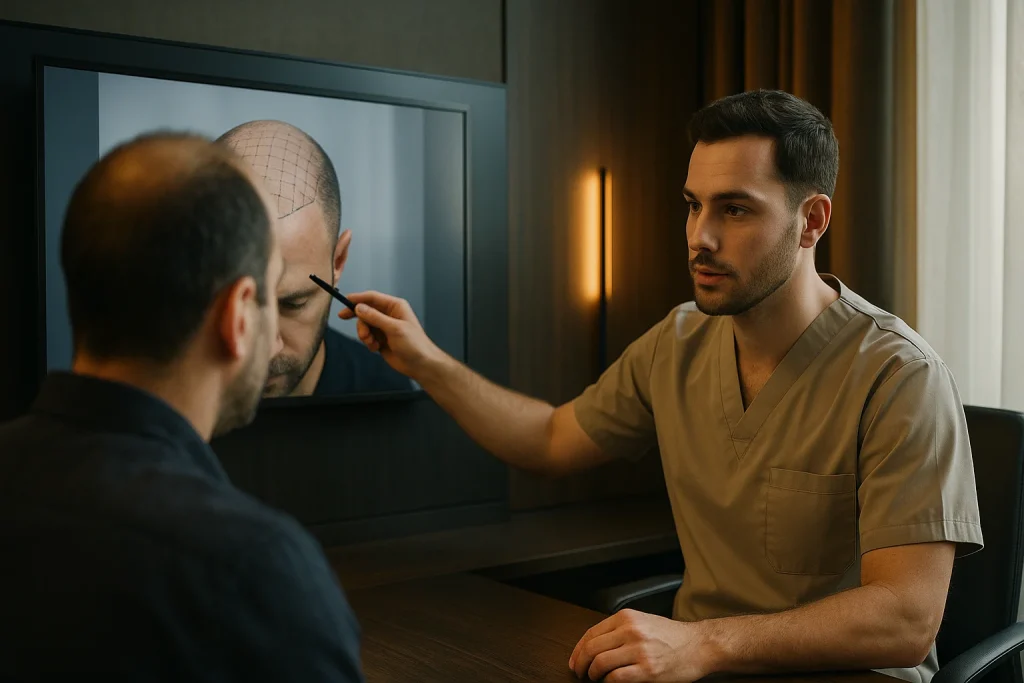
A male hair transplant is most likely to look natural when the hairline, graft placement, donor use, and future hair-loss pattern are planned together. A doctor should assess your scalp, donor area, medical history, and expectations before confirming whether surgery and a specific technique are suitable.
- Natural-looking results usually depend more on long-term planning than on choosing the largest possible graft number.
- A mature, age-appropriate hairline can help a transplant blend with future hair changes.
- Donor hair is limited, so grafts should be allocated carefully between the frontal area, mid-scalp, and crown.
- Sapphire FUE and DHI are techniques that may be selected according to the treatment plan, scalp characteristics, and area being restored.
- Healing, shedding, and gradual growth are normal parts of the process, while final assessment commonly takes many months.
01Male hair transplant planning begins before surgery
A male hair transplant should be planned as a long-term restoration process, not simply as a procedure to fill the areas that look thin today. Male pattern hair loss can continue after surgery, and the transplanted area must continue to look balanced if the surrounding native hair becomes finer over time. For this reason, a doctor will usually review the shape and progression of hair loss, the density and quality of the donor area, your age, family history, and the goals that matter most to you.
The first consultation is also the time to discuss what “natural-looking” means in practical terms. Most patients want a hairline that is not obviously transplanted, enough visual density in important areas, and a result that suits their facial proportions. These goals may be possible, but they need to be balanced against the finite number of grafts available. A responsible plan does not promise unlimited density or a hairline that may be difficult to sustain later.
At Acibadem Hair Transplant Center in Istanbul, patients can begin with a free online hair analysis that is reviewed by doctors. Images and medical information can help the team make an initial assessment, although an in-person clinical examination may still be needed before a final plan is confirmed. Questions sent through WhatsApp typically receive a reply within approximately two hours, helping international patients understand the next steps before arranging travel.
02Read your pattern before choosing graft numbers
Graft numbers should follow the pattern of hair loss rather than lead the decision. A graft is a naturally occurring follicular unit that may contain one, two, three, or sometimes more hairs. Therefore, 3,000 grafts do not equal 3,000 individual hairs. The visual effect also depends on hair thickness, curl, colour contrast between hair and scalp, and the size of the area that needs coverage.
During planning, the doctor commonly divides the scalp into zones: the frontal hairline, frontal third, mid-scalp, temples, and crown. Restoring every zone with high density may not be realistic when donor supply is limited. In many patients, the frontal area is prioritised because it frames the face and is most visible in everyday conversations and photographs. The crown may be planned conservatively, treated later, or left for future consideration depending on the available donor reserve.
A clear graft strategy should explain not only where grafts may be placed, but why. For example, a patient with early frontal recession may need a different approach from someone with extensive thinning from the front to the crown. A good plan considers existing hairs that may still miniaturise, avoids placing grafts so densely that they affect blood supply, and leaves room for future decisions. Your doctor will confirm the estimated graft range only after assessing the scalp and donor area.
03Design a mature hairline rather than a low one
The hairline is often the most important feature of a natural result. It should reflect the patient’s age, facial shape, ethnicity, original hairline pattern where known, and likely future hair loss. A very low, straight, or sharply outlined hairline can look unnatural, particularly if hair behind it continues to thin. In contrast, a slightly irregular and age-appropriate design usually creates a more believable transition between the forehead and transplanted hair.
Hairline work requires careful use of finer, single-hair grafts at the leading edge. These grafts can soften the outline and reduce the appearance of a dense line. Behind the hairline, grafts with more hairs may be used where clinically appropriate to build visual fullness. The direction, angle, and spacing of every placement matter because natural frontal hair does not grow vertically or in identical rows.
Temple points and temporal recession also need caution. These areas can add balance for selected patients, yet they may use valuable donor grafts and can be difficult to recreate naturally if the direction is not planned precisely. A clinic should not treat every recessed temple as a routine request. Instead, the doctor should consider whether restoring it supports the overall design and whether it remains appropriate if hair loss progresses.
04Match Sapphire FUE or DHI to the clinical plan
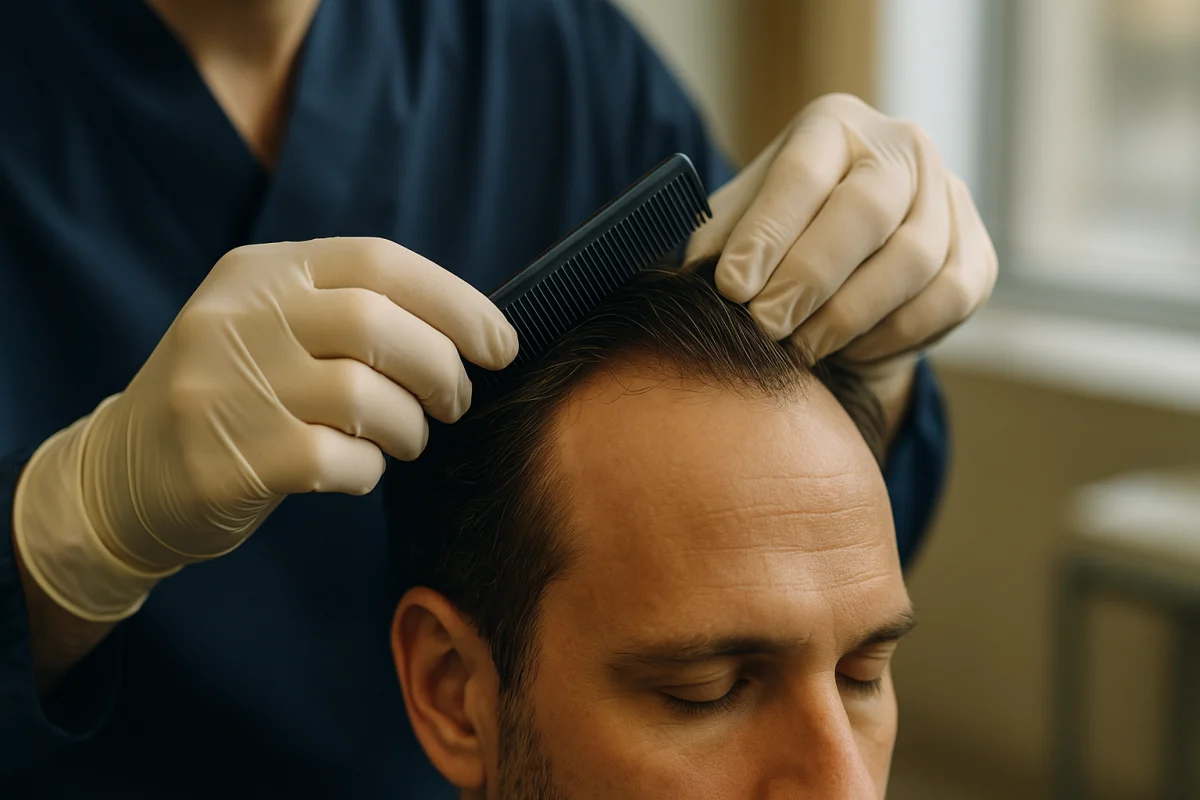
Technique is important, but it is only one part of planning. Sapphire FUE involves extracting follicular units individually from the donor area and preparing recipient channels with sapphire instruments before graft placement. DHI also uses individual follicular unit extraction, while implantation is performed using a specialised implanter approach. Both can be considered for suitable patients, and neither technique automatically guarantees a better result for every scalp or hair-loss pattern.
The best choice may depend on factors such as the treatment area, existing hair between planned grafts, donor characteristics, hair texture, and the density goal. For example, working around native hairs requires a careful strategy to reduce unnecessary trauma to them. The doctor may also consider the direction of growth needed in the hairline, mid-scalp, or crown. The technique should serve the design, not replace detailed design work.
Acibadem Hair Transplant Center offers Sapphire FUE and DHI after clinical assessment. Needle-free anaesthesia is also available for patients who may prefer this option, subject to medical suitability. Before any procedure, patients should disclose medicines, allergies, previous scalp procedures, smoking, and relevant medical conditions. This helps the clinical team assess safety and provide appropriate pre-operative instructions.
05Protect donor capacity for the years ahead
The donor area, usually at the back and sides of the scalp, is a limited resource. Hair taken from this region may be more resistant to the hormonal effects associated with male pattern hair loss, but the donor area still needs to retain an even appearance. Removing too many grafts from one area can cause visible thinning, patchiness, or an unnatural contrast between the donor zone and the transplanted zone.
Donor planning is especially important for younger patients and for men with a family history of advanced hair loss. It may be tempting to use a large number of grafts for immediate coverage, but this can reduce flexibility if more restoration is needed in the future. A conservative first procedure may sometimes be more appropriate than trying to rebuild a full youthful hairline and dense crown at the same time.
This is why a male hair transplant plan should include a discussion of future scenarios, not only current photographs. The doctor may explain which areas are being prioritised now, what donor reserve may remain, and what limitations could affect later surgery. These conversations support informed consent. They also help patients understand that a transplant redistributes available hair; it does not create an unlimited new supply of follicles.
06Prepare for the recovery and growth timeline
Understanding the timeline can prevent unnecessary worry after surgery. In the first days, patients commonly experience small scabs, redness, swelling, or temporary discomfort in the treated areas. The clinic provides aftercare instructions that should be followed closely, particularly regarding washing, sleeping position, exercise, sun exposure, and avoiding friction or pressure on newly placed grafts. Recovery experiences vary, and the clinical team should be contacted if symptoms seem unusual or concerning.
Transplanted hairs commonly shed during the weeks after the procedure. This temporary shedding phase can be emotionally difficult, but it does not necessarily mean that the grafts have failed. New growth generally begins gradually rather than all at once, and early hairs may initially appear finer. Density, texture, and coverage usually continue to develop over several months as the growth cycle progresses.
Final evaluation is commonly considered around month 12, although individual timelines can vary. Acibadem Hair Transplant Center measures results through trichoscopic graft survival at month 12 and documents a 98% rate under its written guarantee. This measurement does not mean every patient will experience identical cosmetic density, because appearance is also influenced by hair calibre, scalp contrast, ongoing native hair loss, and the original extent of thinning.

07Assess safety, limitations, and candidacy honestly
Hair transplantation is a surgical procedure, so it has limitations and potential risks. Possible downsides can include discomfort, swelling, bleeding, infection, temporary numbness, visible scarring, shock loss of existing hair, uneven growth, or a result that does not meet expectations. Although many issues are manageable, no procedure is risk-free. A thorough consultation and adherence to aftercare instructions can help reduce avoidable risks, but cannot remove them completely.
Not every person with hair loss is an ideal candidate. Some people have insufficient donor density, unstable or rapidly progressing loss, scalp inflammation, certain medical conditions, or expectations that cannot be safely achieved. A doctor may advise delaying surgery, considering medical evaluation for the cause of hair loss, or using a more conservative approach. This is not a failure of treatment; it is part of responsible clinical decision-making.
Patients should also understand that transplanted hair and native hair may behave differently over time. Transplanted follicles may be more stable in many cases, while non-transplanted hair can continue to miniaturise. For this reason, doctors may discuss medical management options or ongoing monitoring when appropriate. Any medication decision must be made with a qualified doctor who understands the patient’s health history and possible contraindications.
08Build a plan around follow-up and long-term maintenance
Follow-up is valuable because a hair transplant does not end when the patient leaves the clinic. Early follow-up allows the team to review healing and reinforce washing or activity guidance. Later reviews help assess growth, discuss any concerns, and compare progress with the original plan. International patients benefit from a clinic that has a clear communication pathway after they return home.
Acibadem Hair Transplant Center is a dedicated hair restoration clinic in Istanbul, licensed by the Turkish Ministry of Health. The centre has treated patients from 38 countries over 12 years and provides all-inclusive packages that include VIP transfer, a 4-star hotel, a care kit, and 12 months of follow-up. Package arrangements should not replace medical assessment; the treatment plan must remain based on clinical suitability and individual goals.
Long-term satisfaction often comes from realistic expectations, careful donor management, and a design that continues to look appropriate as the face and hair pattern change. Before choosing surgery, patients should ask how the hairline has been planned, which scalp zones are being prioritised, how graft numbers were estimated, and how the donor area will be protected. Clear answers can support a well-informed decision and a result designed to look natural rather than immediately dramatic.
09Frequently Asked Questions
How long can a hair transplant for men last?
Transplanted follicles are generally selected from areas that may be more resistant to the pattern of hair loss, so they can provide long-lasting growth in many patients. However, results vary, and non-transplanted native hair may continue to thin over time. Long-term planning and follow-up are important because some patients may need future treatment or a further procedure.
What is the price of 3,000 hair grafts in the United States?
There is no single reliable USA price for 3,000 grafts because fees vary widely by city, clinic, surgical team, technique, donor complexity, and what follow-up care is included. A written quote should explain whether the price is per graft or per procedure and identify any additional charges. A medical assessment is needed before a clinic can confirm whether 3,000 grafts are appropriate.
What are the main disadvantages of hair transplantation?
Potential disadvantages include the cost, recovery period, limited donor supply, temporary shedding, scarring risk, and the possibility that native hair loss will continue. There are also surgical risks such as swelling, infection, bleeding, numbness, and an unsatisfactory cosmetic outcome. Careful candidate selection and realistic expectations are essential.
Do hair transplants work well for men?
Hair transplants can be successful for men who have suitable donor hair, an appropriate diagnosis, and a carefully designed treatment plan. Success is not only about graft survival; it also includes a natural hairline, balanced density, protected donor appearance, and a result that fits future hair-loss changes. Your doctor will assess whether surgery is suitable and explain the limitations for your individual situation.
This article is for general information only and is not a substitute for professional medical advice.
 06
06 12
12