
What age does balding start varies widely. Some people notice genetic pattern hair loss in their late teens or twenties, while others keep a full-looking head of hair until later adulthood. A hair transplant is usually considered when the hair-loss pattern is clear and sufficiently stable, rather than based on age alone.
- Genetic pattern hair loss can begin during the teenage years, but its timing and speed differ greatly between individuals.
- A receding hairline or gradual thinning at the crown is different from sudden, widespread shedding and should be assessed differently.
- Family history can increase the likelihood of hair loss, but it cannot predict your exact pattern or age of onset.
- For younger patients, protecting existing hair and monitoring pattern stability are often important before transplant planning.
- A doctor-led assessment helps confirm the cause of hair loss and whether transplant surgery is appropriate at this stage.
01What Age Does Balding Start? Typical First Signs
What age does balding start is a common question because the first changes can be subtle. In men with androgenetic alopecia, also called male pattern hair loss, a mature-looking hairline may develop after puberty, while more noticeable recession or crown thinning can begin from the late teens onward. For others, the process does not become visible until their thirties, forties, or later. There is no single age that applies to everyone.
Early pattern hair loss often appears at the temples, where the front corners of the hairline slowly move back. Another common starting point is reduced density around the crown or vertex, which may be easier to see in bright light, wet hair, or photographs taken from above. Hair shafts in affected areas can become finer and shorter over time before the scalp looks clearly more visible.
Not every change in the hairline means that balding has started. Many adults naturally develop a slightly higher, more mature hairline without continued loss. The key difference is progression. If the hairline keeps receding, density is reducing in a recognisable pattern, or close relatives have similar changes, a professional hair and scalp assessment can help clarify what is happening.
02Hair Loss Ages: Teens, Twenties, Thirties, and Beyond
When asking what age does balding start, it helps to look at age ranges rather than expect a fixed timetable. During the late teens and early twenties, genetic hair loss may show as temple recession, diffuse thinning, or a crown that is less dense than before. These changes can feel especially concerning because the hair-loss pattern may still be developing and can be difficult to predict over the long term.
In the twenties and thirties, some patients notice a more established pattern. The hairline may take on an M-shaped appearance, the crown may gradually widen, or the frontal area may lose density. The pace can be slow and steady, with years between noticeable changes, or it can seem faster during certain periods. Photographs taken under similar lighting every few months can provide a more useful comparison than checking the mirror every day.
Hair loss can also first become apparent after age 40. At this stage, reduced density may be more visible because hair fibres naturally become finer with age, even in people without strong genetic pattern loss. Older patients can still be suitable candidates for treatment or hair transplantation if their general health, donor area, scalp condition, and hair-loss pattern are appropriate. Your doctor will assess these factors individually.
03Telling Pattern Hair Loss From Temporary Shedding
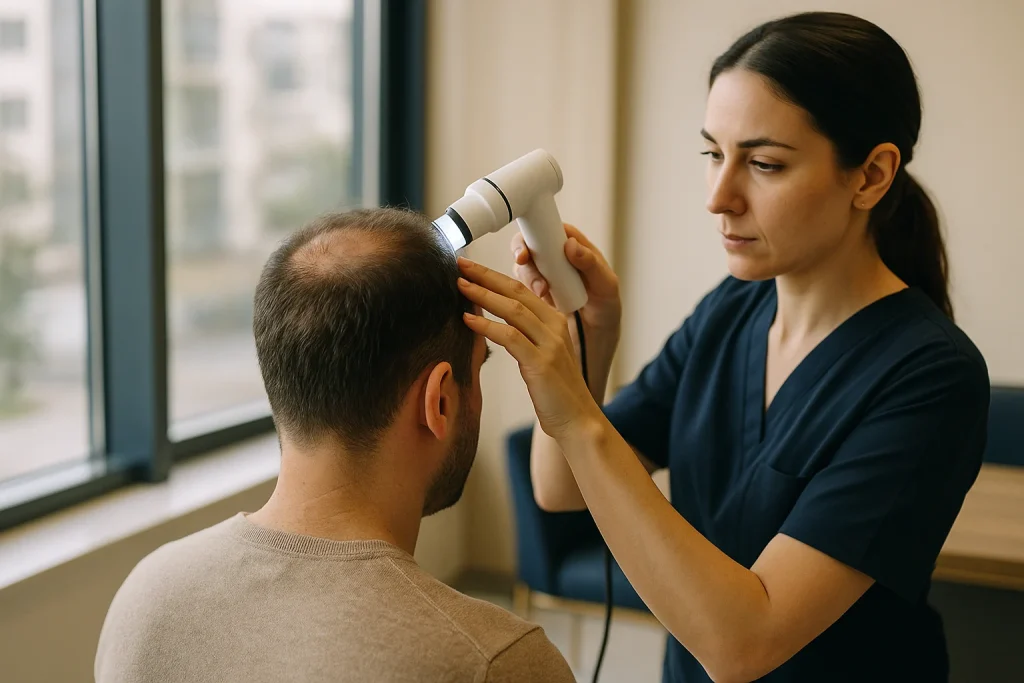
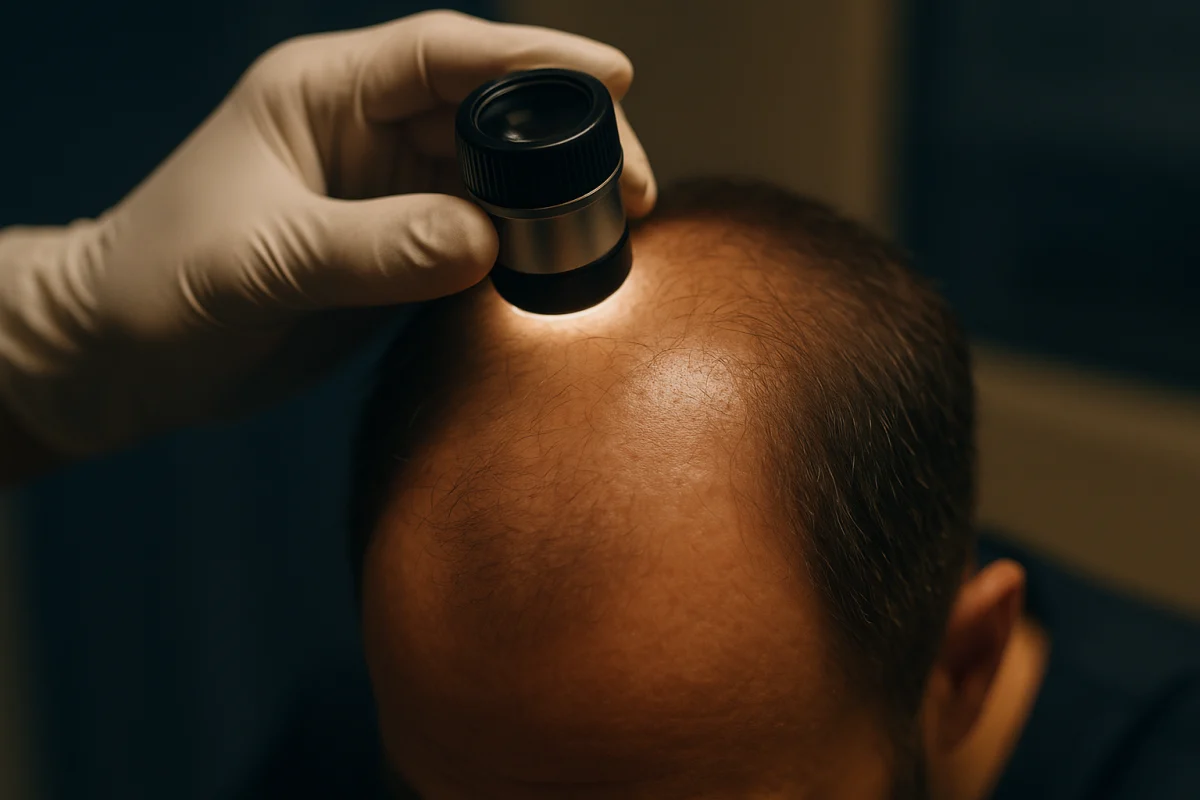
Pattern hair loss is usually gradual and follows a distribution, such as recession at the temples, thinning across the mid-scalp, or loss around the crown. It happens because susceptible follicles progressively produce finer hairs. This miniaturisation process is often influenced by genetics and hormones, and it may continue without treatment. A trichoscopic examination can help a doctor look for variation in hair-shaft thickness and other signs of miniaturisation.
Temporary shedding often looks different. You may notice more hairs in the shower, on a pillow, or while brushing, sometimes across the whole scalp rather than in one pattern. Illness with fever, major stress, rapid weight change, restrictive eating, surgery, some medicines, or nutritional issues can contribute to diffuse shedding. It may occur several weeks or months after a trigger, which can make the connection less obvious.
Some people have both processes at the same time. For example, temporary shedding can make an underlying genetic tendency look more dramatic. This is why it is important not to assume that every episode of increased shedding means permanent balding. A clinician may ask about your medical history, recent events, family pattern, medications, scalp symptoms, and the timeline of change before recommending the next step.
04Genetics, Hormones, and Everyday Contributors
What age does balding start is strongly influenced by inherited sensitivity in the hair follicles, but genetics is not a simple one-parent rule. Male pattern hair loss involves many genes inherited from both sides of the family. Having relatives with thinning hair can raise your likelihood of a similar condition, yet it does not determine exactly when it will begin, how fast it will progress, or what your final hair-loss pattern will be.
Androgens, including dihydrotestosterone, play a role in androgenetic alopecia in genetically susceptible follicles. This does not mean that a person has unusually high hormone levels. Rather, follicles in certain scalp areas may be more sensitive to normal hormonal activity. The sides and back of the scalp are often less affected, which is one reason these areas may be considered as potential donor zones during transplant planning.
Daily habits do not usually cause classic male pattern baldness on their own, but they can affect hair quality and scalp health. Smoking, poor sleep, high stress, harsh grooming practices, and diets lacking essential nutrients may contribute to fragile hair or increased shedding in some people. Gentle hair care, balanced nutrition, and timely medical assessment are sensible supportive measures, but they do not replace a diagnosis when hair loss is progressing.
05When Early Hair Loss Needs Medical Review
It is sensible to arrange a medical review if hair loss begins suddenly, appears in patches, causes itching or pain, or is accompanied by redness, scaling, or scarring. These features are not typical of straightforward androgenetic alopecia and may point to a scalp condition or another cause that needs specific care. Early assessment can be particularly valuable when there is rapid change over a short period.
Young adults should also seek assessment when the cause is uncertain. A doctor may examine the scalp and hair shafts, review your health history, and consider whether further investigation is appropriate. Depending on the clinical picture, they may discuss factors such as recent illness, dietary restriction, thyroid concerns, iron status, autoimmune conditions, medication changes, or traction caused by hairstyles. Testing is not necessary for every patient, but your doctor will decide what is relevant.
Taking clear baseline photographs can support a consultation. Use dry hair, similar lighting, and the same angles for the front, temples, top, crown, and donor area. Avoid relying on filtered images or comparing yourself with images online, since lighting and styling can make density look very different. A proper evaluation focuses on follicle quality, pattern distribution, family history, and likely future change, not only on one photograph.
06Why Pattern Stability Matters Before a Hair Transplant
For people researching what age does balding start, the next question is often whether they should have a transplant straight away. Hair transplantation moves permanent donor follicles into thinning areas; it does not stop future loss in nearby native hair. If surgery is performed before the pattern is sufficiently understood, continuing loss may leave transplanted areas looking separate from the remaining hair and may create a need for additional procedures later.
There is no universal minimum age that makes a transplant right for everyone. Some older teenagers and people in their early twenties are still experiencing an evolving pattern, so surgeons typically take a cautious approach. They may recommend monitoring, medical management where clinically appropriate, or delaying surgery until there is a clearer view of progression. The goal is to protect donor resources and create a hairline that can remain natural-looking as you age.
Stability does not always mean that hair loss has stopped completely. It means the pattern, rate of change, donor capacity, and future plan can be assessed with reasonable confidence. A good transplant plan considers the frontal hairline, mid-scalp, crown, existing native hair, and possible future needs together. Conservative placement and realistic density goals are particularly important for patients with a strong family history of advanced hair loss.

07Choosing a Sensible Transplant Age and Plan
A suitable transplant candidate is assessed on more than calendar age. Doctors consider the cause of loss, how long it has been present, donor-area density, hair calibre, scalp characteristics, medical history, and expectations. Someone in their thirties with a stable pattern and good donor supply may be a more suitable candidate than someone older with diffuse, active loss or limited donor availability. Each plan should be individual.
At Acibadem Hair Transplant Center in Istanbul, doctor-reviewed planning is used to assess whether Sapphire FUE or DHI may be appropriate. Both techniques have different practical features, and the choice depends on the patient’s hair characteristics and treatment goals. Needle-free anaesthesia is also available for eligible patients. Your consultation should include an honest discussion of what can be achieved safely, as well as the possibility that surgery may not be the best first step.
Graft numbers should never be treated as a simple measure of success. A natural result depends on careful distribution, hairline design, direction of placement, protection of the donor area, and realistic long-term planning. At our dedicated hair restoration clinic, results are measured by trichoscopic graft survival at month 12, with a documented 98% rate under written guarantee. This measure relates to graft survival and does not mean every patient will achieve the same cosmetic density or appearance.
08Preparing for Consultation and Long-Term Hair Care
The most useful first step is an informed consultation rather than rushing into a procedure. Prepare a short timeline of when you first noticed change, whether shedding was sudden or gradual, any relevant illnesses or medications, and family history on both sides. If you have used hair-loss treatments in the past, note what you used and for how long. This information helps the doctor distinguish between a stable pattern and a recent, potentially reversible change.
International patients can begin with a free online hair analysis reviewed by doctors. Clear photographs of the hairline, temples, top, crown, and donor area are usually important for an initial opinion, although online review cannot replace an in-person examination where one is needed. Acibadem Hair Transplant Center typically replies on WhatsApp within around two hours. The clinic is licensed by the Turkish Ministry of Health and has welcomed patients from 38 countries over 12 years.
Hair restoration is best viewed as a long-term process. If transplant surgery is recommended, aftercare, follow-up, and protecting existing hair remain important parts of the plan. Our all-inclusive packages include VIP transfer, a 4-star hotel, a care kit, and 12 months of follow-up. During any consultation, ask about realistic healing times, expected shedding after surgery, follow-up arrangements, and how future hair loss may affect the appearance of your result.
09Frequently Asked Questions
Will I go bald if my dad is?
Not necessarily. Pattern hair loss is influenced by multiple genes inherited from both your mother’s and father’s sides, along with hormone sensitivity and other factors. Your father’s hair-loss pattern can be a useful clue, but it cannot predict your exact risk, age of onset, or final pattern.
Why does Gen Z seem to be balding so fast?
There is no clear evidence that an entire generation is suddenly going bald faster. Social media, high-resolution photos, early awareness of hairline changes, styling trends, stress, and temporary shedding can make hair loss feel more visible. If thinning is new, rapid, or diffuse, a clinical assessment can help identify whether it is genetic pattern loss or another cause.
What percentage of men experience balding by age 40?
Figures vary because studies use different definitions of noticeable hair loss and involve different populations. A commonly quoted clinical estimate is that around 40% of men show some degree of androgenetic hair loss by age 40. This is only a broad estimate and does not predict an individual person’s hair-loss pattern.
Is balding at 19 normal?
Genetic pattern hair loss can begin at 19, so it is possible, but it is still worth having the cause checked rather than assuming. Temple changes may be a normal maturing hairline, while sudden shedding, patchy loss, scalp irritation, or rapid progression needs medical review. Early assessment can support a more careful long-term plan.
This article is for general information only and is not a substitute for professional medical advice.
 06
06 12
12