
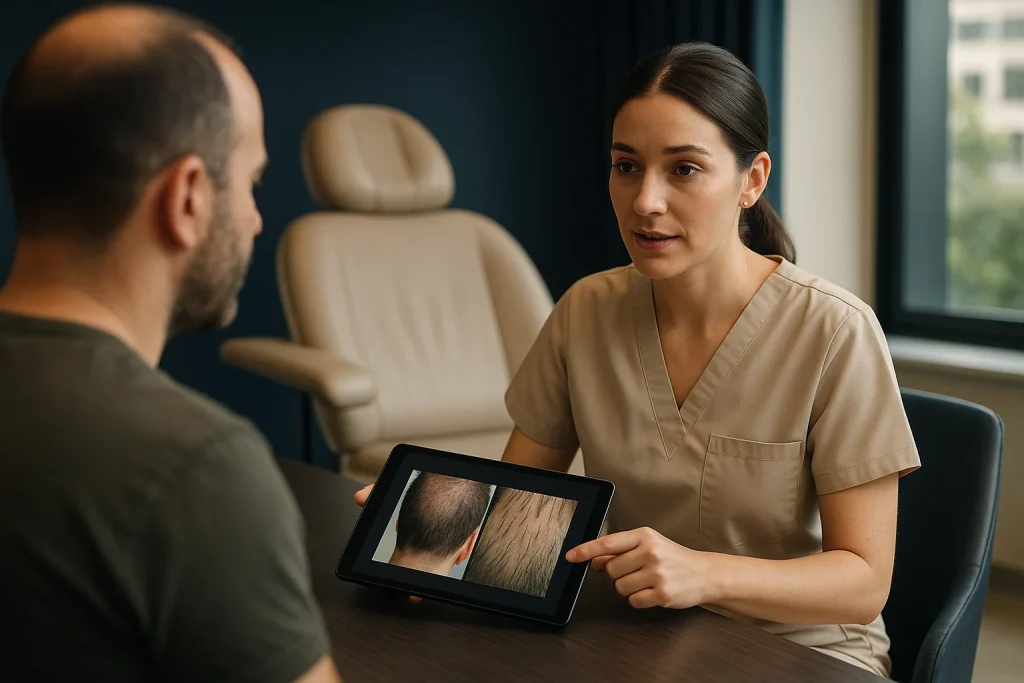
Before treatment, ask a hair transplant surgeon who will perform each stage, how your donor area will be assessed, which technique suits your case, and what follow-up is included. You should also receive clear information about risks, realistic results, recovery, the total cost, and what happens if you need support after returning home.
- Ask who will assess you, design your hairline, extract grafts, open channels, and place grafts.
- A safe plan protects the donor area and focuses on realistic coverage rather than an unrealistically high graft number.
- Request a clear explanation of the proposed technique, anaesthesia, recovery period, possible risks, and expected timeline.
- Compare written treatment plans and inclusions, not only headline prices or before-and-after photographs.
- For international treatment, confirm travel arrangements, aftercare instructions, and how you can contact the clinic after returning home.
01Start With the Consultation and Your Medical Assessment
A consultation should help you decide whether treatment is appropriate, not simply encourage you to book quickly. Your first question can be whether a hair transplant surgeon has reviewed your hair-loss pattern, medical history, current medicines, scalp condition, and family history of hair loss. A responsible assessment usually considers whether hair loss is stable, whether there may be a treatable cause, and whether your donor area has enough suitable hair for the plan. An online assessment can be a useful first step, but your doctor should confirm important findings before treatment.
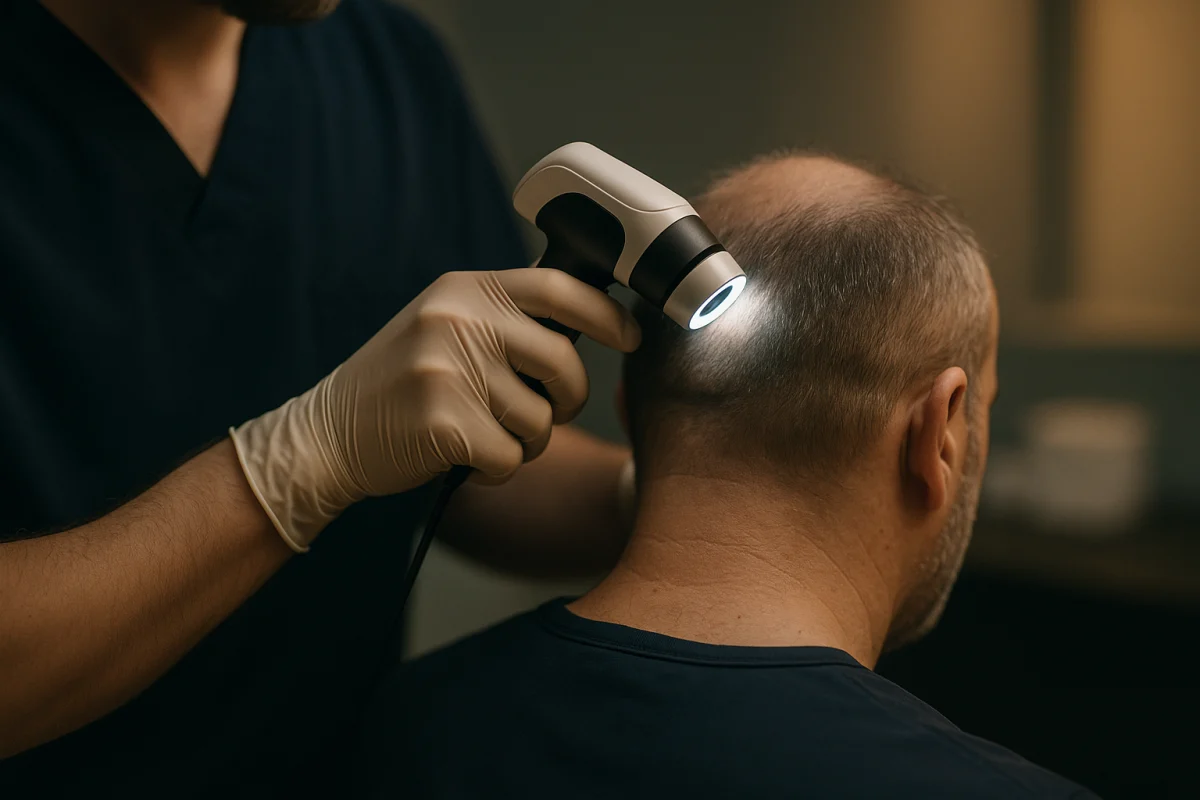
Ask how the clinic evaluates the donor area at the back and sides of the scalp. This area is important because transplanted follicles are generally taken from hair that is more resistant to pattern hair loss. However, donor hair is not unlimited. Your clinician should explain the quality, density, hair characteristics, and likely safe extraction range of your donor area in clear language. If your available donor supply is limited, the plan may need to prioritise the hairline, frontal zone, or another area that matters most to you.
It is also sensible to ask what the team sees as the cause of your thinning. Androgenetic hair loss is common, but not every type of shedding has the same cause or management. Sudden shedding, patchy loss, scalp inflammation, or a history of certain illnesses may need further medical review. A clinic should be open about when transplantation may need to be delayed, when another medical opinion is useful, or when a transplant may not be the right option at that time.
02How to Evaluate a Hair Transplant Surgeon’s Credentials
When researching a hair transplant surgeon, ask about professional licensing, medical training, experience in hair restoration, and the clinic’s regulatory status. Credentials do not replace an individual consultation, but they help you understand whether the provider works within an appropriate medical setting. You may also ask whether the facility is licensed, how clinical standards are monitored, and who is responsible for your medical care throughout the process.
Ask for an explanation of the surgeon’s or doctor’s role at every stage. In some settings, a medical doctor may lead the assessment and treatment plan while trained clinical team members assist with parts of the procedure. What matters is that responsibilities are clearly explained, supervision is appropriate, and you know who will make clinical decisions if an unexpected issue arises. Avoid accepting vague answers such as “our team handles everything” without further detail.
Photographs can be helpful, but they should not be your only selection tool. Ask whether before-and-after images show patients with a similar hair type, degree of loss, age range, and goal to your own. Find out when the after photograph was taken, whether lighting and hair length are comparable, and whether the patient had other treatments at the same time. A transparent provider will explain that individual outcomes vary because graft quality, donor supply, healing, hair characteristics, and future hair loss all differ.
You can also ask how outcomes are assessed rather than relying only on appearance. At Acibadem Hair Transplant Center, results are measured by trichoscopic graft survival at month 12, with a documented 98% rate under a written guarantee. This is a clinic-specific measurement and should be discussed alongside your own treatment plan, not interpreted as a promise that every patient will have the same cosmetic result. Your doctor can explain what follow-up measurements and documentation are available for your case.
03Clarify Who Performs Each Step of the Procedure
One of the most important questions is simple: who will do what on the day of treatment? Ask who will design your hairline, administer anaesthesia, extract follicular units, prepare the recipient area, create channels or sites, and place the grafts. You should also ask which medical professional will be present, who supervises the procedure, and who can respond if you feel unwell or have a concern during treatment.
Hair transplantation involves many detailed steps, and the quality of the process depends on good planning as well as careful handling of grafts. The hairline design is particularly important because it affects how natural the result may look over the long term. A well-designed hairline generally considers your facial proportions, age, likely future hair loss, existing hair, and the need to preserve grafts for future priorities. Ask to see and discuss the proposed design before the procedure begins.
Do not feel embarrassed to ask how long the procedure may take and what your day will be like. The answer can depend on the planned graft count, technique, scalp characteristics, and number of sessions. Ask about breaks, food, comfort, and communication during the procedure. If you are travelling from another country, confirm the timetable for arrival, treatment, washing instructions, and medical review before you leave Istanbul or return home.
04Discuss Graft Numbers, Donor Protection, and Hairline Planning
Many patients focus first on a single number: how many grafts do I need? A graft is a naturally occurring follicular unit that may contain one or more hairs, so graft number and visible hair count are not identical. Rather than asking only for the largest number possible, ask why a specific graft estimate is recommended and which zones it is designed to cover. A thoughtful plan should connect the graft estimate to your donor capacity, the size of the thinning area, hair calibre, curl, colour contrast, and desired density.
Ask whether the plan protects your donor area from overharvesting. Taking too many grafts can make the donor area look visibly thinner, especially if you wear your hair short. A cautious clinician will explain that donor management is a long-term decision. If your natural hair continues to thin, you may wish to keep some donor reserve for a future procedure, depending on your individual situation and medical assessment.
Discuss density honestly. A transplant can improve the appearance of coverage, but it may not recreate the density you had as a teenager across a large bald area. Your clinician should explain where density can be placed strategically to create the best visual effect. The frontal hairline and framing areas often receive particular attention, while the crown may require a different approach because it can cover a large surface area and may continue to thin over time.
Ask how your plan accounts for future hair loss. Existing non-transplanted hair can continue to shed after a procedure, particularly in patients with progressive pattern hair loss. In most patients, a natural-looking plan leaves room for this possibility instead of creating a low, dense hairline that may look less balanced later. Your doctor may discuss medical options where clinically suitable, but the decision should follow a proper medical evaluation.
05Ask Why a Specific Technique Is Recommended
Ask which technique is being proposed and why it fits your hair characteristics, goals, and donor assessment. Sapphire FUE and DHI are two commonly discussed approaches. In FUE, follicular units are individually extracted and then implanted into prepared recipient sites. DHI generally uses an implantation tool to place grafts after extraction. The most suitable method depends on clinical planning and technique, not on marketing language alone.
If Sapphire FUE is recommended, ask how the recipient sites will be planned and how the clinic manages grafts between extraction and placement. If DHI is recommended, ask why it may be beneficial for your particular area of thinning and whether it changes the expected number of grafts, treatment duration, or recovery instructions. Both approaches require careful graft handling and a realistic design. No technique can fully compensate for poor donor supply or an unsuitable treatment plan.
Ask whether shaving is needed and, if so, which areas must be trimmed. This can be especially relevant for patients who want to keep surrounding hair longer or who are considering a smaller treatment area. Ask about the expected appearance during the first days and weeks after treatment, as redness, scabbing, temporary shedding, and visible short hair can affect your social or work plans.
Anaesthesia is another practical subject to discuss. Ask what type of local anaesthesia is used, who provides it, and what comfort measures are available. Acibadem Hair Transplant Center offers needle-free anaesthesia as an available option. Your doctor will confirm whether this option is appropriate for you and explain the process, including any relevant medical considerations.
06Understand Safety, Risks, and When Treatment Should Wait
A reputable consultation should include a balanced conversation about safety and possible complications. Ask about common short-term effects such as swelling, tenderness, itching, scabbing, numbness, temporary shedding, and the time usually needed for these changes to settle. You should also ask about less common risks, which can include infection, bleeding, poor healing, scarring, shock loss, uneven growth, or an unsatisfactory cosmetic result. The purpose is not to alarm you, but to help you give informed consent.
Tell the medical team about all medicines, supplements, allergies, previous surgeries, smoking or nicotine use, and relevant health conditions. Do not stop prescribed medicines without advice from the doctor who manages them. Some factors may affect bleeding, anaesthesia, healing, or the timing of a procedure. Your doctor will confirm whether you need any further assessment or whether treatment should be postponed for safety reasons.
Ask about infection-control processes, emergency procedures, and post-treatment contact. You should know how the clinic maintains a clean clinical environment, what instructions you will receive for washing and medications, and whom to contact if you develop concerning symptoms after discharge. Clear written aftercare is especially important if you are travelling internationally and will complete most of your recovery at home.
It is wise to be cautious of any provider that describes treatment as completely risk-free or promises a perfect result. Hair transplantation is a medical procedure, and all procedures involve some uncertainty. A good discussion should make you feel informed and respected, with time to consider the information before making a decision.

07Set Realistic Expectations for Growth and Recovery
Ask for a month-by-month explanation of recovery and growth. In the first days, small scabs are expected around the transplanted area, and you will need to follow washing and protection instructions carefully. The implanted hairs may shed during the first weeks, which is often a normal part of the process. New growth usually begins gradually rather than appearing all at once, and visible improvement develops over several months.
Ask when you may return to work, exercise, swimming, hats, travel, and your usual hair-care routine. These recommendations vary according to your procedure and recovery, so follow the instructions given by your own medical team. It is useful to discuss your lifestyle in advance, including any upcoming events, sports, work travel, or sun exposure that could make the recovery period more difficult to manage.
A hair transplant surgeon should explain the difference between graft survival and final cosmetic appearance. Even when grafts survive, the visual result is influenced by hair thickness, direction, wave or curl, contrast between hair and scalp, native hair changes, and styling. Some patients may require more than one session over their lifetime, particularly if hair loss progresses or if a large area requires coverage. This possibility should be discussed before treatment, not introduced as a surprise later.
Ask how long follow-up lasts and how progress will be reviewed. Acibadem Hair Transplant Center provides 12 months of follow-up as part of its all-inclusive packages. Follow-up gives patients an opportunity to share progress images, ask practical questions, and receive guidance from the care team. It does not replace urgent local medical care if you develop a serious or rapidly worsening concern while at home.
08Request a Written Cost Plan and Check Travel Support
Before booking, ask for a written quotation that explains what is included and what may cost extra. The total cost of a transplant can vary based on the treatment plan, graft estimate, technique, clinical team, location, aftercare, and travel services. A low headline price may not include medical review, medication, accommodation, transfers, washing appointments, or follow-up, so compare the full scope of care rather than comparing one number alone.
Ask whether the quote is based on a graft range, a session, or a package, and what happens if the medical assessment changes the proposed plan. You should understand cancellation terms, payment timing, and whether there are additional costs for further sessions or unexpected travel changes. Be wary of pressure to pay immediately or promotions that do not allow enough time to review your medical information and consent documents.
For patients travelling to Turkey, logistics can be an important part of a safe and comfortable experience. Acibadem Hair Transplant Center is a dedicated hair restoration clinic in Istanbul, licensed by the Turkish Ministry of Health. Its all-inclusive packages include VIP transfer, a 4-star hotel, a care kit, and 12 months of follow-up. The clinic has treated patients from 38 countries over 12 years, and offers a free online hair analysis reviewed by doctors, with WhatsApp replies typically within around two hours.
Finally, ask how you will receive your treatment plan, instructions, and follow-up contact details in writing. Keep copies of your consent forms, invoices, medication information, and aftercare guidance. A well-organised provider should make it easier for you to understand the plan before you travel and to stay in touch after treatment. Taking time to ask these questions can help you make a more confident, informed decision.
09Frequently Asked Questions
How can I find the best hair transplant surgeon for my needs?
There is no single best hair transplant surgeon for every patient. Look for a licensed medical setting, clear information about the doctor’s role, careful donor-area planning, realistic discussion of risks, and documented follow-up. The best choice for you is a provider whose assessment and written plan suit your medical situation and long-term goals.
Do hair transplant surgeons earn a high income?
Income can vary widely by country, qualifications, years of experience, type of practice, and the number and complexity of procedures performed. Financial success is not a reliable measure of clinical quality. Patients should focus on credentials, transparent care processes, safety standards, and realistic treatment planning.
What does a 3,000-graft hair transplant cost?
The cost of 3,000 grafts varies substantially by country, clinic, technique, services included, and your individual treatment plan. A graft estimate may also change after an in-person medical assessment of your donor area and scalp. Ask for a written quotation that clearly states what is included, such as medical care, accommodation, transfers, aftercare, and follow-up.
Who is the best hair transplant surgeon in Maryland?
It would not be responsible to name one best provider in Maryland, as the right choice depends on your needs and a detailed medical assessment. Compare licensed providers by asking who performs each treatment step, how they protect the donor area, what follow-up they offer, and whether they explain limitations clearly. You may also seek an independent medical opinion if you are unsure about a proposed plan.
This article is for general information only and is not a substitute for professional medical advice.
 06
06 12
12