

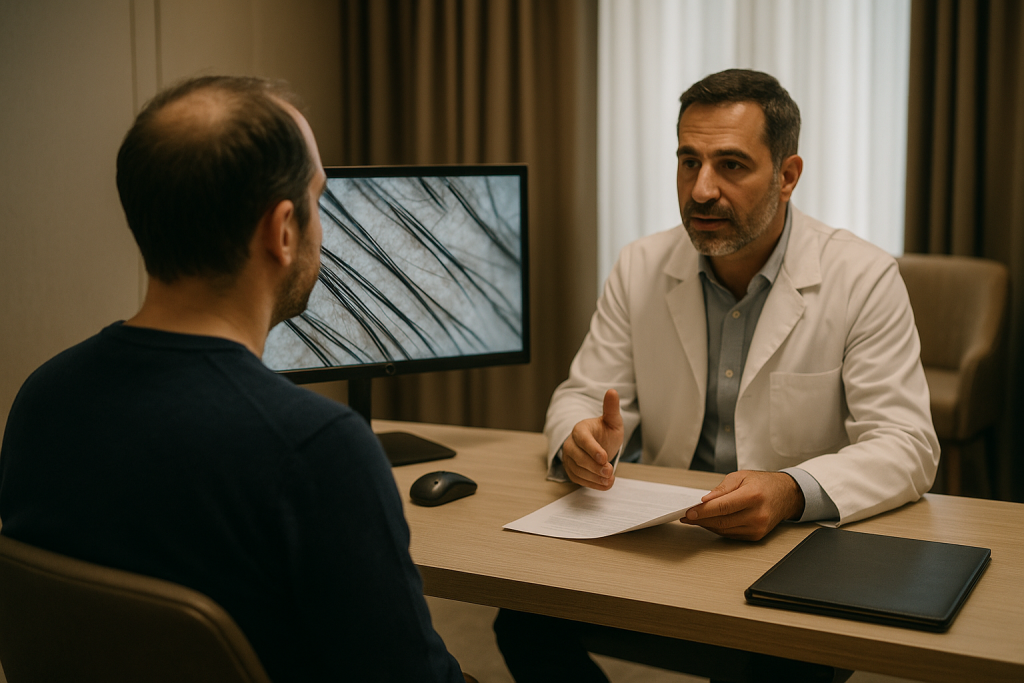
A hair transplant consultation is a medical planning appointment where the doctor reviews your hair loss, scalp health, donor area, goals, and suitability for treatment. You should leave with a realistic understanding of the proposed approach, expected graft range, recovery plan, possible limitations, and the questions you still need answered before deciding.
- A consultation should assess both the thinning area and the donor area before any graft estimate is confirmed.
- Your age, family history, current hair loss pattern, medical history, and future hair loss risk all affect candidacy.
- Hairline design and graft planning should protect the donor supply and allow for realistic long-term results.
- Sapphire FUE and DHI may suit different needs, but the doctor will recommend an approach after examination.
- A careful consultation also explains recovery, follow-up, risks, costs, and what results may look like over time.
01What Happens During a Hair Transplant Consultation
A hair transplant consultation is the first structured step in deciding whether surgical hair restoration may be appropriate for you. It is more than a discussion about how many grafts you would like. The doctor or medical team usually examines your current pattern of thinning, asks about your medical background, reviews your expectations, and considers how your hair loss may change in the future. The purpose is to create a medically sensible plan rather than simply fill every visible area as densely as possible.
Most consultations begin with your concerns. You may be asked when you first noticed thinning, whether the hair loss was gradual or sudden, which family members have experienced hair loss, and what treatments or procedures you have previously tried. Clear answers can help distinguish common pattern hair loss from conditions that may need further investigation before surgery. If hair shedding is sudden, patchy, or linked to illness, stress, medication, or nutritional changes, your doctor may recommend medical evaluation first.
You should also expect an honest conversation about what surgery can and cannot achieve. A transplant redistributes follicles from a stronger donor area to areas of thinning; it does not create an unlimited new supply of hair. The most useful consultation is one where you feel comfortable discussing priorities, such as restoring the frontal hairline, improving the temples, adding coverage through the mid-scalp, or considering the crown. Your doctor will confirm which goals are realistic for your available donor hair.
02Medical History, Age, and Hair Loss Stability
Your medical history matters because it can affect surgical planning, anaesthesia choices, healing, and recovery. During the appointment, disclose current medicines, allergies, previous operations, ongoing health conditions, smoking habits, and any scalp treatments you use. It is also important to mention medicines or supplements that may affect bleeding or healing. This information helps the medical team decide whether a procedure can be planned safely and whether any additional clearance or timing changes may be needed.
Age is considered alongside the stability and pattern of hair loss. Younger adults can be suitable candidates in some cases, but an early transplant is not automatically the right choice. When hair loss is still progressing quickly, a low or dense hairline may look unnatural later if surrounding native hair continues to thin. Doctors generally assess the likely long-term pattern, family history, and donor capacity before suggesting a hairline design.
The consultation may include discussion of non-surgical options that can help preserve existing hair, where clinically appropriate. This is not a sign that surgery has failed or is unnecessary. In many patients, protecting native hair can be an important part of a long-term plan because transplanted follicles are placed among hair that may continue to miniaturise. Your doctor will explain which options, if any, are appropriate based on your situation and medical history.
03Scalp Examination and Donor Area Assessment
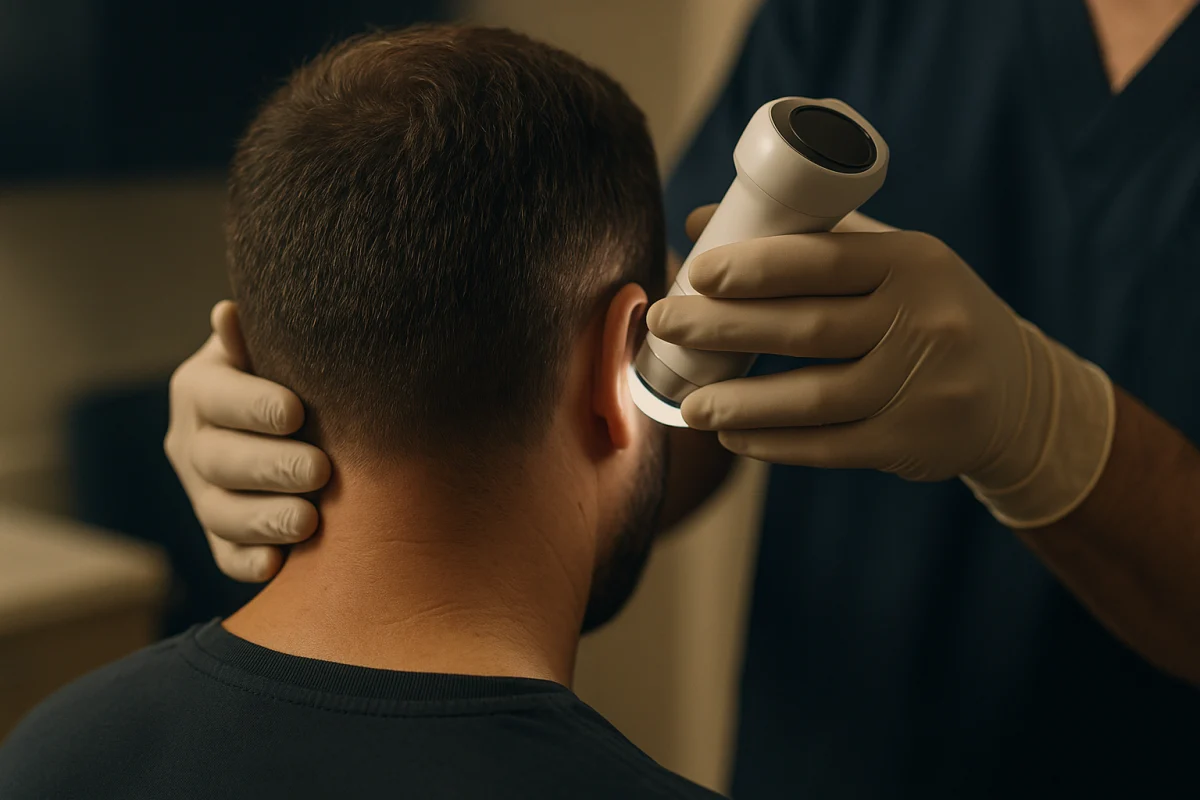
A close scalp assessment is central to planning. The clinician examines the recipient area, where hair is thinning, and the donor area, usually at the back and sides of the scalp. They look at hair density, follicle grouping, hair shaft thickness, scalp condition, curl or wave pattern, colour contrast between the hair and scalp, and the extent of miniaturisation. These details can influence how much visual coverage may be achieved from a given number of grafts.
The donor area deserves as much attention as the hairline. It has a limited reserve, and follicles should be extracted in a controlled way to reduce the risk of visibly thinning the donor zone. A responsible plan considers not only the first procedure but also the possibility that future hair loss could require further support. For this reason, a large graft estimate is not always the best plan if it would place too much pressure on the donor supply.
Photos and magnified scalp imaging may be used to document the starting point and support planning. At Acibadem Hair Transplant Center, results are measured by trichoscopic graft survival at month 12, with a documented 98% rate under a written guarantee. This measurement relates to graft survival under the stated guarantee conditions; it should not be understood as a promise that every patient will achieve the same cosmetic density, hairline appearance, or long-term progression of native hair loss.
04How Graft Numbers and Hairline Design Are Planned
One of the most common questions in a hair transplant consultation is, “How many grafts do I need?” The answer is usually a range rather than one fixed number. A graft is a natural follicular unit that may contain one, two, three, or sometimes more hairs. The number of grafts needed depends on the size of the area, the degree of thinning, the desired coverage, hair characteristics, donor density, and whether the plan focuses on the front, mid-scalp, crown, or several areas.
Hairline design is a key clinical and aesthetic decision. A natural-looking hairline typically has irregularity, soft transitions, and an age-appropriate position rather than a straight, overly low line. The doctor considers facial proportions, existing temples, likely future hair loss, and the amount of donor hair available. A conservative hairline can help preserve grafts for later needs and may remain more natural as you age. It is reasonable to bring photographs showing styles you like, but these should be used as discussion tools rather than exact templates.
Your priorities help shape the graft distribution. For example, concentrating grafts in the frontal third may create a stronger framing effect around the face, while spreading the same grafts across a large crown may produce lighter coverage. The medical team should explain this trade-off clearly. A written plan may outline the estimated graft range, target zones, method under consideration, and any factors that could change the plan after in-person examination on the procedure day.
05Choosing Between Sapphire FUE, DHI, and Anaesthesia Options
The consultation is the right time to ask why a particular extraction and implantation approach may be recommended. Sapphire FUE involves extracting individual follicular units and creating recipient channels with sapphire blades before placement. DHI also uses individual graft extraction, while implantation is performed using a specialised implanter tool. Both techniques can be used in appropriate patients, but neither technique alone guarantees a better result. The skill of planning, graft handling, donor management, and aftercare remains important.
The doctor may consider the size and location of the recipient area, the desired density, your existing hair, scalp characteristics, and the planned hairline when discussing technique. DHI may be considered when controlled placement between existing hairs is needed in selected areas. Sapphire FUE may be considered for broader coverage plans. However, the final recommendation should follow your examination, not a marketing preference or a one-size-fits-all package.
You can also ask how comfort will be managed on the procedure day. Local anaesthesia is commonly used for hair transplantation, and needle-free anaesthesia is available at Acibadem Hair Transplant Center. Your medical team will explain what is available, whether it is suitable for you, and what you may feel during the procedure. Mention anxiety, previous experiences with anaesthesia, allergies, and relevant medical conditions so that the team can plan appropriately.
06Recovery, Follow-Up, and Long-Term Expectations
A good consultation should explain the timeline after treatment in clear language. In the first days, patients commonly need to protect the grafts, follow washing instructions, avoid scratching, and sleep as advised by the medical team. Temporary redness, swelling, crusting, and mild discomfort can occur. The exact recovery experience differs between patients, so your doctor will provide individual post-procedure instructions and explain when you can usually return to work, exercise, travel, hair washing, and sun exposure.
It is also important to understand the growth cycle. Transplanted hairs often shed in the early weeks after surgery before new growth begins. This can be worrying if you are not prepared for it, but it is commonly part of the normal process. Visible improvement usually develops gradually over several months, while a fuller assessment is often made around 12 months. Crown areas may mature more slowly in some patients. Your clinic should explain how progress will be monitored rather than showing only immediate post-procedure photographs.
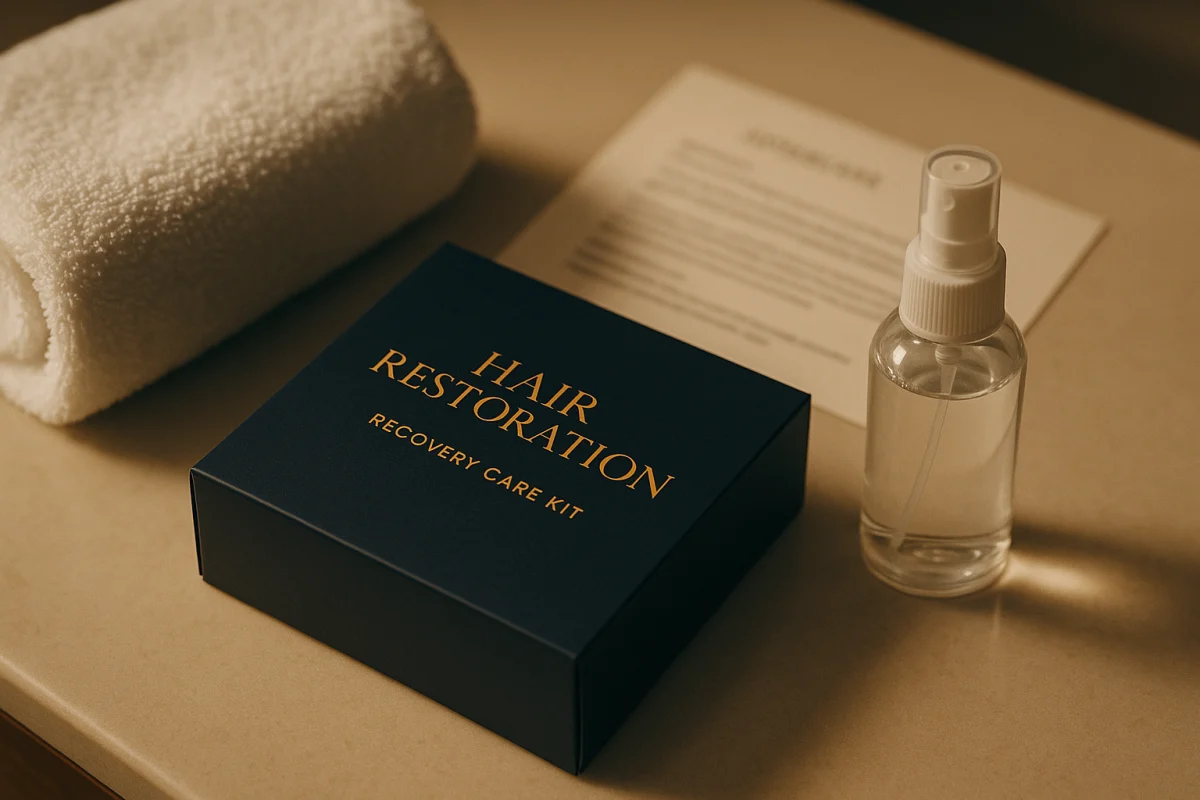
Long-term planning remains important after the operation. Transplanted follicles are generally selected from an area that is more resistant to common pattern hair loss, but individual outcomes can vary. Meanwhile, native hair around the transplant can continue to thin with age. Follow-up therefore helps address changes in appearance and discuss whether ongoing medical support, styling adjustments, or future planning may be appropriate. Acibadem Hair Transplant Center includes 12 months of follow-up as part of its all-inclusive packages, together with a care kit, VIP transfer, and a 4-star hotel stay.
07Questions to Ask Before You Decide
Before committing to treatment, ask who will assess you, how the donor area will be protected, which parts of the procedure are performed by the medical team, and how the graft estimate was reached. You may also ask what result is realistic at 12 months, what could limit density, and how future hair loss has been considered. Direct answers are valuable because they allow you to compare your expectations with the clinical plan.
Ask for a clear explanation of risks and possible complications. While hair transplantation is widely performed, it is still a medical procedure. Potential concerns can include swelling, temporary numbness, infection, bleeding, poor growth, shock loss of existing hair, scarring, or an unnatural-looking result if planning is poor. The likelihood and relevance of these risks vary, and your doctor will discuss the consent process in detail before any procedure is scheduled.
International patients may find it helpful to start with an online review before travelling. Acibadem Hair Transplant Center offers a free online hair analysis reviewed by doctors, with WhatsApp replies typically within about two hours. This initial review can help you understand whether an in-person assessment may be worthwhile, but photographs cannot replace a full scalp examination. The final treatment plan, suitability, and graft estimate should always be confirmed by the doctor after clinical assessment.
08Frequently Asked Questions
What kind of coverage can 3,000 grafts provide?
In many patients, 3,000 grafts may provide useful coverage for a receding hairline and frontal or mid-scalp thinning, but it may not create high density across a large bald area. Coverage depends on hair thickness, donor density, scalp-to-hair contrast, the size of the thinning zone, and how the grafts are distributed. Your doctor will confirm whether this graft range is appropriate for your goals.
Is age 25 too young to consider a hair transplant?
Age 25 is not automatically too young, but doctors usually assess hair loss stability very carefully at this stage. If thinning is progressing, a conservative plan or non-surgical management may be discussed before or alongside surgery. The decision should be based on your pattern of loss, family history, donor supply, and realistic long-term planning rather than age alone.
Can a hair transplant be 100% successful?
No medical procedure can be described as 100% successful for every patient. Graft survival, healing, cosmetic appearance, and future native hair loss can vary between individuals. At Acibadem Hair Transplant Center, trichoscopic graft survival is measured at month 12 and has a documented 98% rate under a written guarantee, but this is not a guarantee of identical cosmetic results for every person.
What may happen 10 years after a hair transplant?
Transplanted hair may continue to grow long term in many patients, but the non-transplanted hair can continue to thin over the next decade. This may change the overall appearance and can make ongoing hair preservation or a future treatment plan relevant. A conservative hairline and careful donor management are important because they help support a natural-looking result as you age.
This article is for general information only and is not a substitute for professional medical advice.
 06
06 12
12